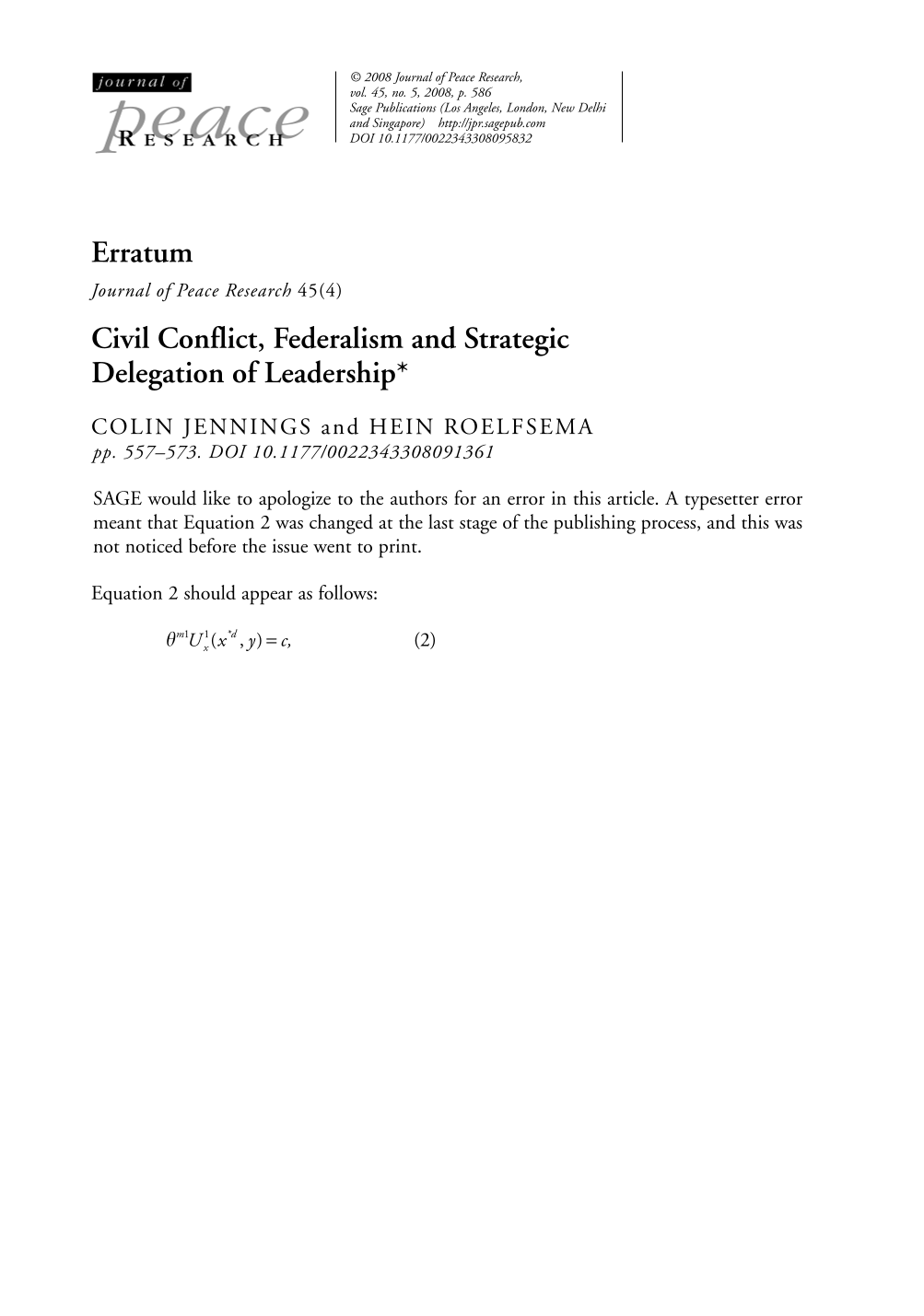
Correction
 Restricted accessCorrectionFirst published September, 2008pp. 586-586

Select search scope: search across all journals or within the current journal


 Restricted accessCorrectionFirst published September, 2008pp. 586-586Restricted accessResearch articleFirst published September, 2008pp. 587-611
Does the type of regime really make no difference to the likelihood of violent conflict over basic issues of stateness such as separatism and decolonization? Can democratic peace theory be successfully applied when dealing with the national identity or stateness question? This article extends the application of the democratic peace to the process of decolonization. It examines conflict between imperial states and their colonies during the process of decolonization and investigates the question of whether democracy affects the likelihood of conflict. The central finding is that, contrary to the implications of some prominent theories of state formation and democracy, democratic imperial states are significantly less likely to go to war with their colonial possessions in the process of achieving independence. Further, the authors find only a monadic, not dyadic, democratic peace effect. The regime type of the colony does not have a significant effect on the likelihood of war. It is the nature of the regime of imperial states, rather than that of colonies, that is a significant factor. In addition, the predominant source of this effect appears to be the institutional constraints placed on executive action within democracies, rather than the influence of mass politics or the effects of political competition. Regarding power-related factors, power parity between sovereign and colony makes conflict more likely (a colonial power-transition effect), but imperial decline actually makes war with colonies less likely. Sensitivity analysis reveals that a number of other hypothesized effects cannot find robust support. Simulations are used to assess the magnitude of the effect of regime type pre- and post-independence. Overall, the article contributes to theory development by investigating different institutional aspects of democracy and by distinguishing monadic and dyadic effects.
Restricted accessResearch articleFirst published September, 2008pp. 613-631This article argues that the systemic security environment influences the structure of domestic political and economic institutions. If states have been primarily created to protect one group from predation by another, then the state may visibly change as external threats rise and fall. The authors argue that political elites respond to threatening environments by enhancing the ability of the state to extract resources from society in order to protect itself. Using data from the Armed Conflict Dataset, Banks's Cross National Data Archive, and COW data from 1975 to 1995, the authors find evidence that supports the conjectured relationship between threat and state strength. As a response to a more threatening environment, the authors find that states significantly increase their capacity in terms of revenue, government spending, and military spending, but they do not easily relinquish these gains. The authors also observe that nation-state security is heavily influenced by regional regime-type patterns. State capacity increases as the regional neighborhood becomes increasingly autocratic. This suggests political elites not only regard violent conflict in the region as a serious concern to national security, but also appear to consider political change a threat as well.
Restricted accessResearch articleFirst published September, 2008pp. 633-652This study applies well-known arguments on the effect of conflict, alliances, and democracy on international trade to identify the determinants of dual-use trade. Dual-use commodities are those that can be used in weapons of mass destruction (WMD) programs or in legitimate civilian applications. This article advances a theory suggesting that governments seeking to maximize the gains from dual-use trade will promote exports to countries where there are security guarantees and restrict exports to countries where security threats exist. Eight hypotheses are tested using data on licensed dual-use exports from the United States to 128 countries between 1991 and 2001. The results indicate that democracy has a positive and significant effect on dual-use exports, while WMD acquisition or pursuit does not necessarily reduce states' access to such commodities. The results vary slightly, based on how dual-use exports are measured. In conducting the first systematic analysis on the determinants of dual-use trade, this study contributes to scholarly understanding of WMD proliferation and research at the nexus of international trade and international security. In particular, it offers important prescriptions for when states are likely to transfer technology that could be used to build WMD. It also encourages further work that disaggregates trade data to examine relationships between particular types of trade and conflict, alliances, free trade agreements, and other political variables.
Restricted accessResearch articleFirst published September, 2008pp. 653-663Cluster sampling has recently been used to estimate the mortality in various conflicts around the world. The Burnham et al. study on Iraq employs a new variant of this cluster sampling methodology. The stated methodology of Burnham et al. is to (1) select a random main street, (2) choose a random cross street to this main street, and (3) select a random household on the cross street to start the process. The authors show that this new variant of the cluster sampling methodology can introduce an unexpected, yet substantial, bias into the resulting estimates, as such streets are a natural habitat for patrols, convoys, police stations, road-blocks, cafes, and street-markets. This bias comes about because the residents of households on cross-streets to the main streets are more likely to be exposed to violence than those living further away. Here, the authors develop a mathematical model to gauge the size of the bias and use the existing evidence to propose values for the parameters that underlie the model. The research suggests that the Burnham et al. study of conflict mortality in Iraq may represent a substantial overestimate of mortality. Indeed, the recently published Iraq Family Health Survey covered virtually the same time period as the Burnham et al. study, used census-based sampling techniques, and produced a central estimate for violent deaths that was one fourth of the Burnham et al. estimate. The authors provide a sensitivity analysis to help readers to tune their own judgements on the extent of this bias by varying the parameter values. Future progress on this subject would benefit from the release of high-resolution data by the authors of the Burnham et al. study.
Restricted accessResearch articleFirst published September, 2008pp. 665-679Using the events leading to the War Powers Resolution of 1973 and its subsequent impact on US military interventions as an empirical example, this article elaborates the notion of `legacy chains'. Expanding on the general notion of policy legacies, the discussion describes the effects that post-World War II US military interventions have had on each other through the policy legacies left by each in turn. The argument allows that military intervention legacies have their strongest impact on decisionmaking for an immediately subsequent intervention but can also leave durable impressions on the institutional context, which, after being modified by subsequent military interventions, constitute `legacy chains'. These legacy chains are path-dependent processes, in that their institutional embodiments follow `increasing returns' logics and will remain in place until the structure of returns changes, usually due to a `critical shift'. In response to a series of perceived abuses of presidential war powers following World War II, the War Powers Resolution sought to ensure congressional participation in future commitments of US forces to hostilities. It has not done so. The lasting legacy of the War Powers Resolution is an unintended consequence of the way it was formally institutionalized. Presidents, following the letter of the resolution, have designed post-War Powers Resolution military interventions to either be short (so the 60-day mandatory reporting period specified in the resolution ends with a
Restricted accessResearch articleFirst published September, 2008pp. 681-695Current understanding of the motivations of young people who engage in paramilitary activity is poor. The youth bulge literature has made important advances in understanding determinants of political violence at population level; however, the psychological processes that underpin engagement with political violence among young people are less clearly understood. Further, the pathologization of terrorist activity has hampered deeper understanding of the motivations of those who seek to effect change using violence. This article explores the explanations offered by 14—16-year-olds regarding possible motivations of young people who engage in paramilitary activities in Ireland. Seventy-four Protestant and Catholic young people residing in the border regions of Northern Ireland and the Irish Republic completed an essay-writing task which elicited explanations for paramilitary involvement. Young people's explanations were multi-levelled and varied, reflecting the breadth and diversity of their personal circumstances and experiences. The essays were analysed using a Grounded Theory approach, which generated four categories of explanations for paramilitary involvement, namely, social identification explanations, family and socialization explanations, developmental explanations and pathological explanations. Though not asked to express a personal judgement regarding such activity, a substantial proportion of respondents did, with females being more likely than males to openly condone or condemn such activity. Discussion and interpretation of these findings centre on understanding of paramilitary involvement in areas affected by political violence.
Restricted accessOtherFirst published September, 2008pp. 697-710In 2007, 34 armed conflicts were active worldwide, up by one from 2006 and by five from 2003, the year with the lowest number of active armed conflicts since the 1970s. While the number of conflicts increased, the number of wars, i.e. conflicts with over 1,000 battle-related deaths in a year, dropped by one to four. Five of the conflicts from 2006 were no longer active in 2007, but during the year, two previously recorded conflicts (in Mali and Pakistan) were restarted by new actors and two (in Angola and Peru) by previously recorded rebel groups. For the first time since 2004, two new conflicts were recorded: a conflict over governmental power in Niger and a territorial conflict in DRC. A conflict may involve one or more dyads or pairs of warring parties. In the 236 conflicts active since 1946, 487 dyads have been recorded in the new UCDP Dyadic Dataset. While most intrastate conflicts involve a single rebel group fighting the government, in 30 of the conflicts two or more dyads were active simultaneously. In 2002 and 2003, over 30% of the active conflicts involved more than one rebel group. The number of active rebel groups and changes in the set of groups are important elements of the complexity of any armed conflict, and the study of these aspects should be greatly facilitated with the new dataset. By adding the dyadic dimension to the study of conflicts, the analysis of a range of phenomena that have hardly been captured by previously available data is made possible.
Restricted accessOtherFirst published September, 2008pp. 711-718 Restricted accessResearch articleFirst published September, 2008pp. 719-720