Research article
Select search scope: search across all journals or within the current journal

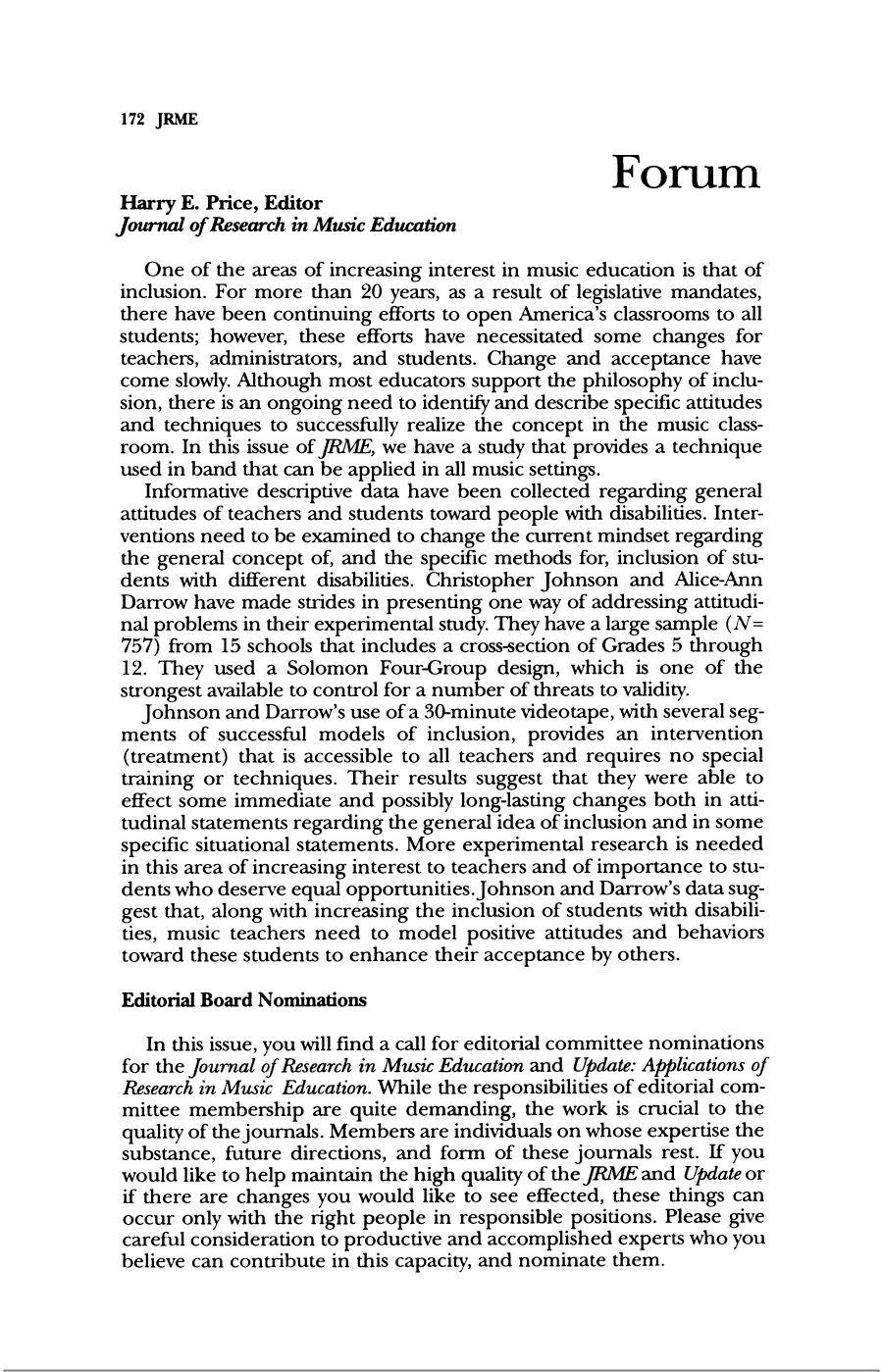
The purpose of this study was to examine the effect of five positive models of inclusion on band students' attitudinal statements regarding the integration of students with disabilities in their music program. Elementary, junior high, and senior high school band students from 15 public school served as subjects (N = 757), and a Solomon Four-Group design was chosen for this study. Bands (from elementary, junior high, and senior high school) were randomly assigned to one of the following four conditions: (1) pretest-treatment-posttest, (2) pretest-posttest, (3) treatment-posttest, or (4) posttest only. The independent variable for this project was a 30-minute videotape containing five segments that documented students with cognitive, physical, behavioral, or sensory disabilities successfully participating in a band in either rehearsal or performance situations. The dependent variable was a questionnaire consisting of attitudinal statements related to the following subscales: (a) inclusion of students with disabilities in band, (b) degree of comfort with inclusion, (c) efficiency of the band with students who have a disability, and (d) procedural issues involving students with a disability in band. Results indicated that treatment-group subjects' attitudinal statements were significantly more positive than were attitudinal statements of control-group subjects on three of the four subscales: inclusion, comfort, and efficiency. In addition, female students were significantly more positive than were male students on the same subscales. No clear trends were found among the different age-groups.
This study is an investigation of the effects of a year-long program of vocal instruction I on measures of respiration (vital capacity, peak flow, duration) and singing performance (high pitch, low pitch, total range, pitch accuracy) among general music students in Grades 4, 5, and 6 (n = 269). A posttest-only control-group design was used with intact classes randomly assigned to either experimental or control conditions. Results of 2 ? 2 ? 3 factorial analyses (MANOVA and ANOVA) were as follows: (1) breath support (peak flow) may be improved with instruction; (2) vital capacity seems to be affected more by age than by instruction; (3) breath control (duration) may be improved with instruction, especially among fifth-grade students; (4) highest pitch of vocal range may be improved with instruction; (5) lowest pitch of vocal range may be improved with instruction, especially for boys; (6) total vocal range may be improved with instruction, especially for boys; (7) pitch accuracy seems to be greater for girl than for boys, and boys pitch accuracy may not be helped with vocal instruction when there is a reluctance to sing in the treble range.
This study is an investigation of the effects of finger placement markers (FPMs) and I harmonic context on the left-hand technique, intonation performance skills, and overall musical performance skills of sixth-grade beginning string students. Central to this study was the question of how a tactile/visual reference and an aural reference influence the development of string intonation performance skills. Subjects were assigned to research conditions in a 2 ? 2 factorial design (FPMs by harmonic context). Students received 90 minutes of weekly, heterogeneous-group instruction from the same teacher and used researcher-prepared audio home practice tapes to accentuate their class experience. Subjects with FPMs played significantly more in tune than those who did not have FPMs. Students whose instruction and practice were accompanied by harmonic background demonstrated a higher degree of overall musical performance ability. Differences were significant even after adjusting for musical aptitude. There were no differences in left-hand technique. Results of this study endorse the theoretical and practical support for the use of these teaching techniques in beginning string instruction.
In this study, the researcher compared the ratings assigned to audio and videotaped vibrato performances of inexperienced and experienced violinists and violists. Thirty-three inexperienced players and 28 experienced players were videotaped white performing vibrato. A panel of experts rated the videotaped performances and then 6 months later rated the audio-only portion of the performances on five vibrato factors: width, speed, evenness, pitch stability, and overall sound. Experienced players' vibrato was rated higher for all factors, regardless of mode of presentation. In addition, results revealed significantly higher audiovisual ratings for pitch stability, evenness, and overall sound for inexperienced players, and for pitch stability for experienced players. Results suggest that string teachers need to occasionally listen to their students' vibrato without watching them since visual cues may inadvertently influence their evaluation of student achievement.
This study was designed to compare the effects of different kinds of visual presentations and music alone on university nonmusic students' affective and cognitive responses to music. Four groups of participants were presented with excerpts from the first and fourth movements of Beethoven's Symphony No. 6 in F major (“Pastoral”). Two groups heard music excerpts only, one interpretation conducted by Stowkowski and one by Bernstein. One of the video groups viewed corresponding excerpts from the movie Fantasia while listening to the Stowkowski recording. A second group viewed and listened to a performance video of the Vienna Philharmonic filmed during the Bernstein recording. All students (N = 128) completed cognitive listening tests based on the excerpts, rated the music on Likert-type affective scales, and responded to two open-ended questions. Significant effects of presentation condition were found. Cognitive scores were higher for the performance video than the music plus animation video on both movements. Scores for the two music-only presentations were not significantly different from each other or the two video presentations. Although affective ratings were not significantly different in magnitude between the presentation groups, the animation video (Fantasia.) presentation ranked consistently higher in affect than the other presentations. Implications of these results regarding the effects of different types of visual information presented to music listeners are discussed.
The purpose of this research was to investigate the effects of the presence or absence of lyrics in children s musical selections on two types of young children's responses to music. Of additional interest were differences in responses due to subjects' ages and genders. Two studies were designed to compare responses to recorded lullabies with the melodies performed either by a woman singing the lyrics or by a solo instrument. In Study 1, a pictographic rating scale was used to obtain like-dislike responses to 10 music excerpts from 40 children, ages 4 and 5 years. Results of a three-way repeated-measures ANOVA indicated no significant differences due to the main effects of performance medium, age, or gender, with no significant interactions. Subjects for Study 2 were 51 preschool and kindergarten children. Each child individually listened to two pieces with lyrics and two without lyrics for as long as he or she chose, up to the compute duration of each piece. Time spent listening was recorded to the nearest second. Results of a three-way repeated-measures ANOVA indicated no significant differences due to the main effects of performance medium or song although girls did listen significantly longer than boys did. The results of both studies are consistent with the results of previous research indicating that young children s music attitudes and preferences do not seem to be based on specific musical characteristics and that children may have very idiosyncratic responses and listening styles. The use of time spent listening as a dependent measure for music preference is called into question.
The primary purpose of the present study was to compare two different methods of measuring subjects' perceptions of overall effect: (1) a record of subjects' ongoing evaluation that is averaged to obtain an overall rating (labeled “continuous') and (2) a single rating of intensity given by subjects at the conclusion of a music excerpt (labeled ”summative“). Subjects were asked to evaluate the level of musical intensity expressed in various music excerpts. We used the term musical intensity as it is commonly understood, that is, to describe an affective perception of music that conveys strong, ardent, or concentrated emotion. Our use of the term does not refer to its physical/acoustical definition. The results illustrate the nonequivalence of subjects' perceptions of overall intensity and mathematical summaries of their perceptions of intensity as recorded while listening. The two different measurement methods evidence extremely high levels of internal consistency; however, in both between- and within-subject comparisons, the summative responses were higher than the continuous response means. It seems reasonable to conclude that subjects' expressions of overall effect are quite consistent between subjects and between replications, but that arithmetic means of subject responses are not equivalent to subjects' ”psychological averages' (i.e., their post hoc perceptions of overall effect), especially with regard to stimuli whose intensity levels change over the course of a given stimulus example.
The suitability of criteria-specific rating scales in the selection of high school students for participation in an honors ensemble was investigated. Three questions regarding criteria-specific rating scales were addressed: (1) Do they yield adequate measurement results? (2) Do they help judges discriminate among different levels of student instrumental performance? and (3) Which dimensions of instrumental performance are most predictive of total scores? All 926 students seeking selection to the Connecticut All-State Band were evaluated by 36 judges with the use of criteria-specific rating scales. The rating scales yielded substantial variability and moderately high to high alpha reliabilities. Stepwise multiple regression indicated that student Total scores could be predicted from scores of five individual dimensions (Multiple R = .96).
The purpose of this study was twofold: (1) to investigate the relationship between college students' perceptions of “knowing” and “valuing” five selected skills on the piano, and (2) to determine whether a successive-approximations approach to learning the skills plus selfe-evaluation would affect students' perceptions of “knowing” and “valuing ” Thirty-two music majors enrolled in piano classes served as subjects for this investigation, which was a pretest-posttest design and covered one academic semester (15 weeks). Results indicated that students' self-evaluations were strongly correlated to their posttest perceptions of “knowing” and that knowledge and valuing became more closely associated following specific instructional and self-assessment procedures. An important aspect of this study was that it defined five areas of keyboard instruction that could be broken down into smaller, observable units before demonstration of the whole skill.
The Junior Eysenck Personality (Questionnaire was administered to 668 instrumental students in Grades 7 through 12 from eight different schools to determine whether (1) there is a propensity for certain personality types to begin instrumental study in the schools, (2) certain personality types are more likely to continue in instrumental music, (3) there is a trend toward homogeneity of personality type among students who choose to continue in instrumental music across grade levels, and (4) there is a relationship between personality type and continuation on a specific musical instrument. Results revealed that instrumental students are very similar to their noninstrumental counterparts on the personality variables measured across all grades, but some minor differences can be found. Educational implications are drawn and discussed.
The purpose of this study was to investigate the effects of conducting instruction on 151 beginning band students' individual rhythmic performance, group rhythmic performance, group performance of legato and staccato, and group performance of phrasing and dynamics. Eight beginning band ensembles, representing diverse cultural and ethnic backgrounds, were randomly selected for the study. Beginning band students and their ensembles were randomly assigned to experimental and control groups. After all subjects were pretested, the experimental bands received 10 minutes of basic conducting instruction per class during a 10-week period. Posttest results demonstrated that individuals in the experimental bands improved significantly more than did individuals in the control bands (p < .001) in their rhythmic performance. Bands in the experimental group improved their rhythm-reading and phrasing abilities (p < .01) more than bands in the control group. No differences were found with regard to legato and staccato, dynamic performance, or overall performance. It was concluded that conducting was a useful tool in teaching rhythm and phrasing in an ensemble setting.
Between 1900 and the early 1920s, music began to be viewed as an important social tool by Progressive Era reformers. One aspect of reform was inspired by the Country Life Movement. With over half the children in the United States still living in rural areas, reformers focused on improving the economic and social conditions of rural people. Rural reformers expanded university offerings in music and campaigned for the legal and educational framework for music education. Ideas for mass music education were explored, including efforts based on agricultural extension models. New approaches were tried that are now standard. A social rationale for music was expounded, giving importance to the Community Music Movement and the Pageant Movement. Rural reform contributed to a wider acceptance of music as an important aspect of education and promoted music as a social necessity.