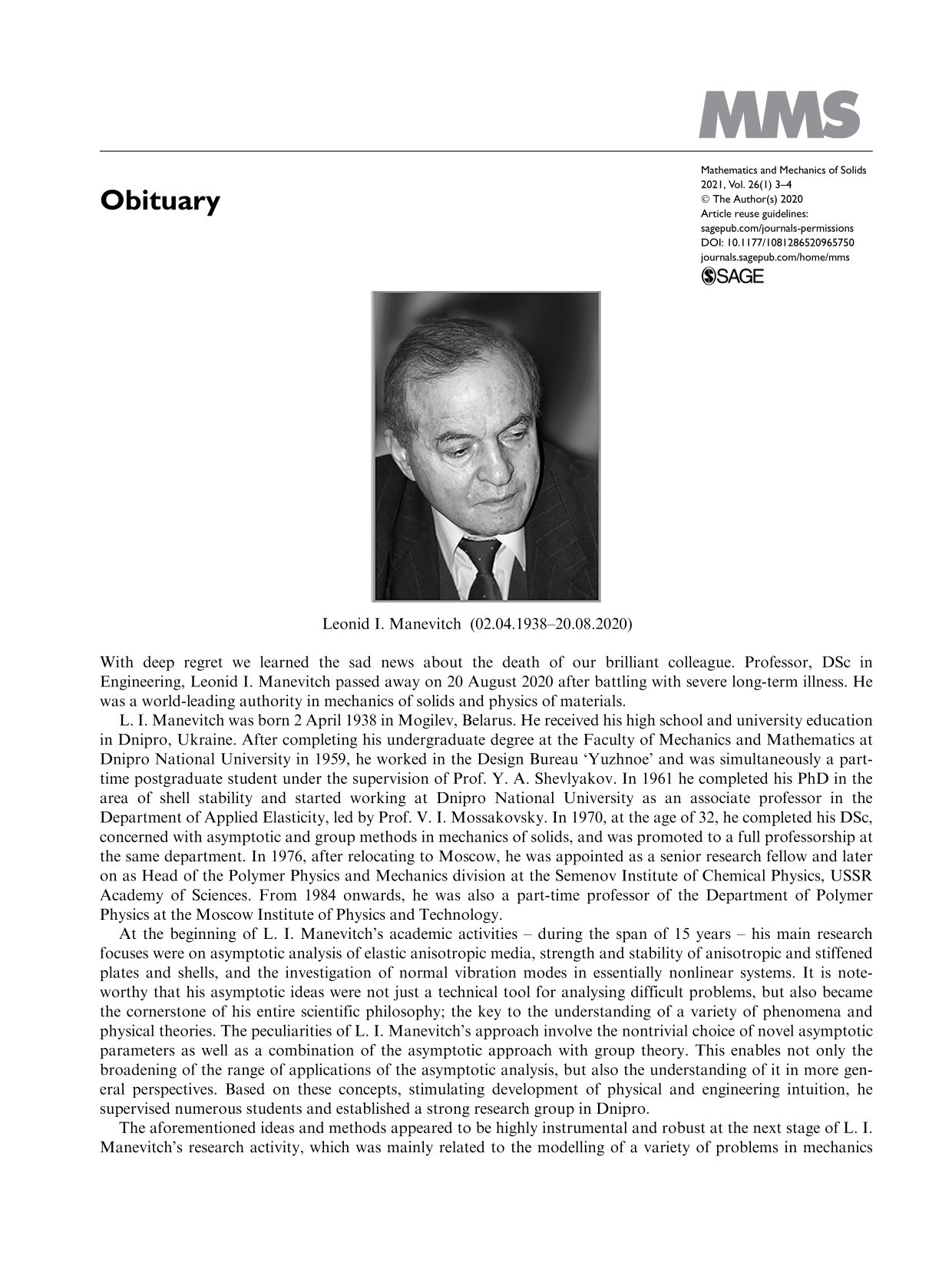
Obituary
Obituary
I.V. Andrianov, J. Awrejcewicz, V. Babitsky , [...]
View All
Abstract

Select search scope: search across all journals or within the current journal

In this research paper, an analytical solution with numerical illustration is presented for elastoplastic analysis in a functionally graded thick-walled rotating transversely isotropic cylinder under a radial temperature gradient and uniform pressure using the transition theory of Seth and generalized strain measure theory. The theory of Seth requires no assumptions, such as infinitesimally small deformation or material incompressibility, or a yield criterion, and is important in determining elastoplastic transitional stresses and fully plastic stresses on the basis of Lebesgue strain measure. The combined impacts of an inhomogeneity parameter, uniform pressure, temperature, and angular speed are discussed numerically and shown graphically. It is concluded that a functionally graded thick-walled rotating cylinder made of steel subjected to a radial temperature gradient and uniform pressure is on safer than a cylinder made of titanium, owing to the percentage increase in pressure. This, in turn, brings to the concept of “stress saving,” which reduces the potential for thick-walled cylinder failure. The fully plastic circumferential stress with the application of thermal effects in a functionally graded cylinder is greater than that at room temperature on the inner surface, whereas fully plastic circumferential and radial stresses for a homogeneous cylinder are independent of thermal effects.
The central theme of this study is to investigate a remarkable capability of a second-gradient continuum model developed for pantographic structures. The model is applied to a particular type of this metamaterial, namely the wide-knit pantograph. As this type of structure has low fiber density, the applicability of such a continuum model may be questionable. To address this uncertainty, numerical simulations are conducted to analyze the behavior of a wide-knit pantographic structure, and the predicted results are compared with those measured experimentally under bias extension testing. The results presented in this study show that the numerical predictions and experimental measurements are in good agreement; therefore, in some useful circumstances, this model is applicable for the analysis of wide-knit pantographic structures.
We consider the Neumann problem in a theory of plane micropolar elasticity incorporating micropolar surface effects. The incorporation of surface elasticity utilizes the Eremeyev–Lebedev–Altenbach shell model, leading to a set of second-order boundary conditions describing the separate micropolar elasticity of the surface. The Neumann problem is of particular interest, since the question of solvability is complicated by the fact that the corresponding systems of homogeneous singular integral equations admit nontrivial solutions that affect the solvability of both the interior and exterior Neumann boundary value problems. We overcome this difficulty by constructing integral representations of the solutions based on specifically constructed auxiliary matrix functions leading to uniqueness and existence theorems in appropriate classes of smooth matrix functions.
A model for the mechanics of lipid membranes with non-uniform (coordinate-dependent) properties is discussed. The coordinate-dependent responses of the membranes are incorporated via the augmented non-uniform energy function and material parameters, which are dependent explicitly on the surface coordinates. We formulate the associated normal and tangential Euler equilibrium equations through which the coordinate-dependent responses of membranes are characterized. The admissible boundary conditions are taken from the existing non-linear model but reformulated and adopted to the present framework. Within the prescription of superposed incremental deformations, a compatible linear model is also formulated, from which a complete analytical solution describing the non-uniform responses of the membrane subjected to substrate–membrane interactions is obtained.
Materials based on pantographic unit cells have very interesting mechanical peculiarities. For these reasons they are largely studied from a theoretical, experimental, and numerical point of view. Numerical simulations furnish an important contribution for the the design and optimization of such materials and, more generally, for metamaterials. Here, we consider the influence of inertial forces, removing the hypothesis of quasistatic loading. By using an intrinsically discrete model, inspired by Hencky’s ideas, already tested in a series of published works, here we add the contribution of inertial forces and, in the framework of stepwise schemes, we re-experience an adaptive integration scheme capable of reconstructing the best structural response corresponding to a prefixed time step. Several numerical simulations, although preparatory, inspire some remarks on materials based on pantographic cells and outline the way for future challenges.
We analysed the problem of determining the exponents in the asymptotic solution of the isotropic theory of elasticity problem at the top of the wedge-shaped region where its sides (or one of them) are supported by a thin coating and lean without friction on the rigid bases. On the other side of the wedge-shaped region, it is assumed that there are various boundary conditions, including when there is a thin coating. Mathematically, the problem reduces to the problem of determining the roots of transcendental characteristic equations arising from the condition for the existence of a nontrivial solution of a system of the linear homogeneous equations. The characteristics of the stress tensor components have been determined for the various combinations of boundary conditions and physical and geometric parameters. The qualitative conclusions are made. In particular, we have established the combinations of the values of these parameters at which the singular behaviour of stresses arises.
In the present work, the effect of a pre-existing nanovoid on martensitic phase transformation (PT) is investigated using the phase field approach. The nanovoid is created as a solution of the coupled Cahn–Hilliard and elasticity equations. The coupled Ginzburg–Landau and elasticity equations are solved to capture the martensitic nanostructure. The above systems of equations are solved using the finite element method and COMSOL code. The austenite (
The conformal mapping, which transforms a half-plane into a unit disk, has been used widely in studies involving an isotropic elastic half-plane under anti-plane shear or plane deformation. However, very little attention has been paid to the possibility of utilizing this mapping in the study of an anisotropic elastic half-plane under the same deformation. In this paper, we discuss a general case of an arbitrarily located anisotropic elastic half-plane that corresponds to several affine counterparts (resulting from corresponding complex variable formalism). We show that this mapping is indeed applicable to each of the affine half-planes if and only if the key parameters in the mapping satisfy simple geometrical conditions. In addition, we introduce the application of this mapping with the corresponding geometrical conditions to the related study of anisotropic thin films under two-dimensional deformation.
Low-frequency vibrations of a thin elastic annulus are considered. The dynamic equations of plane strain are subjected to asymptotic treatment beyond the leading-order approximation. The main peculiarity of the considered problem is a specific degeneration associated with the effect of the almost inextensible midline of the annulus, resulting in a few unexpected features of the mechanical behaviour. In particular, it is discovered that the leading-order even component of the circumferential stress is not uniform across the thickness, as is usually assumed, and can be determined only at the next order. The derived refined equations also govern vibrations of a cylindrical shell at the lowest cut-off frequencies. The two-term asymptotic formula obtained for the latter fully agrees with the expansion of the transcendental dispersion relation for plane strain but does not coincide in the second term with the prediction of the Kirchhoff–Love theory for thin shells.
The paper ‘

