Other
 Restricted accessOtherFirst published September, 2017pp. 353-354

Select search scope: search across all journals or within the current journal


 Restricted accessOtherFirst published September, 2017pp. 353-354Restricted accessResearch articleFirst published September, 2017pp. 355-371
The American Academy of Otolaryngology—Head and Neck Surgery Foundation has published a supplement to this issue of
Restricted accessResearch articleFirst published September, 2017pp. 372-382This plain language summary serves as an overview in explaining the evaluation of the neck mass in adults. The summary applies to patients aged ≥18 years and is based on the 2017 “Clinical Practice Guideline: Evaluation of the Neck Mass in Adults.” The evidence-based guideline includes research to support more effective evaluation and diagnosis of the neck mass in adults. The guideline was developed as a quality improvement opportunity for evaluation of the neck mass by creating clear recommendations to use in medical practice.
Restricted accessResearch articleFirst published September, 2017pp. 383-384Although best-practice standards for clinical guidelines have been released by the Institute of Medicine and Guidelines International Network, a great challenge remains for guideline development for patients afflicted with rare diseases. This article reviews the challenge of guideline development under these circumstances with an emphasis on strategies to overcome these challenges. Guideline development and use in practice have become integral components in the contemporary care of patients to optimize outcome results. The guidelines are developed through an objective, evidence-based process conducted by experts and stakeholders for a given disease process.
Restricted accessReview articleFirst published September, 2017pp. 385-391Laryngopharyngeal reflux (LPR) is a common illness of otolaryngology visits. Over the past few years, pepsin has become a promising marker of LPR. The objective of the present research is to analyze the existing literature using pepsin as a diagnostic tool of LPR through a systematic review.
PubMed (Medline), Trip Database, Cochrane Library, EMBASE, SUMsearch, and Web of Science.
The outcome assessed was the presence of pepsin in LPR patients. We included articles in which pepsin was studied in LPR patients (clinically suspected or with confirmed diagnosis). Studies with no control group, comparison group, and/or a sample size lower than 20 patients were excluded.
Twelve studies were included. All included studies, with the exception of 2, found statistically significant differences for pepsin in cases compared with healthy controls.
Pepsin might be a reliable marker in LPR patients, although questions remain about optimal timing, location, nature, and threshold values for pepsin testing. Future investigations are necessary to clarify the best method to use pepsin in the diagnostic process of LPR.
Restricted accessReview articleFirst published September, 2017pp. 392-400To identify factors predicting performance outcomes following cochlear implantation in patients with cochlear nerve aplasia or hypoplasia.
Individual patient data extracted from published case series and reports.
The MEDLINE database, Cochrane Library, Embase, Web of Science, and Google Scholar were queried for “cochlear implant” in conjunction with “aplasia” or “hypoplasia” between 1985 and 2015. Eighteen studies were included describing 97 subjects with individual postimplant auditory data. Postimplant performance was categorized as follows: level 1, nonstimulation/minimal detection; level 2, improved detection; level 3, closed-set speech perception; or level 4, open-set speech perception. The subjects achieving speech perception (levels 3 and 4) were descriptively compared with those who did not.
Subjects with a hypoplastic cochlear nerve on magnetic resonance imaging had higher reported rates of achieving speech perception than those with an aplastic nerve. Subjects with syndromic medical comorbidities had higher reported rates of nonstimulation than nonsyndromic subjects. The data showed that some children with an aplastic cochlear nerve or those with partial electrode insertion could obtain levels of speech discrimination. Reporting of patient characteristics and auditory outcomes was extremely variable across studies.
As previously shown, cochlear implant in patients with cochlear nerve aplasia or hypoplasia can provide meaningful hearing for select patients. The current study suggests that presence of a cochlear nerve on magnetic resonance imaging and lack of comorbid medical syndrome are associated with better auditory outcomes in such patients. Future efforts to report individual data in a consistent manner may allow better determination of predictive factors.
Restricted accessReview articleFirst published September, 2017pp. 401-408Determine the efficacy of adenotonsillectomy in children with Down syndrome.
Databases included PubMed, EMBASE, CINAHL, and Google Scholar. The search was inclusive of all references available through January 5, 2017.
A systematic review of the medical literature addressing adenotonsillectomy in treating obstructive sleep apnea in children with Down syndrome was performed following the Preferred Reporting Items for Systematic Reviews and Meta-Analyses. Data were pooled using a random-effects model where possible. The quality of studies was graded using the Methodological Index for Nonrandomized Studies criteria.
Of the 957 articles screened, 5 met inclusion for the qualitative analysis and 3 met criteria for the quantitative analysis. The findings of the qualitative analysis were that adenotonsillectomy has a positive effect on children with Down syndrome but in many cases is noncurative, up to 75% need postoperative breathing support, there is a high rate of immediate postoperative airway needs, and there is no change in sleep efficiency or architecture. The articles consistently reported moderate success in improving polysomnographic parameters, and limited pooling of the data demonstrated a mean decrease of the apnea-hypopnea index by 51% (95% confidence interval [CI], 46%-55%).
A 51% reduction in the preoperative apnea-hypopnea index can be expected with the intervention of adenotonsillectomy alone in children with Down syndrome. This information is useful for counseling and managing patient and family expectations. It also serves as a reminder to clinicians to obtain a postoperative sleep study, as many of these patients will need nighttime airway support or secondary sleep surgery.
Restricted accessResearch articleFirst published September, 2017pp. 409-415To define characteristics that influence patient perceptions of thyroidectomy scar cosmesis.
Prospective cohort study.
Tertiary endocrine surgery practice in an academic medical center.
Institutional review board–approved trial in which 136 subjects were recruited from a population of patients being seen for either thyroid or sinus surgery and evaluated standardized photographs, superimposed with computer-generated thyroidectomy scars of varying lengths (2, 4, and 6 cm) and widths (1 and 2 mm), and graded their perception of the scars using the observer scar assessment scale (OSAS) domains of the patient and observer scar assessment scale.
There were 69 subjects in the thyroid group and 67 in the nonthyroid group. Controlling for width, longer scars were perceived as worse than shorter scars; controlling for length, thicker scars were perceived as worse than thinner scars (
As expected, patients of all demographics prefer shorter scars compared with longer scars and thinner scars over thick scars. Ethnic differences in scar perception were identified and deserve additional study. Surgeons should endeavor to perform thyroid surgery through the smallest incision that allows the operation to be performed safely to minimize the cosmetic impact of the operation.
Restricted accessResearch articleFirst published September, 2017pp. 416-418Growth of an aging US population, coupled with implementation of the Patient Protection and Affordable Care Act, will pose logistical challenges for the primary care provider (PCP) workforce for the foreseeable future. In particular, the burden of otolaryngologic care placed on PCPs is substantial, based on research dating back to the 1970s and confirmed by a recent analysis of the US National Ambulatory Medical Care Survey. Collaboration between the otolaryngology and primary care communities will be needed to ensure that PCPs gain adequate exposure and training in routine otolaryngology care to improve the clinical management of ear, nose, and throat conditions in an expanding population.
Restricted accessResearch articleFirst published September, 2017pp. 419-423To determine whether double gloving would negatively affect participants’ ability to perform a simulated microsurgical task.
Randomized single-blinded controlled crossover trial.
Temporal bone laboratory of an academic otolaryngology department.
This study involved the simulated insertion of a stapes prosthesis into a model of the ossicular chain under microscopy. Forty-one participants were recruited from our medical and dental school and randomized into 2 groups. All groups began by performing the task without gloves, acting as their own control arm. The first group (A) then performed the task with a single pair of gloves while the second group (B) next performed the task with 2 pairs of gloves. The groups then switched gloving methods. The total time taken to perform the task was recorded for each participant and the results subjected to a series of statistical measures.
This study found a statistically significant difference in the average time taken to complete the task between the “no-glove” arm of the study and both experimental groups but no difference between the 2 experimental groups. Likewise, no significant difference was found between the 2 experimental groups when comparing the rate at which they improved at performing the task.
These data suggest that wearing 2 pairs of surgical gloves does not negatively affect the speed at which a microsurgical procedure may be performed, lending support to the practice of double gloving, even in the setting of microsurgical fine motor tasks.
Restricted accessResearch articleFirst published September, 2017pp. 424-431Epistaxis is a common complaint, yet few studies have focused on the incidence and risk factors of recurrent epistaxis. Our objective was to determine the patterns of incidence and risk factors for recurrent epistaxis admission (REA).
Case series with chart review.
Single academic center.
The medical records of patients admitted for epistaxis between 1999 and 2015 were reviewed. The follow-up period was defined as 3 years following initial admission. REAs were categorized as early (30 days) and late (31 days to 3 years) following initial admission. Logistic regression was used to identify potential predictors of REAs.
A total of 653 patients were included. Eighty-six patients (14%) had REAs: 48 (7.5%) early and 38 (6.5%) late. Nonlinear incidence curve was demonstrated for both early and late REAs. Based on logistic regression, prior nasal surgery and anemia were independent risk factors for early REAs. According to multivariate analysis, thrombocytopenia was significantly associated with late REAs.
Early and late REAs demonstrate different risk predictors. Knowledge of such risk factors may help in risk stratification for this selected group of patients. All patients at risk should be advised on possible preventive measures. Patients at risk for early REA may benefit from a more proactive approach.
Restricted accessResearch articleFirst published September, 2017pp. 432-438It is unknown if preoperative tracheostomy for persistent/recurrent laryngeal squamous cell carcinoma (LSCC) plays a role in unrecognized local disease spread and disease recurrence after salvage laryngectomy. The goals of this study were to determine the effect of preoperative tracheostomy on disease-free survival (DFS) in patients with recurrent/persistent LSCC undergoing salvage laryngectomy.
Retrospective case series derived from prospectively maintained database.
Tertiary care academic center.
Patients with recurrent/persistent LSCC after radiation/chemoradiation (RT/CRT) who underwent salvage laryngectomy at the University of Michigan from 1997 to 2015.
Demographic, clinical, pathologic, and survival data were collected. Kaplan-Meier survival estimates were performed.
DFS was worse for patients with tracheostomy prior to laryngectomy than patients without a tracheostomy (5 year: 39% vs 67%;
Preoperative tracheostomy is associated with disease recurrence in patients with persistent/recurrent LSCC undergoing salvage laryngectomy, particularly in patients who had tracheostomy prior to completion of initial RT/CRT. Notably, preoperative tracheostomy as a causal factor vs marker for disease recurrence is difficult to ascertain. Nevertheless, clinicians should be aware of the increased risk of locoregional recurrence in patients with preoperative tracheostomy when counseling on surgical salvage and when considering the role of additional therapy.
Restricted accessResearch articleFirst published September, 2017pp. 439-447Our objective was to compare the accuracy of preoperative positron emission tomography (PET)/computed tomography (CT) and contrast-enhanced CT (CECT) in detecting cervical nodal metastases in patients treated with neck dissection and to scrutinize the ability of each modality to determine nodal stage.
Case series with chart review.
Montefiore Medical Center, Bronx, New York.
Patients who underwent neck dissection at our institution for primary treatment of head and neck squamous cell carcinoma (HNSCC) and had received preoperative PET/CT and CECT were included in this study. Imaging studies were reinterpreted by 3 specialists within the field and compared for interreader agreement. Concordance between radiology and histopathology was measured using neck levels and sides, along with patient nodal stage. Sensitivity, specificity, accuracy, positive predictive value, negative predictive value, and agreement coefficients were calculated.
Seventy-three patients were included in the study. Sensitivity was 0.69 and 0.94 (level and side) for PET/CT vs 0.53 and 0.66 for CECT (
No significant difference in sensitivity was found between PET/CT and CECT. CECT was found to have superior specificity compared with PET/CT. The information gleaned from each modality in the pretreatment evaluation of HNSCC appears to be complementary.
Restricted accessResearch articleFirst published September, 2017pp. 448-453We aim to describe a novel, label-free, real-time imaging technique, coherent Raman scattering (CRS) microscopy, for histopathological evaluation of head and neck cancer. We evaluated the ability of CRS microscopy to delineate between tumor and nonneoplastic tissue in tissue samples from patients with head and neck cancer.
Prospective case series.
Tertiary care medical center.
Patients eligible were surgical candidates with biopsy-proven, previously untreated head and neck carcinoma and were consented preoperatively for participation in this study. Tissue was collected from 50 patients, and after confirmation of tumor and normal specimens by hematoxylin and eosin (H&E), there were 42 tumor samples and 42 normal adjacent controls.
There were 42 confirmed carcinoma specimens on H&E, and CRS microscopy identified 37 as carcinoma. Of the 42 normal specimens, CRS microscopy identified 40 as normal. This resulted in a sensitivity of 88.1% and specificity of 95.2% in distinguishing between neoplastic and nonneoplastic images.
CRS microscopy is a unique label-free imaging technique that can provide rapid, high-resolution images and can accurately determine the presence of head and neck carcinoma. This holds potential for implementation into standard practice, allowing frozen margin evaluation even at institutions without a histopathology laboratory.
Restricted accessResearch articleFirst published September, 2017pp. 454-461The effect of tumor differentiation on prognosis of major salivary gland malignancies is controversial. The aim of this study was to determine the effect of tumor differentiation on prognosis by stage in patients with major salivary gland malignancies and to analyze which patient factors are associated with tumor differentiation.
Cross-sectional analysis of Surveillance, Epidemiology, and End Results (SEER) database.
In total, 9810 patients who had a major salivary gland malignancy from 2004 to 2012 were identified using the SEER database. Patients with no staging information or no information on histologic differentiation were excluded. A total of 5366 patients were included in the study. For analysis, patients were categorized by American Joint Committee on Cancer (AJCC) stage and subdivided by tumor differentiation. Multivariate analysis was used to analyze the impact of tumor differentiation on survival, tumor location (parotid, submandibular, sublingual), and sex within each AJCC stage of disease.
Data analysis demonstrated a significant difference in histologic differentiation by stage, with
For patients with stage II, III, and IV disease, tumor differentiation was an independent predictor of survival. This information can be useful when discussing prognosis and can potentially influence management of disease.
Restricted accessResearch articleFirst published September, 2017pp. 462-465Presidents George Washington and Theodore Roosevelt suffered complications of epiglottitis and otomastoiditis, respectively. The introduction of antibiotics and vaccinations against
Restricted accessResearch articleFirst published September, 2017pp. 466-472(1) Develop a novel method for serial assessment of gene and protein expression in laryngotracheal stenosis (LTS). (2) Assess cytokine expression and determine an immunophenotype in LTS.
A matched comparison of endolaryngeal brush biopsy samples from laryngotracheal scar and normal airway.
Tertiary care hospital, 2015-2016.
Brush biopsy specimens of laryngotracheal scar and normal trachea were obtained from 17 patients with LTS at the time of operating room dilation and were used for protein and RNA extraction. Gene expression of the TH1 cytokine interferon γ (INF-γ), TH2 cytokine interleukin 4 (IL-4), transforming growth factor β, and collagen 1 (Coll1) was quantified with quantitative real-time polymerase chain reaction. Cytokine analysis was performed with flow cytometry with a cytometric bead array.
LTS specimens demonstrated a 13.68-fold increase in Coll1 gene expression versus normal (
Brush biopsies from LTS samples can be successfully utilized for RNA extraction and demonstrate the expected increase in Coll1 gene expression associated with LTS. Preliminary gene expression suggests that abnormal collagen production may be mediated by the TH2 cytokine IL-4 and that increased INF-γ expression may represent a key difference between iatrogenic LTS and idiopathic subglottic stenosis. Further analysis of soluble cytokines is needed to confirm these findings.
Restricted accessResearch articleFirst published September, 2017pp. 473-477Jet ventilation has been used for >30 years as an anesthetic modality for laryngotracheal surgery. Concerns exist over increased risk with elevated body mass index (BMI). We reviewed our experience using jet ventilation for laryngotracheal stenosis to assess for complication rates with substratification by BMI.
Case series with chart review.
Tertiary care center.
A total of 126 procedures with jet ventilation were identified from October 2006 to December 2014. Complications were recorded, including intubation, unplanned admission, readmission, dysphonia, oral trauma, pneumothorax, pneumomediastinum, and tracheostomy. Lowest intraoperative oxygen saturation and maximum end-tidal CO2 (ETCO2) levels were recorded.
Among 126 patients, 43, 77, and 6 had BMIs of <25, 25-35, and 36-45, respectively. In the BMI <25 group, there was 1 unplanned intubation. Mean maximum ETCO2 was 36.51 with no hypoxemia observed. In the BMI 25-35 group, 2 patients required intubation, and 1 sustained minor oral trauma. The mean maximum ETCO2 was 38.85, with 4 patients having oxygen saturation <90%. In the BMI 36-45 group, 2 patients required intubation. The mean maximum ETCO2 was 41 with no hypoxemia observed. BMI and length of stenosis were statistically significant variables associated with incidence of intraoperative intubation.
Increased BMI was associated with an increase in highest ETCO2 intraoperatively. However, this was not associated with an increase in major complications. Jet ventilation was performed without significant adverse events in this sample, and it is a viable option if used with an experienced team in the management of laryngotracheal stenosis.
Restricted accessResearch articleFirst published September, 2017pp. 478-487To evaluate the safety and tolerability of repeated intratympanic administration of the gel-formulated NMDA receptor antagonist AM-101 in acute patients with inner ear tinnitus.
Prospective, double-blind, randomized, placebo-controlled study.
Sixty-nine secondary and tertiary sites in North America, Europe, and Asia.
In total, 343 subjects with persistent acute tinnitus after traumatic cochlear injury or otitis media were randomized to receive 3 intratympanic doses of either AM-101 0.87 mg/mL or placebo over 3 to 5 days. They were followed for 84 days. The primary safety end point was the incidence of a clinically meaningful hearing deterioration from baseline to study day 35. Further safety assessments included tympanic membrane closure rates, analysis of adverse events, hematology, blood chemistry, and vital signs. In addition, data were collected on applied anesthetics and injection techniques.
The treatment was well tolerated, with no intervention-related serious adverse events. The incidence of clinically meaningful hearing deterioration was low, comparable between treatment groups (
Repeated intratympanic injections of AM-101 over a 3- to 5-day period appear to be safe and well tolerated, demonstrating the ability to potentially use this delivery approach over longer time periods.
Restricted accessResearch articleFirst published September, 2017pp. 488-492To better understand oligodendrocyte protein expression along the mouse cochlear nerve in postnatal mice.
In vivo murine study.
Research laboratory.
Swiss Webster mice used at multiple postnatal days (0, 1, 3, 5, 7, 8, 10, 14, 30, and 60). There were 5 replicates at each postnatal day. Cryosection was done to produce sections that included the cochlear nucleus, cochlear nerve, and cochlea in a single sample. Differential interference contrast (DIC) microscopy and immunofluorescence with antibodies specific to the oligodendrocyte protein Olig2 were used to study the cochlear nerve of Swiss Webster mice at postnatal days.
The myelination of central nervous system projections initiates in close proximity to the peripheral nervous system–central nervous system transitional zone (PCTZ), and oligodendrocytes in neonatal mice are seen with immunohistochemistry peripheral to the DIC-PCTZ interface.
As the PCTZ migrates from the brain to the cochlea, oligodendrocytes are a part of peripheral extension of central nervous system tissue along the cochlear nerve. Expression of oligodendrocyte marker Oligo2 was observed peripherally to the formation of PCTZ, as determined by DIC microscopy.
Restricted accessResearch articleFirst published September, 2017pp. 493-498Document human motions associated with cochlear implant electrode insertion at different speeds and determine the lower limit of continuous insertion speed by a human.
Observational.
Academic medical center.
Cochlear implant forceps were coupled to a frame containing reflective fiducials, which enabled optical tracking of the forceps’ tip position in real time. Otolaryngologists (n = 14) performed mock electrode insertions at different speeds based on recommendations from the literature: “fast” (96 mm/min), “stable” (as slow as possible without stopping), and “slow” (15 mm/min). For each insertion, the following metrics were calculated from the tracked position data: percentage of time at prescribed speed, percentage of time the surgeon stopped moving forward, and number of direction reversals (ie, going from forward to backward motion).
Fast insertion trials resulted in better adherence to the prescribed speed (45.4% of the overall time), no motion interruptions, and no reversals, as compared with slow insertions (18.6% of time at prescribed speed, 15.7% stopped time, and an average of 18.6 reversals per trial). These differences were statistically significant for all metrics (
Results indicate that continuous insertion of a cochlear implant electrode at 15 mm/min is not feasible for human operators. The lower limit of continuous forward insertion is 52 mm/min on average. Guidelines on manual insertion kinematics should consider this practical limit of human motion.
Restricted accessResearch articleFirst published September, 2017pp. 499-503To describe the cost, length of stay, and incidence of postoperative hemorrhage associated with Down syndrome (DS) patients undergoing tonsillectomy in a national sample of inpatient children.
This study uses a national cross-sectional cohort to analyze children with and without DS undergoing tonsillectomy with or without adenoidectomy.
2012 Healthcare Cost and Utilization Project Kids’ Inpatient Database.
The database was analyzed for postoperative hemorrhage and respiratory compromise, length of stay, and total charges of hospital stay. These outcomes were compared between patients with DS vs patients without DS.
In total, 7512 patients were identified who underwent tonsillectomy: 7159 patients without DS and 353 patients with DS. The non-DS group was younger with a median age of 3 years (range, 0-18) compared with a DS median age of 4 years (range, 0-20),
Across the United States, children with DS hospitalized for tonsillectomy have an increased length of stay and cost of care. These data also suggest an increased risk of postoperative hemorrhage during the initial admission without an increased risk of respiratory complications.
Restricted accessResearch articleFirst published September, 2017pp. 504-514Describe the impact of hearing loss, tympanostomy tube placement before palatoplasty, and number of tubes received on speech outcomes in children with cleft palate.
Case series with chart review.
Tertiary care children’s hospital.
Records from 737 children born between April 2005 and April 2015 who underwent palatoplasty at a tertiary children’s hospital were reviewed. Exclusion criteria were cleft repair at an outside hospital, intact secondary palate, absence of postpalatoplasty speech evaluation, sensorineural or mixed hearing loss, no tubes, first tubes after palatoplasty, or first clinic after 12 months of age. Data from 152 patients with isolated cleft palate and 166 patients with cleft lip and palate were analyzed using Wilcoxon rank-sum, χ2, and Fisher exact test and logistic regression.
Most patients (242, 76.1%) received tubes before palatoplasty. Hearing loss after tubes, but not before, was associated with speech/language delays at 24 months (
Continued middle ear disease, reflected by hearing loss and multiple tubes, may impair speech and language development. Inserting tubes before palatoplasty did not mitigate these impairments better than later tube placement.
Restricted accessResearch articleFirst published September, 2017pp. 515-518This study aimed to examine the efficacy of silver nitrate cauterization of the middle turbinate (MT) for hindering postoperative middle meatal synechia formation after endoscopic sinus surgery (ESS).
Prospective, controlled, and single-blinded.
Tertiary referral center.
For this study, 38 patients undergoing bilateral ESS due to nasal polyposis were recruited. Following ESS, silver nitrate cauterization of the lateral side of the left MT was performed in all cases. The noncauterized opposite right sides served as controls. All patients received the standard ESS protocol, intraoperative middle meatal packing, and postoperative management. The main outcome measured was the formation of partial or complete MT synechia at the end of 6-month assessment, performed by a blinded observer.
At the end of the 6-month follow-up period, MT synechia formation was observed in 7 of the right sides (7 of 38, 18.4%) and none in any left sides. The rate of synechia formation was significantly higher in the controls when compared with the silver nitrate–cauterized sides (
The results of this study suggest that silver nitrate cauterization of the MT is a practical and efficient method to eliminate middle meatal synechia after ESS.
Restricted accessResearch articleFirst published September, 2017pp. 519-523Polypoid change of the middle turbinate (PCMT) is a finding on intranasal examination whose significance is not well understood. We present a comparison of the clinical characteristics of PCMT with paranasal sinus polyposis (PSP), a common condition with potentially similar appearance.
Parallel case series.
Tertiary rhinology clinic.
Data were prospectively compiled from consecutive patients during a 12-month period with either PSP arising from the middle meatus or PCMT limited to the middle turbinate as identified on nasal endoscopy. Recorded data included comorbidities, the 22-item Sinonasal Outcome Test (SNOT-22), Nasal Obstruction Symptom Evaluation (NOSE), Lund-Mackay score from computed tomography (CT) imaging, and total eosinophil levels.
Of 593 patients, 23 (3.9%) had PCMT and 44 (7.4%) had PSP. The PSP group was predominantly male (75% vs 52%,
PCMT is a unique physical finding with clinical associations that distinguish it from PSP. PCMT has greater association with allergic rhinitis than chronic rhinosinusitis, and both PCMT and PSP are associated with impaired quality of life.
Restricted accessResearch articleFirst published September, 2017pp. 524-529Our aim was (1) to develop an objective structured clinical examination (OSCE) for obstructive sleep apnea (OSA) and (2) to test the reliability and evaluate the feasibility of this OSCE while assessing residents’ clinical skills in multiple core competencies via the standardized patient methodology.
Development of assessment tool.
Johns Hopkins Medicine Simulation Center.
Residents of the Department of Otolaryngology–Head and Neck Surgery at The Johns Hopkins University School of Medicine were invited to participate. A 2-station OSCE was developed. The first station used a standardized patient, and the encounter was videotaped for later evaluation by medical faculty not familiar with the participants being tested. The second was a computer-based station developed per a modified Delphi technique, based on feedback from otolaryngology and sleep medicine faculty involved in the care of patients with OSA. Checklists were developed for each station to standardize the evaluation of each trainee’s performance.
The OSCE that we developed is a feasible tool for assessing residents’ performance and skills to diagnose and manage a patient with OSA. Internal consistency, as assessed by Krippendorff’s alpha, was 0.699 for station 1 and 0.95 for station 2.
This OSCE was found to be feasible for assessment of clinical competency in OSA. Our model provides targeted assessment of multiple competencies and opportunity to improve clinical knowledge and skills.
Restricted accessResearch articleFirst published September, 2017pp. 530-532A modified lateral temporal bone resection (mLTBR) is a unique technique that spares the tympanic membrane (TM) and ossicles in select patients with squamous cell carcinoma (SCCa). The records of 5 patients with SCCa of the temporal bone with negative frozen-section biopsy at the tympanic annulus were reviewed. The mean follow-up time for the patients was 29.2 months. One patient received postoperative radiation due to cervical nodal extracapsular spread. All patients were recurrence free as of the most recent follow-up (range, 8-50 months). Postoperative audiometry demonstrated an average conductive hearing loss of 9 dB (range, 0-17 dB). The mLTBR with sparing of the TM can be an effective alternative to the traditional lateral temporal bone resection (LTBR) with better hearing results for patients with SCCa involving the bony external auditory canal. In the short term, oncologic results of mLTBR appear equivalent to the LTBR. However, long-term follow-up is needed for >5-year outcomes.
Restricted accessResearch articleFirst published September, 2017pp. 533-535Insertion of tympanostomy tubes is a common elective pediatric surgical procedure and is typically performed under general anesthesia. The potential to reduce general anesthetic requirements for young children has led to increased interest in alternatives for tympanostomy tube placement. A tympanostomy tube system, developed to enable tympanostomy tube placement in a single pass on conscious patients under moderate sedation, was evaluated. A prospective study on 128 children and 253 tympanostomy tube placements conducted at 4 centers in the United States demonstrated an 88.3% success rate in performing the procedure under moderate sedation with adverse events within normal rates reported in the literature. The feasibility of completing tympanostomy tube placement under moderate sedation enables avoidance of general anesthesia and provides additional choices to physicians and parents.
Restricted accessLetterFirst published September, 2017pp. 536-536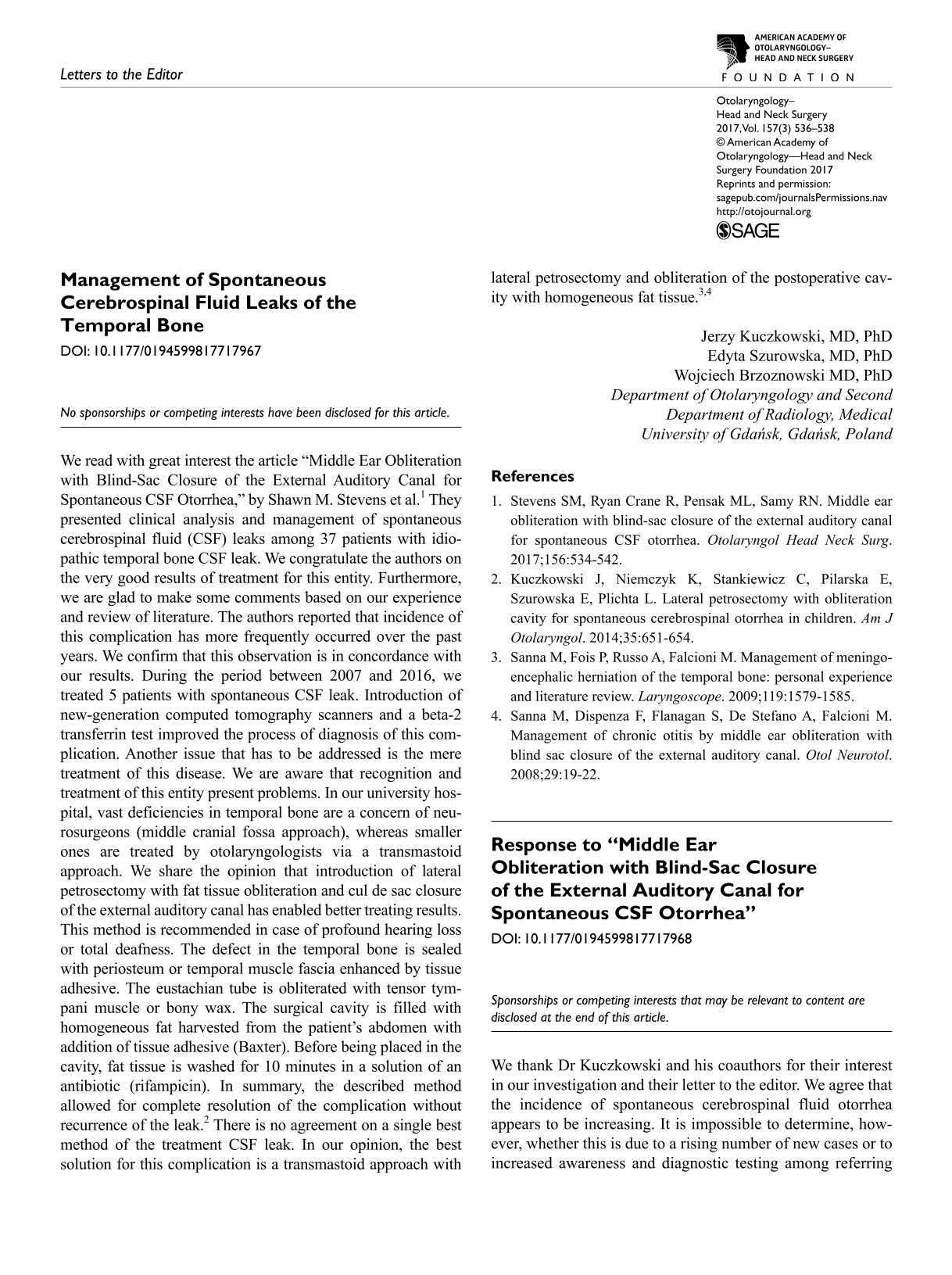 Restricted accessLetterFirst published September, 2017pp. 536-537
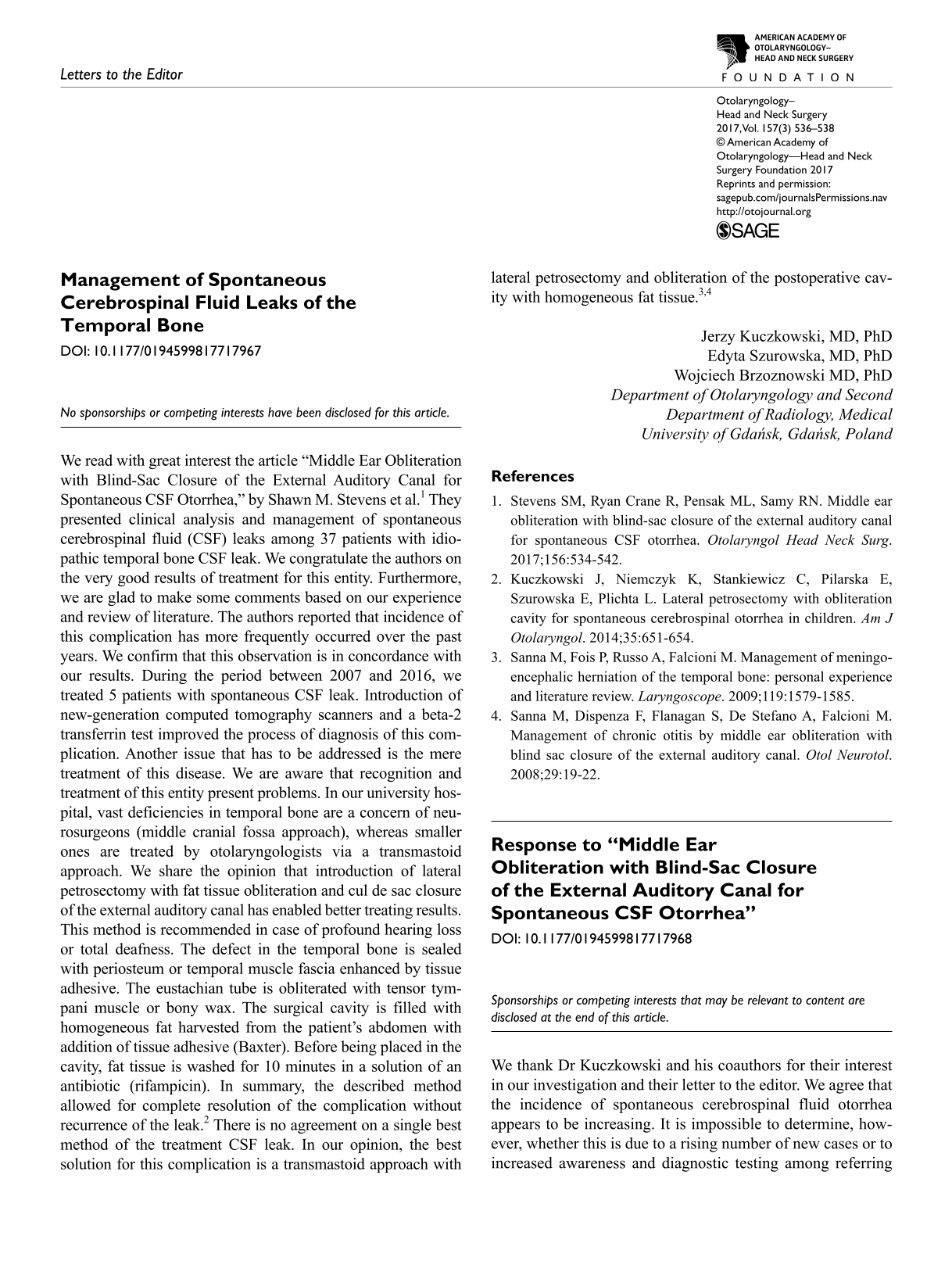 Restricted accessLetterFirst published September, 2017pp. 537-538
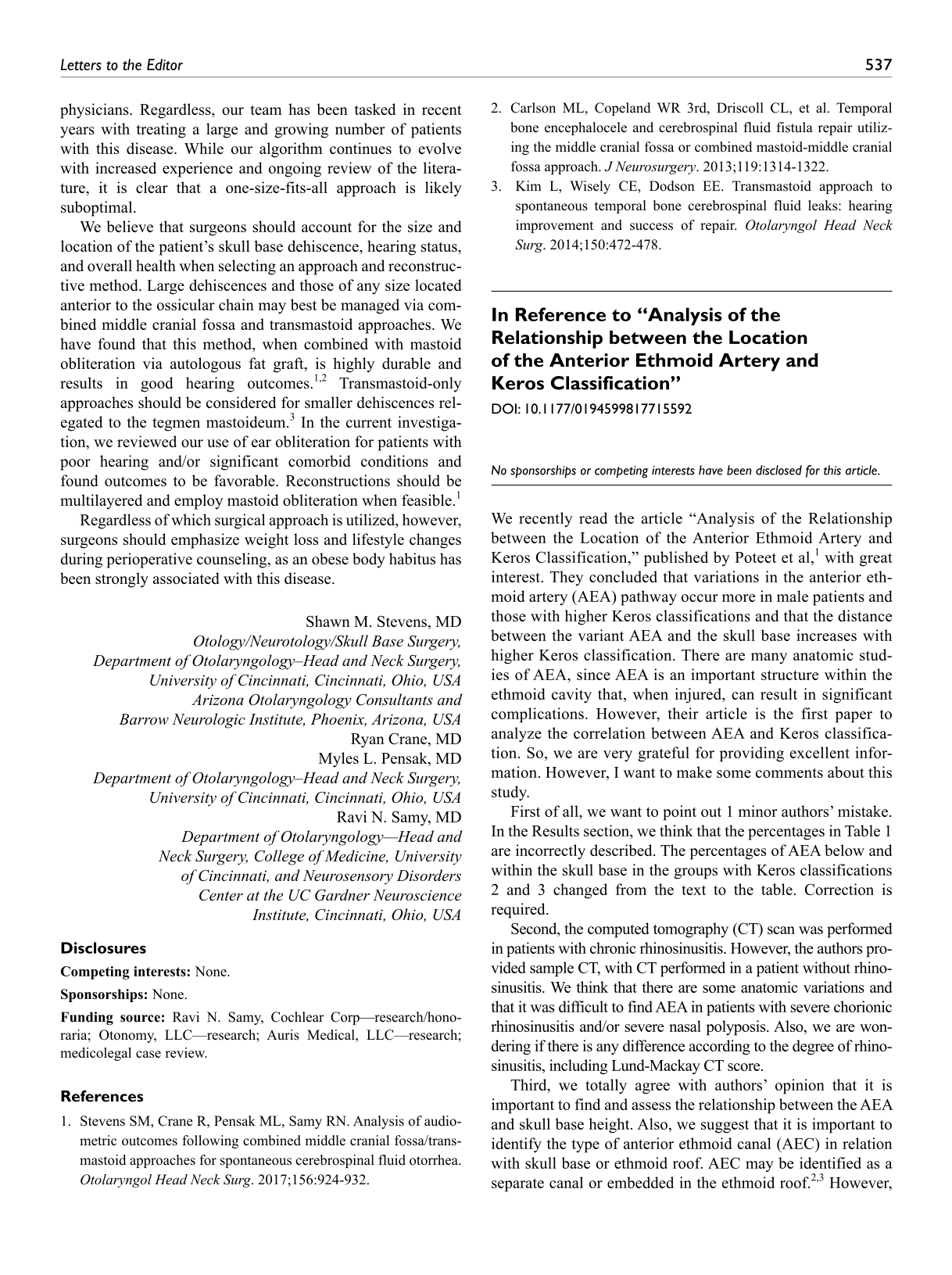 Restricted accessLetterFirst published September, 2017pp. 538-538
 Restricted accessCorrectionFirst published September, 2017pp. 539-539
Schwartz SR, Magit AE, Rosenfeld RM, et al. Clinical practice guideline (update): earwax (cerumen impaction).
Schwartz SR, Magit AE, Rosenfeld RM, et al. Clinical practice guideline (update): earwax (cerumen impaction) executive summary.
In the Clinical Practice Guideline Update and its Executive Summary, the new evidence was misstated. In the abstracts, “Differences from Prior Guideline,” and “General Methods and Literature Search” sections of both pieces, the new evidence was described as being from “from 1 guideline, 6 systematic reviews, 5 randomized controlled trials, and 6 observational studies”; this should have read “1 guideline, 4 systematic reviews, and 5 randomized controlled trials.”
In addition, the fourth paragraph of the Methods section of the guideline and its executive summary (“Clinical Practice Guideline” p. 5, “Executive Summary” p. 3), which describe the English-language search, only included the quality criteria for systematic reviews and omitted the quality criteria for clinical practice guidelines and randomized controlled trials. This information has been included in the revised version below. Also included is a short section, required by the National Guidelines Clearinghouse, that explicitly states that the clinical practice guideline was based on systematic reviews.
The initial English-language search identified 1 potential clinical practice guideline, 7 systematic reviews, 5 randomized controlled trials, and 10 other studies. All searches were conducted on April 3, 2015. Clinical practice guidelines were included if they met quality criteria of (a) an explicit scope and purpose, (b) multidisciplinary stakeholder involvement, (c) systematic literature review, (d) explicit system for ranking evidence, and (e) explicit system for linking evidence to recommendations. Systematic reviews were emphasized and included if they met quality criteria of (a) clear objective and methodology, (b) explicit search strategy, and (c) valid data extraction methods. Randomized controlled trials were included if they met quality criteria of (a) trials involved study randomization, (b) trials were described as double blind, or (c) trials denoted a clear description of withdrawals and dropouts of study participants. Additional evidence was identified, as needed, with targeted searches to support needs of the guideline development group in updating sections of the guideline text. Specifically, ear candling/coning was identified as an area of concern by the reviewers. The databases were also searched using both controlled vocabulary words and synonymous free text words for the topic of interest (ear candling and ear coning) in this population. The search strategies were adjusted for the syntax appropriate for each database/platform. The search was not limited by date range or study design but was limited to the English language. Therefore, in total, the evidence supporting this guideline includes 1 clinical practice guideline, 4 systematic reviews, and 5 randomized control trials. The recommendations in this clinical practice guideline are based on systematic reviews identified by a professional information specialist using an explicit search strategy. Additional background evidence included randomized controlled trials and observational studies, as needed, to supplement the systematic reviews or to fill gaps when a review was not available.