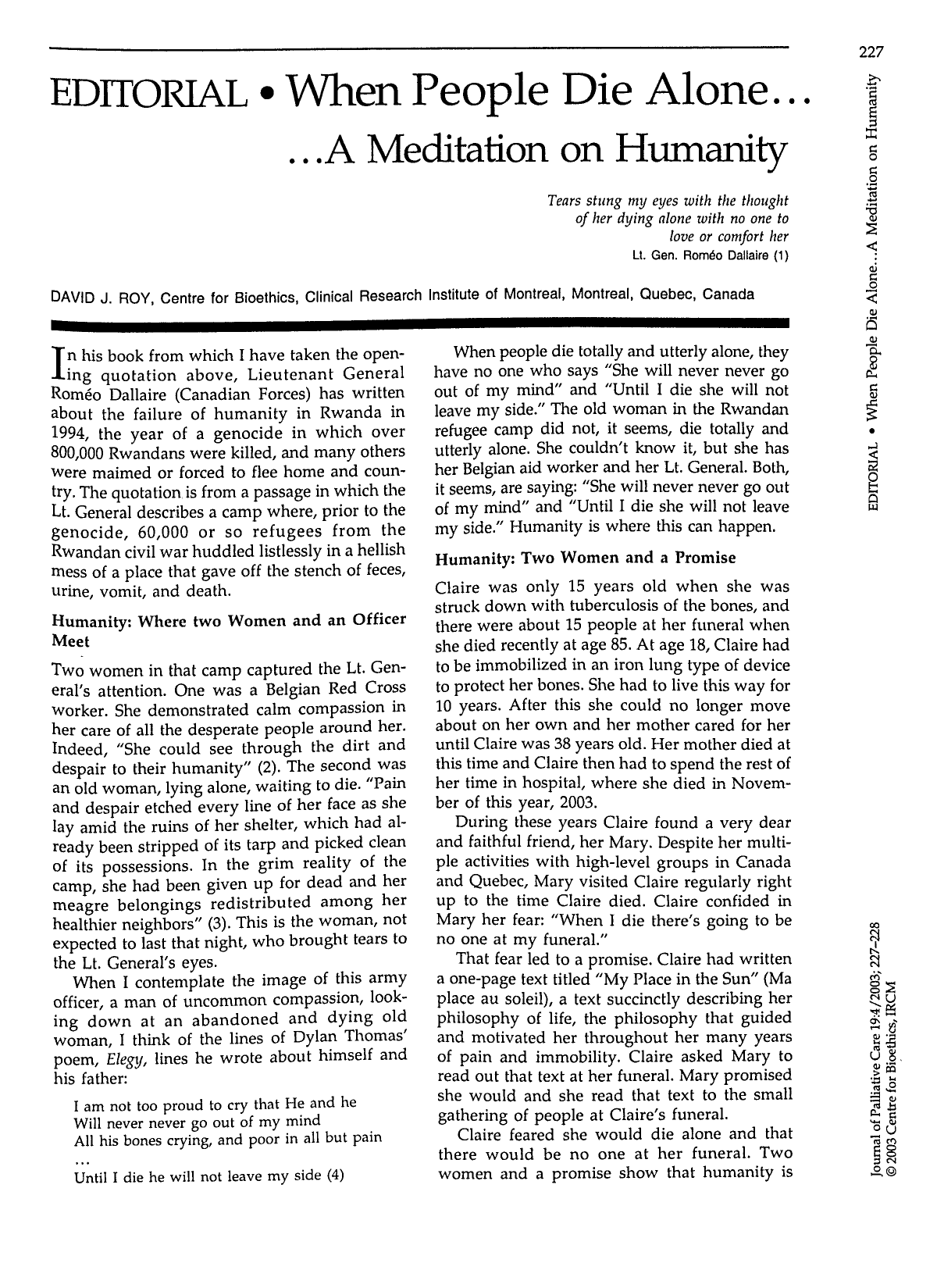
Editorial
Select search scope: search across all journals or within the current journal


A prospective cohort study was conducted to explore the extent of congruence and to identify the determinants of congruence between the preferred and actual place of death of terminally ill cancer patients. A total of 180 terminally ill cancer patients were enrolled (87% response rate) and 127 died during the one-year study period. Nearly 90% of the subjects preferred to die at home. One-third achieved their preference for place of death. The kappa value of congruence (κ=0.11, 95% confidence interval=0.05–0.17) indicated poor to slight agreement between the preferred and actual place death. Important determinants of congruence between the preferred and actual place of death for terminally ill cancer patients included rehospitalisation and receiving hospice home care during the final days of life, perceived ability for family to help achieve preferred place of death, and residence in New Haven County.
This study directly confirms that the degree of congruence between the preferred and actual place death is unsatisfactory. Clinical interventions and health policies need to be developed to assist terminally ill cancer patients who may not be able to achieve their preference for place of end-of-life care and death.
To evaluate the impact of an interactive continuing medical education workshop designed to help physicians in breaking bad news to their patients.
Analysis of post-workshop questionnaires from 539 physicians assessing the retention of the key concepts and the perception of the potential impact of the workshop on their practice immediately after the workshop and six months later.
The most significant concepts retained by the respondents are: the need to take into consideration the whole patient (42.7% post-workshop and 45.6% of follow-up responses), the need to be prepared for the consultation (11.6% and 15%), the importance of better guiding the interview (18.8% and 13.6%), and the value of taking more time during the consultation (5.8% and 8.3%). Analysis of paired responses on the post-workshop and the follow-up questionnaires shows that 35% of the concepts retained are identical.
The majority of physicians retained the key concepts, both immediately following the workshop and in the longer term.
Medical interns, residents, and fellows are heavily involved in caring for dying patients and interacting with their families. Due to a lack of formal medical education in the area, these house staff often have a limited knowledge of palliative care. The purpose of this study was to determine how, given inadequate formal education, house staff learn to provide palliative care. Specifically, this study sought to explore the extent to which physicians learn to provide palliative care through formal medical education, from physicians and other hospital staff, and by on-the-job learning. Twenty physicians were interviewed about their medical education and other learning experiences in palliative care. ATLAS/ti software was used for data coding and analysis. Analysis of transcripts indicated that house staff learn little to nothing through formal education, to varying degrees from attending physicians and hospital staff, and mostly on the job and by making mistakes.
To assess knowledge and associated factors in palliative care.
Self-administered survey of 88 internal medicine house officers in 1996.
Twenty-one interns and 36 residents completed the survey for a response rate of 65%. Most house officers reported 1–5 hours of prior formal training in palliative care, 1–5 hours in pain management, and 6–20 hours in ethics. The mean knowledge score was 75% correct (SD=8); pain management scores were lowest (70%). Overall, interns had a significantly lower mean score than residents (70% vs. 77%; p=0.001). In multivariate analysis, only the year of residency was significantly associated with knowledge score; prior formal training in palliative care, pain management, or ethics was not. One third of house officers rated themselves as “not at all” or “only slightly” at ease in caring for a dying patient. These self-ratings were not associated with prior training or knowledge, but were higher in residents compared to interns.
Palliative care knowledge and ease with dying patients were higher in later years of residency but were not associated with prior formal palliative care training. These data highlight the continued need to evaluate and improve training in palliative care and pain management.
To evaluate whether a short radiation treatment (30 Gy, 3.0 Gy/fraction) had analgesic efficacy in patients with unresectable pancreatic carcinoma.
Twelve patients were included in this analysis. Before starting and at four weeks after radiation therapy, pain intensity was evaluated and analgesic drug therapy was adjusted until a 0–3 pain score was reached (WHO).
No radiotherapy interruptions, no hospitalisation due to toxic reactions, and no severe toxicity were observed. Six patients (50%) had pain control without pharmacological therapy, three patients (25%) reduced their use (35%–72%) of analgesics, while in the remaining three patients (25%) there was no change in analgesic use. Overall, mean reduction in the use of analgesics was 63.1% ± 43.8%. During follow-up (44 months), two patients (16.7%) showed a worsening of pain that required increased analgesia; in one patient, percutaneous splanchnicectomy was necessary.
In patients excluded from standard concomitant chemoradiation, hypofractionated-accelerated radiotherapy is feasible and results in pain relief in most patients, documented as a reduced need for analgesics.
To investigate whether health service input in the last year of life differs between cancer patients who die at home versus those dying in inpatient care.
Post hoc exploratory case-control study of 127 home deaths and 200 inpatient deaths. Retrospective electronic record linkage of patients’ community and inpatient care during the last year of life.
Patients who died at home began their home nursing care closer to death than those who died as inpatients. Their first contact with inpatient hospice care began further from death. Before their final month, home death patients also had more specialist and district nursing than patients who died in inpatient care.
Patients who began their home nursing early were less likely to die at home than those who began such care late. This suggests that it may be difficult to sustain end-of-life care at home for an extended period. Further research incorporating assessment of informal care input and disease trajectory is required to investigate this issue.
In 1999, the French Parliament established a “right to palliative care”, which reactivated public debate about euthanasia. In order to investigate jointly physicians’ attitude toward palliative care and euthanasia, we conducted a cross-sectional survey of a national sample of French GPs, oncologists, and neurologists. Overall, 917 physicians participated in the survey. Significant proportions of respondents, especially among GPs and neurologists, considered that palliative sedation and withdrawing life-sustaining treatments (WLST) were euthanasia. Multivariate analysis showed that the physicians who had special medical training in palliative care, and those who distinguish palliative sedation and WLST from euthanasia were more likely to oppose legalisation of euthanasia. Thus, French physicians’ attitude to the legalisation of euthanasia is strongly influenced by whether or not they distinguish palliative care from euthanasia. Improved palliative care requires better training of the entire medical profession, and clearer guidelines about which end-of-life care practices are legally and ethically acceptable.