Other
Select search scope: search across all journals or within the current journal


The experiments described in this paper are intended to show the approximate magnitude of heat transfer rates between a poppet-type inlet valve and the fluid flowing through it. A model inlet valve, containing an electric heating element, was placed in a short, straight, concentric duct and discharged into a larger, concentric cylinder. Heat transfer rate measurements suggest an increase of Nusselt number proportionate to the 0·6 power of the Reynolds number—the constant of proportionality depending on the valve lift. Calculations show that the effect of this heat transfer on volumetric efficiency is no more than 1 or 2 per cent, and the effect on the temperature reached by an inlet valve in a running engine is also of minor importance compared with those of heat transfer from the gases in the cylinder and of conduction to the seat and guide.
This paper describes some experiences using an on-line computer for transient heat flow investigations. It has been possible to link the experimental equipment to the core of a small high-speed digital computer by way of a multiplexer arrangement which enabled the output of several sensors attached to the experimental equipment to be monitored, sampled, and stored in the computer core at an exceptionally fast rate.
It has been shown that, provided access can be had to such a computer installation, it is possible to accurately investigate the output of thermocouples which have a time constant of less than 0·25 μs. The sampling rate ensures that frequency components above 10 kc/s in the transient heat flow phenomena can be accounted for.
The use of on-line data sampling, described in this paper, ensures that the laborious and time-consuming task of retrieving data from, say, film records or ultra-violet records, can be rejected as well as the effort of transferring such data to a medium suitable for input to a high-speed digital data-processing computer with the possibility of accompanying errors involved owing to manual handling of the data.
The use of multi-channel inputs to the control computer set-up ensures that a maximum of 64 signals can be accommodated simultaneously (although only five are described), and with the sample rates resulting from the use of the on-line equipment, it provides a means of monitoring phenomena such as shock propagations, flame propagations, etc., which might otherwise have been impossible within the accuracy range desirable.
A full description is given of the requirements of the auxiliary equipment necessary for the investigation of transient heat flow using the control computer.
For the laminar flow of a fluid with constant properties in a uniformly heated rectangular duct with no viscous dissipation and internal heat release, an exact solution for the fluid temperature field is presented in the form of rapidly convergent infinite series. Expressions are subsequently derived for the variation of limiting Nusselt number, based on unweighted and weighted mean temperature differences, with duct aspect ratio.
It is shown that previously published approximate solutions for the weighted Nusselt number—determined using numerical techniques—are in agreement with the more versatile exact solution to better than 1 per cent.
Water drops shedding from a cascade of turbine fixed blades have been observed under simulated operating conditions in the C.E.R.L. steam tunnel. The sizes and velocities of the water drops are correlated with conditions downstream in the wake of the blades. The results are shown to be in good agreement with observations made in turbines, and are used to predict the extent and pattern of erosion on a following moving blade row. Upon comparison of the predicted pattern with the actual damage to a moving blade it is found that the impacting drops create pits in the metal surface which are smaller in diameter than the water drops. The physical process occurring when a drop impacts on a surface containing a small pit is illustrated by simple laboratory tests. The impact pressure generated in the water drop causes the front face of the drop to accelerate and strike the base of the pit at up to three times the impact velocity of the drop. This fundamental process accounts for the characteristic pitting of eroded surfaces, and also for the changes in erosion rate observed during continuous water drop bombardment of specimens in material test rigs.
Experimental investigation of air flow in rotating blade rows is widely regarded as desirable, but is rendered difficult in practice because of high rotational speeds and the large number of pressure tappings required. The design and operation of a system using the Scanivalve and able to transmit pressures from a rotor running at 8000 rev/min is described in this paper. Some experience in the use of the system with blade surface measurements on a small (8-in diameter) centrifugal impeller is discussed. Attention is paid to sources of error in pressure readings, including the rotating head correction to convert the transmitted pressure reading into actual pressure at the point of measurement.
Theoretical relative velocities in the impeller have also been obtained with Algol computer programmes for isentropic flow in the axi-symmetric and blade-to-blade directions. A comparison is made between experimental and theoretical relative velocities in the impeller in which the flow is essentially incompressible at the test speed. It is concluded that flow separation occurs early in this particular impeller channel. On the evidence of the results obtained so far, some further uses and developments of the pressure transmission system are discussed.
Two wall static holes of different sizes will give different readings of static pressure and the observed pressure difference is a function of the local skin friction. The static hole pair has, therefore, been proposed as a skin friction measurement device. This paper describes experiments which have been carried out to assess the accuracy of the static hole pair for the measurement of skin friction in favourable pressure gradients. The holes were formed in the wall of a pipe so that the device could easily be calibrated, and the favourable pressure gradient was then generated by inserting a central fairing. The skin friction values obtained from the device were compared with those measured by a Preston tube.
Results showed that the static hole pair is capable of measuring skin friction within about 2 per cent, but a number of practical difficulties are involved, including the necessity to measure very small pressure differences.
Brief consideration is given to the use of the static hole pair in adverse pressure gradients.
This paper discusses experiments carried out to investigate the errors involved when applying the steady flow methods of air measurement to air flows which are pulsating at frequencies between 30 and 130 cycles per second (Hz).
The mass flow measurements for steady and pulsating flow conditions are obtained by using four different sizes of bi-directional square-edged orifice plates with
Attempts are made to determine suitable correction factors and thus establish a commercially satisfactory means of air flow measurement from the delivery side of a two-lobed, Roots-type positive displacement blower. The following effects are discussed: (1) the significance of the non-dimensional parameters involved, and (2) the effect of pulse shape.
This paper reports an experimental research undertaken to explore the performance of a suction slot located in the trailing edge of a representative low-pressure steam turbine fixed blade.
Tests have been made on a 1-in wide section of a full-size hollow blade mounted in a single-blade test section. Typical turbine pressures were reproduced down to 3 inHg (abs.), and blade exit Mach numbers varied in the range 0·57–1·10. With round entry lips, the slot operated satisfactorily in any blade orientation, as it completely removed quantities of water that were in excess of the amount expected under operating conditions. Square entry lips gave somewhat poorer performance.
The results of an investigation into the behaviour of a finite amplitude pressure wave at the junction formed by the intersection of two ducts of equal cross-sectional area are presented. Using a shock tube to produce waves with amplitudes varying from 1 to 37 lb/in2 (g), pressure measurements were made in three junctions in which the side branch formed an angle of 45, 90, and 135° with the main branch. The results are compared with a theoretical analysis which is based on the assumption of one-dimensional, quasi-steady, adiabatic flow. Differences in the theoretical and experimental values have been found at the junction entrance when the velocity at the entrance is subsonic and in the side branch when the velocity at the entrance is sonic. These differences are explained in terms of the wave action known to occur within the junction.
A potential flow model is proposed for the simulation of a closed separation region where a flow reattaches to the wall from which it has previously separated. The model is intended for large Reynolds numbers, for which condition the vorticity in the fluid is assumed to be concentrated along the initial part of the dividing streamline and at the centre of the circulatory flow in the separation region. Using empirical data for the location of the reattachment point, the proposed model is applied to the problem of flow separation at the inner corner of an unequal elbow, and a comparison is made between the calculated and the experimentally observed flow patterns.
The heat transfer from fuel elements in magnox reactors under all normal conditions is predominantly by forced convection. However, in safety assessments a burst in a bottom main coolant duct is postulated, a reversal of the carbon dioxide coolant flow takes place, and heat transfer from the fuel elements at this instant could be by radiation only. The effective emissivity of the fuel element or the normal emissivity of plane specimens of fuel element material and a geometrical factor are therefore required to enable the maximum fuel element temperature to be determined.
The paper is mainly concerned with the development and calibration of an apparatus suitable for measuring the normal emissivity of small plane samples at temperatures up to 650°C. Though the design of the apparatus has been influenced by the special requirements involved in testing magnox specimens, the apparatus has a general application and the normal emissivities of other materials are also given.

This paper is concerned with the gas exchange processes which occur in an engine. Previous work has been concerned with unsteady flow within the exhaust pipework; the present investigation provides a link between the cylinder and the pipe.
The modifications to the pulse generator machine which was used to simulate an engine are described, and an account is given of the tests carried out with the machine. The previous steady flow tests are briefly summarized and the unsteady flow tests which were carried out are summarized with the aid of a table.
The paper also presents a discussion of the test results and of calculations carried out to compare with the experiments.
The main conclusion from the results is that a very satisfactory method has been devised for calculating the gas exchange processes occurring in an engine model.
The main detailed conclusions are:
The dependence upon pressure ratio of the effective area of a poppet valve need not be taken into account for the analysis of unsteady flow tests. Calculations on unsteady flow and gas exchange should be made on a theoretical model which has an exhaust pipe equal in length to the actual external exhaust pipe The method of calculation using the cylinder boundary conditions is an improvement on the previous type of calculations, which used a ‘pressure input’ as a boundary condition.
Finally, the present work on a pulse generator with fixed piston using cold air, has provided a means of calculating the gas exchange processes from a knowledge of the release and supercharge pressures and the engine geometry. It has, therefore, provided an important link between the engine cylinder and the exhaust pipe system.
Equations are developed for the flow of gas-liquid mixtures through nozzles under conditions of critical or ‘choking’ flow. The equations are compared with experimental data obtained during air-water flow through nozzles and pipes at almost atmospheric pressures. Comparison is also made with data on the sonic velocity in mixtures. Additional problems arising with vapour-liquid mixtures are also discussed.
Existing models for the equilibrium of a bubble at a heated surface are discussed; an alternative model is presented, based on conduction as the dominant mechanism in the liquid and on vapour transfer within the bubble. No artificial restrictions are made at the boundaries and the only condition to be fulfilled by the mathematical solution is continuity of temperature and heat flux at the liquid-vapour, liquid-solid, and vapour-solid interfaces. The characteristic distance in the undisturbed liquid, at which the liquid and the vapour temperatures are identical, is determined as a function of dimensionless parameters which contain the physical properties of fluid and wall material in addition to nucleation cavity size.
It is known that the onset of nucleate boiling at a solid surface is related to the dimensions of cavities on the surface. In this paper it is proposed that a commercial surface be characterized by a normal distribution of cavity sizes, and on this basis a theory is developed for the prediction of heat transfer characteristics in the
Experimental data on the influence of pressure (range, atmospheric to 750 lb/in2 (abs.)) and subcooling (range 0–12 degF) on the overall heat transfer rates are also presented.
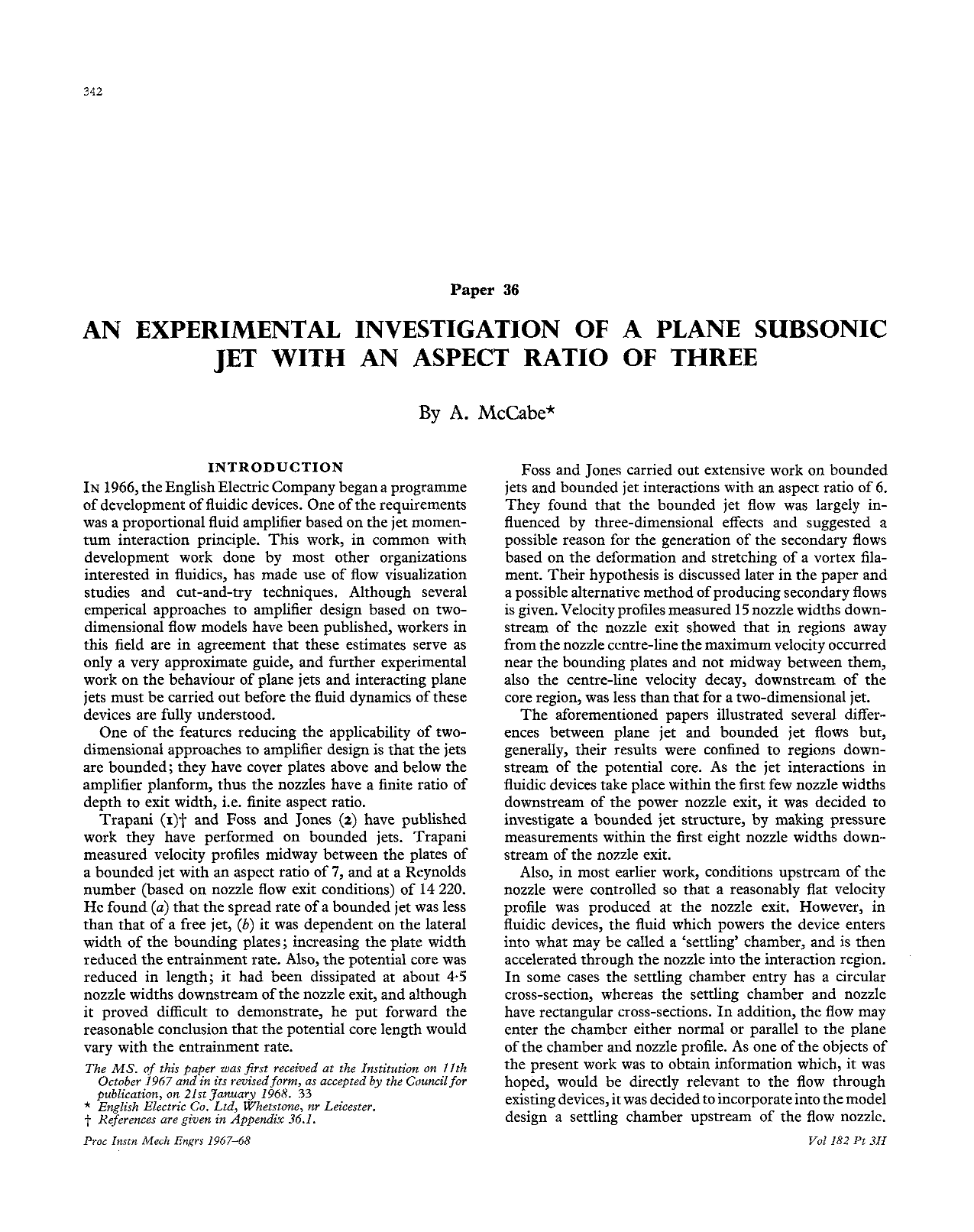
Unsteady flow through three-branched pipe configurations has been investigated with the object of finding boundary conditions suitable for use in the analysis of high-amplitude waves using the method of characteristics. The schlieren method and the hydraulic analogy were used to obtain qualitative information about the quasi-steady flow patterns. Quantitative information concerning these patterns was obtained by the measurement of stagnation pressure losses and of the static pressure distribution. Several methods of deriving boundary conditions have been reviewed, and it is considered that those obtained directly by experiment are the most convenient to use.
The discharge of compressed air from a cylinder has been studied experimentally. The effect of initial pressure and of orifice geometry on the expansion in the cylinder and on the transient flow through the orifice has been examined in detail.
During expansion, radial and axial temperature gradients are established which result in departures from isentropic behaviour. The state can be reproduced analytically only by using a variable polytropic index whose values are dependent on the history of the expansion.
From dimensional considerations the effects of fluid dynamical variables and of heat transfer on the transient flow have been isolated.
This paper deals with a theoretical approach to study the non-steady flow and wave action in a centrifugal impeller and vaneless diffuser, and also to predict the non-steady flow performance of a centrifugal compressor. This was carried out by replacing the compressor unit by a model which consisted of a simplified rotating duct, a vaneless diffuser, and a cone-shaped pipe which replaced the scroll.
A theoretical technique using the method of characteristics and the development of the non-steady flow equations to a rotating duct and radial diffuser is given. The development of the theory and the difficulties encountered are described. In particular, the techniques developed for starting a computer calculation are described.
In order to maintain homentropic flow in the impeller and diffuser all losses were assumed to occur at the impeller inlet. A pressure loss boundary condition was developed to enable the steady pressure ratio-mass flow characteristics to be computed. When these values agreed with the experimentally determined characteristics, the boundary condition at the rotor inlet was such that the pressure loss terms allowed for the impeller and diffuser losses.
The theoretical results obtained are compared with corresponding experimental results, and the possibility of using this theoretical technique as a design tool is discussed.
This paper describes a theoretical and experimental study of the non-steady flow performance of a centrifugal compressor. The experimental work was designed to study the effect of pulse frequency on the compressor performance, for a given delivery configuration, using a rotary valve pulse generator. The experimental rig was designed so that it was possible to study the reverse flow and the pressure pulsations in the suction side of the compressor. The objective of the investigation was to discover how the compressor performance deteriorated with pulse frequency, and also to determine the frequency at which reverse flow through the compressor first occurred.
The objective of the theoretical work was to predict the onset of reverse flow through the compressor and the mean and transient delivery pressure ratio using the conventional stationary pipe non-steady solutions by the method of characteristics. The compressor unit was replaced by a boundary condition within the pipe system equal to the experimentally known steady flow characteristics of the compressor. The physical size of the compressor was replaced by an equivalent pipe length; this technique is described. The theoretical results are compared with an extensive series of experimental results. This work is a direct extension of that given in reference (

The performance of a radial flow turbine, operating on compressed air, is measured over a range of pressure ratio and speed. Separate tests on the nozzle assembly alone enable the rotor performance to be separated from the overall characteristics. In particular, the conditions at each pressure ratio for which the nozzle exit whirl velocity is equal to the rotor tip speed may be deduced. Also, it is possible to evaluate the enthalpy ‘loss’ in the rotor, that is, the difference between the specific enthalpy drop actually occurring in the rotor and its isentropic value.
An attempt is then made to relate this loss with the relative velocities within the rotor passages as predicted by inviscid, two-dimensional analytical techniques. The method developed by Stanitz and co-workers has been programmed to analyse the rotor internal fluid flow properties in the blade-to-blade plane for the conditions of zero incidence. The region investigated does not include the whole rotor, but extends from a boundary upstream of the blade tip to a downstream boundary at a radius equal to 72 per cent of the tip radius. The analysis is performed for overall turbine static to static pressure ratios of 1·2 to 1·6.
The result of the theoretical analysis is to show that the variable ratio of rotor outlet to inlet specific volume with changing pressure ratio is accommodated almost entirely without any change in the flow distribution; that is, over the region of the impeller investigated, and at overall turbine pressure ratios up to 1·6, the compressible flow through the rotor may be considered as being through stream tubes of fixed geometry. There is thus a sound basis for the correlation of rotor loss coefficient in terms of parameters which describe compressible flow with friction along variable area pipes. Consideration is given to the manner in which the zero incidence loss coefficient may be defined in order to remain constant at varying pressure ratios.
This paper is concerned with heat transfer to air passing through the axial cooling ducts of rotors. The measurements have yielded data for a range of axial to rotational velocities and of duct spacing, pitch-circle diameter, and length-to-diameter ratio.
The results, in terms of the ratio of rotating to stationary heat transfer coefficients, show the important parameters which govern the increase in heat transfer due to rotation. Under certain conditions, an increase in heat transfer of 100 per cent is achieved.
A simple non-return disc valve was tested in a pipe in which an unsteady flow was produced. The valve was tested with its disc fixed in position and was also tested with the disc controlled by a spring. Records were taken of the unsteady pressure diagrams at various points in the pipe and the disc displacement diagram.
To obtain the boundary conditions required for the unsteady flow calculation, it was first necessary to examine the flow in the valve under steady flow condition. The results of this investigation are briefly described.
It was found that the disc displacement diagram in unsteady flow can be calculated with reasonable accuracy from the pressure drop across the valve by integrating the equation of motion of the disc numerically. The equation of motion contains terms for the inertia of the disc, the spring force, and the gas force. Viscous friction damping forces were negligible for this valve.
Once the disc displacement is known, the pressure diagram can be calculated using the steady flow values for the pressure loss across the valve and the normal methods for one-dimensional unsteady flow calculations.
This paper describes the problems encountered in the design, operation, and calibration of a small momentum balance fitted within an isokinetic sampling probe located in the test section of a wet steam ‘wind’ tunnel. The probe is suitable for use in air, dry steam, or wet steam. It has an opening of ½ in diameter, a maximum diameter of 1¼ in, and a length of 4½ in, and will detect momentum forces greater than 0·001 lbf. The signal is transmitted by causing the impulse cage to compress a bellows. Turpentine enclosed therein raises the level of its meniscus in a capillary tube and the change in level is observed with a micrometer microscope. An electrical superheating calorimeter is employed in series with the impulse-measuring probe to determine the stagnation enthalpy of the sample. Results are reported for air and steam. For steam the ranges of the respective variables are: pressure, 20–25 inHg vacuum; velocity, 200–500 ft/s; and wetness, 0–10 per cent by weight. Owing to the small size of the momentum cage it was not possible to isolate the contribution to the total momentum made by the entrained liquid.
Experiments are described on evaporative heat transfer to boiling water in upflow in a vertical electrically heated 0·497-in inside diameter tube at 1000 lbf/in2 (abs.). The main objects were to measure the surface temperature profiles in the region beyond the dry-out point in the channel where liquid ceased to flow on the channel wall, and to investigate the behaviour of the dry-out ‘interface’ between the ‘wetted wall’ and the ‘dry wall’ regions. The test section was made from ‘Nimonic’ as this can withstand the highest temperatures in the ‘dry wall’ region and also has a low temperature coefficient of electrical resistivity, thus allowing a uniform heat flux to be maintained with wide axial temperature variation. The temperature in the ‘dry wall’ region first increased rapidly with distance from the dry-out point, after which it either increased at a slower rate or, at high mass velocities, even decreased. The dry-out ‘interface’ moved reversibly down and up the channel as the heat flux was increased and decreased. Local surface temperatures showed no hysteresis with cycling of heat flux, in contrast with the pool boiling situation.
A method of predicting the wall temperature profile in the ‘dry wall’ region has been developed. In this method, the heat-transfer process is considered as being in two steps: wall to superheated steam continuum, and steam continuum to water droplets. The first step was calculated from standard single-phase steam heat-transfer correlations, and the second step was calculated on the basis of simultaneous heat transfer to, and steam diffusion from, the droplets. It was important to take account of the slip between the droplets and the steam. Satisfactory agreement was obtained between measured and predicted wall temperature profiles.
A new theoretical analysis has been made of turbulent heat transfer in the region of simultaneously developing hydrodynamic and thermal boundary layers in annular flow.
A boundary layer-potential stream model has been used to describe the flow, heat transfer being predicted through the use of a modified Reynolds analogy. Skin friction data for the inner heated wall have been obtained from correlations pertaining to boundary layers on immersed bodies.
Experiments have been made with air in the entry region of internally heated annuli with radius ratios 2·1 and 4·0. Satisfactory agreement between theory and experiment has been achieved.
The results of a study of heat transfer and hydrodynamic phenomena during flow of an air-water mist across a heated, horizontal cylinder are reported.
Local and average heat-transfer coefficients have been obtained, under conditions of constant heat flux, on the outer surface of a 19-mm outside diameter cylinder. Air flow rates corresponding to approach velocities of 20–75 m/s have been explored with mixture qualities in the range 0–9 per cent by weight of liquid phase.
Heat-transfer coefficients were found to be strongly dependent on mixture quality, and increases in the average value of the surface heat-transfer coefficient of twenty times the corresponding dry gas values were recorded with mixture qualities approaching 9 per cent by weight of liquid.
Under all conditions explored, a liquid layer was observed to form over the front half of the tube, between forward stagnation and separation. An intense bouncing or splashing action of droplets impinging on this layer was observed and measured.
Average values of surface heat-transfer coefficient were found to be correlated in terms of the quality and Reynolds number of the mixture and of Nusselt numbers based on average and stagnation point heat-transfer coefficients.

A twin-exhaust steam turbine of 60-MW output was used for a field study of a method of wet steam erosion control which had been examined previously under laboratory conditions. The last stage of one exhaust was modified so that measured quantities of steam and water could be extracted, or steam injected through slots in the trailing edges of the diaphragm blades.
Variations in erosion rates of the last-stage moving blades in both exhausts were compared by recording continuously the changes in emissivity of radio-active labels attached to sample blades. An introscope was used to study flow conditions during the experiment, and after some five months' operation the set was opened up for inspection, which confirmed the estimates that water extraction reduced erosion by a factor of 5.

The presence of surface-active material may modify appreciably the flow patterns in two-phase flows. A frequently employed model for the surface adsorption process is used to derive similarity conditions for such flows. The limitations of this model are discussed in relation to the formation of surface films on open channel flow of water containing dilute surfactant.
Laminar convection in vertical systems is affected by buoyancy so that it becomes a combination of natural and forced convection. In downflow the buoyancy forces oppose the main flow. The problem has previously been studied for flows in vertical circular tubes and is here extended to flows in vertical annuli with uniformly heated inner surfaces. This configuration retains the simplicity desirable for both analysis and experiment, but also represents quite closely certain practical systems such as flow in nuclear reactors in which cylindrical components are placed axially in vertical coolant channels.
Buoyancy forces opposing the main flow cause the fluid to be slowed down near the heat transfer surface until it is eventually reversed. In simple theory this flow reversal is associated with a decrease in heat transfer performance.
An experimental study has been performed in a vertical annulus of ¾ in inner and 2¼ in outer diameter using water. Flow visualization by dye injection indicates that while small reversed flows may occur in a stable form, higher buoyancy forces give rise to radial components of the flow. These radial components cause the reversed flow regime to become unsteady and the Nusselt numbers to be higher than those predicted by laminar convection analysis.
From analysis of data for the flow of steam-water mixtures in tubes at pressures between 3 MN/m2 [435 lb/in2 (abs.)] and 17·5 MN/m2 [2540 lb/in2 (abs.)] equations for friction pressure gradient are developed. These equations allow for the influence of the ‘mass velocity effect’, not previously allowed for in accepted correlations. The equations are in a form making them applicable at the critical point, and are compared with the data of Miropolskii, Isbin, and Berkowitz for steam-water flow.

When asymmetrical conditions exist around a heated element cooled by flow in a channel, the temperature varies round its circumference. This results in a tendency for the hottest side of the element to bow away from its nominal axis. Usually a movement in this direction reduces the heat transfer coefficient and increases the local coolant temperature on the hot side, inducing greater temperature differences around the element in addition to further movement. Under some conditions this can lead to complete instability. This problem has previously been examined for the case of an element simply supported at each end, with reference to fuel elements for nuclear reactors. A more general approach has now been made. The behaviour of two- and three-span continuous elements has been examined using a digital computer programme. The previous solution has been extended to cover any channel shape and any number of spans. Experiments with two- and three-span elements have confirmed the predictions.
To prevent or minimize the erosion of the last row rotor blades in large high-speed steam turbines it has been proposed to remove the film of water on the surfaces of the last row stator blades before it reaches the trailing edges and is swept off by the steam drag into the path of the rotor blades.
The paper describes experiments with a cascade of hollow stator blades with various dispositions of slots providing communication from the blade surfaces to the hollow cavity. The same cascade was used in turn with three different wet air tunnels, the experiments thus covering a wide range of Mach number and Reynolds number.
With suitably disposed slots, and bleeding a very small proportion of the working fluid, about 90 per cent of the deleterious water can be removed, thus preventing it from striking the moving blades.
This article considers methods of calculating condensation processes in wet steam turbines. Equations are given for determining the rate of nucleation, the growth of droplets, and the wet steam parameters. The condensation processes within the blade ring of a steam turbine are used by way of example. It is made clear that the condensation process is continuous at large enthalpy gradients. Under these conditions the theory of discontinuous condensation will not represent the actual process. Calculations based on the kinetic theory of phase change agree well with experimental findings.
The constructional features of the blading which operates within the Wilson zone can have a considerable effect on the extent of the undercooling and on the size of the droplets.
The trajectories of the droplets in the space between blade rings can be determined using standard approximate equations. The Coriolis force has a considerable influence on the motion of the entrained liquid within the moving blades. Under the influence of this force the liquid may move either with the flow or against it.
Laminar flow between two vertical parallel plates, with one of the plates uniformly heated and the other thermally insulated, has been studied theoretically for the case where gravitational buoyancy modifies an otherwise forced convection regime. Velocity and temperature fields for two conditions of flow—heated upward flow and cooled upward flow—have been derived. From these results heat transfer and pressure drop data have been calculated and similar tendencies to those which occur in uniformly heated vertical pipe flow were found.
The spontaneous ignition and ignition delays of liquid fuel droplets impinging on a hot surface are investigated. It is shown that the ignition delay–temperature curves follow closely the pattern of lifetime–temperature curves and that for the commercially important fuels, such as kerosine and diesel fuel, the ignition delays have a minimum value at some particular temperature. Zones of non-ignition are isolated and a hypothesis presented for their occurrence. It is further shown that within the temperature range investigated, the ignition delays of droplets impinging on a hot surface are much shorter than those of similar droplets undergoing spontaneous ignition when suspended in a stagnant atmosphere.
The results of tests on a series of small inward radial flow turbines, reported by Hiett and Johnston, are analysed. Stagnation type pressure loss coefficients are established for the rotors, enabling their performance to be predicted with fair accuracy over a wide range of operating conditions in both directions of rotation. In particular, secondary losses are related to the forces acting on the vanes, using a similar method to that of Ainley and Mathieson for axial flow turbines. Additional losses occurring during reverse rotation are related to the variation of lift coefficient with radius in the exducer.