Research article
Select search scope: search across all journals or within the current journal

The mechanized movement of letter mail essentially involves the processing of individual items. The extraction of single items from a reservoir and the later regrouping of the items are therefore the primary and ultimate treatments to which mail must be subjected. The problems involved and the techniques of reliably effecting these basic actions are studied and explained.
Several areas of every item must be examined in any automatic mail processing system. This introduces the necessity for mechanisms to turn and twist items so that the appropriate areas are brought into view of the various scanning devices. This paper studies the basic movements and offers solutions.
A sorting office is a collecting, processing, and redistribution point in our mail-handling system, and, as such, can be regarded in a broad sense as a multi-outlet diverter, directing the various items towards their destinanations. The importance of the routing components in a mechanized system cannot be over-stressed. Their design can take a wide variety of forms, each exhibiting special features which recommend it for certain applications. This paper reviews the subject and discusses the designs that have been advanced in the course of postal mechanization development, together with the means employed to activate them.
The paper commences with a definition of letter presentation, and mention is made of the types of machine in which it is required. After descriptions of various developments carried out by British postal engineers in their search for the ideal presentation unit, the paper continues with an explanation of suspended presentation and concludes that it fulfils all the requirements of the British Post Office.

The paper describes why control elements using discrete components mounted on a printed circuit board were chosen for postal mechanization equipments. Basic design considerations are listed, and principles determining the choice of components stated. The decision to provide both ‘nor’ and ‘not-and’ elements is explained, and the reasons given why negative logic is used. With the use of B.S. symbols it is shown how logic diagrams can easily be converted to functional diagrams. A brief description of each logic unit in the standard set is given and the set of peripheral units listed. Mention is made of the design method and the emphasis placed on noise immunity. Constructional techniques and the use of an automatic tester are described. Current assessment of the actual performance of the units is given and future possibilities, including large-scale integration and M.O.S.T. devices, are discussed.
Resins showing delayed luminescence at room temperature were developed by the British Post Office for postal mechanization as they seemed to offer the best combination of low cost, reliability, and freedom from interference. The materials are prepared by polymerizing a small proportion of ‘activator’ into a cyanuric acid-formaldehyde resin. The properties controlled by the ‘activator’ are the waveband required for stimulation of the resin and the waveband and half-life of the delayed luminescence. Properties, methods of application, effect of operational variables, methods of testing, and quality control are discussed in detail.
This paper describes the work carried out to date to establish a relationship between the amount of phosphor, in a given form, to be applied to a postal item, and the efficiency in terms of the number of correct operations interpreted therefrom by the machine reader. The investigation leads to the specification of the phosphor density for stamps which will provide a known performance margin for the automatic letter facing system. Related problems in the address code sorting system are also discussed.

The speedy preparation of mail into orderly groups suitable for machine sorting became an essential prerequisite for any letter mail mechanization system. The search by the P.O. for a suitable method is traced. The cylindrical segregating drum method is described in detail, together with some interesting variants. Problem areas are discussed and future designs are considered.
The problems involved in developing production models of a successful segregator from a prototype version are described and discussed, together with the subsequent development of later marks of machine.
The evolution of automatic letter facing is traced from the original machines of the 1930s to the present-day equipment. Mechanical engineering problems are discussed and the course of future design considered.
Techniques for controlling the routing and processing of letters flowing through automatic letter facing machines are considered, current U.K. practice being discussed in some detail.
The paper briefly describes the purpose and operation of the letter facing machine and sets out certain basic considerations for the design of production machines for British Post Office use. The design of the letter facing machine Mk 1 is then described by reference to specific aspects and, in addition, by outlining the problems encountered. Further developments following on from the first machines are then discussed and more specific detail given on the Mk 3 machine. Finally, an indication of the possible work still to be done is considered.

Although the highest returns resulting from postal engineering development are likely to come from installations in those offices engaged in large-scale letter sorting operations, there remains considerable scope for reliable devices designed to assist operations in smaller offices. Some devices developed specifically for automatic large-scale working can, with small adaptations, fulfil a labour-saving role in the more numerous smaller offices. Such an apparatus is described; it collects letter mail from a manual facing table, stamp-cancels each item, and delivers it into one of the two stacks according to length. Improved working conditions have resulted and higher mail facing rates make the system economically attractive.
The programme to mechanize the letter post commenced with the development of individual machines to carry out basic processes. Attention is now being directed towards the interlinking of these machines. Linking is discussed generally and a report made on the progress to date.

An initial examination of the factors which affect the development of postal systems is followed by discussion on the use and value of address and machine codes. Finally, a description is given of the coding system adopted in the U.K., with justification of the methods employed.
The search for an ideal keyboard for use on letter coding and sorting machines has continued for many years, and the ideal is still to be realized. The development of keyboards in the British Post Office is traced and the results for each type are presented. One of the major problems is the difficulty of introducing a new type of keyboard to operators who are thoroughly familiar with an older type, yet have duties involving only a few hours' operating each week, mixed with other work. Under these circumstances performance may be worse for up to six months while operators grow thoroughly accustomed to the new keyboard. A better solution would be to introduce an improved type on opening a new office, but there is still a considerable delay before comparable results are available. A further limitation is the need for compatibility with standard typewriters used for initial training. The type of keyboard in use on sorting machines and two types in use on coding desks are described in detail.
The future success of the automated letter coding/sorting system relies, to a large extent, upon the proficiency of the coding desk operators. However, the future demand for trained operators cannot be met by existing training methods. A computer-based system is described which will be operational by late 1970. It is designed to meet the present training requirements and is sufficiently flexible to provide for changes of philosophy which experience may show to be necessary. The integration of the system with other computerized sorting office activities is also discussed.
The essential requirement demanded of a code mark printer is that it should produce economically an easily readable code pattern on letter mail of different surface colours and textures, accurately and without smudging or defacement of written matter. The merits of various methods of marking are compared and reasons for the choice of phosphor for letter mail explained. The advantages and disadvantages of possible coding techniques are discussed. Properties of the phosphor carriers are closely related to the printing method adopted. Printer mechanisms designed for hot transfer from coded tape are described, including three production models in service. The method of marking to permit identification of the source of coding, which is necessary for investigations into mis-routing, is described. The paper concludes with a history of experience to date and comments on possible future developments.
The development of the letter code desk is described, particular reference being made to the necessity for the characteristics to be suited to the operating personnel. An explanation is given of the design features introduced as a result of this unit being required in relatively large numbers for this class of work. The development of the special printing unit for code application is described, with particular emphasis on the very high reliability required. An indication is given of probable future trends.

The paper describes the development of the machine to meet operational requirements and discusses the steps taken to standardize on components for use on this and other associated postal machines. The techniques of sorting mail at high speed, the machine's relationship with the translator, and the features introduced to deal with ‘Post Office Preferred’ items are dealt with in the paper.
The stages in the development of British operator-controlled sorting machines are described, together with an outline description of the functioning of these machines. The natural progression to the production of a multi-selection automatic sorting machine, which included principles proven in the operator-controlled machine, is covered. The latest development, the convertible letter sorting machine, and the reasons for it are briefly explained.

A new stamp-vending machine designed and developed for the British Post Office is described. A brief outline of stamp machine history is followed by a review of the reasons for the adoption of the particular design. A description of the mechanism shows how the design specification has been met, despite the limitation of size imposed by existing mountings. The stamps are issued from a roll by the user operating a lift flap after insertion of a valid coin, and no additional source of power is required. The machine may be readily set to issue any predetermined stamp combination.
The introduction deals with early posting methods—the post receiving office, which became inadequate as postal traffic increased, leading to the design of the first type of pillar letter box in 1852. A brief history follows of the different types of pillar letter boxes (illustrated) until the introduction of the type F (new square type) in 1968. A description is given of the new-type box, dealing in detail with the concept of unit construction and the rapid emptying methods used.

A requirement was foreseen for a translator capable of providing translation facilities in smaller sorting offices. The design philosophy adopted was one which gave insurance against a major breakdown by providing a number of inexpensive independent units in place of a centralized translation equipment. The paper describes a novel data storage device comprising a Perspex drum fitted with a special binary data code film on its periphery, and employing optical scanning techniques for data retrieval. The principles of operation and manufacturing aspects of a code sorting translator incorporating both optical and magnetic storage drums are described.
This paper explains the reasons for reviewing translator techniques after the success of the coding/sorting trial at Luton. The merits of core matrix, magnetic drum, inductive store, and threaded-core memories are discussed. The reasons for choosing the threaded-core technique for translators are explained. Descriptions are given of the coding desk translator, the sorting machine translator, and the methods of achieving flexibility. Current assessment of the production equipments is given, and future developments, including the use of computers, are suggested.
The requirements to be fulfilled by the equipment used to control letter coding and sorting equipment in a modern sorting office are summarized and a method of using a general purpose computer for these purposes is described. Emphasis is given to the use of a magnetic drum to reduce the cost of core store and to the method of organizing the computer program. The ability of the computer to undertake secondary tasks and the constraints imposed by the requirement of high reliability are mentioned.

The function of the machine described is to distribute and convey the primary sorted packets selectively to the secondary sorting positions. Packets are manually loaded into frames of individual boxes provided with electromechanically or electropneumatically controlled flaps which sequentially discharge their load in a controlled and predetermined cycle on to bands beneath the machine. A system of underframe conveyors carries the packets to a series of tilted bands whose gates are operated by a controller on the packet sorting machine, thereby allowing discharge into the direct selection chutes or overhead storage units.
This paper discusses problems concerned with bulk-handling storage devices used in the parcel post. These storage devices, which are used to absorb the traffic peaks, include glacis, containers, band conveyors, concentrators, and chain conveyors. They require automatic feed or discharge, or sometimes both, depending on their functions in the office. The main problems stem from the space needed to provide the required storage capacity and the site limitations.
Opening with a simple description of the principles of the machine the paper then recounts its history and traces the changes made in design since its introduction by the Australian Post Office. Some situations which are critical for machine operation are then analysed, e.g. mechanism of parcel discharge, loss of station of parcel, and maximum length of twist section (where such is essential). Because the throughput of the machine is much greater than that of a sorter or even a two-man facer-sorter team, means of feeding it from two or three positions have been designed. Salient features of these designs are described together with results of computer simulations of traffic. An account of the different methods of information storage that have been used is given and the paper concludes with a review of outstanding problems in the design of this machine.

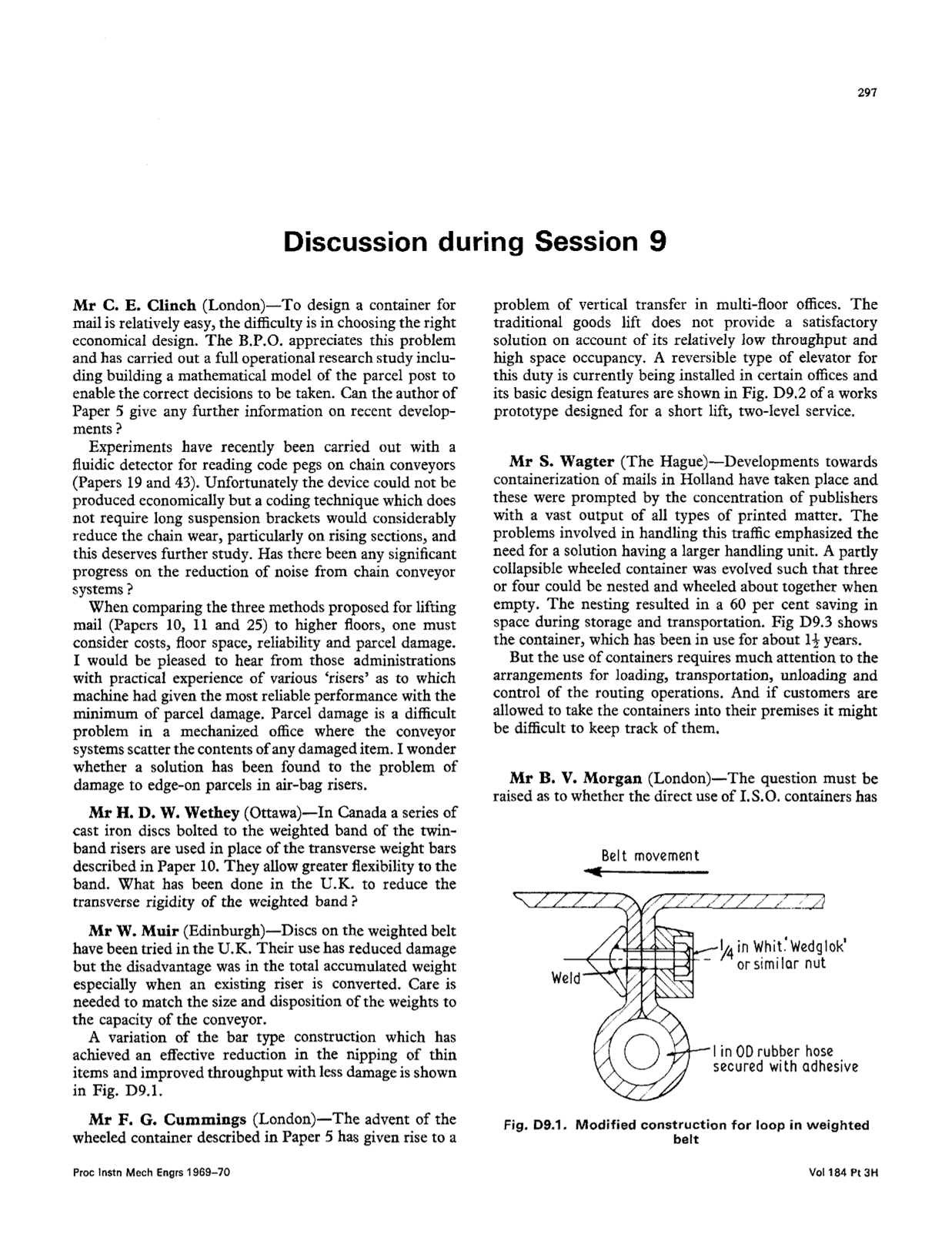
It is often necessary to convey and elevate objects of widely varying characteristics in a confined space with random load conditions. The twin-band rising conveyor is essentially a steeply inclined belt conveyor which carries and controls articles on inclines of up to 60°. In order to control satisfactorily articles handled on such a conveyor, a continuous and weighted cover band, which is driven in synchronism with the conveyor belt, is employed. A horizontal toe band, which may be manually or automatically loaded, is used to aid efficient introduction to the articles between the carrying and weighted belts.
The need to elevate items of widely varying characteristics under random load conditions presents an unusual engineering problem. The riser described provides a means of handling packets, parcels, or mailbags in a vertical path. Two belts contained in a trunking are normally held in close contact with each other against the back plate by means of an air bag providing constant pressure but allowing rapid variation in volume. Articles are introduced between these two bands on the horizontal plane, enveloped by the belts, and carried positively into the heel of the trunking where, after transition into the vertical plane, the articles are conveyed to the point of discharge.
The paper commences with an explanation of the need for reliable bulk-mail elevators in multi-storey sorting offices; it continues with a brief description of the Langton riser. There follows an historical review of Post Office experience with such machines, including references to the first scale model, early operational experience, and the design changes subsequently introduced. Mention is then made of the improved reliability of the redesigned risers. In conclusion, brief descriptions are given of the steps being taken to overcome the remaining shortcomings.
The use of wheeled containers was originally proposed by the Post Office in 1962, for handling parcels between major centres with conventional Post Office road vehicles. Subsequent development has produced much improved interim designs suitable for transport by rail and by I.S.O. type containers as well as by road vehicles. Mechanical handling devices for containers and the problems associated with their development are reviewed. In 1967 a plan was formulated for the modernization of the parcels system including the replacement of mail bags by containers. It was decided to carry out a design study on a countrywide basis, with the intention, using a computor programme, of producing container designs capable of meeting all the requirements, including the bulk transport of letters by container. Progress of the study to date is described.
The paper will give particulars of methods of coding used in conjunction with overhead chain conveyors for selective discharge. An installation is then described for the sorting of mail bags from a storage area into numerous positions where discharge is effected into British Railway Universal Trolleys for transport by rail. After the final loading position, the destination code, which is indicated by a label attached to the mail bag, is keyed into an electronic memory, which in turn activates the selected discharge station at the appropriate time, thereby automatically releasing the bag directly into the appropriate trolley.
The paper describes the adaptation of industrial chain conveyors for the task of moving mail bags, consequent upon the development of a cheap and simple self-gripping carrier for use with such bags. Elements of system design which particularly affect the mail-handling application are surveyed, together with environmental, safety, and economic considerations. Comparison is made of the relative merits of chain and belt conveyors, the latter being the only other broadly applicable alternative. An indication is given of possible lines of future development in the field of chain conveyors. The paper includes an appendix which outlines an empirical method for estimating tractive resistance and driving power requirements.

The organization and progress of a project team's planning of a large mechanized sorting office is explained step-by-step from the early analysis of traffic statistics indicating the need for a new office, through site purchase, building design, and preparation of mechanization layout drawings and associated specifications to the selection of contractors suitable for tendering for the installation work. The various separate and joint responsibilities of the engineering and operational elements of the project team are delineated.
The paper outlines the basic problems, and describes how several features, such as available site, form of building, traffic content, and complexity of plant layout, combine to affect the control and signalling design. Specific sectors of the flow of mail through the mechanical handling plant and sorting machines are examined and examples given of the latest techniques adopted. Some aspects of the essential engineering and operational and signalling controls are also described, with reference to recent installations.
The paper covers primarily the period between the placing of a contract for postal engineering plant and the introduction of this plant into live service following acceptance testing and ‘confidence’ trials. There is, in addition, some reference to the immediate post-commissioning period. The procedures described relate, in the main, to the traditional method of equipment and building provision whereby the two aspects are dealt with under separate auspices. However, reference is made to an alternative approach, known as a ‘package deal’, whereby building and mechanization are provided under a common contract.
This paper surveys the problems involved in the provision of a good working environment in mechanized sorting offices, particularly those problems, such as heat, noise, dust, and lighting, which stem from or are accentuated by the introduction of postal machinery. Current design standards and methods are outlined and estimates are made of the additional costs which can be attributed to mechanization. Possible ways of easing these problems in future generations of sorting offices are discussed.
The paper describes the general mechanization of this new office, which is adjacent to East Croydon railway station. The office was brought into operational use in mid-1969. The first part of the paper is concerned with the general mechanization features of the office and the method of operation. In the second part of the paper, details of the letter code sorting installation are given. An account follows of the procedures for commissioning this installation, and some of the problems encountered are discussed.
The building and equipping of the Birmingham new parcel and letter office is currently nearing completion. This is the most ambitious postal engineering project so far embarked upon by the British Post Office. It is a complex of mechanization equipment which, together with the associated control and signalling apparatus, will be accommodated over six floors of an imposing new building situated in the heart of the city of Birmingham. The paper does not attempt to describe the office in detail but, following a brief outline of the scheme, concentrates on those aspects of the installation which are novel in their application to postal engineering in the U.K.

The ‘state of the art’ in speech recognition is reviewed with particular reference to the kind of problems that are likely to arise in a parcel sorting environment. Speech recognition equipment developed by the authors is described. To justify a speech recognition equipment for parcel sorting it must be shown to increase productivity. Simulations relevant to voice control of parcel sorting have been carried out to try to assess what this improvement might be, and the results are discussed.
The paper describes the current position of a long-term research project for the sorting of mail by automatic reading of the postal codes. Of the four sub-problems, i.e. manipulation (of the envelopes), extraction (of the information), location (of the code), and recognition (of the code once located and extracted), the fourth alone is considered; in particular, attention is concentrated on machine-printed characters. It is necessary to describe the characters in terms of ‘features’, which will conceal differences in style but exaggerate differences in kind. This leads to the concept of a ‘three-layer’ machine, possessing quite remarkably brain-like qualities. The ideal feature list, conceived as a basic set of vectors in an abstract hyper space, has very interesting properties.
A possible system for obtaining television type images of normal typewritten characters is described in this paper. It is intended to use this system for the extraction of postal codes from envelopes. A flying spot scanner is controlled by a data processor in two phases. In the first the postal code is found and the height is estimated, and in the second the images of the separate characters are obtained. Corrections to the width, height, and position are made by altering the scan raster.