Research article
Select search scope: search across all journals or within the current journal

One of the hallmarks of a dexterous robotic hand is the ability to perform in-hand manipulation (i.e., without re-grasping). In the field of robotic hand design, however, there are competing interests between dexterity, simplicity, and reconfigurability. It can be difficult to achieve all of these objectives simultaneously. This paper presents the design of a simple underactuated grasper which uses a gimbal and parallelogram mechanism to achieve in-hand manipulation while maintaining grasp. The new grasper also integrates elements which make it reconfigurable or metamorphic, and is readily adapted for different types of robotic fingers. The design is validated with a physical prototype, and its performance related to in-hand manipulation is evaluated using multibody simulations, showing improved range of reorientation of grasped objects compared to a more standard fixed-palm underactuated finger design.
This paper proposes a concept of an extendable continuum robot arm having many moving plates along a flexible feed screw and deploying each of them at a certain contactable area. The mechanism aims to bear a practical working load by utilizing a bracing on surrounding walls. In general, a narrow and confined workspace of human labor is composed of many discontinuous areas instead. Therefore, the mechanism deploys intermediate plates at certain supportable areas, and pushes rest of plates forward. To bend the arm in such workspace, tendon-driving technique is employed. In this paper, a basic composition of the arm is proposed and its feasibility is demonstrated by using a planar prototype. Subsequently, a simple geometric calculation scheme to obtain a configuration of the arm to avoid two kinds of insufficient conditions, that result in the failure of the arm to bear neither the external load nor its own weight, is proposed. Achievability of the solution of the geometric calculation is then evaluated by a static simulation including feedback control loop, and several experimental results with a spatial prototype performed to demonstrate the feasibility of the proposed concept are finally presented and discussed.
Constant-force mechanisms can be used for gravity counterbalance and force regulation. While many constant-force mechanisms have been designed, most of them have a limited range of force adjustment, which brings very limited capability to maintain an equilibrium state when load changes. In this paper, a novel design of reconfigurable constant-force mechanism is proposed. The new design is inspired by a variable stiffness mechanism, which can work in a similar way as the hinged lever, but take a compact space. Moreover, the design allows to adjust the configuration parameters achieving a large range of the equilibrium state adjustment. Mathematical models are developed to simulate the equilibrium performance changed with configuration parameters. A prototype is constructed and validates the working principle of the design. A design case is included to show the application of the mechanism in a passive assistive upper-body exoskeleton.
The present paper considers workspace and performance analysis of a six degree-of-freedom hexapod-type parallel manipulator with a circular guide. Compared to other similar manipulators, the design of this one allows locating all the drives fixed on the base and avoiding collisions between the carriages. The first half of the paper focuses on a procedure to determine the constant orientation (translation) workspace. The study first considers all the constraints that can affect the working area: constraints in active and passive joints, leg interference, and singularities. Next, the paper discusses the numerical procedure to construct the workspace. The proposed innovative approach combines the features of conventional geometrical and discretization methods. The suggested techniques are implemented in a MATLAB package and verified by examples with various orientations of the mechanism output link. The paper also discusses the accuracy of developed methods and mentions the required computational efforts. The second half of the work analyzes manipulator performance by calculating the conditioning index over the workspaces obtained earlier. The paper evaluates the conditioning index for an ordinary Jacobian matrix and a normalized one. In the latter case, two normalization approaches are considered: using a characteristic length and using linear velocities of three points selected on the mechanism output link.
This paper focuses its attention on investigating the mechanical design and control aspects of a new autonomous mobile agricultural robot being developed for the purpose of automated harvesting of fruits in plantations. The paper goes from discussing the need of automated harvesting of fruits and the problems involved to conceptualizing the design of such a robot and ends with a brief discussion on the control aspects of the robot.
Inspired by the underactuated robotic hand mechanism and its feature of shape adaptive and compliant envelop grasping, the paper presents an underactuated symmetric pinch mechanism to solve the problem of pinch rollers idle and slipped or pinched too tightly. Pinch roll machine is a key device in the high-speed wire rod product line. It is usually designed with actuated symmetric pinch mechanism. The paper considered the pinching and conveying condition of linear objects and discussed the possibility of the underactuated symmetric pinch mechanism to be applied in the pinch roll machine for the first time. Three kinds of underactuated symmetric pinch mechanism solutions are presented. A displacement can be generated at the underactuated joint when the symmetric synchronous pinch action is implemented. The spring system can buff the instantaneous clamping force to reduce the dynamic impact of clamping force. Suitable design criteria are deduced from statics and kinematics analysis. In the process of pinching and conveying wire rods, the contact force is required to be kept at a constant value when the size of wire rods changes. Thus, it can protect the rod from being damaged while pinching and conveying and it can avoid the fatigue damage caused by excessive pinching impact force. Then, the pinching and conveying conditions of four different kinds of variable diameter wire rods are analyzed through 3D modeling and motion simulation experiments. Simulation results show that the proposed underactuated pinching and conveying mechanism can satisfy shape adaptive pinching and conveying irregular long-shaped wire rods. The research method is novel and feasible. The design result will be beneficial to improve the service life of the pinch roll machine.
In robotics, the variable stiffness joints have been developed as an alternative to include flexibility to a rigid mechanism. Variable Stiffness Joint (VSJ) allows for varying the stiffness in a mechanism during the performance of a trajectory. The development of this joint has increased, and various applications have emerged, most to improve human-robot interaction. This paper presents a VSJ based on the principle of antagonistic springs with a set of gears and racks that allow the extension or compression of the springs. The joint provides constant torque or variable torque to obtain a constant or variable force at the output of the link, so a relationship is between the torque provided by the spring’s effort and the output force; however, it is possible to achieve a desired variable force with this joint design. Simulations are realized to obtain the behavior for both a constant and a variable force.
The paper shows an appropriate unitary study of a novel geared planar parallel manipulator with the structure 3-R (
This paper proposes a design process based on the aspects of structure, configuration, and function. A mechatronic integrated design combining a switched reluctance motor with a planetary gear train (PGT) reducer is developed systematically. First, feasible design concepts are generated from the identified design requirements and constraints by considering existing SRMs and PGT reducers. The integration elements are selected to fit the design requirements. Then, detailed design and analysis are performed regarding the performance of the PGTS as well as the electromagnetic characteristics and output performance of the motor. In addition, the Taguchi method is employed to identify the optimal electrical parameters and geometric configuration of the motor. Finally, the output characteristics of the integrated device and existing design are compared. The integrated design has a 12.94% higher average torque, 40.74% lower torque ripple, and 9.10% smaller axial space.
Dynamics of an aerodynamic double pendulum coupled with a linear generator is considered. A cubic nonlinear spiral spring is installed in the first joint of the pendulum. Numerical simulation of the behavior of the pendulum is performed. It is shown that it is possible to choose parameters in such a way as to ensure the instability of the equilibrium and the existence of limit cycle oscillations. Such oscillations are required for the system to be capable of wind power harvesting. The influence of characteristics of the joint spring upon the amplitude and frequency of the cycles is analyzed. In particular, it is shown that the amplitude non-monotonically depends on the parameter characterizing the cubic nonlinearity of the stiffness. In the same time, frequency monotonically increases as this parameter increases. The influence of the system parameters upon the output power is estimated.
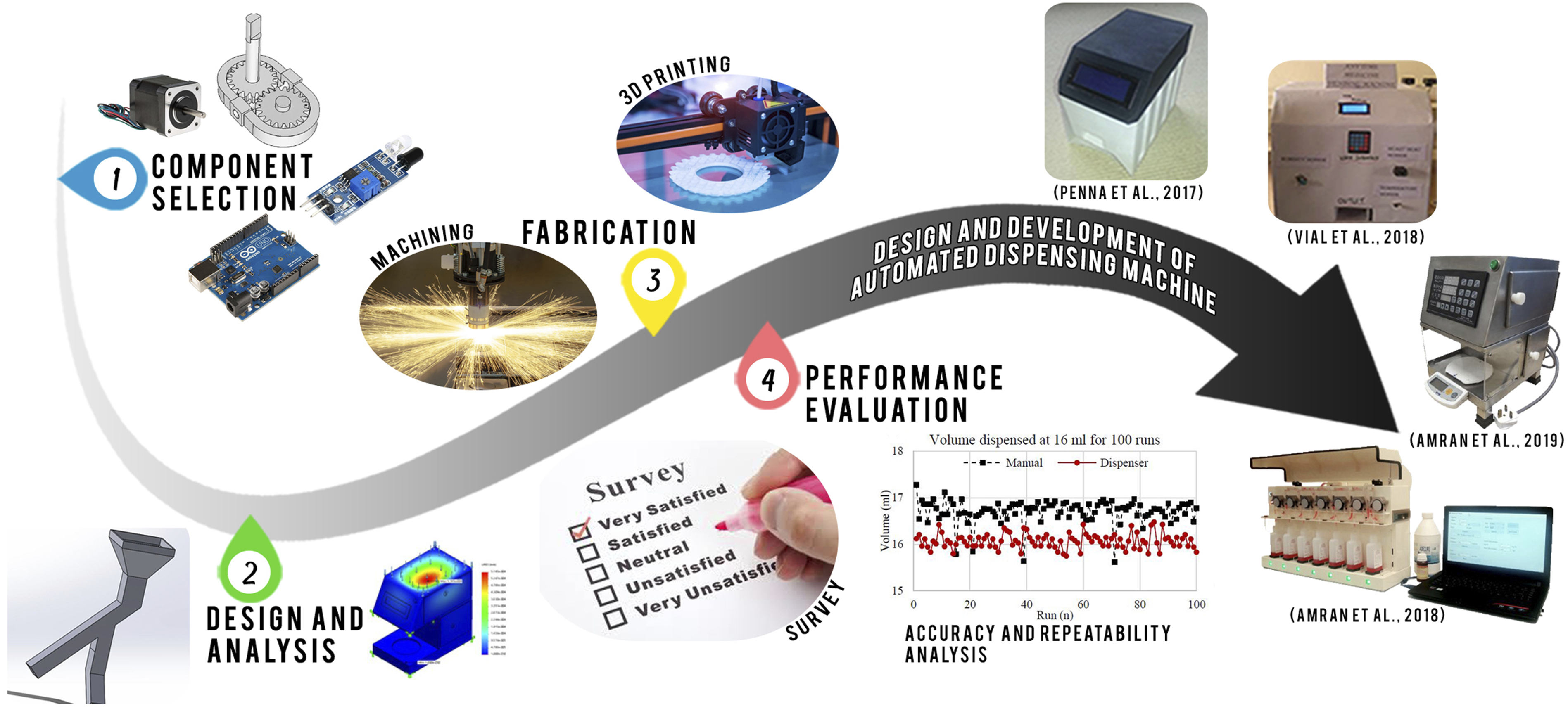
An automatic system in equipment can be recognized as a systematic control system to minimize human tasks or automatically complete repetitive tasks without human involvement. This review paper focused on the dispensing machines in the medical field particularly the design development of the automated dispensing machines which can be considered as one of the important technologies in pharmacy. This paper also briefly describes the main criteria for fabricating the dispensing machine. Next, different fabrication methods of the dispensing machine such as simple fabrication and 3D printing as well as the materials used in 3D printing are also thoroughly discussed. The last section consisted of the evaluation methods to justify the developed devices by comparing the performance of fabricated products and also through surveys and feedback from patients and medical staff. Based on the performance evaluation of automated dispensing machines as reported in the literature, it can be concluded that the implementation of an automated dispensing machine is necessary for the high-quality guarantee of community healthcare.
The interest of industrial companies for the Additive Manufacturing (AM) technology is growing year after year due to its capability of producing components with complex shapes that fit industrial engineering necessities better than traditionally manufactured parts. However, conventional Computer-Aided Design (CAD) software are often limited for the design and representation of complex geometries, especially when dealing with lattice structures: these are bio-inspired structures composed of repeated small elements, called struts, which are combined to shape a unit cell that is repeated across a domain. This design method generates a lightweight but stiff component. The scope of this work is to analyse the problem of the lattice structures representation in 2 D technical drawings and propose some contributions to support the development of Standards for their 2 D representation. This work is focused on the proposal of rules useful to represent such hierarchic structures. Python language and the open-source software FreeCad™ are used as a software platform to evaluate the suitability and usability of the proposed representation standard. This is based on simplified symbols to describe complex lattice structures instead of representing all the elements which constitute the lattice. The standard is thought to be used in technical 2 D drawings where assemblies are represented and lattice components are used (e.g. parts assembly, maintenance, parts catalogues). A case study is included to describe how the proposed standard could be integrated into a 2 D assembly drawing, following technical product documentation production typical workflow.
Service life of a star-wheel directly affects operation stability of a single screw expander. In addition, since star-wheel tooth of a single screw expander is prone to wear, circumferential force of the star-wheel rotor is investigated in this paper. Geometric gap models between the meshing pair with a single line envelope profile at different rotation angles are established and meshed section pressure fields and velocity fields of a referent tooth flank are simulated. Circumferential gas torque calculation model of a referent tooth and multi-tooth are established, and torque influencing factors are analyzed. Results indicate that the pressure difference between the expansion cavity and low-pressure cavity as well as gap geometry shape have a significant influence on the pressure field and velocity field. Both gas forces that act on the meshed section and the unmeshed section of the tooth have significant effects on the circumferential torque. Due to multi-tooth coupling, total gas torque periodically changes with the star-wheel rotation angle. Moreover, the negative values indicate that the gas torque on the left side of the star-wheel is greater than that on the right side. Unbalanced gas torque can cause star-wheel teeth deviation towards the side with less force. This consequently results in wear increase.
In aero-engines applications, nozzle geometric parameters have major effects on the lubricating oil to accurately reach target gears or bearings. To investigate the deviation phenomenon of oil jet flow in the lubrication system, the computational fluid dynamics (CFD) technique integrating with the volume of fluid (VOF) method and SST
Additive manufacturing comprises layer-by-layer construction of 3D parts using computer controls. This present-day study reveals a list of novel concepts for additive manufacturing, where the addition of material is achieved in solid-state. Materials joined by solid-state techniques exhibits properties beyond those exhibited by material joined by conventional techniques. This has been investigated in both theoretical and experimental manner in length. However, with the development of additive manufacturing techniques, a wide range of possibilities for fabricating complex structures have been identified, which can never be accomplished by conventional techniques. Research on metal-based additive manufacturing has been comparatively less as these products deprive lateral and transverse strength and have issues of anisotropy, making them unfit for structural applications. Moreover, these techniques are not cost-effective. So to overcome these issues, methods incorporating friction into additive manufacturing have been developed. These solid-state techniques use the principle of layer-by-layer deposition. Most of these techniques utilize the principle of selective deposition of materials to form the desired material layer. In this literature review, different advances, approaches, features, and principles of friction-based material joining techniques alongside additive manufacturing are discussed in detail, which recommends new openings for researchers to work in interdisciplinary research to fabricate structures that can exhibit unique properties. This literature portrays an extensive account of the contemporary methods in the fabrication of structures using friction-based additive manufacturing techniques and highlights areas that are worth further research and necessitate a consistent effort on account of the aforementioned disciplines to advance the modernistic technique. Initially, a brief review of different solid-state additive manufacturing techniques is presented, followed by a comprehensive summary of friction stir-based additive manufacturing techniques such as friction assisted seam welding (FASW), additive friction stir (AFS) process, and friction stir additive manufacturing (FSAM) process.
Aluminum-based metal matrix composites are extensively used in applications in many industrial fields, especially in the aviation and automotive industry. The usage rate is increasing day by day. Therefore, it is very important to improve the mechanical properties of the composite structure. For this purpose, in this study, 3, 5, and 7 wt.% tungsten carbide (WC) reinforced aluminum matrix composite material was produced by stir casting method. The mechanical properties (tensile strength, hardness, wear) of the produced composite materials and their effect on machinability were investigated. The machinability process was performed in constant cutting speed, constant cutting depth, three different feed rates (0.05, 0.1, and 0.2 mm·rev−1), and dry environmental conditions. Wear tests were performed on dry sliding conditions, under 25 N load, covering different distances (150, 300, 450, and 600 m). In addition, the microstructure of the composite samples was analyzed using optical microscopy and scanning electron microscope. The phases in the composite material were determined using the X-ray diffraction technique. As a result of the experiments, with the addition of WC particles, the mechanical properties of the materials such as tensile strength, hardness, and wear resistance have increased and the machinability capability has decreased.
Compliant mechanisms with stiffness variation are required in engineering applications. But most studies in the field of compliant mechanisms have only focused on a mechanism with a single stiffness. This paper presents a design method of compliant mechanisms with multi-level stiffness variation using internal self-contact between rigid parts. The contact changes the reconfigurations of compliant mechanisms to vary their stiffness for a specific motion range. We avoid the need for an external control to achieve piecewise stiffness variation. We derived the general design guideline by which the desired multiple stiffness and motion ranges can be acquired through rational design of the structural parameter. To illustrate the effectiveness of the design idea, we fabricated proof-of-concept prototypes for experimental investigations, and the experimental results demonstrated that the designed compliant mechanism has a multiple-motion range corresponding to different stiffness. The design ideas can also be extended to the multi-axis spatial compliant mechanisms. This design idea enriches the theory and application of compliant mechanisms.
In this study, a general mathematical model for defining the gear tooth profile and its geometrical aspects that meet a desirable sliding contact during the meshing cycle is built. This model is based on the path of contact shape predefinition. In the contact path, a straight-line segment through the pitch point and a universal transition curve for the other segments are combined to create a free-form tooth profile with desired radius of curvature in the designed gear. The maximum pressure angle during the meshing cycle and the involute curve length parameter are only introduced to characterize this model. The designed gear in this study is given the title “free-form-gear” since it provided a universal manner of establishing the path of contact that provides desirable sliding conditions during the meshing cycle. The proposed tooth form, interference condition, contact ratio, contact stress, sliding coefficient, and meshing efficiency are derived and investigated in this study. The fillet stress and torsional mesh stiffness of the proposed gear pair are obtained using the finite element method (FEM). The performance of the new gear is compared to that of the standard involute and non-involute gear types. The results indicated that the method proposed in this study can be utilized to construct a gear pair with higher surface durability and strength than typical involute gear of the same size.