Surface severe plastic deformation is an important technology for the preparation of bulk ultrafine grain or even nanocrystalline materials. Based on the technical achievements made in the field of surface severe plastic deformation at home and abroad, this article presents the basic principles of various kinds of surface severe plastic deformation techniques in detail. In addition, the effects of surface severe plastic deformation on the microstructure and mechanical properties of steel and stainless steel are reported. The current status of research on the effects of surface severe plastic deformation on fatigue properties and the tribological and biological properties of steel and stainless steel are summarized. The problems of the current surface severe plastic deformation technology for steel and stainless steel are pointed out, and the future development trend is foreseen.
Research article
Restricted accessResearch articleFirst published March, 2024pp. 416-429
Mehdi Hashemi, Omid HatamiORCID, Mohammad Reza TajbakhshORCID
Abstract
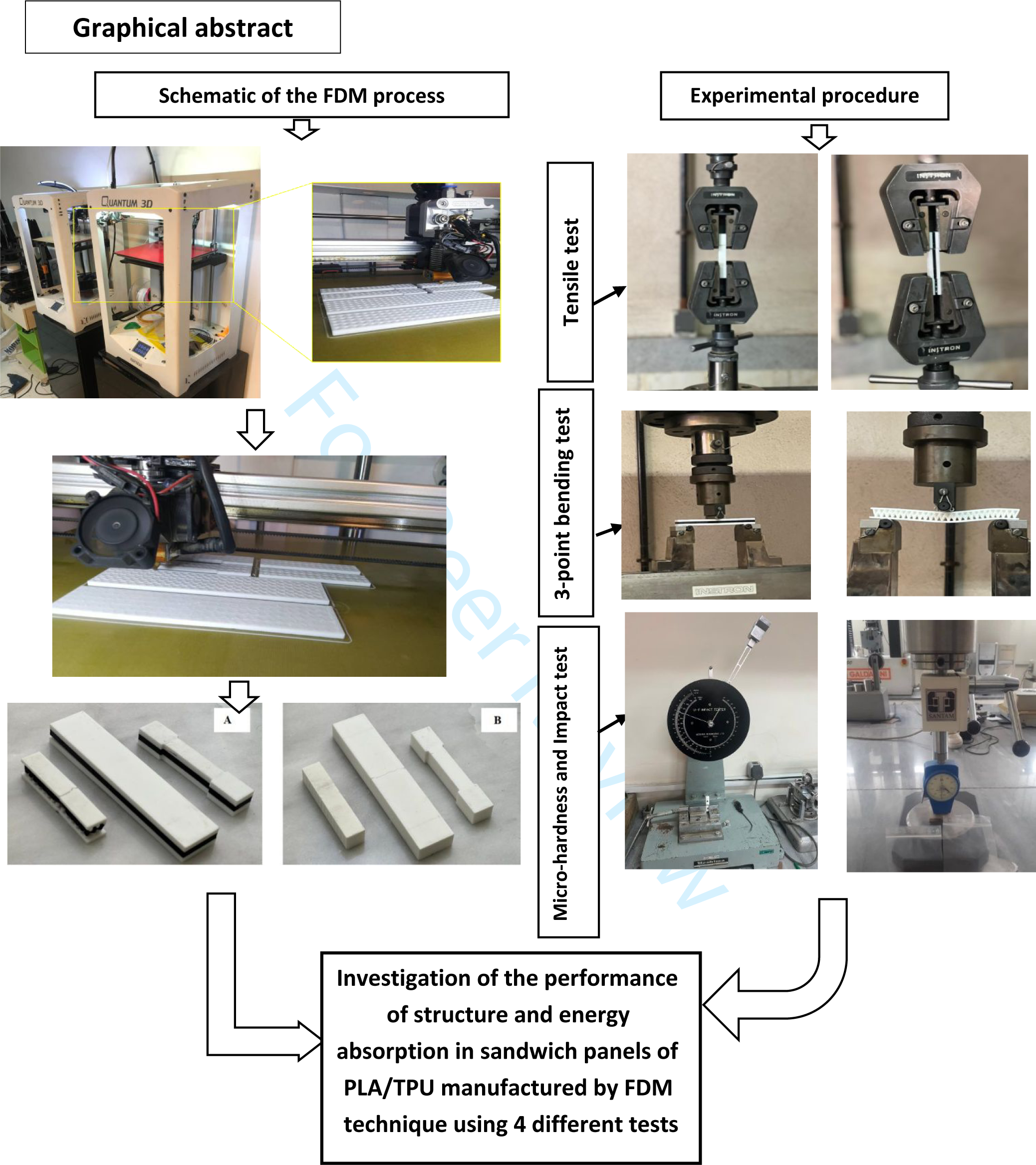
Sandwich structures are often used in the automotive, marine, aerospace, and many other industrial sectors due to their desirable performance properties, energy absorption, and ability to reduce the weight of parts. Multilayer composite materials also provide various design possibilities, making it simple for producers to fabricate intricate parts. One of the most popular additive manufacturing technologies for producing complicated objects is fused filament fabrication (FFF). In this study, sandwich samples with a dual-core of polylactic acid (PLA) and thermoplastic polyurethane (TPU) were fabricated by FFF technique in three different configurations, including cylindrical, honeycomb, and tetrahedral truss cells. Their properties were determined and investigated through tensile, three-point bending, Izod impact, microhardness tests, and scanning electron microscopy. The results were compared with samples manufactured with monolithic PLA. The results demonstrated that sandwich structures with TPU cores had a high-energy absorption capability. In comparison to monolithic PLA samples, these materials’ ultimate elongation and impact strength were dramatically enhanced. However, TPU cores had lower flexural and tensile strengths than samples with PLA cores. The structure's shape significantly influences both its strength and energy absorption characteristics. Firstly, tetrahedral truss core samples revealed that the samples’ elongation climbed considerably and exceeded three times with the deposition of TPU as the inner core compared to monolithic PLA. Last but not least, in flexural testing, sandwich panels with honeycomb manufactured of PLA/TPU showed the ultimate strain unit to be about 0.08, twice as much as samples made of monolithic PLA. The lowest impact resistance and the amount of energy absorbed before collapsing were demonstrated by monolithic PLA with a honeycomb inner core. Regarding energy absorption, dual sandwich panels with PLA/TPU, including cylindrical and tetrahedral truss cores, showed the best results.
This is a visual representation of the abstract.
Research article
Restricted accessResearch articleFirst published March, 2024pp. 430-445
The effect of current density on the microstructure and mechanical properties of cast ADC12 recycled aluminum has here been investigated by using a pulsed electric field and a self-developed high-power pulsed device. The results showed that the pulsed electric field could refine the microstructure of cast ADC12 recycled aluminum alloy and enhance its frictional properties. As a result of the pulsed electric field treatment, the eutectic Si phase changed from long rod-like (or platelet-like) to short rod-like (or fiber-like) and was aggregated and distributed around the α-Al phase. Also, the long needle-like β-Fe phase changed to short needle-like, and the number of round spherical β-Fe phases decreased and changed to small-sized spherical. For a current density of 13.636 A/mm2, the average area of the α-Al phase decreased by 10% (as compared with the original sample). Also, the average area of the eutectic Si phase and β-Fe phase decreased by 8% and 86%, respectively. In addition, the average length decreased by 36%, and the refinement effect was the best. Furthermore, the deep etching analysis showed that the three-dimensional morphology of each phase was significantly refined. The current density was 13.636 A/mm2 and the friction coefficient decreased by 17.8%, as compared with the original sample. Also, the Rockwell hardness and yield strength became significantly increased. In addition, there was an obvious wear surface refinement, the alloy wear surface became smoother, the area of spalling pits was smaller, and the furrow parallel to the friction direction was both shallower and smaller. The size of the plastic shear lip, as accumulated on both sides of the furrow, was smaller, and the wear degree of the alloy surface was greatly reduced.
Research article
Restricted accessResearch articleFirst published March, 2024pp. 446-463
Sean Jenson, Muhammad AliORCID, Bhaven Naik , [...]
View All
Abstract
Roadside barriers are often deployed to prevent vehicles from colliding with roadside obstacles or hazards and from leaving the road surface. These barriers primarily take the form of guardrails or crash cushions and are designed to absorb energy through severe plastic deformation. Due to the severity of these types of collisions, the energy-absorbing mechanisms can fail resulting in the barrier becoming a hazard. To address this issue, a (US Patented) multi-chambered, smart fluid-filled barrier technology (SFFBT) was proposed as a potential replacement for such roadside barriers. This new patented technology utilizes fluid transport between the internal chambers and viscous dissipation as an additional energy-absorbing mechanism to help reduce the effects the severe deformation imparts on the colliding vehicle and its occupants. Numerical models were developed in ABAQUS dynamic explicit environment, and full-scale experimental testing was conducted at the Midwest Roadside Safety Facility of the University of Nebraska—Lincoln. Three barrier configurations were considered for this study with two different fluid levels resulting in six unique test samples. The three test configurations were (a) free-standing, (b) abutted against a rigid backstop, and (c) anchored. Fluid levels chosen were 25% and 33% filled volume. The results show that the proposed designs and fluid addition provided an increase in energy absorption while decreasing overall deformation stroke by up to 5%. Additionally, kinetic energy reduction increased by 15% with a nearly 140% increase in fluid energy dissipation. The best-performing configurations were the rigid backstop cases, followed by anchored and free-standing configurations. The effects of varying anchoring schemes provide additional performance evaluations for maximizing the energy-absorbing performance of the SFFBT system for use as an impact attenuator.
Research article
Restricted accessResearch articleFirst published March, 2024pp. 464-474
High carbon stainless steel 347H (SS347H) and Inconel 625 (IN625) are high-strength alloys, commonly used in high-temperature applications. These metals are commonly used in the fabrication of concentrated solar power energy storage tanks and pipelines. Construction of such tanks involves dissimilar welding as the primary manufacturing process. The critical factor to consider when joining two different materials is the development of microstructure, as it directly impacts the mechanical characteristics of the joints. According to the available literature, an increase in the heat input (HI) promotes alloying element segregation and susceptibility to weld cracking. Traditional arc welding processes, such as metal inert gas (MIG) welding, produce a higher HI. Therefore, there is a need to develop welding techniques that result in reduced HI. In the present study, a pulse-current MIG (PC-MIG) welding method was employed, utilizing current pulsing to minimize HI during the welding process. The welding was followed by metallographic and mechanical characterization. The microstructural examination found variations in microstructure at different regions. Electron backscatter diffraction analysis shows the crystallographic orientation at different regions. Analysis shows that both SS347H and IN625 have a face-centred cubic austenite structure. The inverse pole figure discloses strong texture formation. The average tensile strength of dissimilar weldments was found to be 479 MPa, while the average hardness value of the fusion zone was measured to be 235 HV. The research indicates that the PC-MIG technique is suitable for joining dissimilar materials with reduced HI, effectively eliminating the risk of cracking and enhancing the efficiency of the joint.
This is a visual representation of the abstract.
Research article
Restricted accessResearch articleFirst published March, 2024pp. 475-480
The current research assesses various joining techniques such as an adhesive bond, direct three-dimensional printing, and ultrasonic welding for dissimilar three-dimensional printed thermoplastics such as polylactic acid and wood-reinforced polylactic acid biocomposite. This study is the first of its kind to determine an effective technique for joining three-dimensional printed polylactic acid/wood-polylactic acid profiles. Mechanical responses such as lap shear strength and shore D hardness of the various joints are investigated and compared experimentally. The results highlight that 15%–17% higher shear strength can be obtained for ultrasonically welded joints compared with direct three-dimensional printing of polylactic acid and wood polylactic acid lap joints. The macroscopic investigation of the ultrasonic welded polymeric joint exhibits a good level of melting of polymers and wetting in the interface. This results in an inter-molecular diffusion of polymeric chains and entanglement of polymers under respective conditions.
Research article
Restricted accessResearch articleFirst published March, 2024pp. 481-492
Hemant KumarORCID, Rismaya Kumar MishraORCID, Ghulam Ashraf Ul Harmain
Abstract
The selection of tribopairs, including mating materials, plays a crucial role in controlling material loss under rubbing conditions. In a fast breeder nuclear reactor, almost all moving components have been provided with a hardfaced coating at the mating surfaces for their longer life. Though, in most cases, the hardfaced surfaces come into contact with the components having the same coating; in some instances, they are allowed to rub against other materials. In the present investigations, an effort was made to study the wear behaviour of a Ni-based hardfaced coating made on 316LN stainless steel under similar and dissimilar mating conditions. Prior to wear tests, a defect-free hardface coating of Ni-based hardfacing alloy was made on 316LN stainless steel using plasma transferred arc welding process and subsequently characterized for its microstructure and hardness. Wear tests under dry sliding conditions were carried out at ambient temperature. The specific wear rate for dissimilar mating conditions was found to be one order of magnitude higher than the same rate obtained from similar mating conditions. Moreover, adhesive wear was the dominant wear mechanism in both mating conditions. It is clear from the study that similar material combinations should be given preference in the design of tribopairs instead of dissimilar material combinations to avoid significantly higher material losses for materials with lower hardness. The reported results will provide insight for carefully designing the tribopairs for critical applications.
Research article
Restricted accessResearch articleFirst published March, 2024pp. 493-503
Recently, the demand for natural fiber based composite products as compared to synthetic fiber based products has increased manifold due to their salient characteristics, such as biodegradability, non-toxicity, and sustainability. Hole-making is an inevitable operation to ascertain the structural integrity of complex composite products. Thus, a comparative assessment has been reported between the molded and drilled holes in two types of composites, that is, aloe vera fiber and banana fiber based epoxy composites. The performance of fabricated composites was compared based on load bearing capacity under tensile loading conditions. The molded hole specimens recorded 10.7% (aloe vera based) and 17.2% (banana fiber based) higher failure load as compared to the drilled hole specimens of similar type of composites. The aloe vera fiber based composite specimens, such as, specimens without hole, molded hole, and drilled hole, recorded higher failure load (102%, 45.6%, and 54.1%, respectively) as compared to banana fiber based composites. The quality of molded and drilled holes (before and after fracture) was also assessed using stereomicroscope and field emission scanning electron microscopy images. The microstructural assessment helped to correlate the variation in the mechanical properties of tested specimens with the quality of the holes produced. This study also revealed that the molded hole specimens have better hole quality than the drilled hole specimens in case of both types of composites. The defects like sharp edges, burrs, cracks, and uncut fibers were found to be absent in case of molded hole specimens. Whereas, these defects create the stress concentration zone in drilled hole specimens which is responsible for their lower strength values.
Research article
Restricted accessResearch articleFirst published March, 2024pp. 504-513
The demand for weight reduction, cost savings, more fuel efficiency, and reduced greenhouse gas has led to the increasing application of tailor welded blanks (TWBs) in the automotive industry. The purpose of this study is to investigate the strain rate effect on the tensile behavior of TWB consisting of dissimilar thickness sheets. Hence, a fiber laser was used for welding St14 steel sheets. The weld zone was examined using metallographic and microhardness tests. For investigating the tensile properties, uniaxial tensile tests were performed at strain rates ranging from 0.001 to 10 s−1. It has been found that the presence of Bainitic microstructure in the weld zone increases its hardness. Tensile test results indicate that yield strength and ultimate tensile strength of base metals and TWB enhanced with increasing strain rate. The yield and ultimate tensile strength of TWB are higher than base metals at different strain rates. As the strain rate increases, the total elongation of the TWB decreases, but in base metals, it decreases first and then increases at higher strain rates. In TWB and base metals, by increasing strain rate, uniform elongation decreases, but post-uniform elongation increases. For analysis of plastic deformation of thick and thin parts of TWB, indexes of limiting thickness ratio and difference of ratios (DR) were used. DR decreases with increasing strain rate, which indicates a decrease in the plastic deformation of the thick part of TWB and is consistent with the experimental findings.
Research article
Restricted accessResearch articleFirst published March, 2024pp. 514-533
This work derives the theoretical prediction of the impact behaviour of single thin-walled prismatic columns with various cross-sections based on an improved extensional collapse element. The extensional crushing mechanics were reviewed and improved to calculate the impact crushing characteristics of any single thin-walled prismatic columns: that is, square, hexagonal, octagonal and circular columns. The general equations to predict the mean crushing force and axial instantaneous crushing force of the single thin-walled prismatic versus the folding angle or axial displacement were derived theoretically. Furthermore, using the extensional collapse mode, the maximum (peak) crushing force was theoretically predicted during the first folding process. Lastly, the impact of the columns obtained by the improved theoretical solution was compared via numerical simulation.
Research article
Restricted accessResearch articleFirst published March, 2024pp. 534-541
In the present research endeavor, the waste shells of pistachio and walnut have been used in the form of fillers to develop hybrid flax epoxy composites. The effect of hybridization on the developed composites was studied in terms of thermal, mechanical, and morphological properties. The properties like tensile strength, tensile modulus, flexural strength, flexural modulus, impact strength, and shore hardness were evaluated to ascertain the mechanical behavior. The thermogravimetric analysis of the composites was also performed in order to determine the thermal stability of the developed composites. The results revealed that pistachio shell filler-based flax/epoxy composites showed improved tensile strength and tensile modulus by over 73.26% and 42.53% in comparison to the control specimen. The walnut shell filler-based flax/epoxy composites also exhibited improved tensile strength and tensile modulus by 66.41% and 17.1% compared to the control specimen. Whereas, the hybrid filler-based flax/epoxy composites were found to be thermally more stable. The fractography of the developed composites was also studied using scanning electron microscope which revealed good filler distribution in the epoxy matrix.
Research article
Restricted accessResearch articleFirst published March, 2024pp. 542-561
Raad Arif Mohammed, T.N. ChakherlouORCID, Mohammad Reza Khoshravan Azar
Abstract
Cold expansion of fastener holes is a recognized technique for enhancing the fatigue life of holed plates utilized in detachable joints. This method involves introducing compressive residual stress around the holes, which has proven to be effective in improving the structural integrity and longevity of such components. In this research, the role of using different plasticity models in finite-element simulations of cold expansion (CE) in determining residual stress distribution and predicting the fatigue life of lap joints was investigated. Finite-element simulations were conducted to analyze the distribution of residual stress in cold-expanded Al-alloy 2024-T3 plates utilized in double-shear lap joints. Three time-independent plasticity models, specifically multilinear kinematic hardening, multilinear isotropic hardening (M.L.I.H) based on monotonic tensile tests, and nonlinear combined hardening models derived from saturated hysteresis stress and strain loops, were employed in the simulations. These models allowed for an accurate determination of the residual stress distribution in the plates. In finite-element simulations, two CE sizes of 1.5% and 4.7% were employed to create residual stresses. In the simulations, after creating residual stress by CE, remote sinusoidal loads are applied to the joints corresponding to the previously conducted fatigue tests in order to obtain stress and mechanical strain distributions. In order to predict the fatigue life, four different multiaxial fatigue criteria (Smith–Watson–Topper, Glinka, Kandil–Brown–Miller, and Fatemi–Socie) were employed, using the stress and strain distributions obtained from the finite element simulations with the different plasticity models. The simulations yielded varying stress and strain distribution results for the multilinear kinematic and M.L.I.H models, while the results of the nonlinear combined hardening model fell between the other two models. Notably, the fatigue life prediction based on the nonlinear combined hardening plasticity model closely matched the experimentally observed fatigue lives, with an absolute percentage deviation of 24.8%.
Research article
Restricted accessResearch articleFirst published March, 2024pp. 578-591
Delamination is a critical concern in laminated composites, affecting their structural integrity and overall performance. This study investigates the enhancement of Mode-I and Mode-II fracture toughness in carbon fiber/epoxy (CF/EP) composites through the incorporation of 3D-printed polyamide (PA) interlayers. Vacuum-assisted resin transfer molding was utilized to fabricate composite laminates with and without 3D-printed PA interlayers. Comprehensive testing was conducted to assess the effect of 3D-printed PA interlayers on the Mode-I and Mode-II fracture toughness, interlaminar shear strength, and flexural properties, as well as thermomechanical response using dynamic mechanical analysis. The results revealed a significant improvement in critical energy release rates for both Mode-I and Mode-II (GIc and GIIc), increasing by 43.5% and 81.2% respectively, compared to the reference composites. This enhancement was primarily attributed to crack bridging and plastic deformation of PA filaments in the interlaminar region. Additionally, interlaminar shear strength increased by 17.4%. While the reference composites had a glass transition temperature of 117.3 °C, the PA-reinforced composites showed a slightly higher value at 119.6 °C, with no significant change in the glass transition temperature. tanδmax values increased from 0.321 to 0.576, suggesting better energy dissipation in PA-reinforced composites. However, flexural properties were adversely affected by the increased thickness and reduced fiber volume fraction due to the introduction of 3D-printed PA interlayers, with the flexural modulus decreasing by approximately 28% and the flexural strength by around 50%. These findings offer promising opportunities to enhance the performance of CF/EP composites under specific loading scenarios, thus expanding their potential applications across diverse industries.
Correction
Restricted accessCorrectionFirst published March, 2024pp. 592-592