Other
Select search scope: search across all journals or within the current journal


Limits and tolerances are the basis of all machine manufacture. Fourteen European countries adopted the system known as the ISA (International Federation of National Standards Associations) in December 1936; the system covers all grades of finish from the finest roller bearings to rough agricultural machines. Certain fixed principles of measurement must be observed, both in the manufacture of new machines and in the repair of old ones; for instance, extremely fine boring and grinding machines and jig borers are now obtainable and can be used equally for the manufacture of a new motor car or for the overhauling of an old one.
Before a satisfactory basis for the establishment of correct limits for the manufacture of, say, drilling machines, lathes, and milling machines, the deformations set up during the cutting operations must be known. These deformations must therefore be measured during actual cutting. The measuring apparatus as applied to lathes, drilling machines, and milling machines, though varying greatly in individual cases, can be adapted to this research, which furnishes information on the admissible variations in deformation—which is of use during inspection—and on the forces and bending and twisting moments—which is of use to the designer. These records furnish manufacturers with the information required for organizing the sequence of operations when building machines to work with any desired precision. The “balance sheets” of various machines, giving the relationships of the forces, speeds, feeds, section of chip, power required, and efficiency, are of great value both to manufacturer and user.


Since the presentation of the last paper on excavator practice to the Institution by F. H. Livens, M.I.Mech.E., and W. Barnes, M.I.Mech.E., in 1920,† a great many changes have taken place in both the application and design of excavating machinery. The application of this type of machinery has been dealt with on several occasions during the intervening years, and as recently as December 1934, Sir Henry Japp dealt very fully with “Modern Methods and Plant for Excavations” in a comprehensive paper read before the Institution of Civil Engineers.‡ This paper therefore deals more particularly with the progress in design of the excavator itself rather than its application.
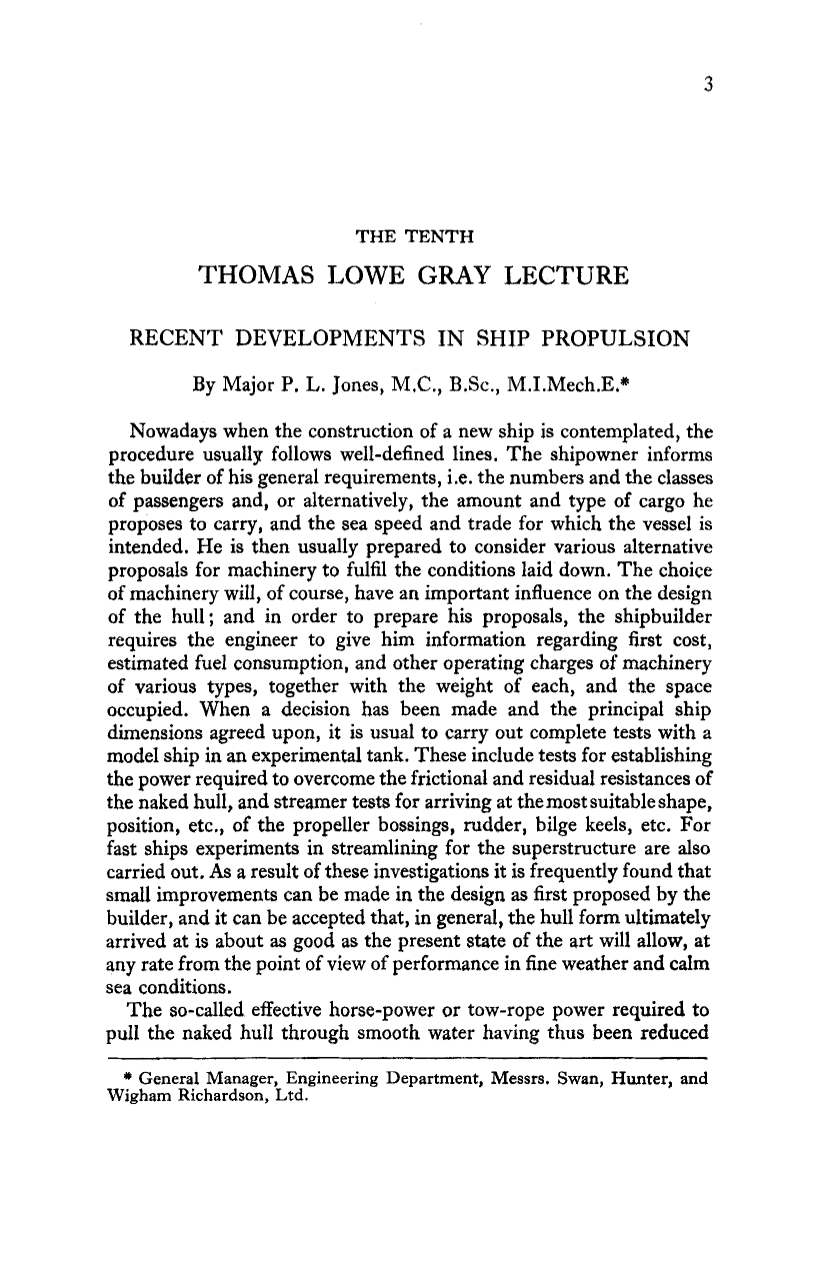
Attention may first be drawn to the extension of the range of sizes available in both directions. In 1920 machines carrying dippers of 6 cu. yards capacity and weighing about 250,000 lb. represented the upper limit in size, whilst machines carrying dippers of
cu. yard capacity were the smallest available. In 1937 machines having dipper capacities of as much as 33 cu. yards and weighing 2,500,000 lb., or as little as

cu. yard and weighing 15,000 lb., were manufactured.

A greater number of distinct types have also been developed. Twenty years ago types in common use were the shovel and the grab or clamshell. To-day, drag-line, drag-shovel, and skimmer-scoop equipments are largely used, and these have been developed to meet the growth of application of the single-bucket excavator, enabling it to do work for which it was originally unsuited.
In 1920 steam was practically the universal motive power, but this has given way to the internal combustion engine and electricity, and is now virtually obsolete for this purpose.

The paper describes experiments performed to determine the pressure distribution in a convergent-divergent steam nozzle of rectangular cross-section. By means of pressure tappings drilled along the axis, it was found that, in the course of its passage through the nozzle, initially superheated steam expanded continuously until condensation commenced, when a sharp rise of pressure (of the order of 1 lb. per sq. in.) occurred. Up to this point the observations were consistent with the predictions of Callendar's equation for the isentropic expansion of superheated and supersaturated steam: the friction loss was small as far as the throat of the nozzle, but in the divergent portion it was of appreciable magnitude.
The Wilson line was determined after allowances for the effects of friction had been made. The pressure rise was also investigated in detail and was found to be accompanied by a decrease of velocity and an increase of total heat. At the peak of the rise, where continuous expansion recommenced, the steam was probably not in thermal equilibrium.
Additional tappings were placed across the throat, where the pressure observations were in close agreement with the values demanded by Taylor's theory. This theory, which does not assume uniformity of conditions over cross-sections of the nozzle, is more accurate in the neighbourhood of the throat than the classical theory of Reynolds.
It is known that the “lift” of biplanes and triplanes per unit of wing surface is inferior to that of a monoplane, and that the degree of departure depends upon the gap-chord ratio. Published data indicate that the lift increases with increasing gap, apparently towards some limiting value. Regarding steam turbine wheels as rings of multiplanes, it may be asked, Is there any direct evidence that the torque on each blade is influenced by the presence of the other blades?.
Many experiments have been made to determine the optimum circumferential pitch for a given blade shape, but most of these have aimed simply at arriving empirically at the best efficiency, without inquiry into the factors involved. The experiments described in the paper were carried out with low-velocity reaction blading, and were aimed at eliminating as many factors as possible, so as to make a clear issue of the effect of spacing the runner blades closer or wider apart. These experiments indicated that the effect of circumferential spacing on maximum torque was fairly critical, and that from the optimum point the torque declined less rapidly with increasing spacing than with decreasing spacing.
The decline in torque with increasing spacing is due probably to lack of proper guidance of the steam, only a portion of which gives up energy to the runner blades, the remainder doing little useful work. On the other hand, the curve of force
The experiments are of interest on account of the above analysis and comparison, but no definite conclusion is possible without further investigation.

The past seven years have witnessed remarkable developments in aircraft. They have marked the advent, for example, of autogyros, cantilever monoplanes, landing flaps, variable-pitch airscrews, and retracting undercarriages. Equally apparent to engineers will have been the perfection of powerful and compact engines weighing little more than 1 lb. per h.p., the adoption of skin stressing and ducted cooling, the shrinkage of wing area until nearly twice as much load is carried per square foot, and the elimination of exposed struts, wires, levers, and rivet heads. Speeds have advanced greatly with little sacrifice in flying weight per brake horse-power or in useful load. Thus there has occurred a very notable increase in the efficiency of aircraft, exercising a profound influence on aerial transport. Many methods of construction, which have been especially devised to meet stringent conditions as regards economy in weight, should also find application in other high-class engineering productions. Again, the new knowledge of fluid motion and matters associated with it, constituting the engineering science of aerodynamics, must eventually prove of service in hydraulics, heat transfer, ventilation, and kindred subjects.
In the paper some of the main considerations affecting the efficiency of aircraft are described. Exhaustive discussion would form too comprehensive a subject, and it has been decided to consider especially those factors in which fluid motion plays a prominent part. Where possible, however, the treatment takes into account structural and other efficiencies attainable in given circumstances. The point of view adopted is that of civil transport, where efficiency is most urgent. Discussion will turn essentially on speed and, in justification, it may be remarked at once that (

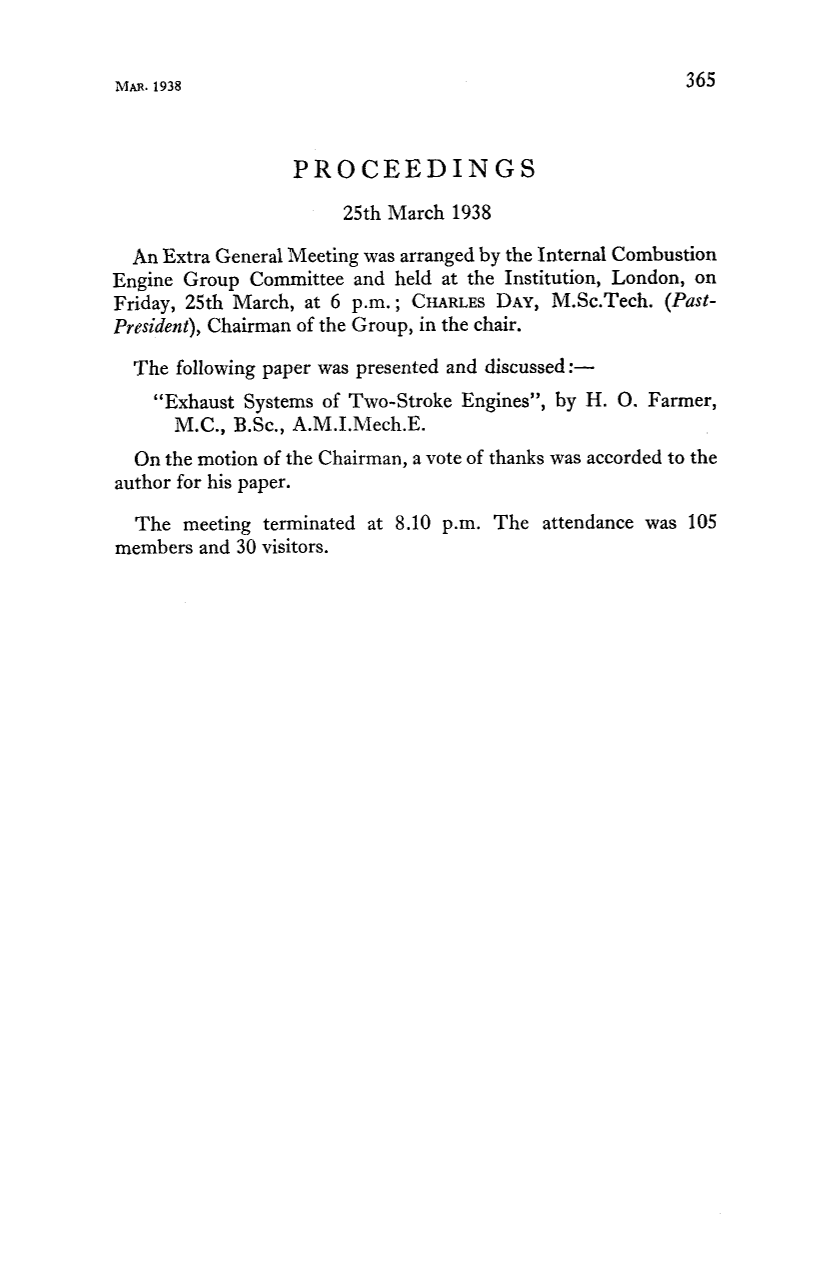
Crankcase-scavenge two-stroke engines have always been fitted with a large expansion chamber immediately outside the exhaust ports, but this is by no means essential, as such engines will operate very satisfactorily with a plain exhaust pipe. The length of this pipe is most important and has a controlling influence on the scavenging of the cylinder and the performance of the engine. Even when an expansion chamber is used in the exhaust system, the length of exhaust pipe still has a very marked effect on engine performance.
It has been found that certain arrangements of this combination of expansion chamber and pipes completely upset the performance of the engine, whilst others improve the performance, but it is possible to calculate the “equivalent length” of any system of this nature, and so arrange matters that the exhaust system is a help rather than a hindrance to the engine. Though certain results have not been satisfactorily explained, the tests carried out do give a fairly clear indication of the way in which the engine performance is affected by the variations in pressure in the exhaust system.
The concluding section gives a description of the principle on which the self-induction engine works, and indicates how use is made of the pressure variations or oscillations in the exhaust pipe to scavenge the engine cylinder, resulting in the complete elimination of the air pump on a two-stroke engine.

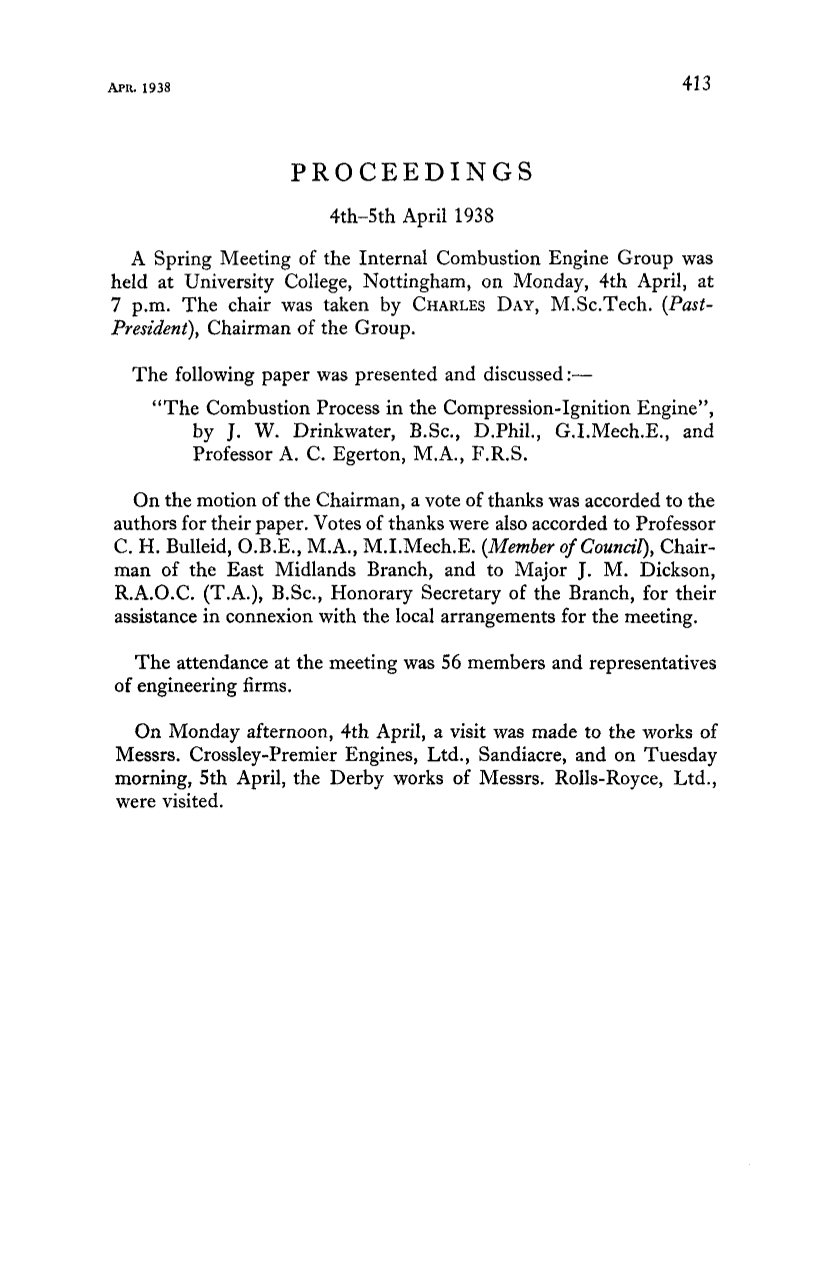
The object of the work, which was carried out in the University Engineering Laboratory, Oxford, was to investigate the combustion process in a compression-ignition engine by determining the extent of the chemical reactions of the fuel and air at various stages during the compression and expansion strokes. The results of the tests are illustrated by several curves showing the percentage volumes of the constituent gases in the engine cylinder at different points in the cycle.
Various inferences are drawn concerning the combustion in this type of engine. Attempts were made to determine the concentration of aldehydes in the gases, but the tests showed that the amount was less than anticipated. Oxides of nitrogen were detected, and considered to have an influence upon cylinder wall corrosion.
It is suggested that there is scope for further work using the sampling method for investigating combustion problems in engines under running conditions.