Research article
Select search scope: search across all journals or within the current journal


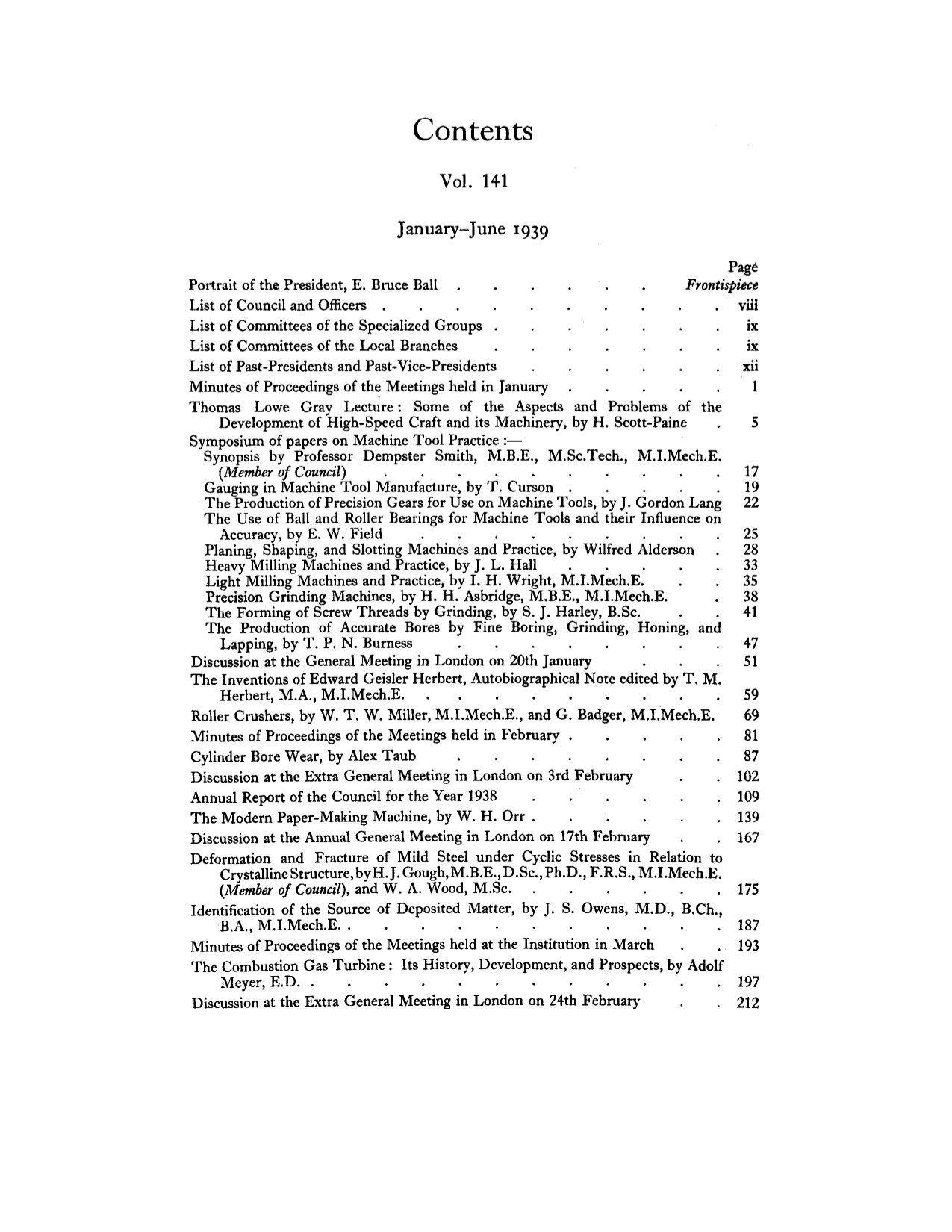
This autobiographical note was written by Edward Herbert a few years before his death, and gives an account of a lifetime devoted to research, mainly on the hardness and machinability of metals. Though taking an important part in the engineering business that bore his name, Herbert was essentially a research worker rather than a business man, and towards the close of his life he withdrew more and more into the laboratory which he had equipped at his home.
The present note emphasizes the continuity of Herbert's work. Thus his original automatic saw was converted into the first experimental file testing machine; the study of the cutting action of file teeth suggested the tool steel tester, the anomalous results of which led to the tool-work thermocouple and the “Pendulum” hardness tester. Then followed in logical sequence his work on critical work-hardening temperatures, the work-hardening capacity of hard steels, the “Cloudburst” process, the age-hardening of superhardened steel, periodic ageing fluctuations and the effects of magnetic treatments; and finally, the invention of the continuous hardness tester and the scanning of diamond scratches as a means of recording fluctuations in hardness due to ageing.
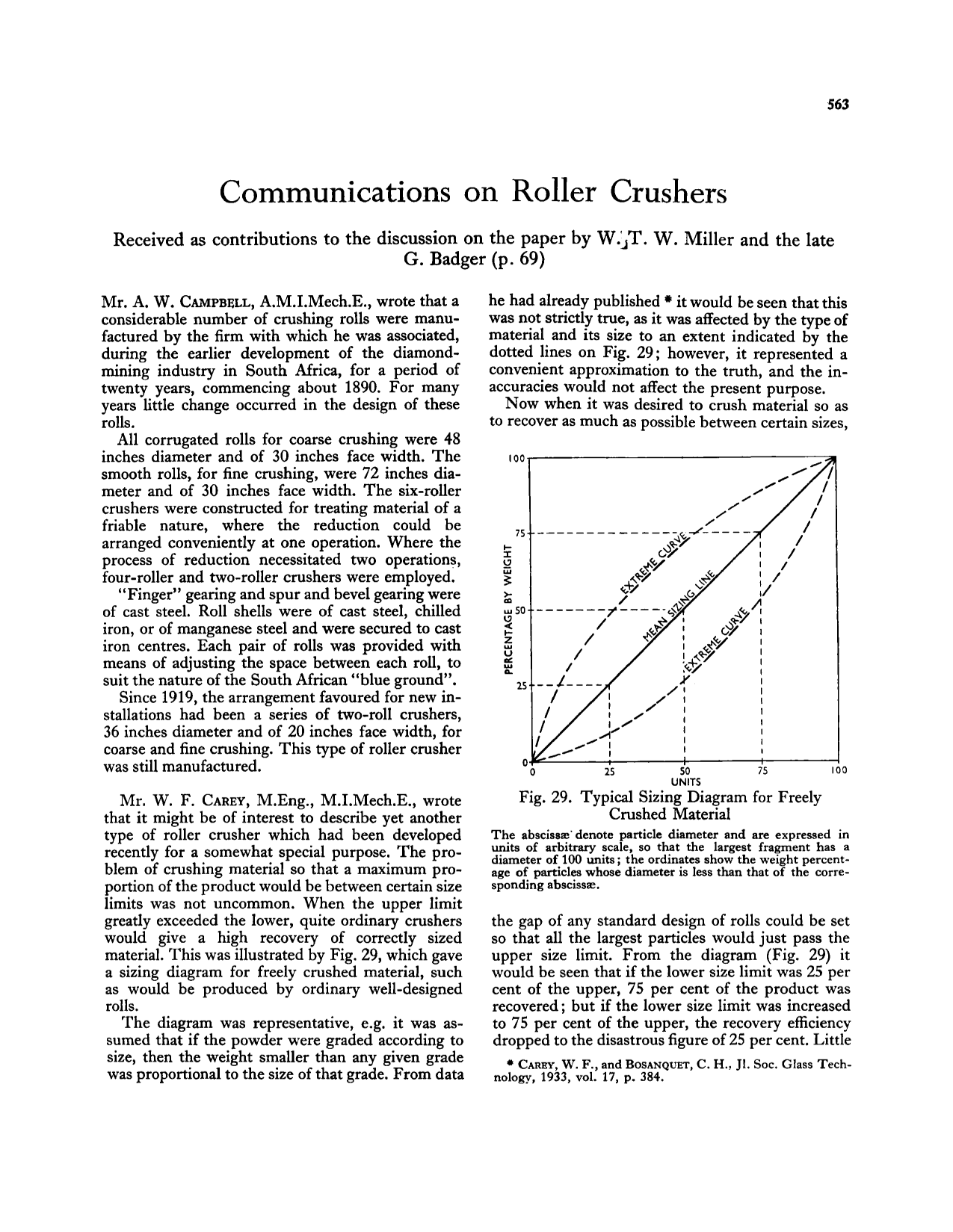
The paper describes roller crushers used for the reduction of ore, stone, coal, or chemical preparations of similar densities. Single-roll breakers developed originally for the crushing of coal, have been applied for the reduction of semi-hard slippery materials such as phosphate, gypsum, shale, and certain limestones. Two-roller crushers are the most numerous class and their growth from the early Cornish type to the modern high-speed rolls of great size and capacity is illustrated. Three-roller mills have not proved very successful in this particular field of service. Two examples are described and their defects explained. Four-roller machines have proved useful for the crushing of coal and some of the chemical products. Six-roller crushers are not very common. Two examples are shown and reasons are given for their restricted application. Two special types of roller crushers are also discussed, namely Taylor's three-stage coal breaker and the “Simplex” machine comprising two rollers and an intervening rotary disk.
The factors which influence the performance of the rolls are examined in detail and a formula for obtaining their capacity is given. The correlation of the angle of nip and the feed size, and their effect on the diameter of smooth rolls, is emphasized. A time factor diagram is given to show the reason why rolls of large diameter can be run with advantage at the higher circumferential speeds. Figures covering normal power consumption are specified.


The author has been responsible for the design of engines for a motor car in which the life of the cylinder bore over a period of ten years and a total of eight million engines is 12,000 miles per 0·001 inch wear.
The factors contributing to this result are as follows: (1) thermostatically controlled cooling for water at a minimum temperature of 145 deg. F., preferably 160 deg. F.; (2) crankcase ventilation to eliminate the effects of blow-by in the oil sump; (3) adequate oil supply to cylinder bores; (4) complete control of the lubricant at the piston rings, not at the source of supply of the oil; (5) control of gas blow-by at the rings; (6) leanest possible mixture ratios for general operating conditions; (7) close attention to the type of fuel used to ensure that it is properly vaporized; (8) a uniform hot metal temperature; and (9) an accurate spark advance mechanism.
All these factors are discussed by the author in detail, special attention being paid to the testing of piston rings in the laboratory, the correct use of thermostats, and crankcase scavenging.

During the last two decades both the speed and width of paper machines have increased considerably. This has resulted in the adoption of many devices which prior to that time were still looked on with doubt. The increase in width and weight of the rolls of modern newsprint machines has made the removable wet end practically standard. Similarly the increase in speed has only been made possible by the use of the projection slice, suction couch, and press rolls, which are being fitted with success to machines of all types.
The shells of suction rolls must be free from blowholes and this has entailed the use of centrifugal castings, and has been the means of developing their technique. A further development is the vacuum-forming paper machine, probably the most revolutionary modification of the Fourdrinier machine yet proposed. The two-wire machine gives a paper free from any wire mark, and recently a wire has been produced which goes some way towards the elimination of the wire mark. Electric drives arc nearly standard on all new machines.
The paper describes an extension of a recent research into the characteristics of the deformation and fracture of metals under static and fatigue stressing as revealed by precise methods of X-ray diffraction. The four series of fatigue tests were designed specially to take into consideration the cases where the upper stress of the cycle is in the immediate neighbourhood, first, of the ultimate tensile strength, and second, of the static yield point of the material. Accurate records have been made throughout of the changes in shape of the specimen. The structure has been examined by the X-ray method at the end of the test in every case, and also, in certain cases, at various interrupted stages.
The results have shown that, in general, the observed changes in structure, even under the most critical conditions of stress, are similar in nature to those found in the previous work. It has also been established that, under a safe range of stress, the damage to the structure is equivalent to that caused by a single sustained application of a static stress equal in amount to that of the maximum stress of the cycle. Further, the additional and progressive damage caused by cycles of an unsafe range of stress leads to a complete fragmentation of the whole or part of the specimen. Finally, the results of the complete series of alternating and pulsating direct stresses have been reviewed in relation to the deformation in the specimen; the conclusion is reached that, though complicating factors are present, the
When complaints of a smoke nuisance arise it is very important to be able to identify the source. The aim of the paper is to indicate possible methods of overcoming the difficulties of correct identification. Consideration is given to the rate of settlement and the terminal velocity of dust particles, and the application of the physical laws governing deposition. The author has used successfully a method of measurement involving the arrangement of series of gauges in rows extending radially from the suspected source, observations being made with due regard to the prevailing winds. Another method is particularly applicable to the measurement of dust emitted from pulverized coal furnaces, and is based on the tendency of the particles emitted from such furnaces to fuse whilst suspended in the furnace during combustion.
Directional deposit gauges have been tried, but so far have not been very successful. The basic idea is to provide a gauge which will separate the deposits from different directions, and various forms have been experimented with.


By “combustion gas turbine” is meant a turbine actuated by the steady flow of the products of a continuous combustion under pressure in a combustion chamber. Inventors appear to have been at work on the gas turbine since 1791, the original attractions of the proposal being its simplicity and the elimination of the reciprocating motion of the early steam engines. Simplicity remains the principal advantage of the gas turbine, though the first applications have been made possible by the needs of special chemical processes, such as the Houdry cracking process. The efficiency attainable under present conditions is 17–18 per cent, but this would be increased to 23 per cent if the gas inlet temperature could be raised from 1,000 to 1,300 deg. F. The proposed new fields of application of the gas turbine include locomotive and marine propulsion, blast furnace plants, and the power supply for wind tunnels.
The paper describes an experimental investigation of the mutual corrosion of metal surfaces in closely fitting contact when subject to vibration. It is shown that the corrosion is mechanical rather than chemical in character. Vibration or alternating surface stress alone will cause no corrosion and it is established that some surface slip, alternating in direction, is the necessary condition. Slip effectively causes corrosion even if reduced to the order of molecular dimensions, and this has been found to occur without exception, whatever the condition of the surfaces. Lubricants modify but do not prevent corrosion. Softer materials in general tend to seize and harder materials to produce corrosion debris. The amount of corrosion does not appear to depend on the intensity of normal pressure, but only on the occurrence of contact. Comparative tests of many pairs of materials show differences in the resistance offered to corrosion, but no pair of materials has been found to be free from the effect. A theoretical discussion of the mechanism of the phenomenon is given in which the idea of ordinary mechanical abrasion is rejected, and a process of molecular attrition, possibly closely associated with fatigue effect, is suggested.
The paper describes some recent advances in knowledge of the physico-chemical principles on which the correct treatment of boiler feed water is based. Straub's work in America was confined mainly to the tannins, the use of which in boiler compounds is almost traditional. The effect of tannins in the boiler appears to be threefold: (1) the delay of the precipitation of calcium compounds by the action of heat or alkalies; (2) the reduction of the amount of deposit which may be due to a change in the crystal shape of calcium sulphate and calcium carbonate brought about by the presence of tannins; and (3) a marked effect in conjunction with alkali, in preventing corrosion by the formation of protective films.
The principles laid down by R. E. Hall for the prevention of calcium sulphate scaling are restated. Recent work has led to a modification of the theory underlying Hall's recommendations, the significance of which is explained. A short description is given of Partridge's experiments on the growth of crystalline deposits on hot metal surfaces, but further work is necessary to explain why these deposits adhere to the metal. Recently published studies on the solubility of the calcium phosphate precipitated in the boiler, and the effects of sodium salts are described. Mention is also made of the formation of silicate scales and the use of sodium phosphate and caustic soda as preventatives.
It is suggested that the work described in this paper emphasizes the fact that the prevention of scale in boilers is essentially a chemical problem, and that the success of the recommended methods of prevention depends on careful control at each stage of the feed water treatment.
The report gives a summary of the research carried out during the past eight years by the British Electrical and Allied Industries Research Association on the development of steels for the construction of plant operating within the range of 350 deg. C. to 600 deg. C., and the development of methods of test by which comparative data for acceptance purposes can be obtained. A further report is in course of preparation dealing with the properties of steels as a basis for design for high-temperature service.
The usual theory gives leakage per unit clearance area
but this assumes that the successive pressure drops are all small, and further, ignores the fact that with decreasing back pressure the quantity flowing cannot go on increasing indefinitely, but reaches a maximum, and thenceforth any further decrease of back pressure
For calculating the leakage quantity a method is given, more accurate than the usual formula above. For the case where the kinetic energy of the fluid is not completely destroyed at each stage, the consequent increase of leakage can be assessed by a correction factor given by a formula made to agree with some test results, but based on the fundamental idea that the stream spreads out conically from the cylindrical surface at a small angle.
The author has amplified and in some degree revised the treatment described in a series of articles published last year. He believes that the method is new. By presenting the energy balance sheet in the form of a triple account the quantities which cannot be directly determined appear as differences.
For the original articles the author had to fall back on tests of an Otto cycle engine of his own design, dated 1895, but his attention has since been called to an admirable Ph.D. thesis by J. S. Clarke of Birmingham University, the data in which he has been able to use for this paper. It is unfortunate that the indicating of high-speed engines is not yet sufficiently precise to allow of the application of the author's treatment. The production of an indicator capable of giving reliable diagrams up to 2,000 or 3,000 r.p.m. is a matter of great importance.

The plant was installed at the Glasgow Corporation Electricity Department Generating Station at Dalmarnock during 1936–7, and consists of six Yarrow water-tube boilers, each capable of evaporating 200,000 lb. of steam per hour at 625 lb. per sq. in. working pressure, superheated to 850 deg. F. The boilers are the largest in Scotland and are typical of modern practice in steam generating plant for large power stations. The description of the plant includes particulars of the boiler drum scantlings, tube sizes, and spacing; the effect of bending on the drum design; the pipe connexions between water-wall headers and boiler; the preliminary heating arrangements; and the automatic interstage control of steam temperature. A table gives results of tests at three different loads, and curves of fuel consumption are included. Particulars are also given of the time taken to execute the work, and the paper concludes with some operating notes.
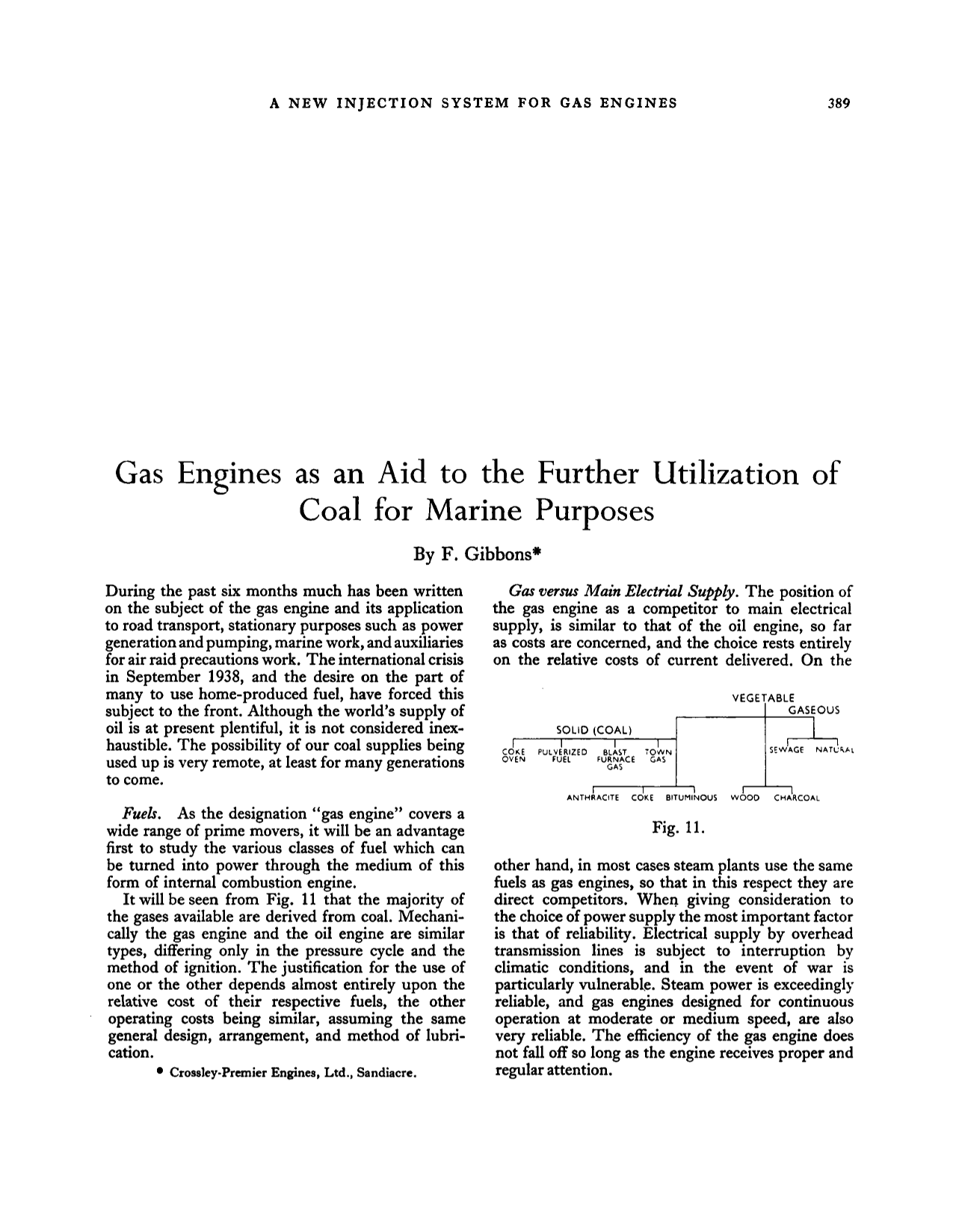
Three main methods by which the national fuel of this country, coal, may be used for internal combustion engines were dealt with at the conference at Swansea arranged by the Internal Combustion Engine Group: the conversion of coal to gas by small portable producer plants; the injection of coal dust directly into the engine; and the use of coal gas supplied in compressed form at the gas works. The first group of papers, besides giving an account of the present position of producer gas propulsion for road vehicles in this country and on the Continent, and some results obtained in service, deals with factors in the design of portable producers and the choice of suitable coals. A report on the development of the coal dust engine in Germany was to have been given by Dr.-Ing. Hans Wahl of Germany, but was withdrawn a few days before the meeting. Informative contributions on this subject are, however, included in the discussion. The second group of papers reviews the prospects of the application of compressed gas for road vehicles and marine purposes, and also deals with marine producer gas plants and the use of coke oven and blast furnace gas for power generation.


The research † has continued to follow the main lines of the programme originally laid down by the Committee, with an important addition, namely that relating to the study of the creep relaxation of model flanges. Some sections of the work are still incomplete; in such cases the data so far obtained are recorded and discussed, but final conclusions must be postponed until the research is terminated.
The present report deals with the following sections of work:—(I) an investigation of conditions on the joint under which tightness is maintained at room temperature (p. 433); (II) an investigation of the behaviour of compressed asbestos packing materials under certain conditions of loading and temperature (p. 437); (III) the completion of the examination of the properties of the materials used in the bolt assembly tests (p. 439); (IV) experiments on full-scale bolted flange joints under conditions of high temperature and pressure (p. 441); and (V) creep relaxation tests on model flanges (p. 453).


The paper describes methods of obtaining the greatest efficiency in the foundry by the simplest possible means, a principle of the first importance. The author has had forty years' experience of foundry practice, during which he has often changed his opinion on particular points, as requirements have grown, and as the means of realizing them have developed.
Economy in transport in the foundry depends on sound organization of methods. The preparation and stocking of sand are of no less importance. Continuous discharge from the sand mill is advocated, and the various means of transporting and handling the sand are described, and the suitability or otherwise of different types of apparatus discussed. Mould conveyers and the positions of the moulding machines relative to them are also considered. The conclusion is drawn that with care the simplest plants can be profitably mechanized.

High-tensile structural steels generally contain relatively small additions of alloying elements which affect their welding properties because of hardening effects. The paper gives data regarding the composition and test values of some typical high-tensile steels, together with results on metallic-arc welded joints. Laboratory cracking tests to determine the weldability of steel plate are described, and their utility is demonstrated. The composition and inherent grain size of the steel, together with the conditions of welding, affect the properties of the heat-transformed zone. It is desirable to limit the carbon content to 0·20 per cent; and for single-run fillets the use of a relatively slow welding speed of 4–6 inches per minute, with a fillet size of not less than half the thickness of the plate, has given the best results in the authors' work.
The properties of various covered electrodes have been studied. Carburization experiments on all-weld metal reveal interesting differences between electrodes.
The cutting of these steels by gas is considered, in so far as most of the factors influencing weld hardness may operate, to produce cut edges having hard surfaces of reduced ductility.
The paper gives details of a method of calculation for use in determining the pressure variations in the normal fuel-injection system. This method, besides dealing with the transmission of pressure impulses from one end of the pipe to the other, includes those modifying conditions present in an actual system, namely the capacity effects at the pump and at the nozzle, the action of the pump delivery valve, and the varying conditions in the spring-loaded injection valve.
The results of a calculation on a typical injection system have been incorporated in the paper. A diagram of nozzle pressure, obtained experimentally from the same system, is also included for comparison with the results of the calculation. This experimental diagram agrees so well with the calculated results that the treatment described may be regarded as giving a very close approximation to the actual conditions in the injection system.
The developments since the author's paper to the Institution in 1932 are reviewed under the subdivisions: combustion chamber design; injection systems; fuels. While few novel features can be reported under combustion chamber design, the growth of knowledge concerning injection systems and the properties of fuels has been considerable. The processes in fuel-injection systems are now well understood, while the conditions governing the break-up of fuel sprays are now also reasonably clear. The fundamentals of combustion and what determines ignition lag still remain obscure; the interaction of break-up of spray and course of combustion are also indefinite, and trial-and-error methods must still be employed. On the other hand, the cetane scale for assessing the suitability of fuels has been introduced. Reference is made to electrical indicators and the determination of impact loading on running gear during combustion. Two-stroke working and supercharging are discussed.
The author was entrusted with the task of reorganizing the machine shops of the Wilton-Fijenoord shipyard at Rotterdam-Schiedam in 1936 and of raising their output considerably. It was uneconomic to replace all the old machines; machines which were not adaptable were gradually eliminated, whilst those capable of having their speed doubled and of working to precision limits were rebuilt.
All hand-grinding machines were removed from the shop and collected in a central grinding department, and the number of materials was reduced from 50 to 14 machining groups. For each group the tool angle, size and shape of tip and shank, and the tool steel to be used were fixed so that the optimum output coincides with the minimum cost of materials and repairs. To ensure that the instructions given by the rate fixer are followed by the workmen, an engineer continuously inspects the work produced. A form was drawn up, and is reproduced, giving all the data required by the operator for carrying out the rate fixer's instructions.