Other
Select search scope: search across all journals or within the current journal

This paper, an abstract of the original, is intended to provide information concerning the present status of Diesel fuel research.
The paper is divided into two parts, the first of which concerns the types of fuel in use, describing briefly their sources and properties. A short account is also given of the existing fuel situation and how this may influence future research.
Part II deals with the effects of fuel characteristics on engine performance, wear, and fouling. The methods of overcoming any deleterious effects caused by the fuel are discussed, and particular reference is made to the beneficial effects of lubricating oil additives.
It must be emphasized that most of the work described refers to the high-speed Diesel engine, owing to the unsuitability of large units for laboratory testing. However, this is beneficial since the high-speed Diesel is most sensitive to fuel characteristics, and it serves to disclose the majority of defects that can arise in a Diesel engine.
Following the development of the Fuel Research Station “smoke eliminator” fire doors for hand-fired, natural-draught Lancashire boilers, a series of trials was carried out to obtain figures for their performance under a variety of conditions. Most of the trials were made with one or other of two sizes (”singles” and “smalls”) of a Northumberland coal, which was chosen because of its tendency to make heavy smoke; similar results were obtained with both sizes. The figures obtained during these trials, together with those of a few supplementary trials, are used to illustrate the effects of certain variables upon the performance of a boiler of that type. The information presented includes (1) the correlation of smoke intensity with the composition of the flue gases and with thermal efficiency, (2) the use of secondary air and suitable methods of firing to reduce the heat losses caused by incomplete combustion, (3) the effect of too little and of too much excess air upon efficiency, and (4) the effect of load upon efficiency.
With the special fire doors, the admission of secondary air over the fire could easily be controlled and a simple method of firing could be employed. In consequence, the efficiency of combustion was maintained at a consistently high level without calling for exceptional skill or effort on the part of the fireman. Maximum efficiency was obtained when the quantity of secondary air was just sufficient to eliminate smoke: decreasing the percentage of excess air by a small amount below the optimum had as bad an effect upon efficiency as a considerable increase. Varying the load also affected efficiency, the maximum being reached well below rated load, but the variation in efficiency between 40 and 100 per cent of full load was comparatively small.
The paper summarizes results obtained in a programme of research carried out by the British Coal Utilisation Research Association, under the guidance of the Shell-type Boiler and Firing Equipment Committee, an advisory committee convened by the Association in 1943.
In this country, 70–80 million tons of coal are consumed per annum in shell boilers of different types or burnt in industrial and heating furnaces in which mechanical firing is, or might be, employed. It is probable that 45–50 million tons per annum are used for steam raising in Lancashire boilers and it is more specifically with this type of boiler that the paper deals.
Excess air admitted through or in the neighbourhood of the fuel bed in a boiler represents, perhaps, the most important source of inefficiency, owing to the fact that it results in a substantial increase in gas temperature at the boiler exit. The experiments quoted show that, in terms of fuel consumption per pound of steam produced, increase in exit-gas temperature is responsible for approximately 50 per cent of the total effect of excess air. The elimination of excess air entering the furnace tubes of a Lancashire boiler represents one of the most important possibilities of effecting fuel economy on a large scale.
The rate of evaporation in relation to the normal rating of a boiler is another important factor. The investigations described show that, over a wide range of conditions, the heat absorption efficiency of a Lancashire boiler—without an economizer—decreases by 2 per cent for each 1,000 lb. per hr. increase in evaporation. The corresponding figure for the complete plant—boiler and economizer—is 1·8 per cent. It is suggested that the most efficient rate of evaporation with this type of boiler is approximately 70 per cent of normal rating. Under these conditions, with modern equipment and suitable fuel, operating efficiencies up to 80–85 per cent should be practicable.
Brief reference is made to “unaccounted” heat loss as an important item in the testing of a boiler and to the influence of boiler and stoker type and the effect of fuel characteristics on efficiency. Many of the points mentioned in the paper are being further investigated in the steam engineering laboratories of the British Coal Utilisation Research Association.
At the last two meetings of the British Association the view was expressed, without dissent, that the most urgent need today is not for further scientific discovery but for a more intensive application in industry of discoveries already made. The achievement of the highest rate of industrial development, and the highest level of industrial efficiency, depends primarily on an adequate supply of technologists, and the present supply appears to be inadequate both in quantity and quality. The provision of courses in technology has not hitherto been planned; many courses have come into being as the result of private generosity and not as the result of deliberate educational policy. At this critical juncture in our economic life, the whole question of technological courses merits the most careful examination.
The principal aspects of the problem appear to be: (1) In the case of full-time degree and diploma courses, is the provision adequate; should the number of students in the existing courses be increased? Are there other branches of technology for which courses should be provided? (2) Is the general structure of degree and diploma courses satisfactory? If not, what modifications are desirable? (3) Should there be far more provision of post-graduate courses of various types? (4) What modifications, if any, are desirable in part-time courses of the National Certificate type? (5) Do courses in technology need liberalizing, and how can this best be done? (6) Good management is an essential factor in securing the highest standard of industrial efficiency; how can management studies best be incorporated in technological courses?
Subsidiary questions arise, but if answers can be obtained to the principal questions it will be simpler to plan further developments in technological education.
Those steel structures which are subject to repainting during service are considered, particularly those subject to exposed atmospheric conditions. Since any major improvement in paint life is dependent on surface preparation, alternative methods are examined. Mechanical shot blasting is the cheapest method for structural steel, but it is only possible prior to fabrication. The choice of prime coats, which must satisfy several requirements, lies between paint, oil, and metallic coatings. It is believed that suitable paint could be developed. No suitable oil is yet available, and of the metallic coatings sprayed aluminium is the most suitable.
Fabrication difficulties, and in particular welding, require further investigation.
The cost of painting a structure during a life of fifty years shows that surface preparation prior to fabrication is economical.
The paper describes a casting process which differs from standard foundry practice in that it uses a wax pattern in a high refractory one-piece mould to produce metal castings with a good surface finish to an accuracy of ±0·002 inch.
The process involves making a master pattern in either hard wood or metal, relating it to a soft metal die by precision casting technique, and then the production of wax patterns from the die on an injection machine. Finally, the wax patterns are invested in refractory moulds, the wax is melted out, the mould baked, and the metal component is cast.
The “lost wax” process is advantageous in cases where (
The tool costs are relatively low compared to the costs involved in alternative methods of manufacture, the die cost being a function of the number of castings required.
The production of cheap castings is necessarily dependent on the scrap percentage being kept to a minimum; at present the scrap from the manufacture of gas-turbine blades is less than 30 per cent, and the author surmises that it would not be unreasonable to expect it to be less than 10 per cent in two years' time.


The air ejector, in its various forms, is a device which has many applications in engineering practice, and several attempts have been made to analyse its mode of action, some of these having been supported by experimental work. Most of the experimental results available are related to ejectors in which relatively high-pressure steam is utilized as the driving fluid, but even in these cases the information provided is restricted to a narrow field.
The investigation described relates to an air ejector employing as the driving fluid air at a relatively low pressure, not exceeding 40 lb. per sq. in. (abs.), and covering a wide range of operating conditions by means of interchangeable nozzles. Two distinct experimental arrangements were built—one for the set of conditions in which the ejector draws in a relatively small quantity of suction fluid and pumps it through a relatively high pressure-ratio, and the other covering conditions in which the quantity of suction fluid is much larger, but the pressure ratio is quite small. For a given initial pressure and quantity of driving fluid, the rate of mass flow of suction fluid depends chiefly on the diameter of the combining tube, in which the driving and suction fluids mix; in the experiments, the ratio of com-bining-tube area to driving-nozzle area was varied in twelve steps, covering a range of area ratios from 1·44 to 1,110·0, and compression ratios ranging from about 3 to about 1·001.
Efforts were made to find the best proportions of those parts of the ejector which exert a major influence on performance, and certain conclusions are drawn from the results of the experiments. Theoretical aspects of the problem are briefly discussed.
A comparison is made between gas-turbine cycles with inlet temperatures of 1,250 and 2,200 deg. F. The use of high inlet temperatures necessitates cooling; the effect of air and water cooling in turbines is examined, and equations are given and used to show the factors controlling cooling loss. A cooling-loss factor is also derived which gives the turbine efficiency obtainable with various degrees of cooling. A cycle with an inlet temperature of 2,200 deg. F. is examined to show the effect of air or water cooling. With water cooling the steam generated is then considered either to provide an increase in useful power or to pre-cool the inlet air. For greater efficiency the steam should be used to increase the power delivered. Practical considerations and a proposed marine layout are given, together with a series of conclusions. Appendices are also included giving the assumptions made and derivations of the equations.
The reports of the Lemon Committee and of the Anglo-American Council on Productivity draw timely distinctions between the terms “standardization”, “simplification”, and “specialization”. This paper discusses simplification, with special reference to complex proprietary engineering products.
The problems examined are those of determining and controlling a range of simplified products; the determination of domestic standards, classified as “manufacturing standards” and “constructional standards” for the components of those products; the need for, and effect of, more refined manufacturing standards with increasing volume of production; the possibility of obtaining varieties of end-product by alternative assemblies of simplified components, through what is here tentatively termed “rationalized construction”; and the increased complexity of the technical problems which the development of those products entails.
Finally, attention is directed towards the new problems and responsibilities with which simplification confronts top-management, partly in the closer control of line of products, but chiefly in the integration of the design, production, and marketing functions.
The development of high-pressure processes (200–1,500 atm.) in the chemical industry in recent years, often carried out at high temperatures, has helped considerably to cheapen the production of basic materials, such as ammonia and methanol, and has opened up entirely new fields, particularly in the manufacture of important plastic materials, in coal hydrogenation, and in oil-cracking operations, calling for special equipment and novel techniques.
This paper deals with the mechanical requirements for high-pressure vessels, and traces progressive changes in their construction during the last thirty years, from cast autoclaves to forged vessels and to modern composite designs, having due regard to the volume-to-weight ratio, construction, inspection, cost, and maintenance.
Stress distributions in the cylinder wall, suitable closure mechanisms, the effects of temperature, chemical and physical attacks, and the provisions for stirring, heating, and cooling are discussed.
A brief account of the control mechanisms involved and of the necessary vital safety precautions is given.

Early attempts to adapt the mechanism of the turbine to the air- or gas-engine were frustrated by the losses in the compressor, but in the last twenty years improvements in the efficiency of the latter, together with better high-temperature metals for the turbine, have enabled the gas turbine to approach the efficiency of the steam turbine. The gas turbine has to operate from a much higher temperature and with more effective high-temperature regeneration to achieve this. On the other hand it cannot utilize heat down to anything like the same lower temperature as steam power. Most regenerative gas-turbine cycles are therefore more efficient than the steam cycle at the upper temperature range, and less efficient at the lower temperature range. Now that the Rankine steam cycle has reached 1,000 deg. F., a given increment of temperature has much less effect on the steam turbine than on the gas turbine.
The paper describes a condensing gas-turbine† cycle with external combustion, which utilizes orthodox gas-turbine and steam-turbine components in such a manner that the thermodynamic advantages of the two in the respective temperature ranges mentioned above are combined to give a higher thermal efficiency than either the steam or the gas turbine is capable of alone, and with the prospective ability to utilize almost any fuel.
A great improvement may thus be made possible in the fuel economy of condensing steam power stations, steamship propulsion, and steam locomotives, and in the ratio of mechanical power to heat in combined power and process or district heat production. It may become commercially worth while, apart from the saving in coal, to eliminate a large proportion of condensing operation on land in the winter months. By integrating the fuel-using industries in this manner it should be possible to save at least fifty-million tons of coal per annum on the present aggregate output of power and heat, with a further saving of eleven-million tons of locomotive coal. This should enable the nation to afford much more liberal use of power and heat and thus achieve much greater production in transport and industry.
The paper outlines the full scope of the application of motion study to an industrial organization. The successful use of motion study is not confined to any one industry: it has been applied in recent years to an increasingly large number of different industries. There are great advantages to be gained from making detailed investigations into single specific problems, using all the detailed motion study techniques; but there is also a need for training large numbers of supervisors, technical specialists, and even operators to use simplified techniques in their daily work, so as to make numerous small improvements over a wide field. The first type of application gives high percentage savings over a small area of work, and the second, low percentage savings over a large area of work. The best and most profitable results are obtained by combining the two types of application, the fully trained motion study investigator dividing his time between making major investigations and teaching and supervising others in the use of simplified techniques.
Of the detailed techniques, micromotion study, process charting, and the study of the path of movement, the latter is the least well known. Although Gilbreth originated the chronocyclegraph it has been neglected since his time, but recent work has shown its value, and it is now taking its place as an essential technique. It is the only technique that can put on to paper the subtle difference between a good and a bad movement. It is, therefore, of great value in teaching students of motion study to discriminate between one type of movement and another and to see the path of a movement as it is made.
In its broader applications, motion study can be used in some way by everyone in an organization. It is most effective where it is applied as team work, each man playing the part that best suits him and that best fits in with his normal work. In planning the general use of motion study, the programme should begin with a campaign of lectures, exhibitions, and general propaganda to rouse interest. Courses should then be planned for all groups: managers, supervisors, technical specialists, and operators. Since each will apply motion study differently, each will need a different syllabus and different illustrations. There can be no ready-made scheme applicable to all. Courses of training should be followed up by a long-term plan of progress reports, meetings, and supervision, to maintain interest and stimulate individual work.


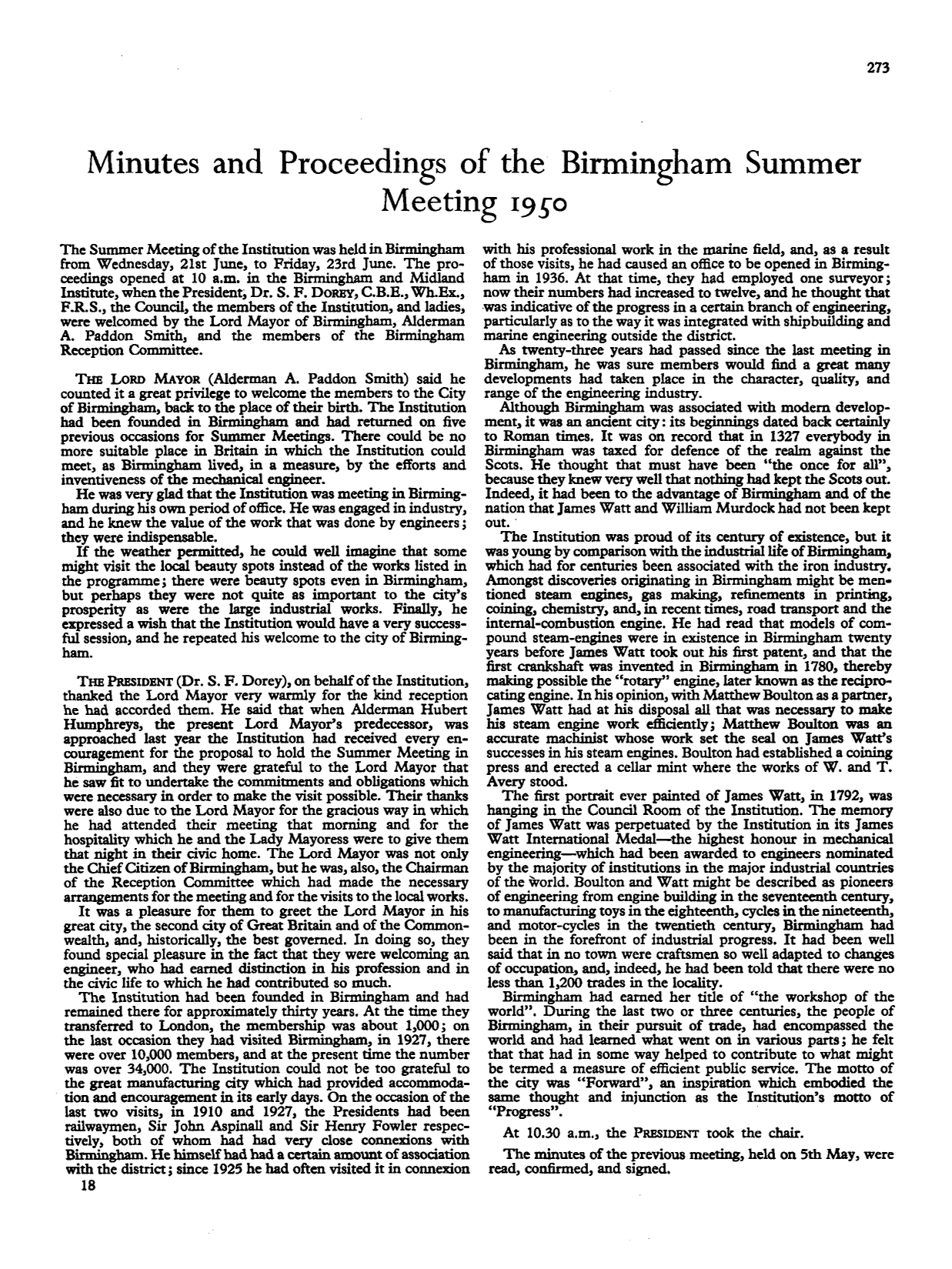
Developments of popular interest that have taken place in the mechanical engineering industry in Birmingham and the surrounding districts by the year 1950, which is not only twenty-three years since the Institution last met there but also is the turn of the half century, are briefly surveyed. Power plant, incorporating steam boilers, steam turbines, oil engines, and gas turbines, is discussed, with special reference to the development of the oil engine and its adaptation for special usage in the 1939–45 war.
Changes in public and private road transport engines are traced up to the first turbine-engined private motor car.
Improvements in the design of machine tools from practical and aesthetic aspects are touched upon. Mass production and its effect on the craftsman, and advances that have been made in factory management, amenities, and the prevention and treatment of accidents are mentioned, as also is the rehabilitation of workmen, with special reference to the work carried on by the Birmingham Accident Hospital. In processes, the hydroblast method of cleaning castings and the automatic rustproofing of car bodies are described.

The well-known theory of the motion of a four-wheeled vehicle having pairs of tapered tread wheels joined by an axle is applied to cranes, and is extended to the important case of a four-wheeled crane with only one axle and to eight-wheeled cranes with two pairs of wheels driven by a common shaft. Observations of the actual motion of a number of cranes with parallel and tapered tread wheels are recorded. The tapered tread cranes give sinusoidal curves of motion in good agreement with theory, and design rules for the width of both parallel and tapered treads are suggested.
The paper reviews some of the facilities for management training now available, under the headings
The term “management” connotes anything from top-management to junior supervision, and the problems and treatment differ according to the nature of the firm and the level of management considered. Discussion should indicate clearly, therefore, which type of management is under review and, with respect to educational schemes, for what kind of personnel (apprentice, post-graduate apprentice, or post-apprenticeship) the schemes are intended.
Some important considerations dealt with individually in the paper include: the provision of facilities for training by individual firms; education in leadership; selection of personnel for management training; the first position of responsibility; and the dangers of over-emphasis on management training.
The paper shows how the basic principles of frequency response analysis may be applied to automatic process control without the introduction of any of the mathematics which are used in the servomechanism field of study, and which have in the past discouraged its use in the process field.
It is shown how the frequency response of any part of an automatic control system may be represented graphically, how the response of any simple element of a system may be calculated, and how the response of the individual elements thus obtained may easily be combined to give the characteristics of the whole plant. Alternatively, the frequency response of the plant may be plotted experimentally without interrupting its operation.
By reference to a typical example, it is shown that all proprietary “three-term” controllers do not necessarily function as simple theoretical controllers, but that their performance may often be represented as that of an effective theoretical controller, and may, in any case, be shown as a frequency response diagram from which the necessary information is available to match the controller to any particular process.
The method introduced is shown to give a convenient measure of plant controllability, and by means of plant analysis on this basis, it is suggested how automatic control may often be improved by better design of the process rather than of the controller.
The design of automatic controllers is also treated, and it is shown how various design features may be compared in the light of their frequency response characteristics. It is suggested that future controllers should be designed to give a specified frequency response.
Economic competition compels many firms to operate processes which emit gases carrying a dust burden many thousand times that of atmospheric air. Even after treatment in the most expensive deduster this effluent will still hold some 5 per cent of its original dust, so that it must be discharged up a tall chimney. Wind eddies then dilute the chimney gases until they can be tolerated at ground level; however, during dilution the coarser dust is liable to settle and cause objectional deposits in the vicinity. The problem of designing an installation to avoid nuisance is therefore to remove the coarser grits in a deduster and to arrange the stack to dilute the finer residue so that deposits will not be noticed.
The authors have developed a set of reasonably simple formulae and charts for predicting the path of particles emitted from a stack and spread by the wind. Experimental checks have been applied to the predictions, but the subject is complex, and at this stage it is unlikely that it will be possible to predict the rate of deposit within a factor of 2.
In order to illustrate the implications of the paper a worked example is given on a powdered-coal boiler installation. This shows that with properly designed cyclones and a moderately high stack there will be no noticeable deposits. The implication is that it should be possible in time to extend the treatment given in the paper to specify a deduster exit which will avoid nuisance with fair certainty and at a relatively moderate cost.

An examination is made of two particle size analyses which are typical of two categories of crushed products. One example represents material reduced in a hammer mill; subjected to indiscriminate reduction, it contains a preponderance of smaller sizes, and this is characteristic also of ball mill products and the small particles in the products of jaw, gyratory, and roll crushers. The second example illustrates the influence of the sizing action which occurs in the latter machines and results in a closer grading of the coarse particle fraction.
These characteristic features are illustrated by graphs, and a mathematical basis is given for Gaudin's law of particle size distribution.


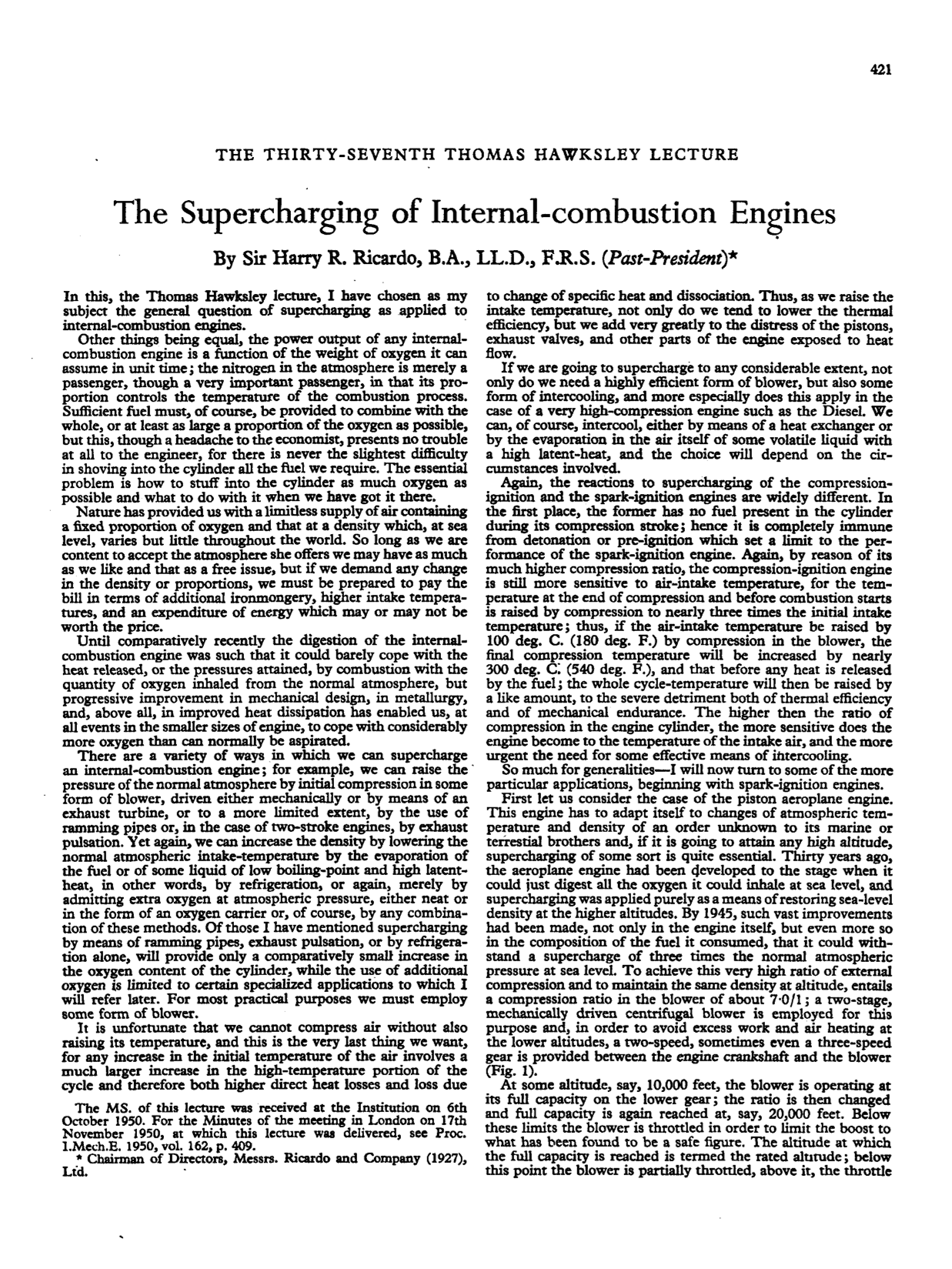
This lecture is an attempt to give a cross-section of aviation engine development and progress during the last two decades.
Such a lecture is now opportune, since great progress has been made during the last ten years—mainly due to the 1939–45 war and the advent of the aviation gas turbine. The rapid development of this prime-mover has started a new era in aviation and the well-tried piston engine is already being relegated to second place and even eliminated in the more important aircraft applications.
The lecture is divided into two parts. The first deals with the piston engine and the second with the gas turbine. In the first part, the development of the piston engine is discussed; with emphasis upon those factors, such as supercharging and improved fuel, which have particularly contributed to its present high performance.
Cooling developments of both the air- and the liquid-cooled engine are discussed, and also the influence of such detail refinements as the sodium-cooled valve and sparking plugs having sintered aluminium oxide insulators.
The second part of the lecture describes the present forms of aviation gas turbine, with some details of its specific performance and the author's views concerning the future development and application of this new engine.
At the request of the Council, and where relevant, the author has shown how the development of the aviation engine has influenced that of the automobile engine and he has also given—in Appendix I—a summary of his views on the application of the gas turbine to road-vehicle propulsion.
This lecture would not be complete without reference to the great part played, in the 1939–45 war, by the aviation engine and automobile industries of Britain, in combining to produce large numbers of aviation engines for the Royal Air Force. In this particular connexion, the author is of the opinion that the experience and the production methods of the automobile industry, as a whole, contributed largely to the uniform excellence and economical production of the aviation engine, and fully vindicated the faith of those who originated the “Shadow” scheme in the rearmament period before the war.