Other
Select search scope: search across all journals or within the current journal


Tests of an exploratory nature into a novel process, which improved the load-carrying capacity of sliding surfaces and significantly reduced friction, are described
Particles of a hard material, for example, diamond, were impregnated into the sliding surface, the projecting sharp edges being subsequently removed to leave numerous small pads of diamond above the surface. The experimental programme was limited mainly to bronze sliding on hardened steel and lubricated with aviation paraffin, but a few tests under conditions of high Hertz stress (hard steel sliding on hard steel) and synthetic-oil lubrication showed similar, beneficial effects. Only the hardened steel was impregnated in the bronze on steel tests
Endurance running of the impregnated surface (bronze on steel lubricated with fuel) at loads up to 300 per cent of the failing load of a conventionally lapped surface was satisfactorily performed with coefficients of friction of the order of 0.001. Excellent repeatability of control tests was obtained
Silicon carbide was shown to be a suitable substitute for diamond
One instance of impregnation of the surfaces within a fuel pump with a subsequent reduction in wear rate is also described
The earlier British carbon-dioxide-cooled, graphite-moderated power reactors were designed to operate without lubrication. This was necessitated by lack of knowledge of the effects of radiation and other reactor operating conditions on lubricants, and of the degree of compatibility of lubricants with reactor materials
Investigations carried out over the past few years of the effects of nuclear radiation on many types of lubricant have shown that it is possible to produce materials capable of lubricating some reactor components. In order to further the development of such lubricants the U.K.A.E.A. and the nuclear manufacturing groups have co-operated in providing lubricant manufacturers with details of design and operating conditions of reactor components which it is desirable to lubricate
In this paper is described the range of operating conditions which lubricants are expected to encounter in different reactors, with particular emphasis on the C02-cooled, graphite-moderated reactor. Nuclear lubricant requirements proposed by the U.K.A.E.A. to cater for many applications are also discussed
With this information available it is now possible to assess realistically the types of test facility necessary for the evaluation of nuclear lubricants. Such test facilities are described. They include irradiation sources, a test rig for running under irradiation conditions, various test rigs to simulate reactor operating conditions for testing products both before and after static irradiation, and other specialized equipment
The effect of radiation on both conventional and nuclear lubricants is described and the use of ‘anti-rads’ illustrated. Attention is drawn to other desirable properties of nuclear lubricants such as temperature stability, low volatility and compatibility with reactor and fuel-can materials
Designers of reactor machinery have taken, and will increasingly continue to take, advantage of the developments in lubricants but, while still further advances in lubricant quality will be made, some components, particularly of the more advanced types of reactor, will probably continue of necessity to be operated without lubrication


Much of the published data on steam cycles cannot be applied to modern power stations owing to the advanced steam conditions and complex cycles now used. Plant optimization therefore requires the detailed analysis of a large number of cycles over a wide range of steam conditions
Modern high-speed digital computers offer the engineer relief from the tedium of lengthy calculations and the uncertainty of broad simplifying assumptions. The Ferranti ‘Mercury’ computer is used in the present work and, for economy in computing time, separate boiler and turbine programmes are written and the results combined through a short desk calculation
The turbine programme, which is applicable to both conventional and nuclear stations, is sufficiently general to deal with all anticipated steam conditions and cycle arrangements and it also takes account of minor cycle corrections. Possible variations in boiler design, however, make a similarly general treatment more difficult and several separate programmes are described here, each dealing with a steam cycle and boiler design suitable for use with the low-temperature gas-cooled reactors being built in Britain at present
Application of the programmes to the design optimization of a complete nuclear power station is discussed
Test results for a non-standard type of venturi meter with a wide throat metering a mixture of water and crushed bakelite or water and basalt chippings are presented. In addition, results using a 90° bend as a flow meter are given, and a ‘vertical counterflow meter’ is described, which measures both mixture velocity and concentration
Current methods of assessing gear-tooth load carrying capacity remain largely empirical; so also is lubrication technique. There is need for more research and more endeavour to apply it. The lecture states the quantities, definitions and notation employed in the analysis of contact conditions; outlines the phenomena of oil-film formation and friction; gives experimental values obtained by disc machines; and develops a modified treatment of temperature calculation. Phenomena encountered in practice are summarized, and the conclusion is reached that scuffing begins not within the oil film but by dislocation of the bounding surfaces. The emphasis throughout is on the problems which still await solution

With the growing increase in the bulk handling of grain, the grain-auger type elevator is now being widely used. While some theoretical analyses of the grain auger have been made and performance data for particular size augers have been obtained, little information is available for general design purposes. This work, which is based on an experimental approach, is aimed at producing such information. The investigation has been carried out using a small scale model auger which allowed a comprehensive range of tests to be conducted on a more manageable basis
In the first part of the investigation, a study is made of the auger performance characteristics with the aim of determining the conditions for most efficient operation. An examination is made of output and volumetric efficiency in relation to speed, angle of elevation and choke length (the length of exposed screw projecting from the lower end of the casing). The effect of casing clearance on auger output is also partially examined. In addition, the variation of auger horsepower and overall efficiency with speed and angle of elevation is observed
In the second part of the investigation, equations are developed and design charts given which enable the performance of augers to be predicted. The equations and charts are based on the application of dimensional analysis and dynamic similarity and apply to augers of the same geometrical proportions as those of the model. The data apply mainly to granular materials of similar shape and properties to wheat. A comparison is made between the predicted performance with the actual performance of a 6-in. auger, good agreement being obtained
The investigation shows that many combinations of auger size, speed and angle of elevation may be adopted for a particular conveying application and general recommendations are given regarding the choice of these variables for efficient operation
While the design of diesel engines is necessarily based upon some estimate of the pressure and temperature conditions expected in the cylinder and in the air and exhaust manifolds, such estimates have usually been very approximate. The suitability of the design has to be proved, or improved, during a considerable programme of rigorous development
As engines become more highly rated the value of more accurate early estimates of engine performance, as a guide to the designer, becomes more obvious. The paper describes a method of calculating this information by digital computer based on a fundamental approach to the processes involved. It is demonstrated that the cylinder pressures and temperatures, exhaust gas temperatures, fuel consumption, air flow, heat losses, piston and wall temperatures and engine output so calculated, correlate very well with experimental results
Using this technique, different combinations of engine variables can be ‘tested’ by computation to reduce the range of engine tests necessary to develop the optimum design, and allow the designer and the development engineer to concentrate their practical experience and technical ‘know-how’ on the formidable problems of mechanical development and combustion improvement
A review of existing test methods and apparatus as applied to full-flow lubricating-oil filter testing including, where applicable, notes on functional operation which need to be considered in testing and in the ultimate interpretation of test results. Reference is also made to the desirability of a future standard test procedure and performance specification
The paper describes the work carried out in the preparation of a ‘natural’ contaminant of a definite and reproducible composition for use in tests on oil filters. The arbitrary limits set in the specification of the contaminant are based on various factors from data on used oil filters and previous knowledge gained in the examination of used engine oils
The preparation of the contaminant from the raw material is described in detail, and reference is made to a method of testing filters which is used to make sure that the standard contaminant affects a filter in a consistent manner. Detailed methods of chemical analysis for inorganic constituents and particle size measurement are given in the appendixes to the paper
The choking of fuel filters in most services is caused by soft organic trace constituents of the fuel, and is independent of the extraneous contaminants over the range of concentrations normally encountered in service
It is possible for a filter which is reasonably efficient initially to deteriorate in service to such an extent that most of the damaging contaminants applied pass through the filter. Such a filter, when tested with hard particles only, can show a continuously improving efficiency due to the filtering action of the bed of retained particles. The choking life, as determined by the quantity of hard particles it retains before reaching a chosen limiting resistance, is a measure of the effective filtering area and the volume available for retained contaminants rather than of the life which would actually be experienced in service. It is therefore important in testing fuel filters that the service choking process should be reproduced
A combined choking and particle transmission test is described which gives information on the service life to be expected and on the particle transmission of the filter at any stage during that life. The methods of preparation and specification of the powders and choking medium used in this test are also described

This paper draws on experience gained during the 14 years of operating experience at the Calder Hall nuclear power station, and describes the problems encountered in maintaining the plant and the reasons for, and effects of, restrictions imposed because of their special features

When the useful life of a commodity in the field (the field life) is affected by the time which the commodity spends in store prior to issue (the store age), it is possible to show that there is an optimum sequence for issuing a given number of items of this commodity from the store, when it is desirable to maximize their total useful life in the field. Two common issuing policies are FIFO (first in first out) and LIFO (last in first out) and it is shown that one of these policies becomes optimal, depending on the characteristics of the field life function, i.e. on the relationship between the useful life of a commodity in the field and its store age prior to issue. Attention is drawn to the risk of obsolescence, when items in the store cease to be useful owing to excessive storage periods, and the effect of this factor on the above two policies for issuing items from store is discussed. The cost of implementing these policies and problems relating to acquisition or replenishment of commodities for a stock-pile of two units are considered and the conditions under which each policy becomes less costly to apply are stated
The total energy relationships are given for a thin blade vibrating in combined bending-bending-torsion when allowance is made for bending of the longitudinal fibres occurring due to torsion. The Lagrangian function is, thus, obtained and, by use of variational methods, the equations of motion and the boundary conditions are derived. For the special case of a straight blade of uniform cross-section, symmetrical about both principal axes, an expression is deduced for the torsional frequencies which shows agreement with a similar expression obtained previously by a somewhat different approach
The experiments, which were sponsored by the British Shipbuilding Research Association, were designed to study how the strength of an expanded joint depends on the degree of expanding with normal propulsive type expanders. Fourteen tests were made, varying the back extrusion from 0.029 in. to 0.093 in. on a 2 in. O.D. × 11/2 in. bore tube in 1 1/4 in. long seat
There is an optimum degree of expanding for maximum joint strength measured either by the push-out load or mean seat pressure. The position of the maximum in the curve of push-out load is dependent upon surface finish. Within the inevitable variation present in industrial machining finishes the presence of a peak will be masked. Moreover, the peak occurs at a degree of expanding well beyond the values recommended by previous workers for the same size of joint. Bearing in mind the added difficulties of controlling the process in the field, these recommended figures are open to question
Mean seat pressures as high as 5 ton/in2 are easily reached at the optimum degree of expanding
In view of the large variations in joint strength that can occur even with carefully controlled expandings, reproducibility tests were carried out. It is shown that, where exceptional care is taken to control all the conditions of the test, good consistency in the characteristics of identically expanded joints is possible


This paper describes briefly techniques for the rapid preparation of optically flat metal plates to an accuracy of approximately two interference bands over an 8-in. span. The construction and use of two large Fizeau interferometers for observing defections resulting from flexure is described
The technique was developed 'as an experimental means of circumventing the very great theoretical complexity of analysing various forms of flexed multiply-connected plate occurring in engineering construction. It is illustrated qualitatively from studies of perforated circular plates subjected to lateral loading, of annular and triangular plates subjected to concentrated loads and of perforated bars subjected to pure bending
Quantitative studies based on the method are to be described in subsequent papers
An experimental method based on optical interferometry is applied to find the deflected shape of gridworks subjected to lateral loads
These experimental results are compared with results obtained by moment distribution calculations and by the use of the equivalent elastic constants of Horvay and Malkin
The technique itself, which has been developed by one of the authors as a general experimental method of studying the flexure of thin elastic plates, has been described in the accompanying paper


The paper reviews the development of practice in Great Britain of the extraction, handling) and disposal of ash from pulverized fuel boilers—other than slag-tap boilers

In this paper consideration is given to the effect upon the performance of small compression-ignition engines of variations in ambient atmospheric conditions. The validity of some correction and derating formulae when applied to such engines is discussed, and an experimental investigation is described in which two small air-cooled compression-ignition engines were run at constant speed in atmospheric conditions which could be controlled at values ranging from the normal to those widely different from normal conditions. Some conclusions relating to corrections for deviation from standard conditions are drawn from these test results and a comparison is given of the correction of experimental results by a number of correction or derating formulae, which are described in Appendix I


The equations for a flexible rotor in journal bearings are set up and solved, extending the method previously used by Hummel and Cameron. It is shown that if
The frequency calculated by the method given here is applied to a number of cases of large turbines and alternators and found to give quite satisfactory results
Expressions for the load-carrying capacity, stiffness and damping rate of pressurized oil film bearings are derived and expressed in terms of the variables available to the designer
By adding a simple automatic flow valve, operated by pressure feed-back, the pressurized oil film exhibits infinite stiffness to steady normal loads. The method can be adapted for a system, embodying pilot pad control of a main bearing pad, in which the pilot pad slides on a flat strip and the film thickness of the main pad is varied to compensate for undulations in the main slideway
A further experimental and theoretical investigation is described in which feed-back control is used to support concentrically the shaft of a journal bearing. With a shaft diameter of 2 in. and a radial clearance of 0002 in. the eccentricity is generally not greater than 2 × 10⁻⁵ in., as inferred from the pressure measurements, for loads exceeding 300 lb and rotational speeds up to 1200 rev/min. It is argued that much greater loads and higher rotational speeds can be attained with virtually no eccentricity
An analysis is made of the whirling performance of an elastic rotor supported in fluid lubricated journal bearings, taking account of both the displacement and velocity-dependent components of dynamic bearing action. It is shown that two distinct modes of vibration occur corresponding roughly to half-speed whirling, oil whip, etc., and to reduced elastic whirling speed respectively. Typical bearing coefficients are given for short journal bearings. Using these, examples are given illustrating the calculation of the natural frequencies of a rotor running at a fixed speed and the calculation of the response curve of a rotor running through a range of speeds. Experimental evidence confirming these results is given
The inherent stability of an elastic rotor bearing system is also investigated and a chart presented showing the limits of stable operation of an elastic rotor
A phenomenological theory of the half-speed whirl of gas bearings is developed; it predicts the existence of four modes of whirl which depend variously on the mass and transverse inertia of the bearing and on the mass and transverse inertia of the shaft. All four modes of whirl have been distinguished experimentally, and related to each other theoretically. From these measurements, it is shown that the half-speed whirl properties of a plain bearing can be considerably improved by cutting an axial slot in the bearing. Further improvement, if required, can be effected by introducing an ovality into the bearing or cutting circumferential grooves in it. The introduction of these anti-whirl devices, however, reduces the load capacity, although measurements have shown the effect is not serious except for the circumferentially grooved bearing
The paper deals with the wear problems which are sometimes experienced when operating parallel cylindrical roller bearings at high speed, with jet lubrication, in turbine mainshaft bearing practice
Tests show that considerable cage slip often takes place, as reported by previous investigators, the cage and roller assembly travelling at speeds lower than that predicted from the epicyclic relationship
It is concluded that hydrodynamic lubrication normally occurs between the rollers and races when appreciable cage slip takes place. If the radial load on the bearing suddenly increases under these conditions, the hydrodynamic film is not always able entirely to prevent metallic contact and wear of the rollers and races
Further experimental work is required before complete understanding of the problem can be obtained. Tentative recommendations, however, are made for minimizing the incidence of this type of wear in practice

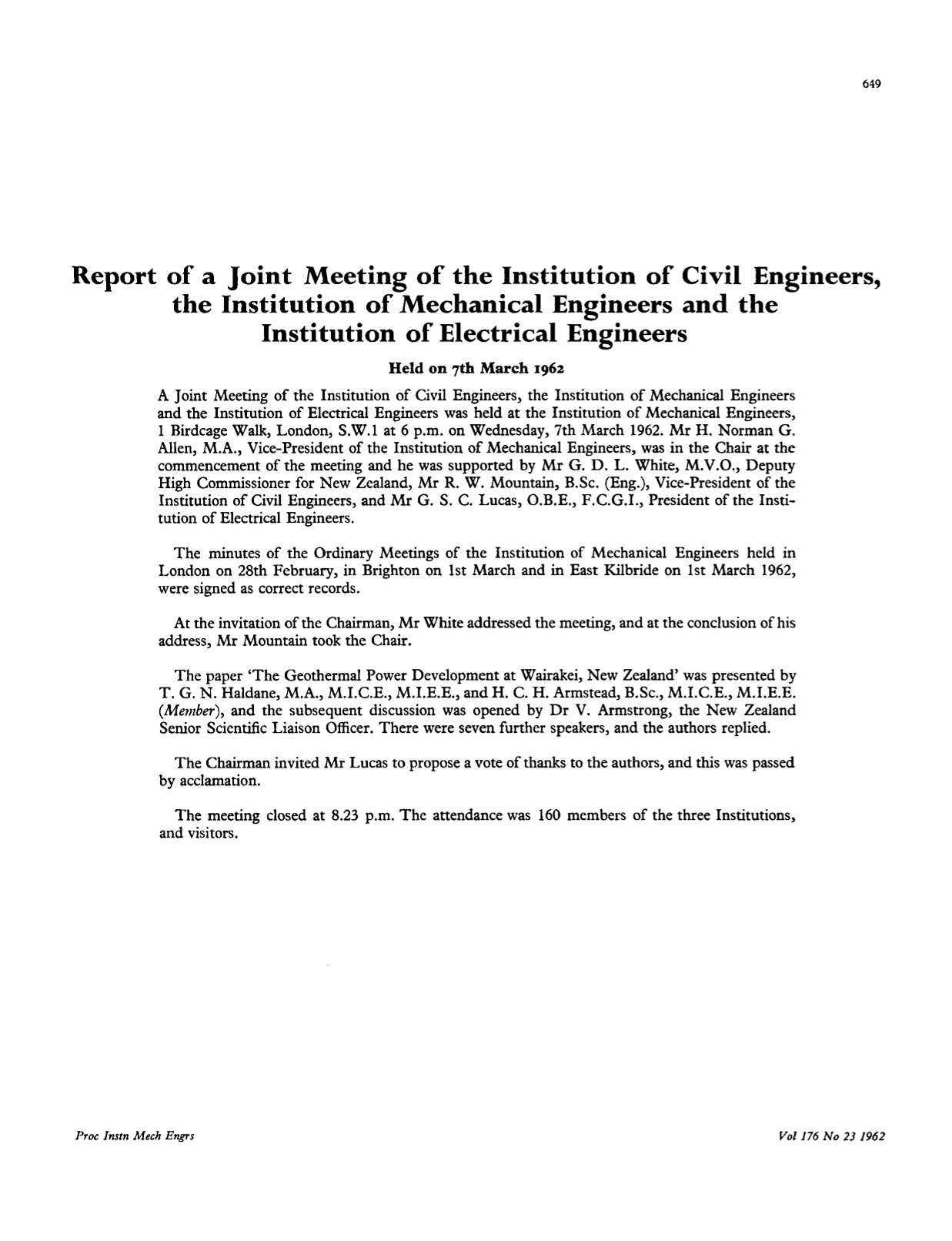
Until recently the only country to generate power on a substantial scale from geothermal heat has been Italy, but New Zealand is now doing this successfully at Wairakei near the centre of the North Island. The field from which heat is obtained covers only a very small part of an extensive belt—about 150 miles long by 30 miles wide and bounded by active volcanoes—in which a variety of thermal activity occurs
69 MW of plant, forming the first stage of development, had been commissioned by March 1960 and a 123 MW extension is now under construction. The total authorized installation of 192 MW is expected to be completed early in 1963. The largest of the generating sets now being installed are 30 MW mixed pressure machines. About 10 per cent of the energy requirements of North Island is now being supplied from Wairakei and in a year's time this contribution should be about 20 per cent
The Wairakei bores yield a mixture of hot water and steam, and the paper describes how the two phases are separated from one another at the wellheads. The first stage plant is supplied with bore steam only, but in the extension now in hand limited use will be made of flash steam from the hot water. A further plant extension has been tentatively planned to raise the installed capacity to 282 MW, the intention being then to generate about one-third of the total output from flash steam. The bores are mostly about 2000 ft deep and after separation at the wellhead the steam is delivered to the power station at two working pressures—180 lb/in2 g and 50 lb/in2 g. The hot water is being transmitted separately at a somewhat higher pressure
The paper, which deals briefly only with geophysical theories as to the origin of the heat and the mechanism of its upward transfer to the ground surface, is primarily concerned with the engineering problems of extracting electrical power from the steam and hot water. The site, the bores, the plant and equipment and the buildings are first described and some of the principal design problems are then considered. These problems include the choice of suitable materials resistant to corrosive steam and the techniques of transmitting large quantities of steam and hot water over a considerable distance and of flashing part of the water into steam on arrival at the power station. After dealing with design considerations the paper proceeds to describe the control methods and the safety precautions adopted. An account of operating experience to date then follows and estimates of cost are given
The station provides base load at a very high load factor, the output being independent of seasonal or diurnal variations, and the development has come at a time when the hydraulic resources of the North Island are approaching full exploitation. Despite much practical experience there is as yet little firm knowledge regarding the origin and extent of the geothermal heat. Although it is believed that the heat resources of the Wairakei area are ample it was thought prudent to write off all capital costs over a period not exceeding 20 years, and allowance has been made for writing off the bore-hole costs over a shorter period
The New Zealand Ministry of Works are responsible for drilling and other steam winning work; the generating plant is installed and operated by the State Electricity Department. The Wairakei geothermal development is of considerable scientific as well as commercial interest and scientific investigations are undertaken by the New Zealand D.S.I.R

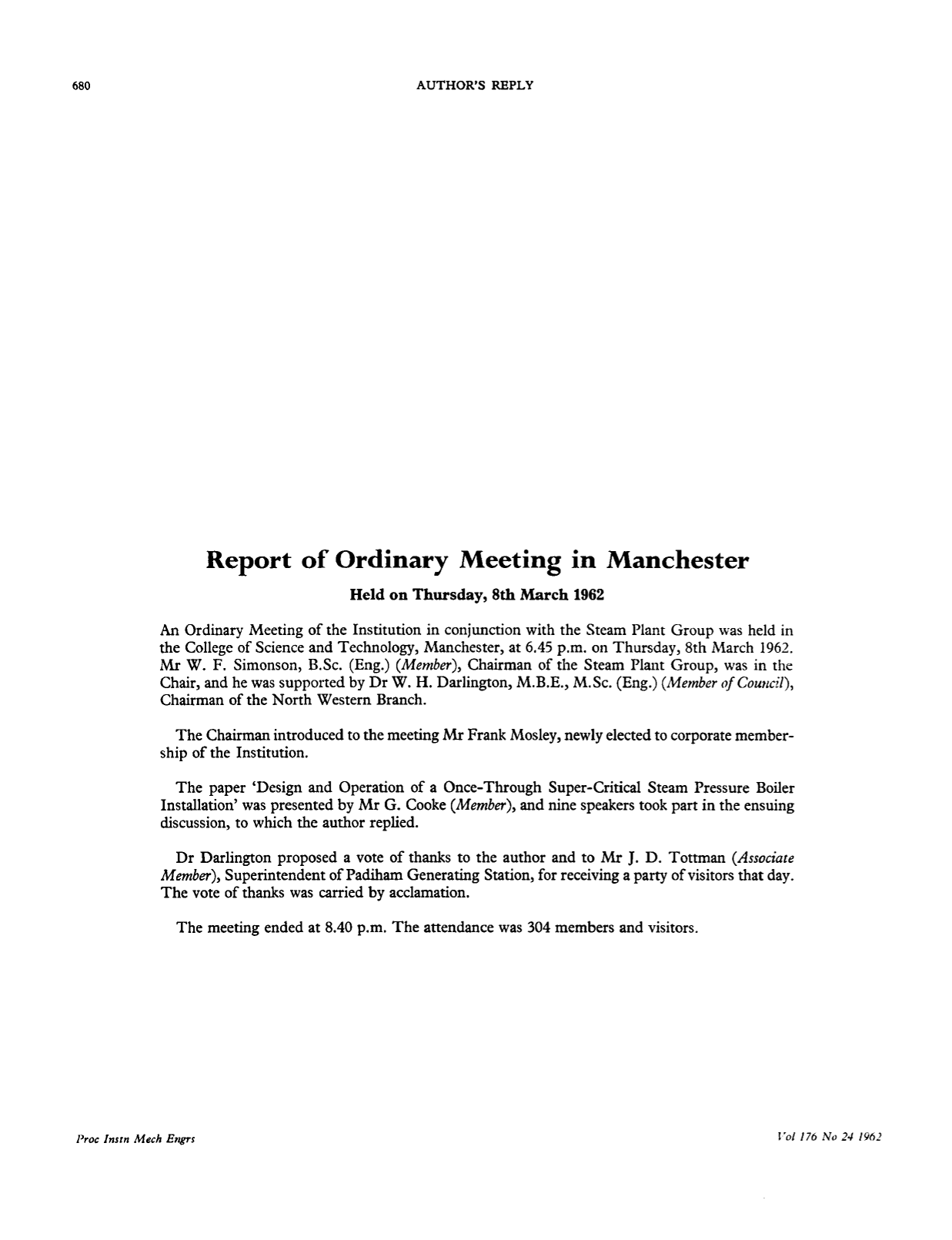
The paper describes the first super-critical once-through boiler to be installed in Great Britain. The unit is designed as a topping installation working in conjunction with a back pressure turbine exhausting into a medium pressure steam system
Reasons for the choice of critical pressure are given, followed by a note on the fuels used and their effect on design. The boiler and its auxiliary plant are then described together with the control system; a note is included on feed water
The operation of the boiler, including the method of starting up and shutting down, as well as some difficulties with tube faults, is described
The paper concludes with a statement that the boiler has fulfilled its purpose since it is extremely flexible in response to load changes, and is also capable of operation below the designed pressure and temperature, if required to do so.

The paper summarizes the results of a number of starting tests, after unit shutdowns of 6 and 36 hours respectively, conducted collaboratively by the manufacturers of the principal generating plant and the C.E.G.B. on a 100-MW reheat unit, in October-November 1959, and on a 120-MW reheat unit in June-July 1961.
The units were extensively instrumented for the tests and many steam and metal temperature measurements on the boiler, pipework and turbine were taken at regular short intervals to determine the thermal condition of the unit during the shutdown and starting operation.
The tests were conducted on the basis of carefully planned and agreed operational procedures, within the framework of the working limits recommended by the manufacturers of the principal generating plant.
It was demonstrated that the units could be satisfactorily and quickly started up to full load with a drainage loss of about 22 000 lb, after a 6-h shutdown, and with a drainage loss of approximately 20 000 lb, and 52 000 lb, after a 36-h shutdown, for the 120-MW and 100-MW unit respectively, without exceeding the recommended limits.
It was possible to operate the 100-MW unit at full load in 64 min, and 120-MW unit in 51 min from lighting the boiler, after a 6-h shutdown. The minimum turbo-generator loading times were 25 and 11 1/2 min respectively.
After a 36-h shutdown the 100-MW unit was brought up to full load in about 200 min and the 120-MW unit brought up to full load in about 170 min from lighting the boiler. The corresponding loading times were 110 and 55 1/2 min respectively.
Information obtained from the tests has been used in designing new plant.
The paper includes descriptions of the plant installed, instrumentation used, and the development of the tests. The recommended procedures for two-shift operation of these units are also given, based on the results obtained.

Steam and steam-water flashing flow were used to obtain critical† discharge pressures for pipes over the stagnation enthalpy range 230 to 1200 Btu/lb and for the critical pressure range 14 to 64 lb/in2 abs.
Pipe sizes used were 3, 6 and 8 in. in diameter. The following empirical equation covers the data with an accuracy of ±3 per cent:
where
It is also shown that the amount of energy flowing along a pipe can be obtained accurately to within ±10 per cent if the critical pressure only is known; that is, the stagnation enthalpy is not known.


The theory of the operation of porous metal bearings as given in the 1957 Conference on Lubrication and Wear has now been extended. The analysis of a 360° porous bearing leads to a critical value of the Sommerfeld reciprocal 1/δ below which full fluid lubrication cannot be obtained. The magnitude of this critical value 1/Δc is found to vary only with the length to diameter ratio of the bearing
The frozen stress photo-elastic technique was employed to determine the elastic stresses in T-shaped branched pipes. All branches had the same ratio of inner diameter to outer diameter as the main pipes and this ratio varied from 1/6 to 1/1 1/2. The ratio of branch diameter to main pipe diameter varied from 1/4 to 1. The peak stresses measured in 21 models of plain intersections showed no significant changes due to variation of branch diameter. External reinforcements in the form of collars, ‘Blair triforms’ and horseshoes were shown to be effective.
Internal chamfers and counter-bores also reduced the peak stresses in thick pipes.


Some comments are made on the teaching of mechanical vibration theory to undergraduates. Reassessment appears to be needed of several topics which are normally taught and certain others demand admittance to a modern syllabus.

A brief review is given of the early methods used for the load verification of material-testing machines. Demands for greater accuracy led to the development of elastic proving devices, followed by deadweight standards of sufficient accuracy to calibrate these devices. The methods resulting from these developments are also described. The definition of the technical unit of force is given, followed by a consideration of the minimum accuracies required of deadweight standards, proving devices and testing machines verified by proving devices. These considerations of accuracy bear particular reference to the British Standard covering the load verification of testing machines.
A deadweight standard machine and many of the more common types of proving devices are briefly described. General guidance is given of the range of loads covered and the performance which may be expected of the various types of proving devices.