Other
Select search scope: search across all journals or within the current journal

Over-the-counter (OTC) medication use has increased among HIV-infected patients. Inappropriate use of OTC drugs may increase the risk of potential adverse drug events (ADEs), thus decreasing health-related quality of life (HRQL).
To examine the effect of OTC medication misuse and associated ADEs on HRQL of HIV-infected patients.
A cross-sectional field study with HIV-infected patients from an HIV clinic in Houston, Texas, was conducted from April 1, 2005, to June 30, 2005. A validated questionnaire (including questions on OTC medications used; ADEs experienced; and HRQL, Short Form-12, version 2 scale) was administered using self-administered and personal interview techniques. Cronbach's α was estimated to evaluate internal consistency for HRQL scores and χ2 and
Of the 215 respondents, 80 (37.2%) misused OTC medications. Thirty-six participants (16.7%) experienced ADEs due to OTC use or misuse. ADE incidence was significantly higher in patients misusing OTCs. Significantly lower HRQL scores for the physical component summary score domains were observed in patients reporting ADEs versus those who did not.
HIV-infected patients had lower HRQL scores when they experienced an OTC-associated ADE. Patients misusing OTC medications had a higher incidence of associated ADEs. Interventions by healthcare providers and patients aimed at reducing misuse and ADEs due to OTC medications would improve care and the quality of life for HIV-infected patients.
Medication safety is a major concern in primary care. Documented interventions by clinical pharmacists have shown positive clinical outcomes. In addition, it has been shown that student pharmacists have positive outcomes when participating in their advanced pharmacy practice experiences (APPEs). Most of this documentation has taken place in hospital settings. No data are available regarding interventions performed when APPE students record medication histories prior to a primary care provider (PCP) appointment.
To describe the number and types of interventions made by APPE students in recording medication histories and to describe PCP acceptance rates.
This prospective study documented the interventions from medication histories by 2 APPE students. With faculty supervision, the students recorded medication histories and vital signs prior to patient appointments with their PCPs. This was done approximately 1.5 days/week. Recommendations to the PCP were made verbally prior to the patient examination. Type of recommendation made, patient demographics, and PCP acceptance were documented. Descriptive statistics were employed.
Over 6 weeks, 109 interventions were documented. The mean ± SD patient age was 61.8 ± 14.94 years. The most common interventions documented were laboratory monitoring (22.0%), drug information (17.4%), and patient education (14.7%). Of the applicable interventions, 69% (49/71) were accepted by the PCP.
APPE students in this clinic provided a variety of recommendations following completion of medication histories. A majority of the interventions were accepted. Such data demonstrate the benefit of including APPE students in patient care.
Although cognitive services have become more widely accepted among pharmacists since Medicare Part D provided a benefit to allow for billing of services, not all pharmacists have incorporated services into their practices.
To identify opportunities for pharmacy technicians to aid pharmacists in medication therapy management (MTM).
Articles were identified through searches of MEDLINE/PubMed (1950–July 2008) and review of MTM resources from the American Pharmacists Association. Articles describing medication therapy management and pharmacy technicians were included.
As the pharmacy profession embraces extensive patient counseling in the form of MTM, many aspects of the practice of pharmacy need to evolve to ensure MTM program success. Time constraints limit the ability of pharmacists to handle administrative tasks and represent a major barrier to MTM program implementation. Technicians can do some of the work to reduce this barrier. With proper training, technicians can assist pharmacists in the tasks that do not require the professional judgment of a pharmacist, freeing pharmacists to focus on clinical activities and enabling an MTM program to be more sustainable. For example, technicians can help in areas such as scheduling and patient reminders through phone calls. Medication histories and health histories can also be documented by technicians, as can chart construction, filing, and the documentation of release forms and health histories. Additional steps can be taken to further increase efficiency in the MTM process and include creation of a flow map and cross training of all pharmacy staff.
Through developing new roles, technicians can help pharmacists provide pharmaceutical care and develop a successful MTM program.
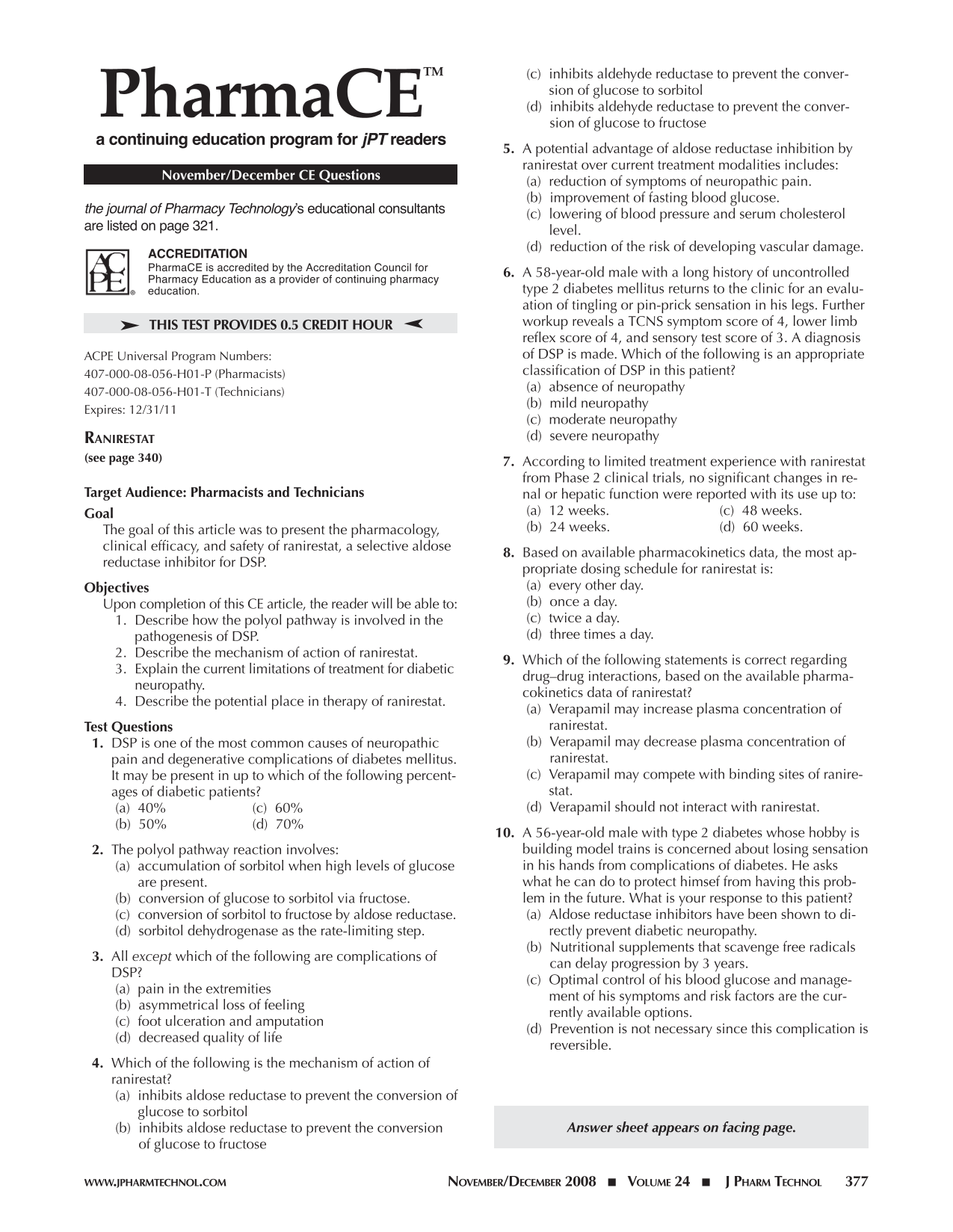
To review the pharmacology, pharmacokinetics, clinical efficacy, and safety of ranirestat, an oral aldose reductase inhibitor with a unique chemical structure, as treatment of diabetic sensorimotor polyneuropathy in patients with diabetes mellitus.
Primary literature and review articles were identified by searching MEDLINE (1950–June 2008), EMBASE (1991–June 2008),
Reviewed literature was restricted to available English-language articles. Preclinical and clinical trials were reviewed. One Phase 2 clinical trial and its extension study were identified. No data have yet been reported from Phase 3 trials that were conducted between 2004 and 2006.
Ranirestat is a selective and reversible inhibitor of aldose reductase. Nerve damage is reduced by inhibiting this key enzyme in the polyol pathway, thus preventing the accumulation of sorbitol and fructose. Ranirestat has been compared with placebo in randomized, double-blind, controlled trials. Improvement in nerve function, sensation, and clinical grading scale were noted. Ranirestat was reported to be well tolerated.
Ranirestat may offer a clinical advantage over current treatment modalities as the first agent to address one factor in the underlying cause of diabetic sensorimotor polyneuropathy. Further studies should be done on safety, efficacy, tolerability, and quality of life to determine how successful this agent will be in the treatment of diabetic sensorimotor polyneuropathy.
407-000-08-056-H01-P (Pharmacists); 407-000-08-056-H01-T (Technicians)