
Editorial
 Available accessEditorialFirst published March, 2015pp. 143-144

Select search scope: search across all journals or within the current journal


 Available accessEditorialFirst published March, 2015pp. 143-144Available accessResearch articleFirst published March, 2015pp. 145-158
An important component of political polarization in the United States is the degree to which ordinary people perceive political polarization. We used over 30 years of national survey data from the American National Election Study to examine how the public perceives political polarization between the Democratic and Republican parties and between Democratic and Republican presidential candidates. People in the United States consistently overestimate polarization between the attitudes of Democrats and Republicans. People who perceive the greatest political polarization are most likely to report having been politically active, including voting, trying to sway others’ political beliefs, and making campaign contributions. We present a 3-factor framework to understand ordinary people’s perceptions of political polarization. We suggest that people perceive greater political polarization when they (a) estimate the attitudes of those categorized as being in the “opposing group”; (b) identify strongly as either Democrat or Republican; and (c) hold relatively extreme partisan attitudes—particularly when those partisan attitudes align with their own partisan political identity. These patterns of polarization perception occur among both Democrats and Republicans.
Available accessResearch articleFirst published March, 2015pp. 159-175Researchers have proposed different accounts of the development of prosocial behavior in children. Some have argued that behaviors like helping and sharing must be learned and reinforced; others propose that children have an initially indiscriminate prosocial drive that declines and becomes more selective with age; and yet others contend that even children’s earliest prosocial behaviors share some strategic motivations with the prosociality of adults (e.g., reputation enhancement, social affiliation). We review empirical and observational research on children’s helping and sharing behaviors in the first 5 years of life, focusing on factors that have been found to influence these behaviors and on what these findings suggest about children’s prosocial motivations. We use the adult prosociality literature to highlight parallels and gaps in the literature on the development of prosocial behavior. We address how the evidence reviewed bears on central questions in the developmental psychology literature and propose that children’s prosocial behaviors may be driven by multiple motivations not easily captured by the idea of intrinsic or extrinsic motivation and may be selective quite early in life.
Available accessResearch articleFirst published March, 2015pp. 176-199The primary goal of instruction should be to facilitate long-term
Available accessOtherFirst published March, 2015pp. 200-201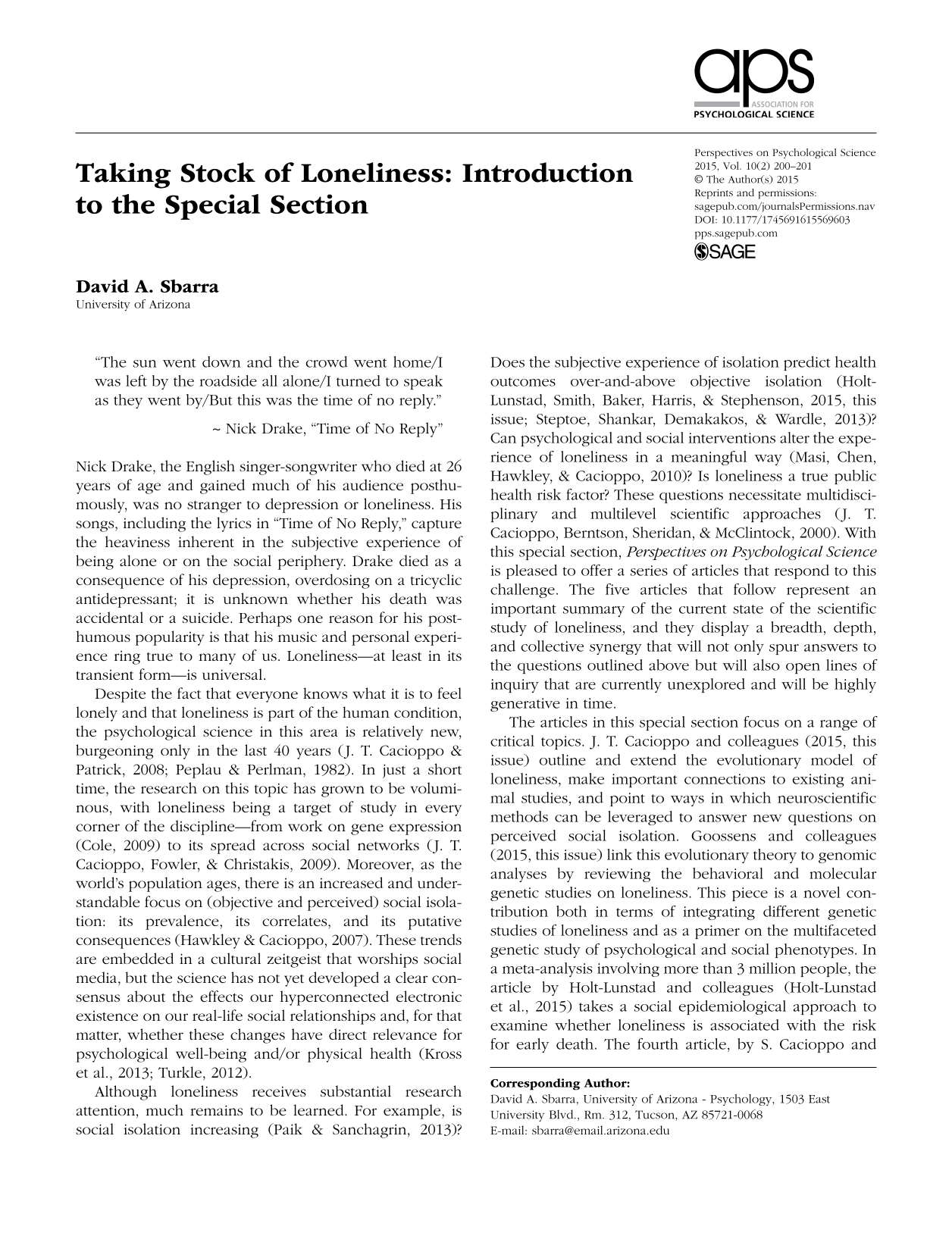 Available accessResearch articleFirst published March, 2015pp. 202-212
Loneliness typically refers to the feelings of distress and dysphoria resulting from a discrepancy between a person’s desired and achieved levels of social relations, and there is now considerable evidence that loneliness is a risk factor for poor psychological and physical health. Loneliness has traditionally been conceptualized as a uniquely human phenomenon. However, over millions of years of evolution, efficient and manifold neural, hormonal, and molecular mechanisms have evolved for promoting companionship and mutual protection/assistance and for organizing adaptive responses when there is a significant discrepancy between the preferred and realized levels of social connection. We review evidence suggesting that loneliness is not a uniquely human phenomenon, but, instead, as a scientific construct, it represents a generally adaptive predisposition that can be found across phylogeny. Central to this argument is the premise that the brain is the key organ of social connections and processes. Comparative studies and animal models, particularly when integrated with human studies, have much to contribute to the understanding of loneliness and its underlying principles, mechanisms, consequences, and potential treatments.
Available accessResearch articleFirst published March, 2015pp. 213-226As a complex trait, loneliness is likely to be influenced by the interplay of numerous genetic and environmental factors. Studies in behavioral genetics indicate that loneliness has a sizable degree of heritability. Candidate-gene and gene-expression studies have pointed to several genes related to neurotransmitters and the immune system. The notion that these genes are related to loneliness is compatible with the basic tenets of the evolutionary theory of loneliness. Research on gene-environment interactions indicates that social-environmental factors (e.g., low social support) may have a more pronounced effect and lead to higher levels of loneliness if individuals carry the sensitive variant of these candidate genes. Currently, there is no extant research on loneliness based on genome-wide association studies, gene-environment-interaction studies, or studies in epigenetics. Such studies would allow researchers to identify networks of genes that contribute to loneliness. The contribution of genetics to loneliness research will become stronger when genome-wide genetics and epigenetics are integrated and used along with well-established methods in psychology to analyze the complex process of gene-environment interplay.
Available accessResearch articleFirst published March, 2015pp. 227-237Actual and perceived social isolation are both associated with increased risk for early mortality. In this meta-analytic review, our objective is to establish the overall and relative magnitude of social isolation and loneliness and to examine possible moderators. We conducted a literature search of studies (January 1980 to February 2014) using MEDLINE, CINAHL, PsycINFO, Social Work Abstracts, and Google Scholar. The included studies provided quantitative data on mortality as affected by loneliness, social isolation, or living alone. Across studies in which several possible confounds were statistically controlled for, the weighted average effect sizes were as follows: social isolation odds ratio (OR) = 1.29, loneliness OR = 1.26, and living alone OR = 1.32, corresponding to an average of 29%, 26%, and 32% increased likelihood of mortality, respectively. We found no differences between measures of objective and subjective social isolation. Results remain consistent across gender, length of follow-up, and world region, but initial health status has an influence on the findings. Results also differ across participant age, with social deficits being more predictive of death in samples with an average age younger than 65 years. Overall, the influence of both objective and subjective social isolation on risk for mortality is comparable with well-established risk factors for mortality.
Available accessResearch articleFirst published March, 2015pp. 238-249In 1978, when the Task Panel report to the U.S. President’s Commission on Mental Health emphasized the importance of improving health care and easing the pain of those suffering from emotional distress syndromes including loneliness, few anticipated that this issue would still need to be addressed 40 years later. In 2011, a meta-analysis on the efficacy of treatments to reduce loneliness identified a need for well-controlled randomized clinical trials focusing on the rehabilitation of maladaptive social cognition. We review assessments of loneliness and build on this meta-analysis to discuss the efficacy of various treatments for loneliness. With the advances made over the past 5 years in the identification of the psychobiological and pharmaceutical mechanisms associated with loneliness and maladaptive social cognition, there is increasing evidence for the potential efficacy of integrated interventions that combine (social) cognitive behavioral therapy with short-term adjunctive pharmacological treatments.
Available accessResearch articleFirst published March, 2015pp. 250-264Most people have experienced loneliness and have been able to overcome it to reconnect with other people. In the current review, we provide a life-span perspective on one component of the evolutionary theory of loneliness—a component we refer to as the reaffiliation motive (RAM). The RAM represents the motivation to reconnect with others that is triggered by perceived social isolation. Loneliness is often a transient experience because the RAM leads to reconnection, but sometimes this motivation can fail, leading to prolonged loneliness. We review evidence of how aspects of the RAM change across development and how these aspects can fail for different reasons across the life span. We conclude with a discussion of age-appropriate interventions that may help to alleviate prolonged loneliness.