Editorial
Select search scope: search across all journals or within the current journal

Transport of serum proteins from the circulation to peritoneal dialysate in peritoneal dialysis patients mainly focused on total protein. Individual proteins have hardly been studied. We determined serum and effluent concentrations of four individual proteins with a wide molecular weight range routinely in the standardised peritoneal permeability analysis performed yearly in all participating patients. These include β2-microglobulin, albumin, immunoglobulin G and α2-macroglobulin. The dependency of transport of these proteins on their molecular weight and diffusion coefficient led to the development of the peritoneal protein restriction coefficient (PPRC), which is the slope of the relation between the peritoneal clearances of these proteins and their free diffusion coefficients in water, when plotted on a double logarithmic scale. The higher the PPRC, the more size restriction to transport. In this review, we discuss the results obtained on the PPRC under various conditions, such as effects of various osmotic agents, vasoactive drugs, peritonitis and the hydrostatic pressure gradient. Long-term follow-up of patients shows an increase of the PPRC, the possible causes of which are discussed. Venous vasculopathy of the peritoneal microcirculation is the most likely explanation.
Patients receiving peritoneal dialysis (PD) experience poor quality of life, depression, anxiety and lifestyle changes. Insights into how patients adjust to and cope with PD from a psychological perspective will aid care.
Participants were recruited purposively through the Central Northern Adelaide Renal and Transplantation Service in South Australia. Ten patients receiving automated PD (APD) (5 females and 5 males) aged 31 to 77 years (M = 59.3) participated in a semi-structured interview. Interview transcripts were analysed thematically through inductive and deductive methods.
Five main themes representing participants’ experiences and perspectives of adjusting to and coping with APD were identified: (1) Resigned Acceptance, (2) A Bridge to Transplant, (3) Navigating Emotions at Milestones and Transitions, (4) Professional Support (Sub-themes: Psychological Support and Education and Information Delivery and (5) Social Enablers (Sub-theme: Hidden from View and Hiding Illness).
Patients employ cognitive, emotional and behavioural strategies and rely strongly on social supports to cope with APD. PD at home aids preservation of pre-illness identity, however, also results in feelings of isolation and being misunderstood. Psychological distress and poor coping may be heightened at key disease milestones and transition periods when professional psychological support should be offered. We provide suggestions to address patients’ psychosocial needs and coping in treatment decision-making and dialysis care.
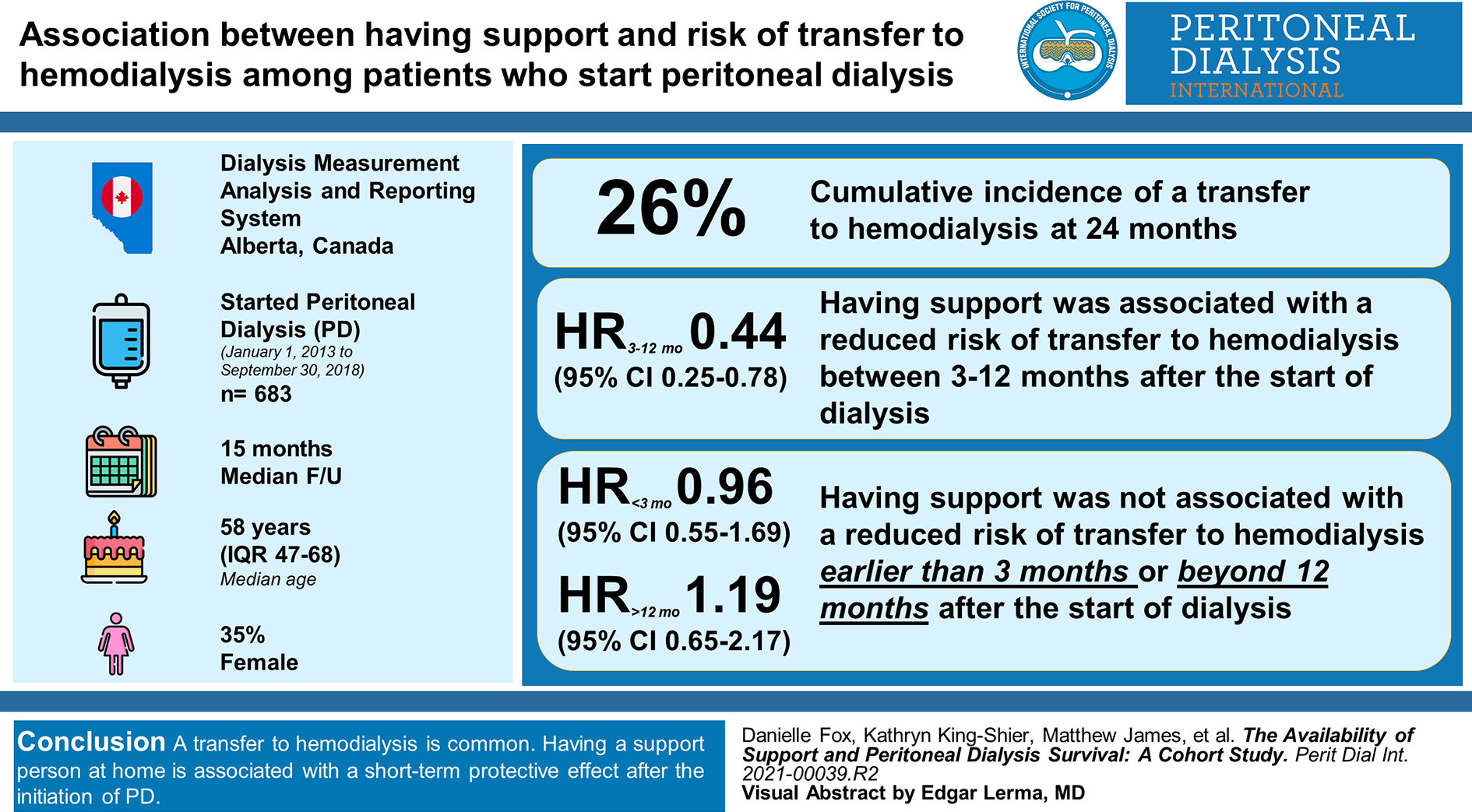
Providing support is important to maintain a patient on peritoneal dialysis (PD), though its impact on outcomes has not been investigated thoroughly. We examined the association between having support and risk of a transfer to hemodialysis.
In this retrospective observational cohort study, we used data captured in the Dialysis Measurement Analysis and Reporting system about patients who started PD in Alberta, Canada, between 1 January 2013 and 30 September 2018. Support was defined as the availability of a support person in the home who was able, willing and available to provide support for PD in the patient’s residence. The outcome of interest was a transfer to hemodialysis for at least 90 days. We estimated the cumulative incidence of a transfer over time accounting for competing risks and hazard ratios to summarise the association between support and a transfer. We split follow-up time as hazard ratios varied over time.
Six hundred and eighty-three incident PD patients, median age 58 years (
A transfer to hemodialysis is common. Having a support person at home is associated with a short-term protective effect after the initiation of PD.
This is a visual representation of the abstract.
Social deprivation could act as a barrier to peritoneal dialysis (PD). The objective of this study was to assess the association between social deprivation estimated by the European deprivation index (EDI) and PD uptake and to explore the potential mediators of this association.
From the Renal Epidemiology and Information Network registry, patients who started dialysis in 2017 were included. The EDI was calculated based on the patient’s address. The event of interest was the proportion of PD 3 months after dialysis initiation. A mediation analysis with a counterfactual approach was carried out to evaluate the direct and indirect effect of the EDI on the proportion of PD.
Among the 9588 patients included, 1116 patients were on PD; 2894 (30.2%) patients belonged to the most deprived quintile (Q5). PD was associated with age >70 years (odds ratio (OR) 0.79 [95% confidence interval (CI): 0.69–0.91]), male gender (0.85 [95% CI: 0.74–0.97]), cardiovascular disease (OR 0.86 [95% CI: 0.86–1.00]), chronic heart failure (OR 1.34 [95% CI: 1.13–1.58]), active cancer (OR 0.67 [95% CI: 0.53–0.85]) and obesity (OR 0.75 [95% CI: 0.63–0.89]). In the mediation analysis, Q5 had a direct effect on PD proportion OR 0.84 [95% CI: 0.73–0.96]. The effect of Q5 on the proportion of PD was mediated by haemoglobin level at dialysis initiation (OR 0.96 [95% CI: 0.94–0.98]) and emergency start (OR 0.98 [95% CI: 0.96–0.99]).
Social deprivation, estimated by the EDI, was associated with a lower PD uptake. The effect of social deprivation was mediated by haemoglobin level, a proxy of predialysis care and emergency start.
Treatment of kidney failure with peritoneal dialysis (PD) at home implies that the patient and/or their caregiver develop a series of skills and basic knowledge about this therapy. There is not a specific inventory of the patient’s abilities to safely perform the PD procedure at home. The objective of this study was to describe the development of an instrument that allows measuring the self-management capacity of patients receiving PD, locating the performance areas that justify the need for intervention by a caregiver.
This is a qualitative study developed in three phases: The first phase was the identification of performance areas through bibliographic search and validation of the results with focus groups of experts in PD. The second phase was the design of a system to measure self-management capacities. The third phase was a pilot test of the preliminary version of the instrument applied in 20 incident PD patients.
Three domains were identified to evaluate the fundamental components of self-management capacity: cognitive and sensory, each one evaluated with four items and motor domain evaluated with eight items. After applying the instrument, we found that 15 patients (75%) did not require support from the caregiver in any of the items. PD patients and nurses found the tool valuable, easy to understand and applicable in the early evaluation of a PD patient.
We developed an easy-to-administer instrument to measure the self-management capacity of patients receiving PD. This inventory could locate areas that require specific support from a caregiver. Planning an individualised and focused education and training process could result in better health outcomes.
There are various options for managing end-stage kidney disease. Each option impacts the lives of patients differently. When weighing the pros and cons of the different options, patients’ values, needs and preferences should, therefore, be taken into account. However, despite the best intentions, nephrologists may, more or less deliberately, convey a treatment preference and thereby steer the decision-making process. Being aware of such implicit persuasion could help to further optimise shared decision-making (SDM). This study explores verbal acts of implicit persuasion during outpatient consultations scheduled to make a final treatment decision. These consultations mark the end of a multi-consultation, educational process and summarise treatment aspects discussed previously.
Observations of video-recorded outpatient consultations in nephrology (
In nearly every consultation nephrologists used some form of implicit persuasion. Frequently observed behaviours included selectively presenting treatment options, benefits and harms, and giving the impression that undergoing or foregoing treatment is unusual. The extent to which nephrologists used these behaviours differed.
The use of implicit persuasion while discussing different kidney replacement modalities appears diverse and quite common. Nephrologists should be made aware of these behaviours as implicit persuasion might prevent patients to become knowledgeable in each treatment option, thereby affecting SDM and causing decisional regret. The developed coding scheme for observing implicit persuasion elicits useful and clinically relevant examples which could be used when providing feedback to nephrologists.
This retrospective cohort study investigated the characteristics and outcomes of the end-stage kidney disease (ESKD) patients treated with incremental peritoneal dialysis (PD) at a large academic centre.
ESKD patients initiating PD with a dialysate volume ≤6 L/day were analysed.
One hundred and seventy-five patients were included and were followed up for 352.6 patient-years. The baseline residual kidney function (RKF) was 8.3 ± 3.4 mL/min/1.73 m2. The unadjusted 1- to 5-year patient survival rate was 89.6%, 80.4%, 65.4%, 62.7% and 48.8%, respectively, and the corresponding time on PD therapy rate was 95.1%, 89.1%, 89.1%, 82.4% and 77.6%. Greater initial PD dose (hazard ratio = 1.608, 95% confidence interval 1.089–2.375) was associated with death after adjusting for age, Charlson comorbidity index (CCI), haemodialysis prior to PD, assisted PD and baseline RKF, likely as a result of residual confounding. There was no association with PD discontinuation. The average peritonitis rate and hospitalisation rate were 0.122 and 0.645 episodes per patient-year, respectively. The dialysate volume increased from 4.5 (4.3–5.7) L/day to 8.0 (6.0–9.8) L/day at 5 years. Fifty-seven (32.6%) patients graduated to full-dose PD at a median time of 10.3 (6.2, 15.7) months. Male sex, greater body mass index and lower baseline serum albumin were risk factors for increasing PD dose to over 6 L/day within 1 year.
Incremental PD is a safe approach to initiate dialysis, and it offers satisfactory outcomes. Close monitoring, comprehensive evaluation of clinical responses and prompt adjustment of the prescription as needed play a crucial role in this patient-centred treatment.
Regeneration of peritoneal dialysis (PD) fluid using sorbent technology can provide flexibility and improve quality of life. This study examined the safety and efficacy of the automated wearable artificial kidney (AWAK) device in PD patients.
This pilot study included prevalent PD patients from a single center in Singapore between 2016 and 2018. Participants underwent up to nine AWAK therapies over 72 h and were followed up for 1 month. Primary outcomes were serious adverse events (SAEs) and completion of nine therapies without device deficiency. Secondary outcomes were weekly peritoneal Kt/
Twenty-one patients were screened and 15 were included in the study. Device alterations were required to overcome issues including flow occlusions initially, which resulted in three cohorts (
This preliminary study demonstrated that no SAEs were observed with the AWAK-PD device; however, 60% of participants developed abdominal pain/discomfort. Further device enhancements are needed to improve ultrafiltration and reduce AEs.
The Peritoneal Dialysis Outcomes and Practice Patterns Study (PDOPPS) is an international, prospective study following persons treated by peritoneal dialysis (PD) to identify modifiable practices associated with improvements in PD technique and person survival. The aim of this study was to assess the representativeness of the Australian cohort included in PDOPPS compared to the complete Australian PD population, as reported to the Australia and New Zealand Dialysis and Transplant (ANZDATA) Registry.
Adults with at least one PD treatment reported to ANZDATA Registry during the census period of PDOPPS Phase I (November 2014 to April 2018) were compared to the Australian PDOPPS cohort. The primary outcomes were the representativeness of centres and persons. Secondary outcomes explored the association of person characteristics with consent to study participation.
After data linkage, 511 PDOPPS participants were compared to 5616 Australians treated with PD. Within centres eligible for PDOPPS, selected centres were similar to other Australian centres. The PDOPPS participants’ cohort tended to include older persons, more males, a higher proportion of Caucasians and more persons with higher socioeconomic advantage compared to the Australian PD population. Differences in distribution across sex and ethnicities between the PDOPPS cohort and the overall PD population were in part due to the selection and consent processes, during which females and non-Caucasians were more likely to not consent to PDOPPS participation.
Sampling methods used in PDOPPS allowed for good national representativeness of the included centres. However, representativeness of the unweighted PDOPPS sample was suboptimal in regard to some participant characteristics.
Thymus and activation-regulated chemokine (TARC), which induces a Th2-dominated inflammation, is a well-known biomarker that reflects the severity of atopic dermatitis. The present study aimed to evaluate TARC as a Th2-associated marker with chronic kidney disease-associated pruritus (CKD-aP) in patients with peritoneal dialysis (PD).
This single-centre cross-sectional study included patients who underwent PD in our hospital between August 2020 and July 2021. The severity and impaired quality of life (QOL) of CKD-aP were assessed using the visual analogue scale (VAS) and Japanese version of the 5-D itch scale (5D-J), respectively.
A total of 48 patients with PD were included in the present study. Age and dialysis vintage were (mean ± SD) 64.8 ± 12.0 year and (median (IQR)) 38.5 (11.5–91.5) month, respectively. VAS and 5D-J scores were 3.3 ± 2.0 and 10.5 (9.0–12.0), respectively. Serum TARC level was 481.5 (278.9–603.4) pg/mL (upper limits of normal 450 pg/mL) and significantly correlated with VAS (
Serum TARC level is an independent predictor of the severity and impaired QOL of CKD-aP in patients with PD, and TARC might be involved in the pathogenesis of CKD-aP.
Peritoneal dialysis (PD) is as safe and more cost-effective than haemodialysis (HD). It also allows patients to undergo renal replacement therapy (RRT) from home. However, PD remains underutilised in many parts of the world. This is true in part because of many perceived relative contraindications to PD, including a history of prior major abdominal surgery. Prior major abdominal surgery is a concern for standard bedside or surgical catheter placement since these patients are at risk of having adhesions, which can complicate catheter placement. However, with laparoscopic advancements, prior major abdominal surgery is no longer even a relative contraindication to PD for skilled and experienced surgeons. We report the case of a male in his 70s with a history of cystoprostatectomy which was curative for a muscle invasive bladder carcinoma 5 years prior to his RRT. The patient had longstanding chronic kidney disease which worsened gradually. After receiving RRT education, the patient favoured PD. The catheter was placed despite the surgeon noting abdominal adhesions and the patient successfully underwent 12 months of PD which had a positive impact on his quality of life. He transferred to HD after contracting a complex PD-associated peritonitis. Thus, new research should be conducted to better understand the real impact of prior abdominal surgeries as a contraindication to PD, especially in centres where the surgeons have experience with advanced laparoscopy.
Despite an increase in incident peritoneal dialysis (PD) use of 20% per year, the overall PD prevalence in Indonesia is only 1–2%, with the goal of 30% yet to be reached by 2019. In the absence of contraindications, increasing continuous ambulatory PD (CAPD) use may be an attractive option for Indonesia to reduce the high costs of end-stage kidney disease (ESKD) treatment. The implementation of CAPD in Indonesia faces several challenges, including the cost of PD, the unique archipelagic geography, limited facilities and trained medical personnel in rural areas, inadequate reimbursement rates and incentive fees, high rates of PD discontinuation, as well as insufficient knowledge regarding CAPD by the general public and health professionals. Changes in the policy of medical service incentive fees and improvements in the national health insurance system regulation over CAPD may improve the utilization of PD for ESKD patients in Indonesia. Nationwide promotional and preventive efforts on chronic kidney disease, dialysis modality education and establishment of PD training programs for medical professionals are necessary.