Article commentary
Select search scope: search across all journals or within the current journal

Low bone density is common among those individuals receiving peritoneal dialysis. While cross-sectional studies support an association between low bone mineral density (BMD) and prevalent fracture, relying on bone density alone, particularly at the lumbar spine and in those with high degrees of hyperparathyroidism may underestimate fracture risk. Commonly used risk calculators in the general population have been shown to perform reasonably well in those receiving dialysis although they do not include any risk factors for high turnover bone disease that may play a role in increased fracture risk. The best options for decreasing fracture risk in patients receiving peritoneal dialysis are unclear. The evidence for bisphosphonates is limited to small studies of BMD, and concerns about drug accumulation have limited their use. Denosumab is more commonly used and has some evidence for improvement in BMD but carries with it a high risk of hypocalcaemia requiring rigorous prophylaxis. More research is needed to explore practical methods to identify those at risk of fracture and determine the efficacy of antiresorptive and anabolic therapies to decrease this risk.
Peritoneal dialysis (PD) uptake around the globe has steadily increased over the last several decades as a viable alternative to haemodialysis. Continued success of this technique for patients is contingent on the application of continuous quality improvement (CQI) principles in PD practice which can improve patient outcomes and in turn lead to more successful PD programmes worldwide. In this installation of ‘Your Questions Answered’, we will outline an approach to quality improvement initiatives and examine the importance of CQI principles in PD practice. We will also highlight common pitfalls and provide strategies to identify potential targets for improvement within your PD programme.
The practice and clinical outcomes of peritoneal dialysis (PD) have demonstrated significant improvement over the past 20 years. The aim of this review is to increase awareness and update healthcare professionals on current PD practice, especially with respect to patient and technique survival, patient modality selection, pathways onto PD, understanding patient experience of care and use prior to kidney transplantation. These improvements have been impacted, at least in part, by greater emphasis on shared decision-making in dialysis modality selection, the use of advanced laparoscopic techniques for PD catheter implantation, developments in PD connecting systems, glucose-sparing strategies, and modernising technology in managing automated PD patients remotely. Evidence-based clinical guidelines such as those prepared by national and international societies such as the International Society of PD have contributed to improved PD practice underpinned by a recognition of the place of continuous quality improvement processes.
Gastrointestinal (GI) health is considered vital to the success of peritoneal dialysis (PD) and is critically important to patients, caregivers and clinicians. However, the multiplicity of GI outcome measures in trials undermines the ability to evaluate the frequency, impact and treatment of GI symptoms in patients receiving PD. Therefore, this study aimed to assess the range and consistency of GI outcomes reported in contemporary PD trials.
Systematic review.
Individuals with kidney failure requiring PD.
All randomised controlled trials involving patients on PD, identified from the PUBMED, EMBASE and COCHRANE Central Registry of controlled Trials (CENTRAL) database, from January 2010 to July 2022.
Any PD-related intervention.
The frequency and characteristics of GI outcome measures were analysed and classified.
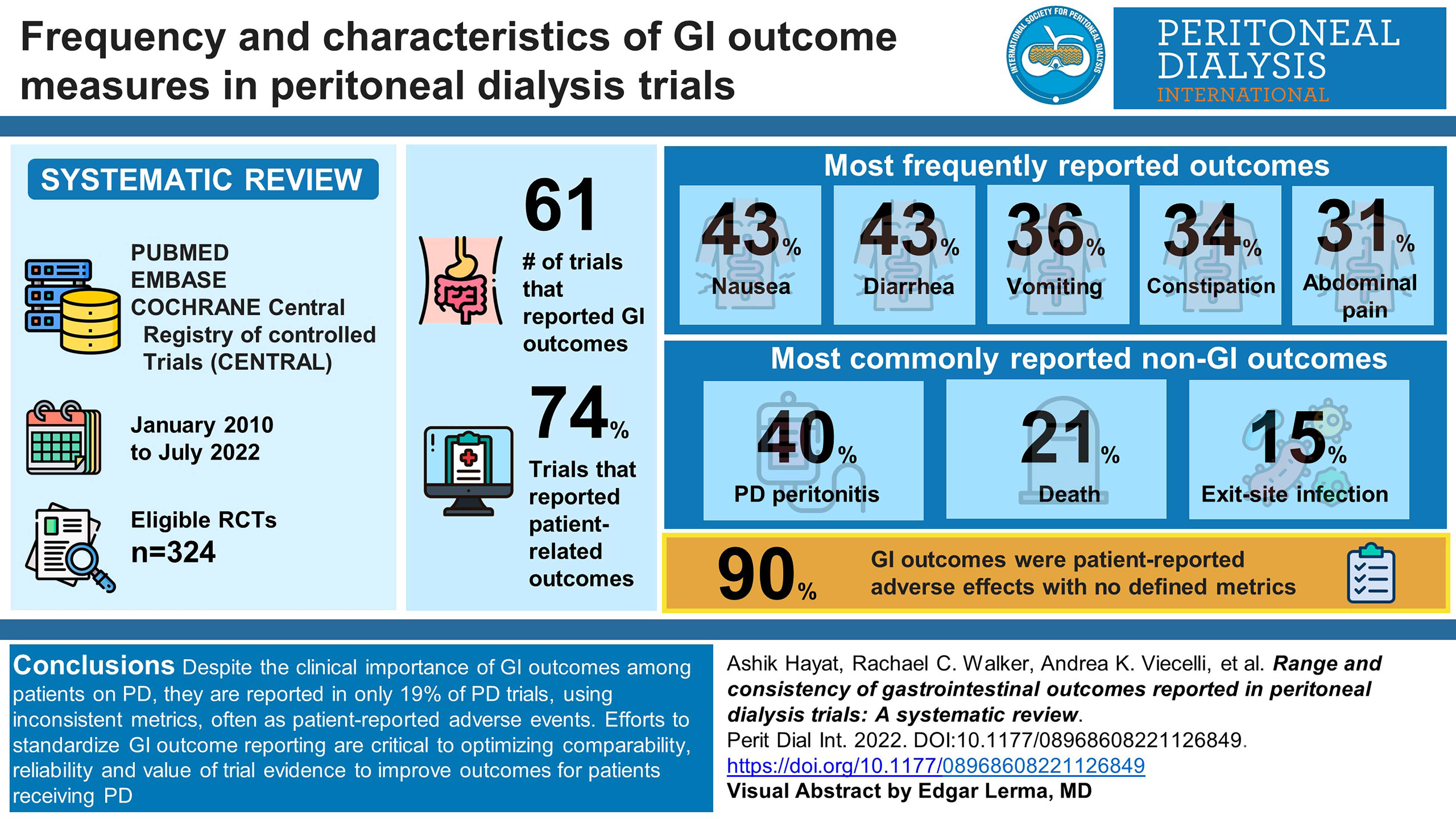
Of the 324 eligible PD trials, GI outcomes were only reported in 61 (19%) trials, mostly as patient-reported outcomes (45 trials; 74%). The most frequently reported outcomes were
Restricted sampling frame to focus on contemporary trials.
Despite the clinical importance of GI outcomes among patients on PD, they are reported in only 19% of PD trials, using inconsistent metrics, often as patient-reported adverse events. Efforts to standardise GI outcome reporting are critical to optimising comparability, reliability and value of trial evidence to improve outcomes for patients receiving PD.
This is a visual representation of the abstract.
Small hyperbranched polyglycerol (HPG) has been recently of interest for peritoneal dialysis, but its pharmacokinetics is barely understood. This study investigated the absorption, distribution and excretion of 1 and 3 kDa HPG.
Rats (naive, 5/6 nephrectomy (5/6 Nx) or bilateral nephrectomy (BNx)) received a single dose of 3H-labelled HPG-containing solutions intraperitoneally (IP) or intravenously (IV). Radioactivity in tissues, urine and faeces was counted using a scintillation counter. Pharmacokinetic parameters were calculated using WinNonlin software.
During 8-h dwell with IP injected therapeutic dose of HPG-based hypertonic solutions, the plasma levels of 1 kDa HPG reached the peak at 2 h, followed by a decrease to the end, whereas 3 kDa HPG increased for the duration of the 8 h. At the experimental endpoint, the distribution of both sizes of HPG in major organs was minimal, whereas most of 1 kDa HPG was excreted via urine, and of 3 kDa remained in peritoneal cavity. The elimination of both 1 and 3 kDa HPG after either IP or IV administration was significantly delayed by 5/6 Nx or BNx as compared to naive controls. Further, 24-h faecal excretion of HPG (3 kDa) was <5% of injected dose that was not different between healthy and BNx rats.
Data suggest size-dependent peritoneal absorption of osmotic HPG that are not specifically absorbed by any of the organs tested. The clearance of small HPG mainly depends on kidney excretion, implying the risk of HPG accumulation in patients with end-stage kidney disease who receive maintenance dialysis with HPG.
The pattern of chronic kidney disease–mineral bone disease has changed following the increase in elderly patients receiving dialysis, with escalating likelihood of osteoporosis, with associated increased fracture risk and mortality. Thus, we wished to determine the prevalence of osteoporosis in our peritoneal dialysis (PD) cohort. Lumbar spine (LS) and femoral neck (FN) bone mineral density (BMD) measured by dual-energy X-ray absorptiometry (DXA), and low BMD (osteoporosis) and reduced BMD (osteopenia) defined according to the World Health Organisation
Richter’s hernia is a rare type of hernia that occurs when the antimesenteric intestinal wall protrudes through a defect in the abdominal fascia leading to ischaemia, gangrene, bowel perforation and enterocutaneous fistulae. In this article, we describe a rare case of enterocutaneous fistula due to a Richter’s hernia after a Tenckhoff catheter removal. This type of complication has not been previously reported in the literature. An 82-year-old man presented with a 1-day history of enteric content at the Tenckhoff catheter insertion site. Seven weeks earlier, the catheter was removed due to peritonitis. Removal was performed using open technique, and the fascia was not closed. Computed tomography revealed a small incarcerated hernia and subcutaneous fluid collection at the previous catheter insertion site. He underwent laparoscopy, which showed a Richter’s hernia with perforation of the ileum causing an enterocutaneous fistula. A laparoscopic enterectomy was performed using a primary mechanical anastomosis. The hernia was repaired by primary suture without a mesh because of wound enteral contamination and the small size of the hernia. Richter’s hernia has a misleading clinical presentation and contributes to high rates of morbidity and mortality. A secure myofascial closure during catheter removal may reduce the chances of this complication.