Other
Select search scope: search across all journals or within the current journal

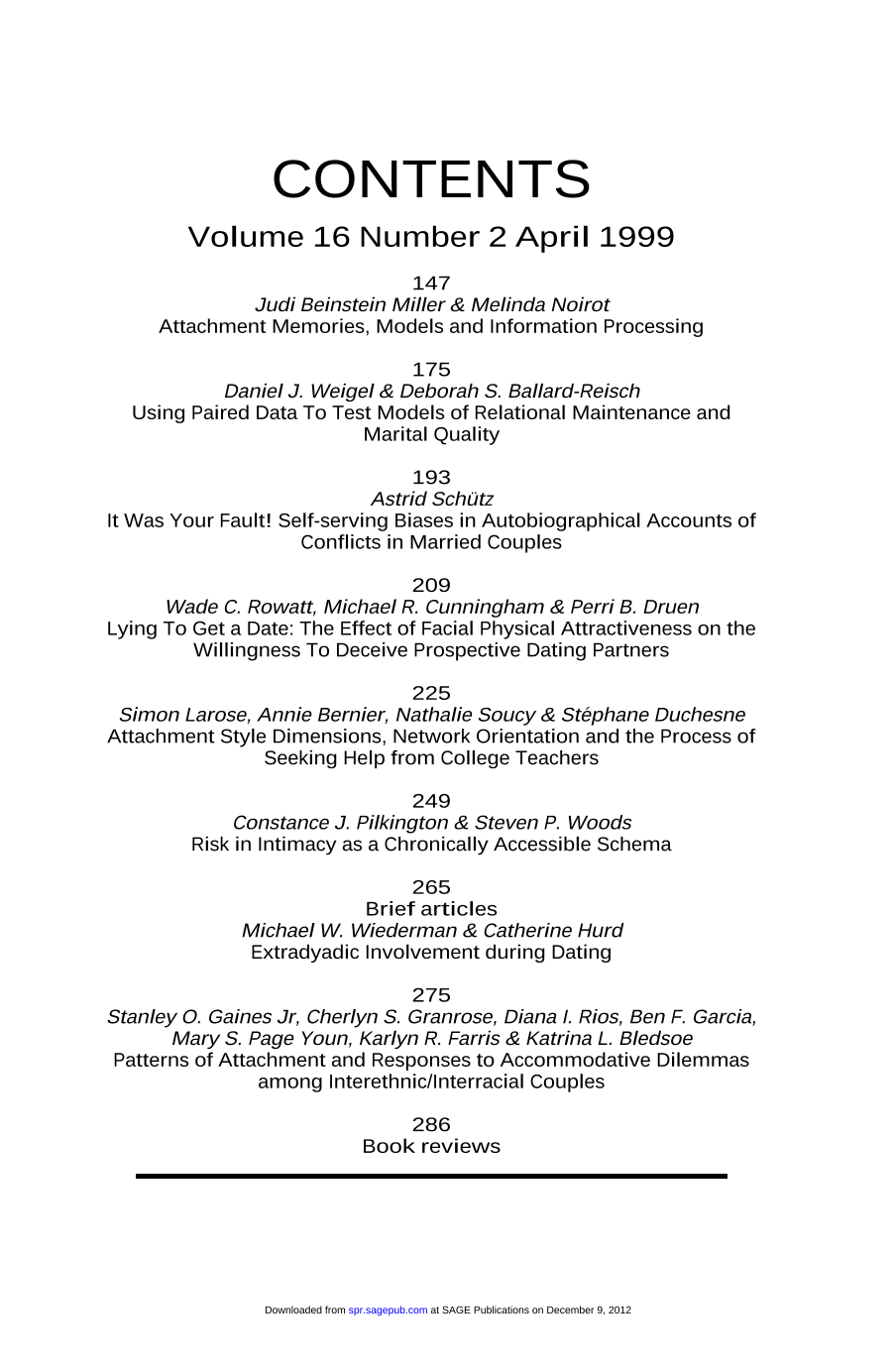
Working models of attachment are considered key mediators of responses to attachment-related events, but relatively little research examines their directive influence. In this study we investigated the dynamics of working models by means of a memory paradigm. Participants were tested for attachment orientation and several weeks later read an attachmentrelated story, performed an attachment-unrelated task, and took a cued-recall test about the story. They were additionally primed by the writing of supportive or rejecting friendship experiences either before reading the story or afterwards. Results provided evidence for two types of information processing effects, attachment-schematic information processing and attachment-related constraints on information processing capacity. Secure attachment was associated with better recall of positive story events when participants were primed by rejecting memories before the story. Fearful attachment was associated with better recall of negative story events, when participants were primed by either rejecting or supportive memories before the story. Fearful attachment was associated with impaired performance on the attachment-unrelated task, when participants were primed by rejecting memories prior to executing the task.
Recent research has developed a good understanding of how maintenance behaviors are related to husbands’ and wives’ individual perceptions of marriage. Unfortunately, one of the limitations is that data have been collected from an individual spouse and may be misleading when applied to the relationship as a whole. The purpose of the present study was to test a procedure by which data collected from spouses can be used to examine joint couple-level concepts. Specifically, the study employs structural equation modeling with 129 married couples to examine the relationship between husbands’ and wives’ use of maintenance behaviors and joint couple-level constructs of marital quality. The final models for couple satisfaction, couple commitment, and couple love had good fits, indicating that individual use of maintenance behaviors has an influence upon couples’ marital quality. Also, wives’ overall use of maintenance behaviors had a stronger relationship with marital quality than did husbands’ use of maintenance behaviors.
Accounts of naturally occurring interpersonal conflicts were collected in interviews with 25 married couples from a community sample. The findings suggest that even in non-distressed close relationships accounts of conflict are distorted in a self-serving manner. Both partners tended to emphasize their own needs and hurt feelings, and to refer to aspects that excused or justified their own behaviour. Each partner also tended to blame the other for initiating the conflict, to describe the partner’s behaviour as irrational and incomprehensible, and to refer to prior negative partner behaviour. Results are interpreted in terms of self-serving biases and favourable self-presentation. Effects of self-focused attention and actor observer biases are discussed.
This research explored the extent to which people use deception to initiate a date with opposite-sex prospects who varied in facial physical attractiveness. Participants reviewed profiles of prospective dates varying in facial attractiveness, described their own personal characteristics to the prospective dates (study 1), and rated their willingness to lie to make themselves appear to be more desirable to each prospect (study 2). Both men and women deceptively altered their self-presented expressivity and love attitudes to more attractive prospects (study 1), and reported being more willing to lie about their personal appearance, personality traits, income, past relationship outcomes, career skills and intelligence to prospective dates who were higher in facial physical attractiveness, compared with prospective dates who were lower in facial physical attractiveness (study 2). No sex-differences in the willingness to use deceptive self-presentational tactics were found. A strong positive correlation was found between people’s willingness to lie about a specific personal dimension and the extent to which physically attractive individuals differed from other people on that dimension. Thus, it appears that people endeavor to lie to physically attractive people in ways that maximize their similarity with the attractive target.
In this study, a model was tested positing that attachment style dimensions affect the individual’s social support network orientation, which, in turn, influences the process of seeking help from teachers. Data from two independent samples of college students using global and dyadic interaction reports of the quality of their help-seeking behaviours were used to assess the model. Evaluation by the EQS method indicated acceptable levels of fit, with the models explaining 49 percent and 23 percent of the variance in help-seeking behaviours. The results are discussed in light of the relations between attachment and social support theories.
The cognitive underpinnings of perceptions of risk in intimacy (RII) were investigated in two studies. Using response times to measure schema accessibility, we found partial support for the hypothesis that, although most people have risk-in-intimacy schemas available in memory, those schemas are more accessible to high-RII individuals. In Study 1, high-RII women responded to relationship events more quickly and rated those events as representing greater risk than did low-RII women. In Study 2, high-RII individuals interpreted ambiguous social situations more negatively and did so more quickly than low-RII individuals. In some cases, however, high-RII individuals responded more slowly than low-RII individuals. Possible explanations for these findings are discussed.
College student men (n = 299) and women (n = 392) reported their experiences with extradyadic (ED) dating and sexual activity. We also investigated the relationships between ED activity and religiosity, sex–love–marriage association beliefs, narcissism, sexual sensation seeking, a ‘ludic’ or game-playing orientation to romantic relationships, and self-perceived ability to deceive one’s dating partner. Despite normative disapproval for ED activity, a majority of respondents reported having had ED involvement while dating. There was no sex difference in the incidence of ED dating or ED kissing; however, men were more likely than women to experience ED fondling, oral sex, or vaginal intercourse. In general, ED dating and ED sexual activity were related to less adherence to sex–love–marriage association beliefs, increased sexual sensation seeking, a ‘ludic’ love style, and a self-perceived ability to deceive one’s dating partner. Findings are discussed with regard to possible implications and directions for future research.
In the present study, partners from 103 heterosexual inter-ethnic/interracial couples (103 men and 103 women) completed categorical measures of attachment style and continuous measures of responses to accommodative dilemmas. Consistent with hypotheses, there was a significantly higher proportion of secure over insecure individuals among both sexes. Further, the difference between secure and insecure individuals’ accommodative tendencies was greater for destructive responses than for constructive responses (significant among men, marginally significant among women). However, contrary to hypotheses, attachment style per sewas not a significant predictor of accommodation responses among either sex. Implications for the study of interethnic/interracial romantic relationships are discussed.

