
Letter
 Restricted accessLetterFirst published March, 2016pp. 5-5

Select search scope: search across all journals or within the current journal


 Restricted accessLetterFirst published March, 2016pp. 5-5Restricted accessLetterFirst published March, 2016pp. 6-6
 Restricted accessResearch articleFirst published March, 2016pp. 7-16
For thousands of years, the average woman spent 100 percent of her adult life in childbearing and child-rearing and averaged five or fewer menstrual cycles in her lifetime. That changed radically in the last few generations. Today, the average American woman will spend just 15 to 20 percent of her adult life in childbearing and -rearing, if she elects to have a child at all, and she will experience up to 500 menstrual cycles. I illustrate these changes with examples from generations of my own family and speculate about how such structural changes in families and households can affect gender inequality.
Restricted accessResearch articleFirst published March, 2016pp. 17-26In the United States and beyond, there is often a wide disconnect between grounded empirical evidence about the sex industry and policies on sex work and human trafficking. In this introduction, we briefly review empirical and critical scholarly literature on sex work and human trafficking policy within the United States. We then introduce three sociological articles that provide compelling empirical research on individuals who work in the sex trade as well as those who organize on behalf of sex workers and trafficked individuals. We conclude by inviting more sociologists to narrow the gap between reliable empirical evidence and policies on sex work and human trafficking, and we urge activists and policy makers to listen.
Restricted accessResearch articleFirst published March, 2016pp. 27-45This article examines how U.S. sex worker rights activists articulate “rights-based frames” to counter mainstream “victim frames” that conflate sex work and sex trafficking. Drawing on interviews with 19 U.S. sex worker rights activists conducted between 2010 and 2012, and participant observation of a national sex worker rights conference in Las Vegas, Nevada in 2010, I illustrate how activists create sex worker rights frames that (1) contest the labeling of sex workers as victims and (2) contest the accuracy and emotionality of stories and statistics used in mainstream anti–sex trafficking efforts. This rights-based framing draws on two master frames, labor rights and equal rights, to redefine the criminalization and stigmatization of sexual labor as a social problem, rather than prostitution itself. In the framing conflict over sex work, a rights-based approach also problematizes the intent and outcomes of anti–sex trafficking efforts to protect and rescue. To the extent that U.S. policy and advocacy efforts assume that sex work is a social problem and morally reprehensible, and that abolition of prostitution is a sound goal, those who challenge these assertions are at a disadvantage for acquiring credibility, voice, and support.
Restricted accessResearch articleFirst published March, 2016pp. 46-65Human trafficking has been identified as the second or third most profitable illicit business on the planet. Underlying these claims and billions of dollars in policy funding since the 1990s is an economics of human trafficking built heavily on two assumptions. The first is that nonconsensual labor is more profitable than consensual labor with minors being particularly profitable due to their ubiquity and inability to effectively consent. The second is that, unlike illicit narcotic and weapons sales, human trafficking involves a uniquely renewable and nearly limitless source of profit. This article uses empirical data collected from street sex markets in Atlantic City, New Jersey in 2010–2012 to test some of the assumptions of the economics of human trafficking and puts particular focus on U.S.-based domestic minor sex trafficking by exploring market practices and understandings of young sex workers and pimps/third parties who have opportunities to benefit from the sexual labor of minors. Consistent with broader literature by economic historians and labor process scholars, findings do not support the assumptions of trafficking economics, suggesting the need for trafficking economists and policymakers to give more consideration to local political economies of sex in the design of antitrafficking policy.
Restricted accessResearch articleFirst published March, 2016pp. 66-90In 2008, the San Francisco-based antitrafficking nonprofit organization
Restricted accessResearch articleFirst published March, 2016pp. 91-111Research on skin-tone bias has focused primarily on intraracial inequality with little attention to skin-tone inequality across ethnoracial groups. We engage the debate over the color line by considering the independent, simultaneous, and interactive impacts of skin tone and self-identified race on educational performance. Analyses of National Longitudinal Study of Adolescent Health (Add Health) and Adolescent Health and Academic Achievement (AHAA) data show significant skin-tone differences in grade point average (GPA) both across and within racial groups, with darker skinned tone individuals receiving significantly lower grades than their lighter skinned tone counterparts. Net of controls, skin-tone differences in GPA are essentially flat among African Americans but are notably stronger among other race/ethnic groups. These findings highlight the interplay between racial categorization and colorism by revealing the categorical disadvantage of racial stigma versus the more fluid colorism boundaries of nonblack groups.
Restricted accessResearch articleFirst published March, 2016pp. 112-129Applying the idea that ethnic enterprise benefits from the vertical integration of complementary economic activities, the present study examines ethnic-group differences in the retail trade in the late nineteenth century. Census data are used to estimate a regression model that explains retail enterprise as an outcome affected by wholesale enterprise and by the vertical integration of retail and wholesale enterprise. The results provide insights into the under- or overrepresentation of ethnic groups in the retail trade. For example, even if blacks had the same level of wholesale enterprise as did whites, and had vertically integrated retail and wholesale enterprise to the same extent as did the latter, blacks still would have been greatly underrepresented as merchants in the retail trade. This finding implies that blacks’ underrepresentation was substantially affected by outright discrimination against black retail merchants as well as by blacks’ extraordinarily low level of wholesale enterprise.
Restricted accessResearch articleFirst published March, 2016pp. 130-152This study examines the relationship between Latino immigration and violence in the context of the geographic diversification of immigrants to emerging destinations. Drawing on research on immigration and literature on assimilation and place stratification, I identify circumstances in which immigration may either increase or decrease violence. I use 2001–2004 arrest data from the National Incident-Based Reporting System and the crime reporting programs of California, New York, and Texas to evaluate these circumstances. Most notably, I examine whether effects of immigration on violent offending of specific racial/ethnic groups (Latino, white, black) vary depending on whether the movement of immigrants is into established or emerging immigrant destinations and whether immigration’s effects vary by race/ethnicity
Restricted accessResearch articleFirst published March, 2016pp. 153-176As an important type of cosmopolitan orientation, global self-identification refers to a higher level of self-identification with the world than with a particular nation-state. It has implications for the fate of nation-states and the prospect of global governance. This article examines what factors promote the adoption of global self-identification, using the recent wave of the World Values Survey data (2005–2008). I conceptualize the adoption of global self-identification as a two-level
Restricted accessResearch articleFirst published March, 2016pp. 177-200Through participant-observation and interviews, I explore the conservative social identity of College Republicans at a midsize, midtier public university in the United States. Using the concepts of repertoires and frames, I analyze how individuals make claims to political social identities. Specifically, I show that symbolic appeals to the free market were an essential aspect of the conservative repertoire at my field site. Furthermore, the shifting and contradictory frames used by the College Republicans in this study demonstrate that their discursive political practices were not primarily about policy preferences; they were about affirming a conservative social identity. Understanding how stated policy preferences and identity intertwine in everyday political talk has important implications for American democracy.
Restricted accessResearch articleFirst published March, 2016pp. 201-218In this study, we began with Snow and Anderson’s insight that the physical deprivation and extreme poverty of homelessness not only have negative effects on the health and mortality of homeless people but also present challenges to their well-being. The data are derived from 287 men living in downtown Atlanta. Applying and extending identity theory, we found support for the expectation that positive identity meanings, even a stigmatized identity such as being a homeless person, may provide support for a more general sense of self-esteem. Furthermore, homeless people can negotiate the subjective importance they attribute to the identity (homeless identity centrality) and the situations and social setting in which they invoke the identity (homeless identity salience). Findings reveal that lower homeless identity centrality increased self-efficacy but not self-worth, and homeless identity salience did not influence either self-worth or self-efficacy. Our study supports and extends the emerging recognition that homeless people do not passively, inevitably, and uniformly accept a deprecated and devalued sense of self.
Restricted accessCorrectionFirst published March, 2016pp. 219-220Conway, Brian. 2014. “Religious Public Discourses and Institutional Structures: A
Cross-National Analysis of Catholicism in Chile, Ireland, and Nigeria.”
In the June 2014 issue of Pastoral Letters and Generational Changes in Post–Vatican II Catholic Leadership
Conferences. Signifies total number of pastoral letters in the faith and morals domain in the
time period of the study. Signifies total number of pastoral letters in the social justice domain in the
time period of the study. Percentage of national hierarchy who were members of the hierarchy in 1962 but
not members in 1970, the higher the percentage, the greater the generational
change that took place between 1962 and 1970 (just five years after Vatican II).
This percentage was computed based on historical data about the period of
appointment of Catholic prelates. Sources of Legitimacy in Pastoral Letters of Catholic Leadership Conferences,
1990–2011. Numbers (and percentages) apply to the number of references in each pastoral
letter to the various categories.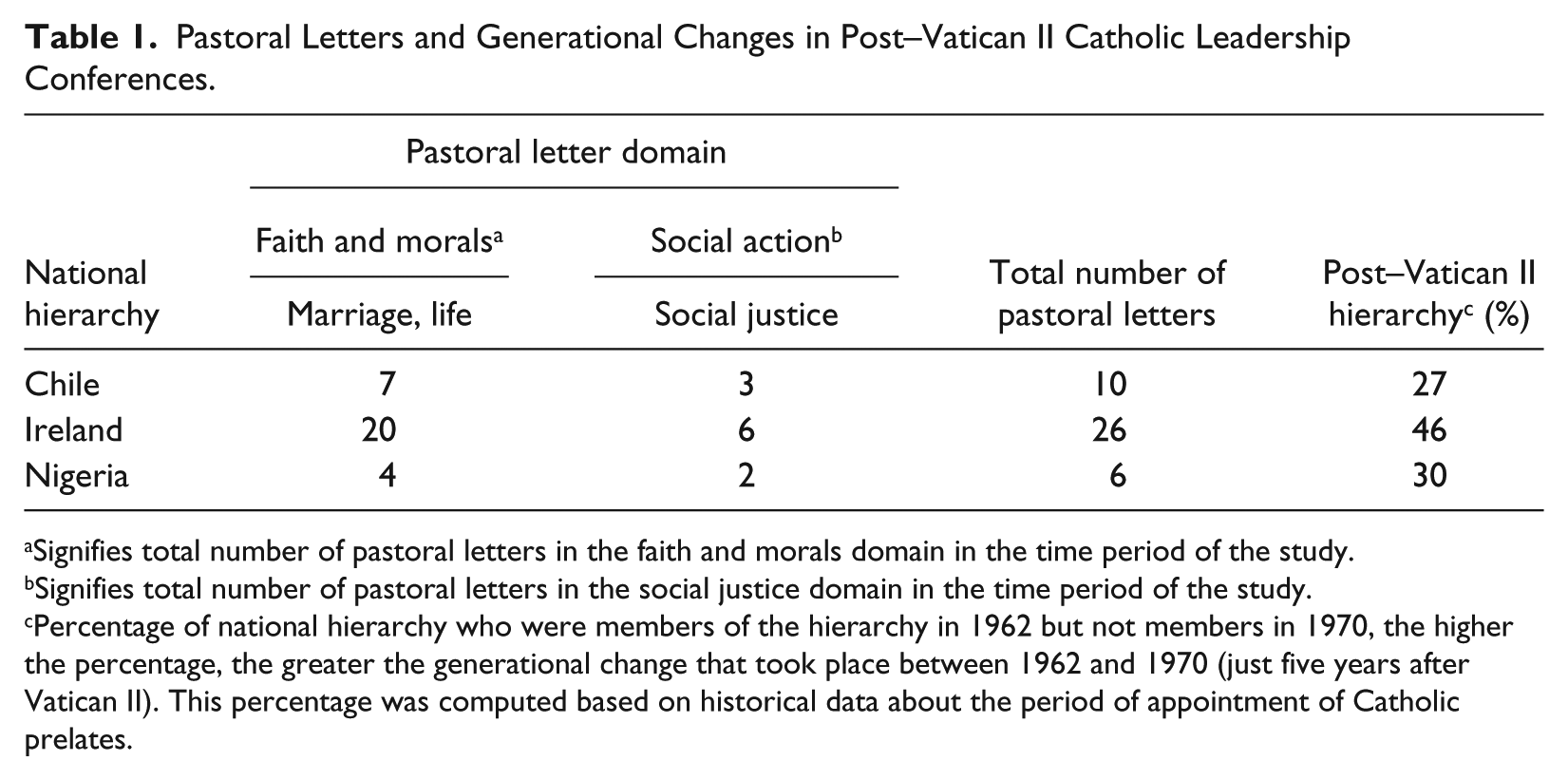
National hierarchy
Pastoral letter domain
Total number of pastoral
letters
Post–Vatican II
hierarchyc (%)
Faith and moralsa
Social actionb
Marriage, life
Social justice
Chile
7
3
10
27
Ireland
20
6
26
46
Nigeria
4
2
6
30
Chile
Ireland
Nigeria
%
%
%
a. Faith and morals
Catholic
Papal writings/discourse
17
19
58
34
14
9
Church writings
13
15
47
28
80
54
Gospel writings
35
40
54
32
44
30
Secular
National identity
14
16
4
2
7
4
Social/physical science research
2
2
1
.5
2
1
Secular writings/discourse
6
7
5
3
1
.01
b. Social action
Catholic
Papal writings/discourse
9
10
110
22
28
22
Church writings
19
20
99
19
54
42
Gospel writings
57
60
58
12
18
14
Secular
National identity
10
10
37
7
26
21
Social/physical science research
176
35
Secular writings/discourse
25
5
1
.01
This is despite the fact that—as Table 1 shows—the greatest post–Vatican II generational
personnel shift within the episcopacy took place in the Irish hierarchy, followed by the
Nigerian hierarchy, and then the Chilean hierarchy.
For this content analysis, the full document—ranging in length from 2 to 109 pages, with
an average length of 11, 14, and 25 pages for the Chilean, Irish, and Nigerian pastoral
letters, respectively—was the unit of investigation.
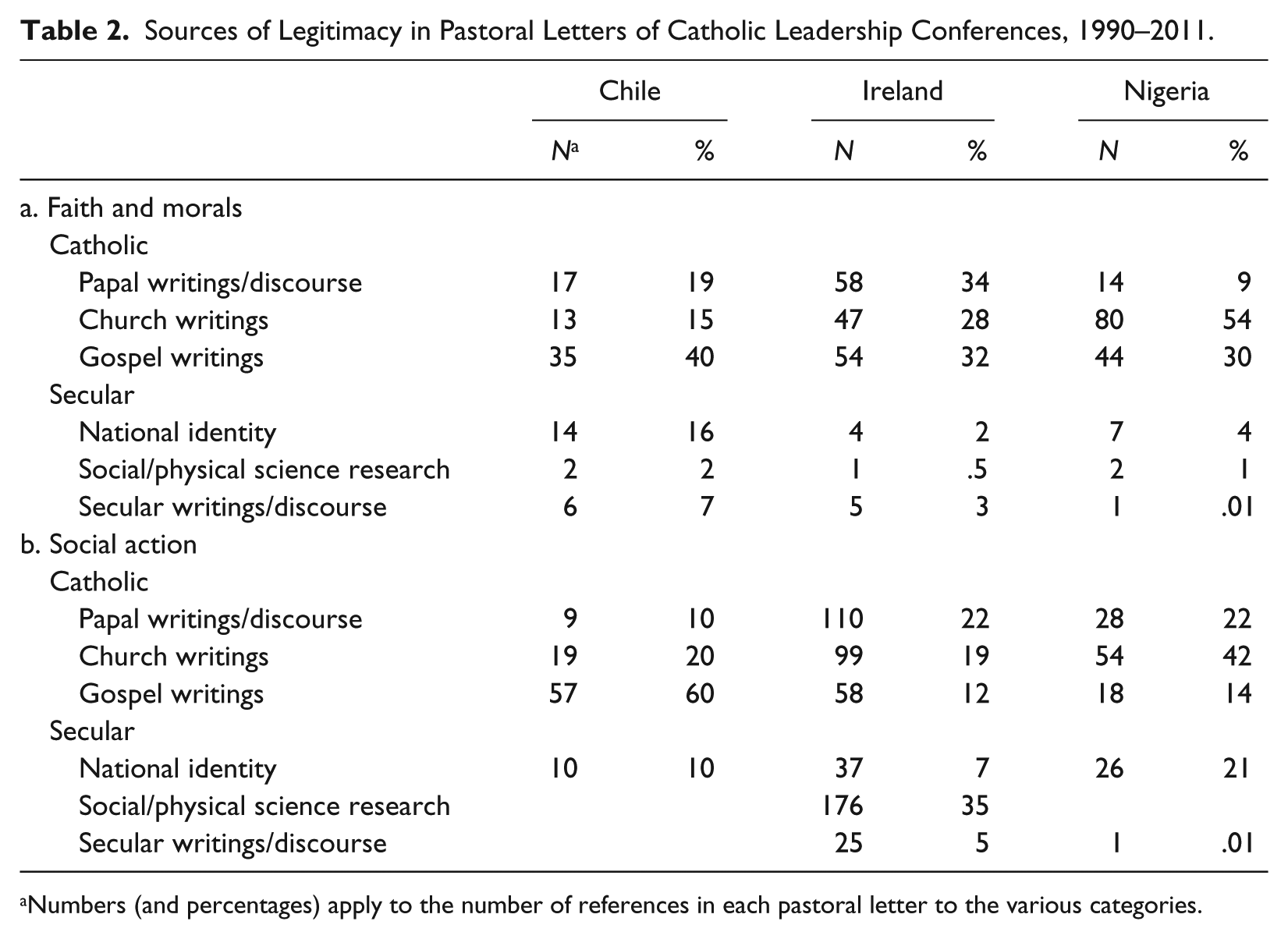
I found that the church in Chile and Nigeria appealed to national identity more than its
counterpart in Ireland (see Table 2)—in Chile, 16 percent of pastoral letters in the faith
and morals category and 10 percent in the social action category made mention of national
identity, compared with 2 and 7 percent, respectively, in the Irish case. In Nigeria, 4
percent of faith and morals and 21 percent of social action pastoral letters invoked
references to national identity.
When the Chilean and Nigerian cases are compared, however, I found that the church in
Nigeria was more likely to mobilize national identity in the social action domain while
the church in Chile was more likely to do so in the faith and morals domain—in Chile, 16
percent of pastoral letters in the faith and morals category and 10 percent in the social
action category invoked national identity compared with 4 and 21 percent, respectively, in
the case of Nigeria.
A total of 47 percent of legitimations by the Irish hierarchy in the social action domain belonged to the secular category compared with 53 percent falling into the Catholic category.