The coefticient
If the logic leading to
Select search scope: search across all journals or within the current journal
The coefticient
If the logic leading to


Longitudinal swelling of keratin fibers has been measured as a function of time following abrupt humidity changes in the environment of the fibers. The equilibrium length change and the shape of the longitudinal swelling vs. relative humidity isotherm for horse hair and Corriedale and Lincoln wool fibers is dependent on the fiber type. The increase of length is associated with the disruption of the fiber microfibrils. At high humidities there is an overshoot in the length swelling accompanying the water absorption. For interval absorption at high humidities, the entire length increase for Corriedale fibers is transient, and the length returns to the value before the step was applied. For horse hair, only a part of the length increase is transient. The corresponding interval desorp tion causes no change of length. An effect on the longitudinal swelling due to the load on the fiber is observed for loads sufficiently large to extend the fiber into its yield region , in water. The observed relationship between longitudinal swelling and water content during sorption steps is discussed.
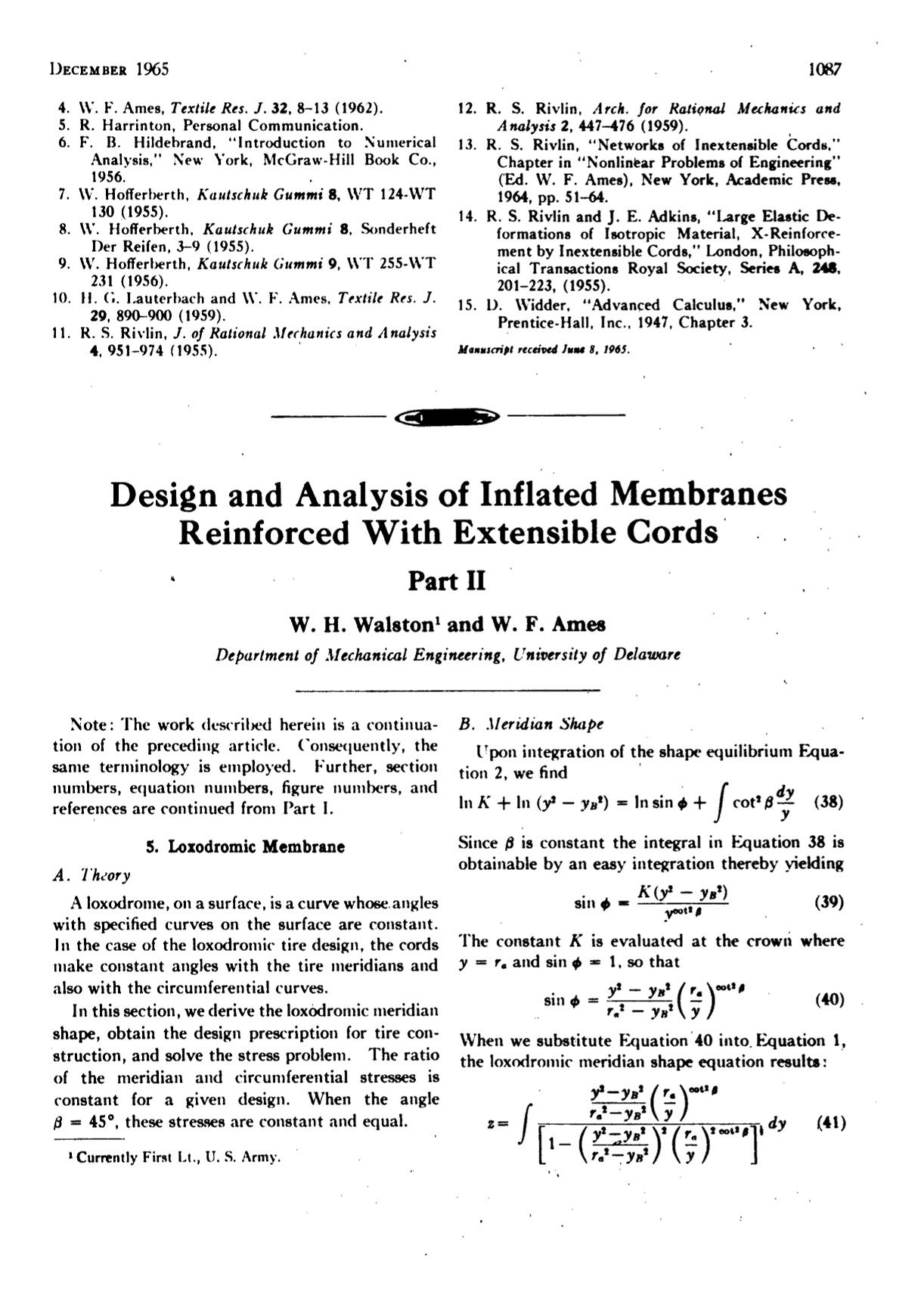
Three configurations of reinforced membranes termed loxodromic, geodesic, and quadratic are considered. Prescriptions for the construction of each design are derived. In all cases the cords are assumed extensible and the case of cylindrical symmetric de formation is considered. The equilibrium shape and stress problem, for each design, is solved. Principal stresses, cord tensions, cord lengths, and membrane strengths are calculated and compared to a standard design. The advantages and disadvantages of each design are discussed.

Carbamates, organic phosphorus compounds, and organic chlorine compounds of low toxicity have been evaluated as proofing agents for wool against larvae of clothes moths and carpet beetles.
Carbamates are unsatisfactory because they cannot withstand the hydrotytic conditions encountered during application and use.
Several organic phosphorus compounds are effective at economic levels, and, of these, the most durable effect is obtained by treatment with Ethyl Guthion.
Organic chlorine compounds related to DDT represent the closest approach to a group of compounds that are selectively toxic to wool eating insects, since they are effective proofing agents but have relatively little effect on mammals. The choice of a suitable compound is largely dependent on durability and economic considerations.
The application of Dilene (DDD or TDE) at the boil is effective and durable at levels costing a penny per pound of wool.
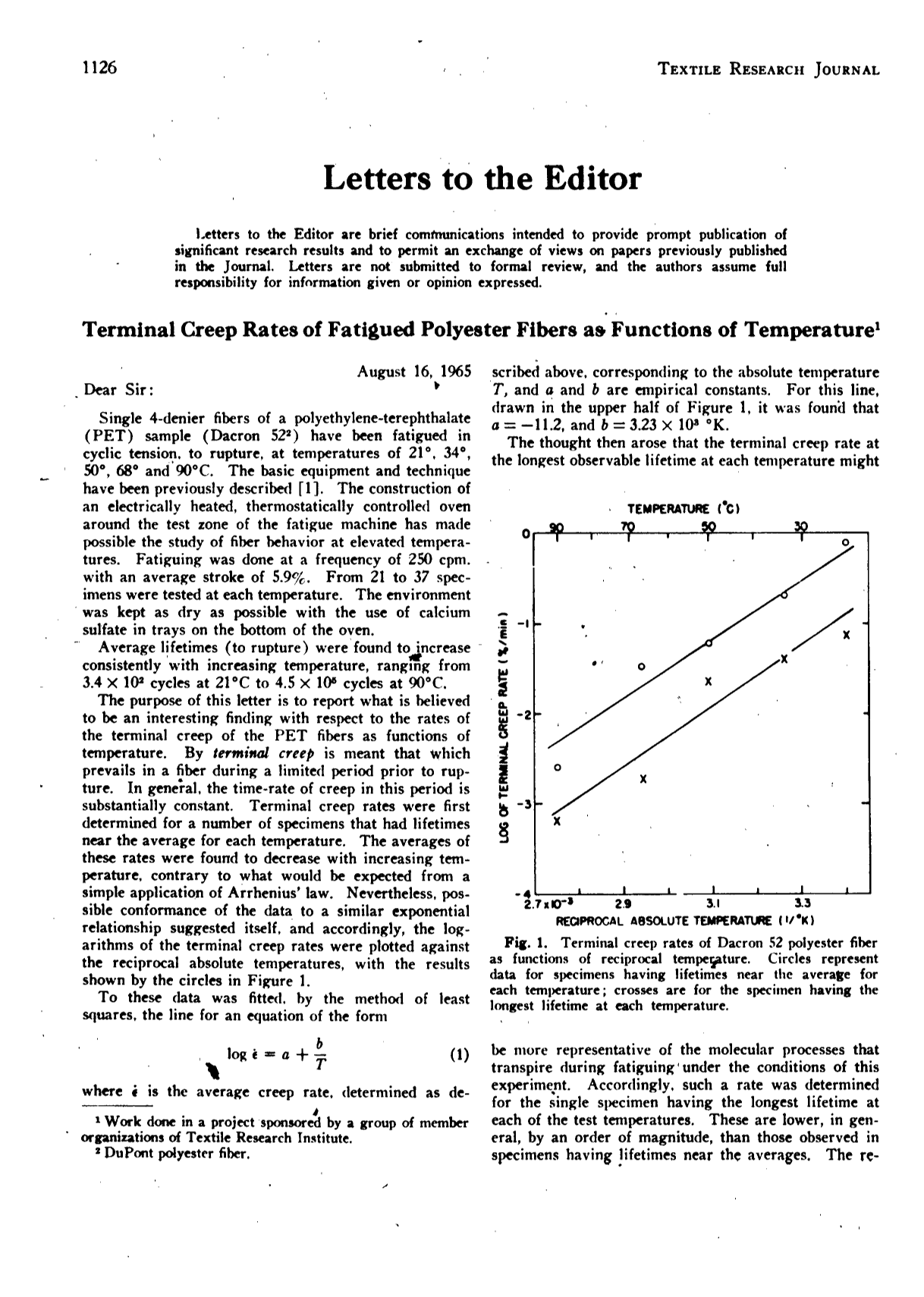
Specimens of a polyester fiber (Dacron3 52), with zero twist and 100 turns per inch have been fatigued in cyclic tension, with a few different static (bias) loads. In two experiments an intermediate twist was used. 'With low loads it was found that the lifetime generally increases with twist. This effect is reversed when the specimens are subjected to greater static loads, presumably reflecting a tightening of the molecular, or microfibrillar structure. Average lifetime, in both untwisted and twisted fibers, was found to decrease drastically with increases in the static load. With a low static load a smaller amount of creep occurs in twisted fibers during a fatigue test than in untwisted controls. When the load is increased, it was found that this tendency is reversed.
The mechanical properties of four different polyimide samples are measured. H-film, poly(N,N'-(
While x-ray techniques show H-film to be slightly crystalline, the other polyimides display typical amorphous scattering patterns.
Annealing raises the softening temperature and induces crystallinity in one of the samples.
Factors such as the purity of starting materials and the complete conversion to polyimide linkage must be considered when comparing the mechanical properties of these various polyimides.
Protection of fibrous cotton cellulose from weathering degradation and from degrada tion on exposure to high energy radiation (as measured by breaking strength retention), by substitution of benzoyl groups on the cellulose molecule, was demonstrated. It can be concluded that the presence of the benzoyl groups affected the absorption of incident energy by the cellulose molecule and/or the localization of energy within the molecule.
Cotton fabric treated with aqueous sodium montmorillonite dispersions retains 0.12 ± 0.02% clay after three to at least ten washes with fresh portions of water. When fabric containing this tenaciously held clay is washed with solutions of deter gents and other chemicals, any reduction in the amount of retained clay must be due to the action of these chemicals.
Polyoxyethylated nonionic detergents and polyethylene glycol were active, removing up to 70% of the clay. Cationic detergents were ineffective owing to their strong interaction with montmorillonite, which flocculates the clay and renders it hydro phobic; they also prevented or strongly reduced clay removal by nonionic detergents. Anionic detergents were ineffective because they are sorbed neither by montmorillonite nor by cotton: they did not interfere with clay removal by nonionic detergents.
The irremovable sodium montmorillonite (approximately 0.04% ) is equal to the amount needed to completely cover the cotton surface with a clay layer consisting of elemental laniellae 9.4 A thick lying flat against the fibrils. Therefore, even non ionic detergents, which readily penetrate adjacent clay lamellae and separate them from each other, cannot detach the bottom lamellae of clay from the cotton substrate.