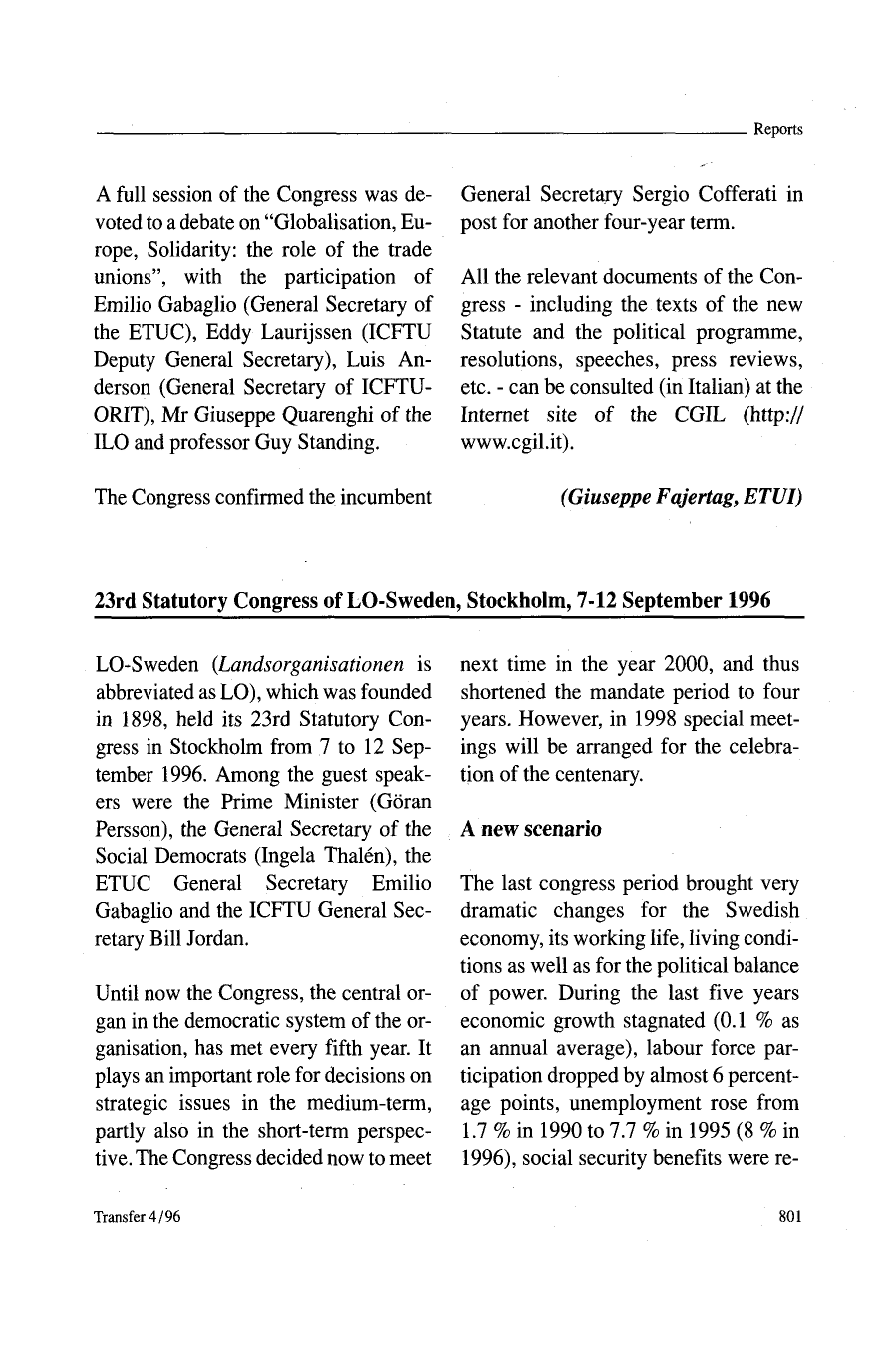
Editorial
 Restricted accessEditorialFirst published November, 1996pp. 553-558

Select search scope: search across all journals or within the current journal


 Restricted accessEditorialFirst published November, 1996pp. 553-558Restricted accessResearch articleFirst published November, 1996pp. 559-573
Problems arise in connection with the flexibility of labour which has become such a widespread demand in Europe in the attempt to get to grips with the challenge of globalization, “Atypical” forms of labour (flexible, temporary, or mobile employment, sometimes crossing over into self-employment) could increasingly become the new “typical” form of work. There can be no doubt that such work is, after all, preferable to unemployment. But what happens to the rights of citizenship (qualitative and quantitative) attaching to such jobs and to the workers performing them? What will be the social destiny of these “atypical” workers once they reach retirement and advanced old age?
By way of describing the problem and introducing a few elements of scepticism into the economic and social policy options which, for better or worse, appear to have gained universal acceptance, this article discusses the significance which citizenship continues to derive from work and social protection models, the features of the European social model which currently appear to be in jeopardy. Finally we present a working objective (a new form of social protection provided from a combination of public and trade unions funds) which could be one means of enhancing the trade unions' capacity to represent the labour force in its new composition.
Etant un besoin I a entraîné d'importants problèmes. Des formes “atypiques” du travail (flexible, temporaire, mobile, parfois comme indépendant, etc.) pourraient devenir de plus en plus la nouvelle forme de travail “typique”. II n'y a aucun dote que ce type de travail est, après tout, préférable au chómage. Mais qu'en est-il des droits decitoyenneté (qualité et quantité) liés à de tels emplois et dont ces travailleurs jouissent? Quelle sera alors la destinée sociale de ces travailleurs atypiques une fois atteint le troisième ou le quatrième âge?
En décrivant le problème et en introduisant également certains éléments de doute en ce qui concerne les choix en matière de polique économique et sociale qui, pour le meilleur ou pour le pire, semblent étre acceptées par rout le monde, cet article présente l'importance que la citoyenneté continue à avoir grace au travail, les modèles de protection sociale, les caracteristiques du modèle social européen qui sont actuellement en danger. En dernier lieu. l'article met en lumière un objectif de travail concret (une nouvelle forme de protection sociale provenant de fonds publics et syndicaux) qui pent être utile pour l'amélioration de la capacité des syndicats de représenter la nouvelle composition de la main-d'oeuvre.
Mit der Flexibilisierung der Arbeit, die sich in ganz Europa ausgebreitet hat, nicht zuletzt um sich der Herausforderung der Globalisierung stellen zu können, sind gänzlich neue Problem-stellungen verbunden. “Atypische” Arbeit (flexibel, befristet, mobil, manchmal selbständig usw.) könnte mehr und mehr die neue “typische” Art der Arbeit werden. Es steht außer Zweifel, daß diese Art von Arbeit besser ist als Arbeitslosigkeit. Aber wie sieht es mit den qualitativen und quantitativen Bürgerrechten aus, die diese Art von Arbeit und diese Arbeitnehmer besitzen? Welches soziale Schicksal erwartet diese “atypischen” Areitnchmer im Rentenaher?
Um dieses Problem zu beschreiben und einige skeptische Hinweise zu den wirtschafts- und sozialpolitischen Optionen zu geben, die wohl oder übel von allen akzeptiert zu werden scheinen, diskutiert dieser Beitrag die Bedeutung der Bürgerechte, die sich auch weiterhin aus der Arbeit und den sozialen Sicherheitsmodellen ableiten lassen sowie die Merkmale des europäischen Sozialmodells, das heute immer stärker bedroht zu sein scheint. Schließlich wird eine konkrete Zielvorstellung präsentiert (neue Formen der sozialen Sicherung durch eine Kombination von öffentlichen und gewerkschaftlichen Mitteln), die die Gewerkschaften dabei unterstützen könnte, die neu zusammengesetzte Erwerbsbevölkerung besser und wirksamer zu vertreten.
Restricted accessResearch articleFirst published November, 1996pp. 574-601The persistent employment crisis that dogged all of the countries of the European Community, with the exception of Luxembourg, throughout the 1980s has led to the spread of all sorts of jobs which cannot be compared with full-time, life-time work: part-time employment; temporary employment; jobs created by the public authorities; and work experience schemes for young people, as well as jobs with varied or unusual schedules.
The present study follows the evolution of the principal forms of atypical employment during three periods (1983–1985, 1985–1990 and 1990–1994), revealing the constants and the variations, as well as the national divergences in the development of the methods of flexibility and of organisation of working time. The first part looks at divergences and convergences, whilst a second highlights the localisation of the types of atypical employment in certain segments of the labour market
La persistance, durant le début des années quatre-vingt, d'une crise de l'emploi dans tous les pays de la Communauté européenne, à l'exception du Luxembourg, a favorisé la prolifération qualitative et quantitative d'emplois qui ne peuvent être comparés à des emplois à temps plein el à durée indéterminée: l'emploi à mi-temps, l'emploi temporaire, les emplois créés par les autorités publiques, et les stages en entreprise, ainsi que les emplois à horaires variés et anormaux.
L'étude présentée ici suit l'évolution des principales formes de travail atypique durant trois périodes (1983–1985, 1985–1990 et 1990–1994), soulignant les constantes et les variations, de même que les divergences nationales dans le développement des méthodes de flexibilité et d'organisation de l'horaire de travail. La première partie de l'étude est consacrée aux divergences et convergences et la seconde met en évidence la localisation des différents types d'emploi atypique dans certains segments du marché du travail.
Die anhaltende Beschäftigungskrise seit Anfang der 80er Jahre in allen Ländern der Europäischen Gemeinschaft, mit Ausnahme von Luxemburg, hat sowohl qualitativ als auch quantitativ zu finer Ausweitung von Arbeitsplätzen geführt, die nicht mit unbefristeten Vollzeitarbeitsplätzen verglichen werden können: Teilzeitbeschäftigung, Zeitverträge, Arbeitsplätze im zweiten Arbeitsmarkt, Ausbildungplätze für Jugendliche sowie Arbeitsplätze zu unterschiedlichen oder unüblichen Bedingungen.
Die vorliegende Studie verfolgt die Entwicklung der wichtigsten Formen atypischer Beschäftigung im Verlauf von drei Zeiträumen (1983–1985, 1985–1990 und 1990–1994) und legt die Grundzüge und die Veränderungen dar sowie die nationalen Abweichungen bei der Entwicklung der Flexibilitätsformen und der Arbeitsorganisation. Der erste Teil ist den Abweichungen und den Übereinstimmungen gewidmet, während der zweite Teil die Ansiedlung der atypischen Beschäftigungsformen in bestimmten Bereichen des Arbeitsmarktes beleuchtet.
Restricted accessResearch articleFirst published November, 1996pp. 602-614Are the policies to combat unemployment and social exclusion really ways of getting the jobless back to work or do they represent alternative forms of exclusion in already vulnerable sectors such as social protection and employment? Do the changing nature of work and the wage insecurity this entails augur a deepening of the current rift in society or an opportunity for new and appropriately devised social plans to safeguard the social and economic cohesion of Europe and citizenship extended to and exercised by all? The reduction of working time, the active use of unemployment benefits, the modernisation of education and training systems and generalised access to them, new sources of employment and the social economy may offer new paths to thinking about the current modes of production which generate exclusion.
Les politiques mises en place pour lutter contre le chômage et l'exclusion sociale sont-elles réellement des mesures de réinsertion ou représentent-elles d'autres formes d'exclusion dans des secteurs déjà fragilisés comme la protection sociale et l'emploi? La modification de la nature du travail et la précarisation salariale qui s'en suit présagent-elles l'approfondissement de la fracture sociale actuelle ou de la possibilité de voir mis en place des plans sociaux cohérents pour sauvegarder la cohésion économique et sociale de l'Europe et l'exercice d'une citoyenne reconnue pour tous. La réduction du temps de travail, l'activation des allocations de chômage, la modernisation des systèmes d'éducation et de formation et la généralisation de son accès, les nouveaux gisements d'emploi et l'économie sociale peuvent constituter quelques pistes de réflexion sur les modes de production actuelles, générateurs d'exclusion.
Handelt es sich bei den Maßnahmen zur Bekämpfung der Arbeitslosigkeit und der sozialen Ausgrenzung tatsächlich um Instrumente der Wiedereingliederung oder um neue Formen der Ausgrenzung, insbesondere in bereits betroffenen Bereichen wie soziale Sicherung und Beschäftigung? Bedeuten die Veränderung der Arbeitsformen und die damit einhergehende Einkommensunsicherheit eine Verstärkung der gegenwärtigen sozialen Spaltung oder ermöglichen sie neue, angepaßte Sozialpläne, um die soziale und wirtschaftliche Kohäsion in Europa und Bürgerrechte für alle zu schützen? Arbeitszeitverkürzung, die Aktivierung der Arbeitslosenunterstützung, die Modernisierung der Bildungs- und Ausbildungssysteme sowie der allgemeine Zugang zu ihnen, neue Beschäftigungsformen und die soziale Wirtschaft verweisen auf neue Wege, um über die gegenwärtigen Produktionsformen, die soziale Ausgrenzung verursachen, nachzudenken.
Restricted accessResearch articleFirst published November, 1996pp. 615-634There are growing fears that post-industrial society will produce a new class of permanent losers, a modern-day lumpen proletariat. The catch, however, is that an erosion of social protection threatens not only the losers but, even more importantly, also the winners. The single greatest challenge to the welfare state today lies in the need to rethink its classical assumptions about work, family and social risk. Social protection has been inordinately biased in favour of the elderly (who were the traditional high-risk poverty group), and this bias has been strengthened as welfare states sought to manage unemployment with early retirement. In contrast, for young families who now experience a host of new risks, welfare states tend to be passive.
On craint de plus en plus que la société post-industrielle ne produise une nouvelle classe de perdants permanents, un sous-prolétariat des temps modernes. Néanmoins, ce qui se cache ĺ en dessous, c'est que l'érosion de la protection sociale menace non seulement les perdants mais aussi, et de manière beaucoup plus importante, les gagnants. Le défi le plus important pour l'Etat-providence aujourd'hui se base sur le besoin de repenser ses concepts classiques sur le travail, la famille et les risques sociaux. La protection sociale a été démesurément déformée en faveur des vieux (qui étaient traditionnellement le groupe de pauvreté à hauts risques), et cette tendance a été renforcée lorsque les Etats-providence ont cherché à gérer le chômage avec la retraite anticipée. Par contre, pour les jeunes familles qui sont confrontées à toute une série de nouveaux risques, les Etats-providence tendent à être passifs.
Die Befürchtungen nehmen zu, daß die post-industrielle Gesellschaft eine neue Klasse von ständigen Verlierern produziert, ein modernes Lumpenproletariat. Das Problem dabei ist jedoch, daß ein Verlust der sozialen Sicherung nicht nur die Verlierer betrifft sondern in bedeutendem Umfang auch die sog. Gewinner. Die größte Herausforderung des Wohlfahrtstaates liegt heutzutage in der Notwendigkeit, die klassischen Begriffe von Arbeit, Familie und sozialen Risiken zu überdenken. Soziale Sicherung war vorwiegend auf ältere Personen ausgerichtet (die traditionsgemäß die risikoreichste Armutsgruppe darstellte). Diese Ausrichtung wurde verstärkt, da der Wohlfahrtstaat davon ausging, die Arbeitslosigkeit mit dem Vorruhestand in den Griff zu bekommen. Im Gegensatz dazu bleibt der Wohlfahrtstaat passiv gegenüber jungen Familien, die heute mit einer Reihe von neuen Risiken konfrontiert sind.
Restricted accessResearch articleFirst published November, 1996pp. 635-659Alarming messages are regularly launched into the public arena concerning the financing situation of the European Welfare States, and in particular their capacity to continue financing public pension schemes. Titles like: Sprengen Pensionslasten die Staatskasse? (Are pensions liabilities going to explode the State Treasuries?) are illustrative of the general trend. Depending on the source of such messages, their degree of reliability and credibility varies. Given the tremendous economic and political interests which are at stake, social protection has become a battlefield between different political ideologies and between public and private providers of social protection or private insurance. Financial data are a central element in this debate.
All experts involved with social protection issues are bound to recognise that the future financing of social protection gives rise to serious problems, due to factors which include the excessively low level of economic growth, the unfavourable employment situation, the ageing of our society, the fierce international competititon and the budgetary constraints placed on governments in the run-up to EMU. Where divergences arise is in the conclusions drawn from these findings. Those who believe in solidarity will seek ways and means of keeping the public systems on their feet and adequately resourced: those who, on the contrary, favour less collective arrangements will recommend the development of private insurance systems to replace the public systems, thereby lightening the collective burden. A third possible future approach consists in a sort of flexible policy mix whereby people will be offered a choice concerning the level up to which they wish to join the collective insurance schemes. One thing, however, appears clear from the outset: whatever the option may be, the financing of future social or individual protection will require more money, and the option of individual insurance arrangements could well prove the most expensive choice. For this reason, as well as on social and political grounds, the maintenance of a financially-sound collective system of social protection emerges as preferable.
Des messages alarmants concernant la situation financière des Etats-providence européens sont régulièrement lancés au public et en particulier, en ce qui coincerne la capacité de ceux-ci à continuer à finance les systèmes de pension publics. Des titres tels que: Sprengen Pensionslasten die Staatskasse? (L'endettement lié aux pensions va-t-il faire exploser le Trésor Public?) illustrent bien la tendance générale. Leur degré de fiabilité et de crédibilité varie en fonction de la source dont émanent de tels messages. Vit les énormes intérêts politiques et économiques qui sont en jeu, la protection sociale est devenue un champ de bataille entre les différentes idéologies politiques, caisses publicques et sociétés privées, protection sociale ou assurance privée. les données financières constituent un élément central de ce débat.
Tous les experts concernés par les questions de protection sociale sont forcé de reconnaitre que le futur financement de la protection sociale donne lieu à de sérieux problèmes, en raison de facteurs liés au niveau excessivement lent de la croissance économique, à la situation défavorable de l'emploi, au vieillissement de noitre société, à la concurrence internationale sauvage et aux contraintes budgétaires placées sur les gouvernements dans la foulée vers l'UEM. Les divergences apparaissent au niveau des conclusions tirées de ces constats. Ceux qui croient en la solidarité chercheront tous les moyens de maintenir les systèmes publics et de les alimenter de manière adéquate; ceux qui, au contraire, favorisent moins les dispositions collectives recommanderont le développement des systèmes d'assurance privée afin de remplacr les systèmes publics, et par là alléger le fardeau collectif. Une troisième approche possible pour l'avenir est une politique flexible à différentes options qui permettrait aux individus de choisir le niveau jusqui'auquel ils souhaitent adhérer aux systèmes d'assurance collective. Une chose apparait néanmoins clairement dès le début; quel que soit le choix, le financement de la future protection sociale ou individuelle nécessitera plus d'argent, et le choix des dispositions concernant l'assurance individuelle pourraient très bien être le reflet du choix le plus onéreux. C'est la raison pour laquelle, tant sur le plan social que politique, le maintien d'un système collectif de protection sociale, financé sur une base solide, semble préférable.
In regeimäßigen Abständen wird die Öffentlichkeit mit alarmierenden Nachrichten über die finanzielle Stiaution der europäischen Wohlfahrtsstaaten konfrontiert. Titel wie “Sprengen die Pensionslasten die Staatskasse?” verdeutlichen diesen allgemeinen Trend. Das Maß an Zuverlässigkeit und Glaubwürdigkeit dieser Nachrichten schwankt jedoch je nach Intention der jeweiligen Autoren. Die soziale Sicherung ist je nach wirtschaftlichen und politischen Interssen zu einem wahren Schlachtfeld zwischen unterschiedlichen politischen ideologien und zwischen offentlichen und privaten Trägern geworden. Die finanziellen Eckdaten sind ein wesentlicher Bestandteil dieser Debatte.
Die Experten müssen anerkennen, daß die zukünftige Finanzierung der sozialen Sicherung aufgrund von verschiedenen Faktoren, zu denen das geringe Wirtschaftswachstum, die ungünstige Beschäftigungslage, die Überalterung unserer Gesellschaft, der rauhe internationale Wettbewerh und die Haushaltszwänge der Regierungen im Vorfeld der EWWU gehören, zu erheblichen Herausforderungen führt. Die Schlußfolgerungen, die aus dieser Bestandsaufnahme gezogen werden, sind jedoch unteschiedlich. Diejenigen, die auf Solidarität setzen, suchen Mittel und Wege, die öffentlichen Systeme lebensfähig zu halten und mit den nötigen Ressourcen auszustatten. Diejenigen, die die Entwicklung privater Versicherungssysteme empfehlen, wollen die öffentlichen Systeme ersetzen und dodurch die öffentliche Hand entlasten. Ein dritter möglicher, zukünfitger Ansatz besteht in einer Art Flexiblem policy mix, in dem die Menschen die Möglichkeit erhalten, selbst zu entscheiden, inwieweit sie von den öffentlichen Versicherungsträgern erfaßt werden möchten. Eines ist jedoch von Anfang an klar: wie auch immer die Meinung sein mag, die Zukunft der sozialen Sicherung und des individuellen Schutzes erfordert mehr Geld, und die Option für eine individuelle Versicherung könnte sich sehr wohl als die kostspieligste Form herausstellen. Daher ist aus sozialen und politischen Gründen die Beibehaltung eines finanziell tragfähigen kollektiven Systems der sozialen Sicherung zu bevorzugen.
Restricted accessResearch articleFirst published November, 1996pp. 660-680The aim of the article is to explore the triangular relationship between social protection, flexibility and unemployment, the main focus lying on the third side of the triangle, that between social protection and unemployment. The author looks at this relationship from the viewpoint of unemployment benefits because this branch is at the heart of the current European debate on how to make social protection more employment-friendly, as demonstrated by the European employment strategy and the recent Communication from the European Commission on the future of social protection.
By exploring the questions of whether unemployment benefits contribute to unemployment or rather protect against and alleviate the problem of unemployment, the question is raised of the criteria which determine the effectiveness of an unemployment benefit system.
L'objectif de cet article est d'analyser la relation triangulaire entre la protection sociale, la flexibilité et le chôntage, en se concentrant particulièrement sur le troisième côtè du triangle, celui de la relation entre la protection sociale et le chômage. L' auteur examine cette relation au point de vue des allocations de chômage car ce domaine est au coeur du débat européen actuel: comment faire en sorte que la protection sociale favorise l'emploi? Cette question centrale fait partie de la stratégic européenne sur l'emploi et figure dans la récente Communication de la Commission européenne sur l'avenir de la protection sociale.
En Examinant la question de savoir si les allocations de chômage contribuent au chômage ou servent plutôt à se protéger contre le problème du chômage ou à l'amemuiser. il est soulevé la question des critères déterminant l'efficacité du système des allocations de chômage.
Das Ziel dieses Artikels besteht darin, die Dreiecksbeziehung zwischen der sozialen Sicherung, der Flexibilität und der Arbeitslosigkeit zu untersuchen, wobei der Arbeitslosigkeit die größte Aufmerksamkeit beigemessen wird. Die Autorin prüft diese Beziehung aus dem Blickwinkel des Arbeitslosengeldes. da dieser Bereich im Zentrum der gegenwärtigen curopäischen Debatte steht. Im Kern geht es durum, wie die soziale Sicherung in Europa beschäftigungsfreundlicher gestaltet werden kann, und in welcher Weise sie ihren Niedersclag in der europäischen Beschäftigungsstrategie findet. Dabei wird auch Bezug auf die jüngste Mitteilung der Europäischen Kommission über die Zukunft der sozialen Sicherung genommen.
Mit der Frage, ob Arbeitslosengeld zur Arbeitslosigkeit beiträgt oder im Gegenteil vor Arbeitslosgkeit schützt und das Problem mildert, wird auch die Frage nach den Kriterien aufgeworfen, die die Effizienz eines Arbeitslosengeldsystems bestimmen.
Restricted accessResearch articleFirst published November, 1996pp. 681-698The European Union has different traditions concerning the main concept of social security in general, and of retirement and pension benefits. Different political decisions dictate the range of personal coverage, how benefits are calculated and how the systems are financed. Within this paper, the author will try to distinguish the different types of core systems and will present a rough grouping of twelve national systems.
The systems that provide social protection in old age have entered a period of massive socioeconomic change. This includes changes in the structure of employment, and of family life. At the same time, most European countries have become countries of immigration. The author does not intend to make a detailed analysis of these changes themselves, but rather to select elements of them, and examine different types of old age security systems within these changes.
Au sein des pays de l'Union européenne, nous devons reconnaître différentes traditions concernant les idées maîtresses de la sécurité sociale en général et la protection sociale des personnes âgées. II existe différentes décisions politiques concernant la gamme de couverture personnelle, différents concepts de calcul de l'allocation et différents instruments qui financent les systèmes. Dans cet article. l'auteur essaie d'établir une distinction entre les différents types de systèmes fondamentaux el présente un regroupement approximatif des douze systèmes nationaux.
Les systèmes de protection sociale des personnes agées sonl entrés dans une période de changements massifs du contexte socio-économique. Cela signifie des changements de la structure de l'emploi rémounéré et des formes de vie privée. En méme temps, les pays les plus européens sont en réalité devenus des pays d'immigration. L'auteur n'essaie pas d'établir une analyse détaillée de ces changements. II choisit certains éléments du changement socio-économique et les met en présence avec différents types de systèmes de protection sociale des personnes âgées.
Innerhalb der EU bestehen unterschiedliche Traditionen hinsichtlich der Grundlagen der Systeme der sozialen Sicherung, insbesondere im Hinblick auf die Altersicherung. Unterschiede bestehen vor allem in bezug auf den Umfang des persönlichen Schutzes, der Berechmung der Unterstützung und der Instrumente, die für die Finanzierung der Systeme angewandt werden. In diesem Beitrag unternimmt der Autor den Versuch, die verschiedenen Formen der Systeme zu verdeutlichen und eine knappe Darstellung von zwölf nationalen Systemen vorzunchmen.
Die Systeme der sozialen Sicherung im Alter treffen auf einen Zeitraum des grundlegenden sozio-ökonomischen Wandels. Dies betrifft die Änderungen in der Struktur der Erwerbsarbeit sowie Änderungen in den Lebensstilen. Gleichzeitig sind die meisten europäischen Länder Einwanderungsländer geworden. Der Autor beabsichtigt nicht. eine genane Analyse dieses Wandels vorzulegen, sondern hat verschiedene Elemente ausgewählt und sie mit den unterschiedlichen Formen der Sozialversicherungssysteme im Alter in Verbindung gebracht.
Restricted accessResearch articleFirst published November, 1996pp. 699-723Normally the studies concerning the development of pension funds focus on the quantitative dimensions of the phenomenon. Supplementary pensions include a plurality of instruments and various types of pensions. Thus to modify this situation, we need redirect reflection towards a more qualitative approach. Quantitative approach is the consequence of the existence of an ideological clash between a liberal and a social view of welfare problems.
Social and economic framework has been modified in the last decades and so there is no reason for keeping the terms of the conflict unaltered. It suggests the need to develop an empirical and flexible approach to the matter. Pension funds will be one of the pivot of a mixed pension system. involving both public and private players with capitalisation and pay-as-you-go system.
Defining this process requires a major planning effort by the social partners. Pension funds offer opportunities for shifting relations between social parties onto a level which has never been achieved, but at the same time they require a long-term strategy which also presupposes that different national situations will move towards convergence. The experience of the European Union may perhaps offer a suitable occasion for achieving this objective.
En général, les études concernant le développement des fonds de pension se concentrent sur les dimensions quantitatives du phénomène. Les pensions additionnelles incluent une pluralité d'instruments et divers types de pensions. Par conséquent, pour modifier cette situation, nous avons besoin de réorienter notre approche vers une approche plus qualitative. L'approche quantitative est la conséquence de l'existence d'un conflit idéologique entre le point de vue libéral et social des problèmes de l'Etat-providence.
Le cadre social et économique a été modifié durant les dernières décennies et par conséquent, il n'y a pas de raison de maintenir les termes du conflit. Cela signifie qu'il existe un besoin de développer une approche empirique et flexible à ce sujet. Les fonds de pension seront un des pivots d'un système de pension à différentes options, impliquant tant les acteurs du secteur public que privé avec la capitalisation et le système de retenue à la source de l'impôt sur le revenu.
La définition de ce processus requiert un effort important de planification de la part des partenaires sociaux. Les fonds de pension offrent des chances de déplacer les relations entre les partenaires sociaux à un niveau qui n'a jamais été atteint, mais en méme temps, ceux-ci nécessitent une stratégic à long terme qui suppose également que les différentes situations nationales tendent vers la convergence. L'expérience de l'Union européenne pent probablement offrir une occasion bien à propos d'atteindre cet objectif.
Normalerweise konzentrieren sich die Studien über die Entwicklung der Rentenfonds auf die quantitativen Dimensionen des Phänomens. Zusatzrenten beinhalten eine Vielzahl von Instrumenten und unterschiedliche Arten von Renten. Um diese Situation zu ändern, müssen wir unsere Überlegungen also verstärkt auf einen qualitativen Ansatz lenken. Der quantitative Ansatz ergibt sich aus dem ideologischen Gegensatz zwischen einer liberalen und einer sozialen Sichtweise der Wohlfahrtsprobleme.
Der soziale und wirtschaftliche Rahmen hat sich in den letzten Jahrzehnten geändert, und deshalb besteht kein Grund mehr dafür, die Austragung dieses Konfliktes unverändert fortzusetzen. Es ist vielmehr erforderlich, einen empirischen und flexiblen Ansatz in dieser Frage zu entwickkeln. Rentenfonds werden eine der Säulen eines gemischten Rentensystems sein, das sowohl öffentliche als auch private Träger. Kapitalisierung und direkte Auszahlung enthält.
Die Entwicklung dieses Prozesses erfordert größere Planungsanstrengungen der Sozialpartner. Die Rentenfonds bieten die Möglichkeit, die Beziehungen zwichen den Sozialpartnern auf eine Ebene zu heben, die bisher noch nicht erreicht worden ist. Gleichzeitig erfordern sie aber eine langfristige Strategie, die auch voraussetzt. daß sich die unterschiedlichen nationalen Bedingungen zu einer Konvergenz entwickeln. Die Erfahrung der Europäischen Union bietet vielleicht eine geeignete Grundlage, dieses Ziel zu erreichen.
Restricted accessResearch articleFirst published November, 1996pp. 724-737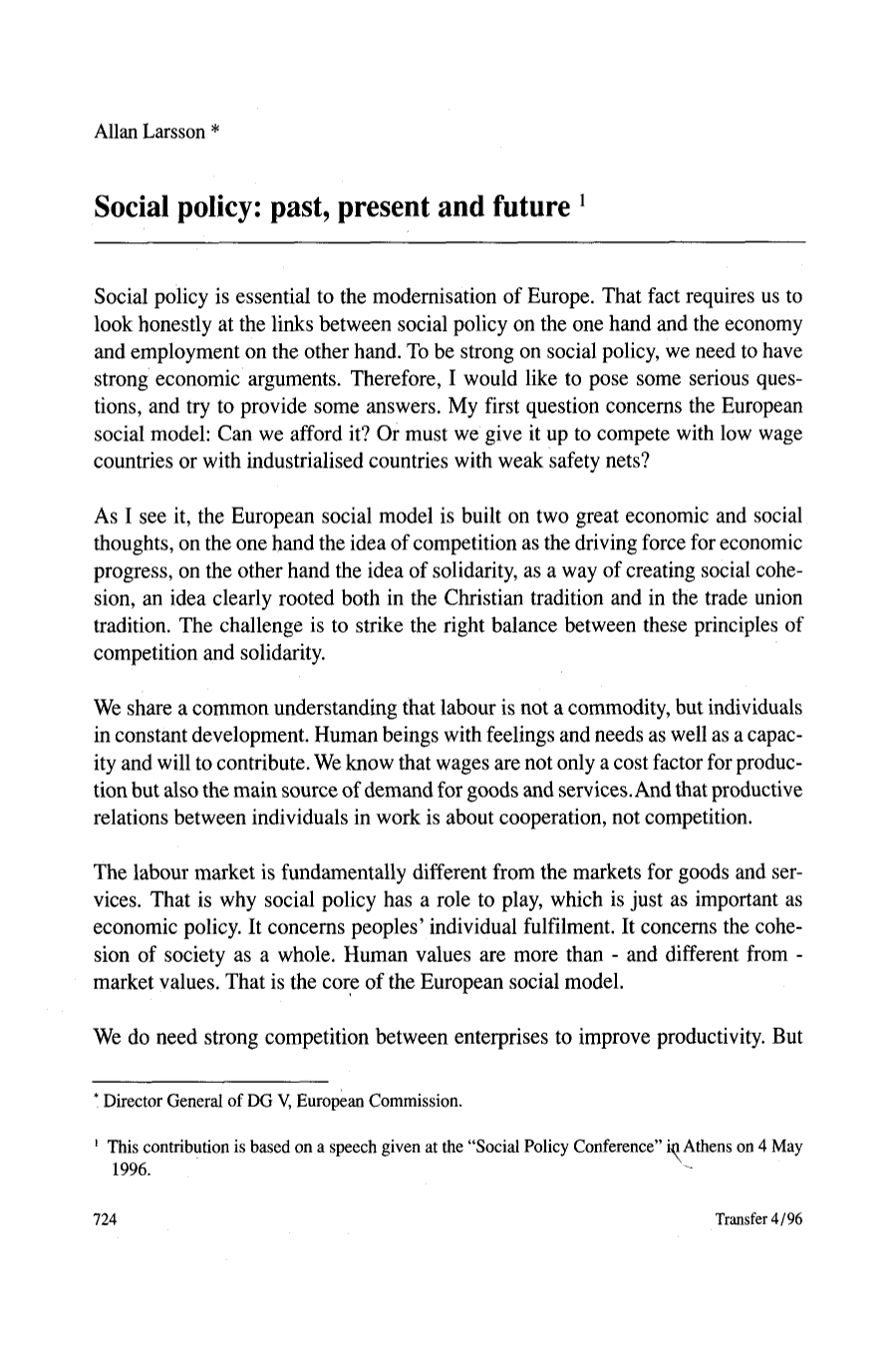 Restricted accessResearch articleFirst published November, 1996pp. 738-754
In this article we look at the consequences of the increase in atypical jobs for the modernisation of trade unions. Atypical jobs present considerable problems, not only at the level of practical strategies, but also (and perhaps more importantly) at the level of more fundamental issues like work, income and social security; and participation, solidarity and internal democracy. These problems should not only be seen as a threat. In our view, they also present possibilities for the process of modernisation of trade unions. As a central issue in this process, we look at working-time patterns.
Cet article analyse les conséquences de l'augmentation des emplois atypiques pour la modernisation des syndicats. Les emplois atypiques présentent des problèmes considérables, non seulement au niveau des stratégies pratiques mais aussi (peut-être de manière plus importante) an niveau des questions plus fondamentales comme “le travail, les revenus et la sécurité sociale” et “la participation, la solidarité et la démocratie interne”. Ces problèmes ne devraient pas être perçus dans un sens négatif, c'est-à-dire comme une menace. D'après les auteurs, ces problèmes représentent un défi pour le processus de modernisation des syndicats. L'analyse des modèles du temps de travail représente la question centrale de ce processus.
In diesem Artikel werden die Auswirkungen der zunehmenden atypischen Beschäftigung für die Modernisierung der Gewerkschaften untersucht. Atypische Arbeitsverhältnisse bringen bedeutende Probleme mit sich, nicht nur hinsichtlich der praktischen Strategien sondern auch (und vielleicht noch bedeutender) bezüglich der fundamentalen Begriffe wie “Arbeit. Einkommen und Soziale Sicherheit” sowie “Beteiligung, Solidarität und innere Demokratie”. Diese Probleme sollten nicht nur im negativen Sinne. d.h. als eine Gefahr, betrachtet werden. Aus unserer Sicht bieten sie auch Möglichkeiten für den Prozeß der Modernisierung der Gewerkschaften. Als ein zentraler Punkt in diesem Prozeß richtet sich unser Augenmerk auf unterschiedliche Systeme der Arbeitszeit.
Restricted accessOtherFirst published November, 1996pp. 756-758 Restricted accessOtherFirst published November, 1996pp. 759-773
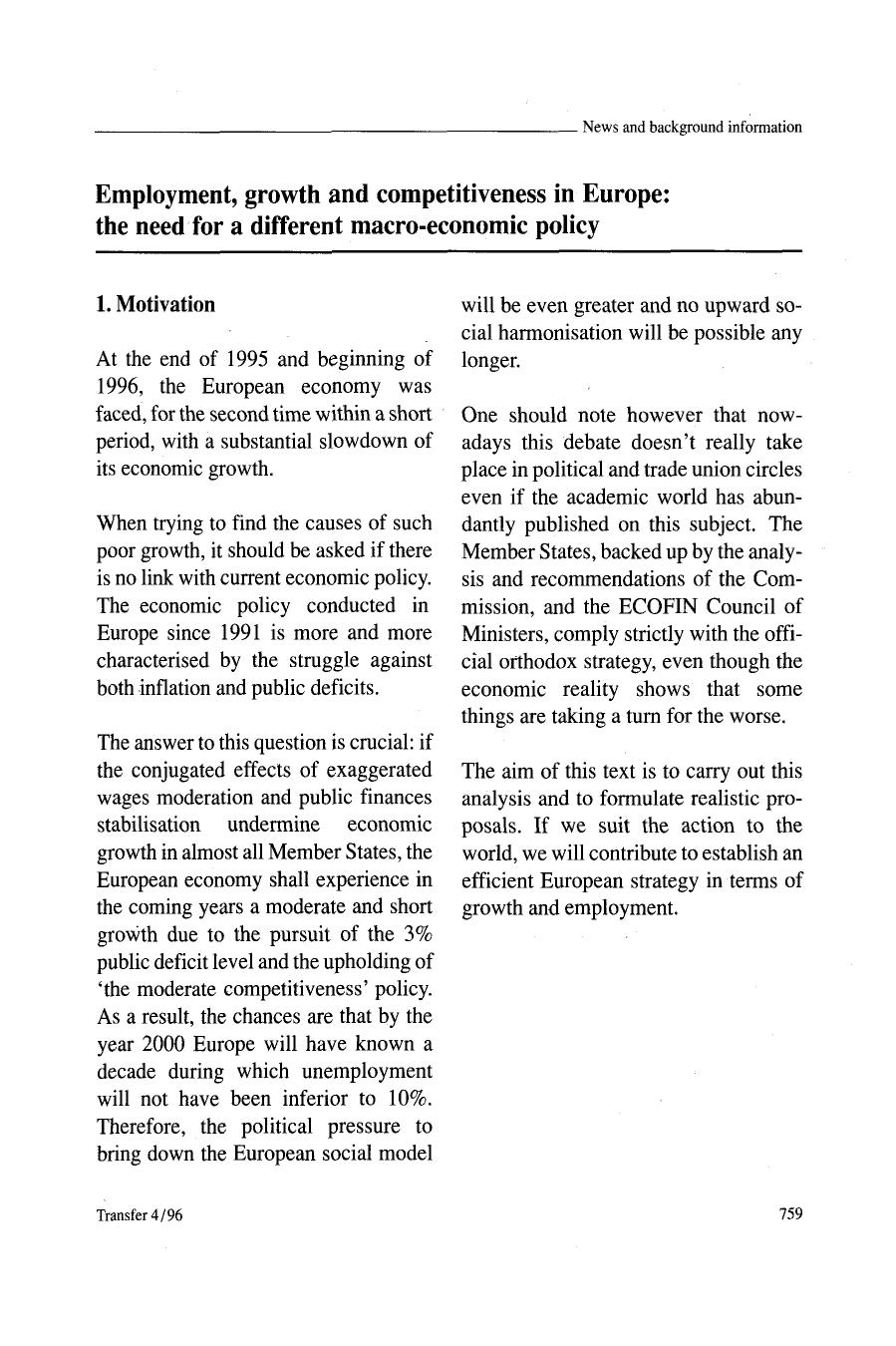 Restricted accessOtherFirst published November, 1996pp. 773-776
 Restricted accessOtherFirst published November, 1996pp. 776-785
 Restricted accessReview articleFirst published November, 1996pp. 786-790
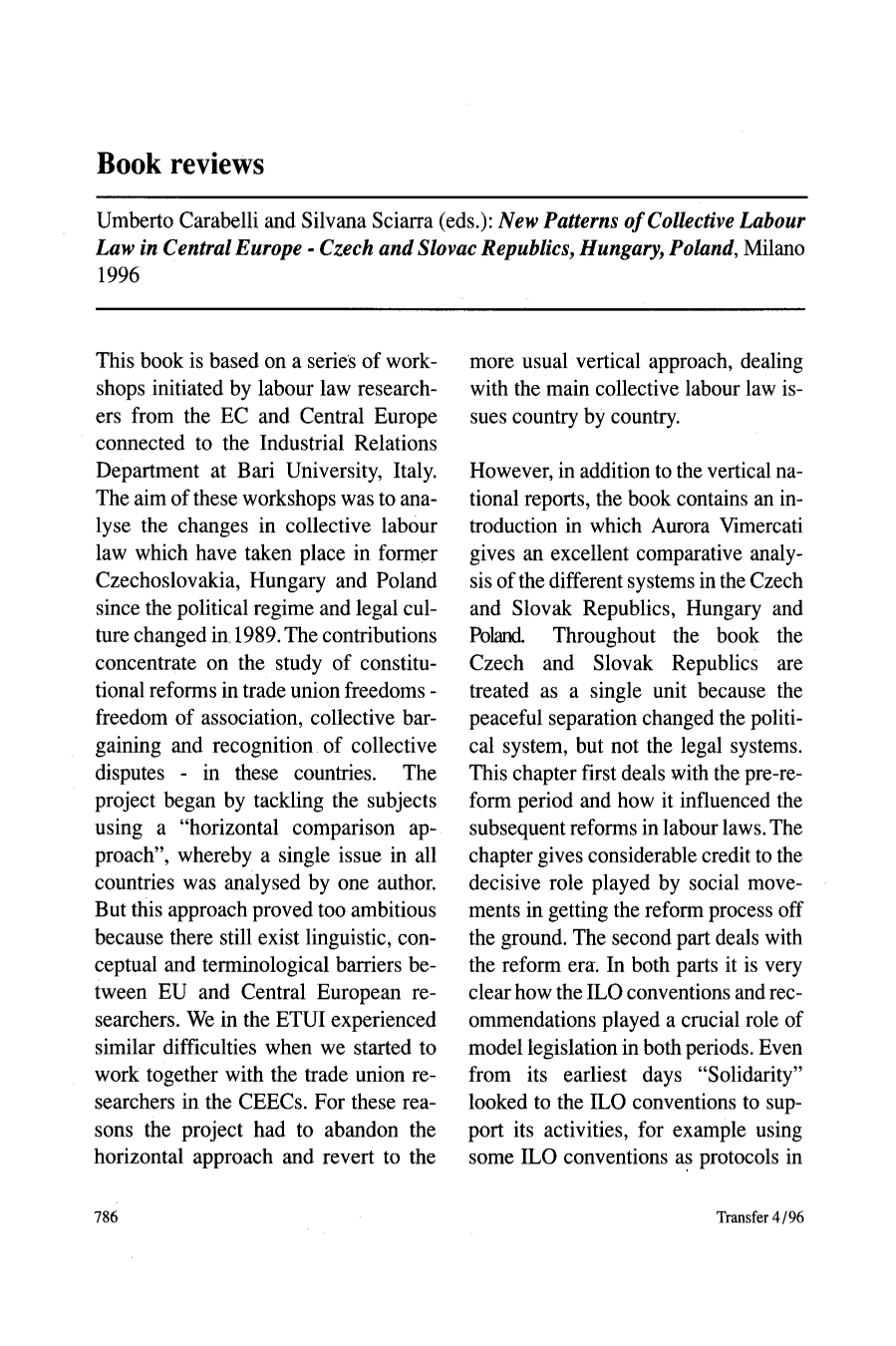 Restricted accessReview articleFirst published November, 1996pp. 791-793
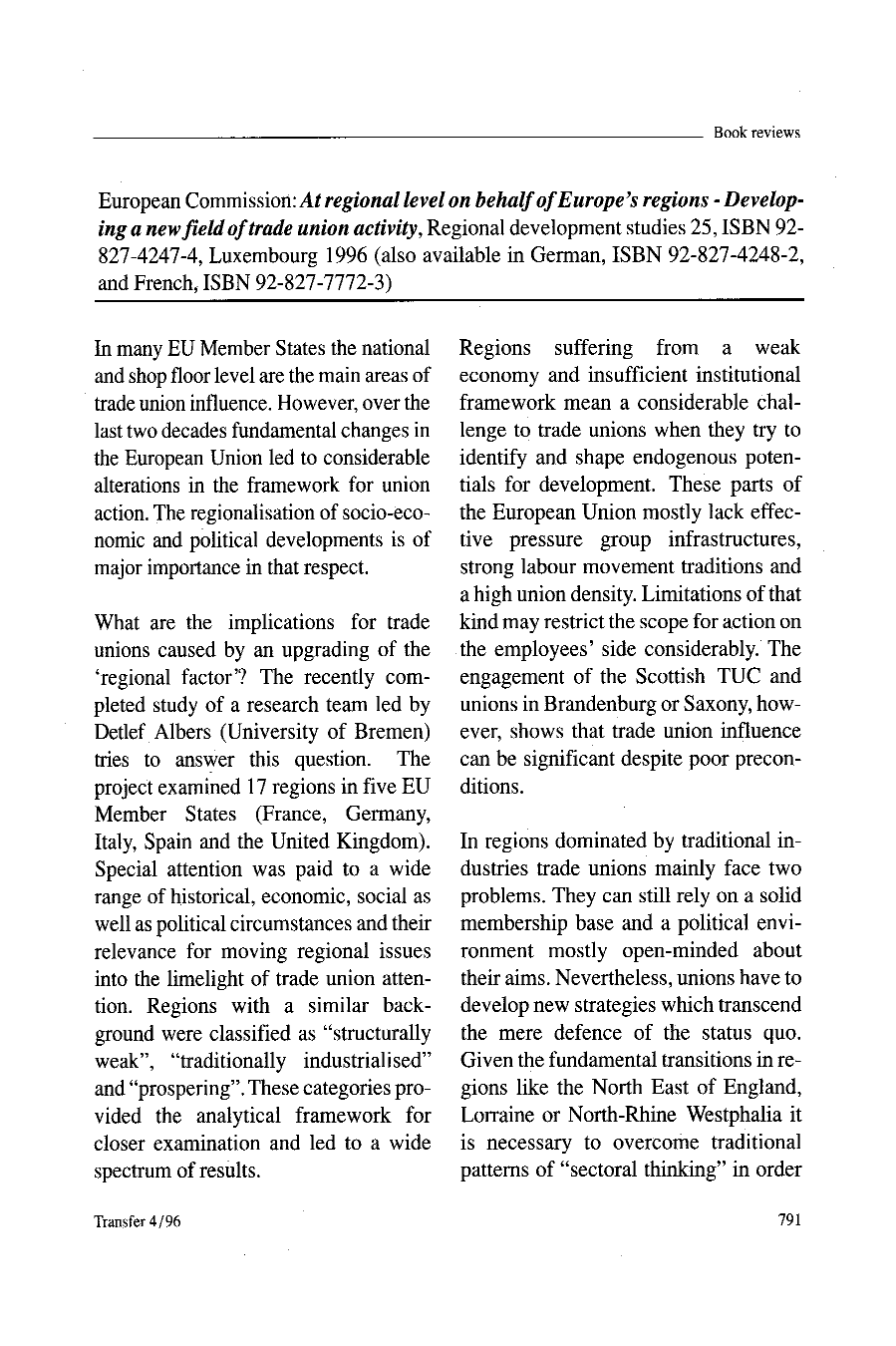 Restricted accessOtherFirst published November, 1996pp. 794-797
 Restricted accessOtherFirst published November, 1996pp. 797-799
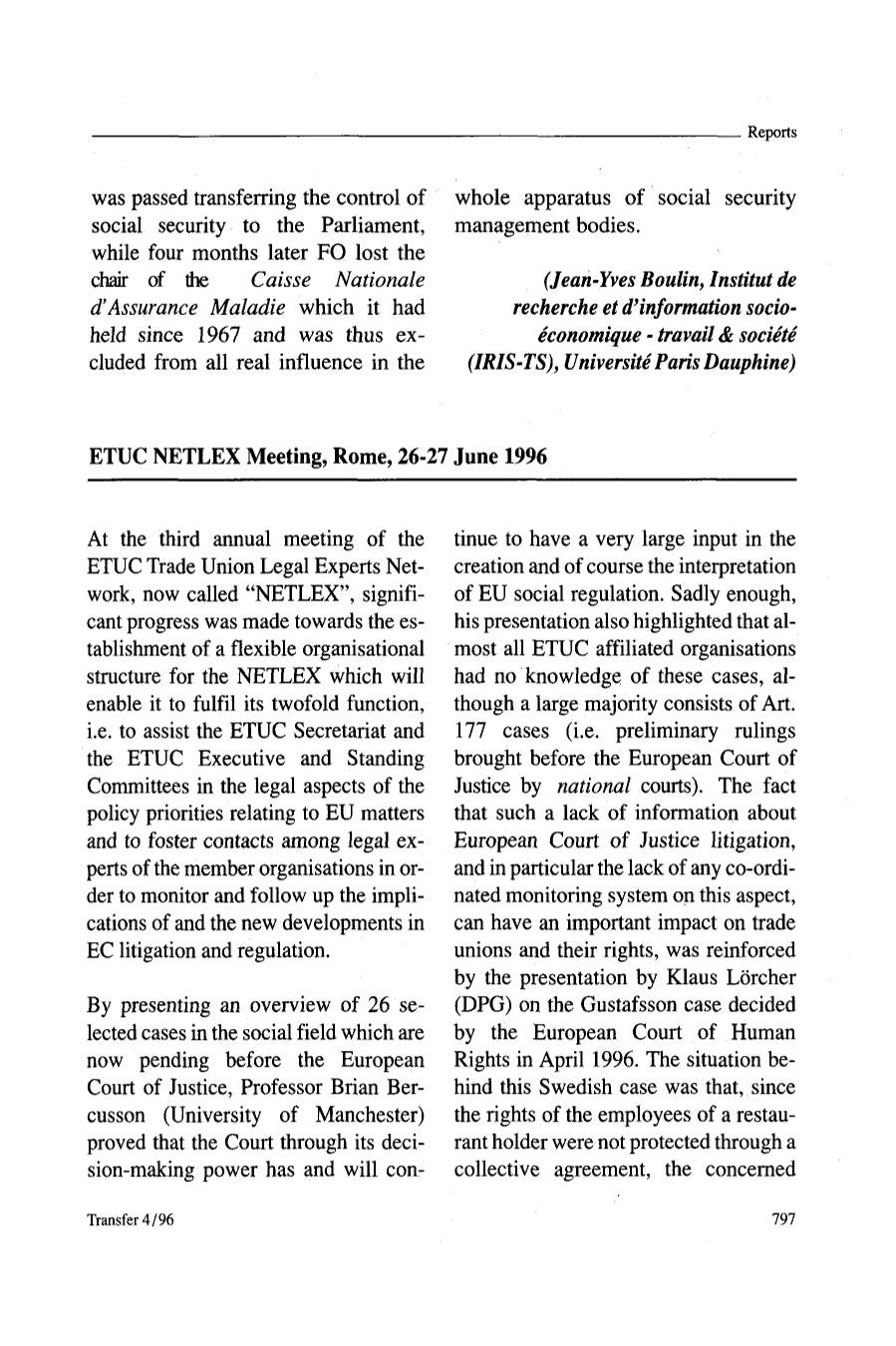 Restricted accessOtherFirst published November, 1996pp. 799-801
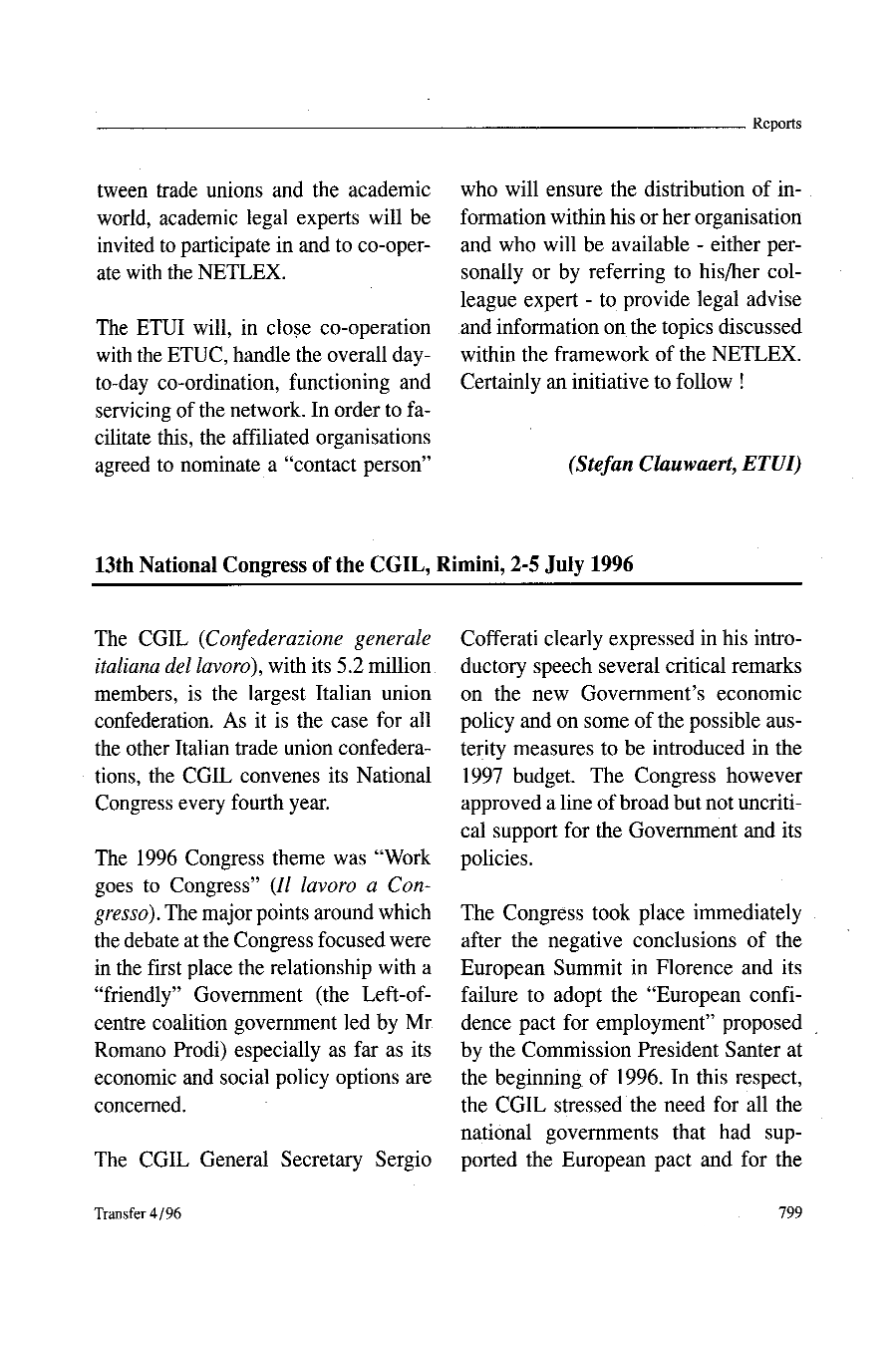 Restricted accessOtherFirst published November, 1996pp. 801-805