Editorial
Select search scope: search across all journals or within the current journal

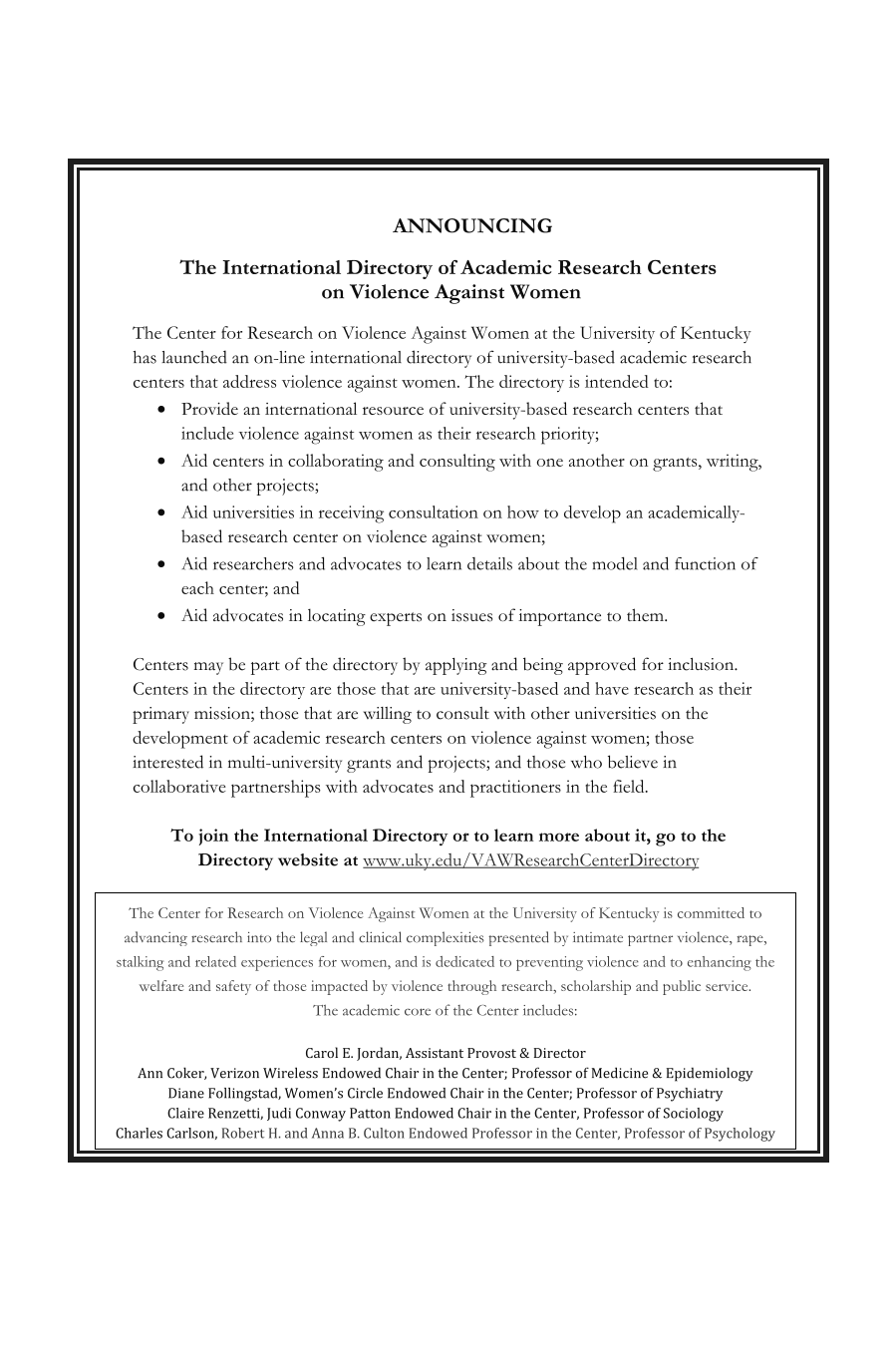
Research in the violence against women area has been undertaken for more than 30 years, but individual researchers who have made these scholarly contributions have not been advantaged by adequate attention, funding, or organizational structure within the university setting. This article offers a detailed description of a model of an interdisciplinary research center designed to provide an academic architecture within which research on intimate partner violence, sexual assault, stalking, and other forms of violence against women can flourish and advance. The article describes the impetus for creation of the University of Kentucky Center for Research on Violence Against Women, its current mission, organizational structure, financial operations, and initiatives related to research, education, and public service. Practical strategies for establishing and sustaining a center of this type are offered.
The importance of Canadian research on violence against women became a national focus after the 1989 murder of 14 women at École Polytechnique in Montreal. This tragedy led to several federal government studies that identified a need to develop centers for applied research and community–university alliances on violence against women. One such center is the Centre for Research & Education on Violence against Women and Children. The Centre was founded in London, Canada in 1992 out of a partnership of a university, a community college, and community services. The centre’s history and current activities are summarized as a model for the development and sustainability of similar centers.
This article describes an interdisciplinary center at the University of Illinois at Chicago focused on collaborative research on violence. Our center is unique in its emphasis on developing infrastructure and distinctive processes for overcoming obstacles to interdisciplinary research; the involvement of outside policy makers, advocates, and service providers in jointly discussing and developing research proposals; the breadth of commitments from leading violence researchers and administrators across five colleges; and the innovativeness of proposed research projects that support interdisciplinary activity and show promise for funding. The center has developed an infrastructure to address violence-related issues in both research and teaching. This article discusses the challenges of implementation and boundary spanning in a university context and makes recommendations for sustainability.
The article discusses the University of Texas at Austin’s (UT Austin) Institute on Domestic Violence and Sexual Assault (IDVSA), an institution that was established in 2001. IDVSA is a collaboration of the Schools of Social Work, Law, and Nursing, and 150 community affiliates. Recognizing that interpersonal violence does not occur in a vacuum, the IDVSA operates within an ecological framework in which explanations for interpersonal violence acknowledge that individuals and families are nested in larger mezzo and macro systems, and factors such as gender, poverty, ethnicity, religion, disability, sexual orientation, and immigration status play influential roles in our understanding of these issues. The overarching goal is to advance knowledge and meaningful practice in the field through partnerships with survivors and community practitioners. Specifically, the mission is to advance the knowledge related to domestic violence and sexual assault in order to end interpersonal violence. IDVSA seeks to achieve its mission by focusing on three key areas: (1) rigorous research and scholarship on domestic violence and sexual assault; (2) comprehensive training, technical assistance, and information dissemination to the practitioner community and the community at large; and (3) substantial collaboration with our community partners. This article summarizes the authors’ pursuit.
The Minnesota Center Against Violence and Abuse (MINCAVA) was established in 1994 through an appropriation of the Minnesota Legislature. Located at the University of Minnesota, MINCAVA conducts original research, develops extensive collections of translational materials, provides higher education training on family violence prevention, and disseminates information globally. Over a dozen professional and student staff work on projects funded by federal, state, and private sources and collaborate closely with national and global advisory boards and partner agencies as well as local community-based and national advocacy organizations. The Center operates multiple project-specific and general websites that receive millions of unique visits each year from dozens of countries.