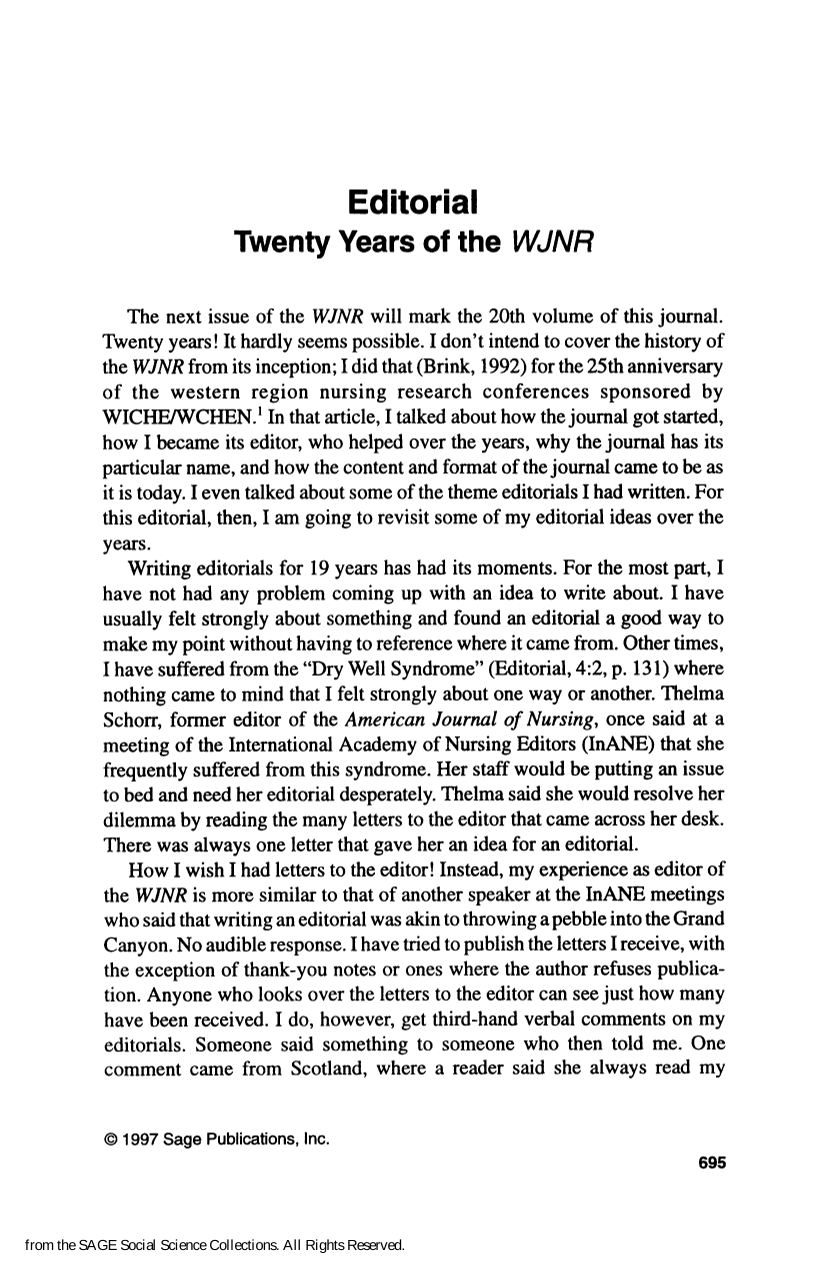
Editorial
Select search scope: search across all journals or within the current journal

Research has indicated that using coping strategies is significantly related to resisting smoking during highly tempting situations. However, little is known about the nature of coping during smoking cessation. The purpose of this study was to identify coping strategies used within the first 10 days of smoking cessation by having participants describe these strategies into a handheld tape recorder at the actual time of occurrence. The aim of a qualitative analysis of the narrative accounts was to create a descriptive taxonomy of smoking cessation strategies grounded in the participants'own terms. Over3 consecutive days, 36participants recruitedfrom smoking cessation programs provided 477 narrative accounts of coping episodes. Seven major taxons-context, anticipatory efforts, awareness, urges, strategies, effects, and metaphors-reflected the entire process participants described when dealing with the urge to smoke. This taxonomy, inductively derivedfrom real time rather than retrospective data, provides a holistic picture of strategies used in the early stages of the quit experience.
Although there is an increase in the visibility offamilies in hospitals, there was little known about the meanings, patterns, and day-to-day experience offamilies staying with hospitalized relatives. The purpose of this qualitative, ethnographic study was to describe vigilance, defined as the family member's experience of staying with a relative in the hospital setting. Eight adult family members with relatives on two acute care neurology units were purposively selected to participate in the study. Data were collected using informal, semistructured interviews and participant observation. Qualitative analysis provided a meaningful grouping of the data pieces into five categories of meaning: commitment to care, emotional upheaval, dynamic nexus, transition, and resilience. These categories of meaning provide a description of vigilance and enhance the theoretical understanding of this care phenomenon.
To manage the care of residents with dementia, many long-term care facilities have created special care units designed to meet the unique needs of this group. This article describes results of the qualitative component of a larger research project examining environment-behavior relationships in dementia care settings. The study includes 18 in-depth interviews that were conducted with 9 staff and 9 family members of special care unit (SCU) residents. Thematic analysis was conducted using grounded theory techniques. Although participants described residents 'needs in relation to both the physical and social environments, the latter was perceived to have more impact on quality of life andfunctional ability. This article focuses on five areas of need, identified by participants, in relation to the social environment: stimulation and meaningful activity, human contact, safety and supervision, individualized care, andflexibility.
Respect was analyzed as a concept in the domain of nursing action using the hybrid model of concept development. Field research methods provided empirical descriptions of respect in two different cross-cultural settings. Participant observations were conducted in an outpatient clinic ofa large U.S. hospitalproviding services toa multicultural clientpopulation, and key informant interviews were undertaken in a Canadian First Nations community. Data analysis proceeded according to a variation of Schatzman and Strauss 's notation system. Findings from analyses of field data revealed patterns of interaction indicative of respect and lack of respect. By synthe-sizing theoretical and empirical findings, key indicators, potential operational indicators, and a conceptual definition of respect were developed. Thefindings provide preliminary descriptions of respect that lay the foundation for future analyses and applications in nursing.
A new tool, the Interpersonal Competence Instrument for Nurses, was evaluated for content validity and readability. Evaluators consisted of a panel of 10 nursing experts. The instrument measures four categories of the patient-nurse interaction: translating, getting to know you, establishing trust, and going the extra mile. The content validity indexes (CVI) for 14 of 15 behaviors within the four categories rangedfrom .8 to 1.0 and are considered to have content validity. The CVIfor the 15th behavior, clicking, was calculated as. 7, and, thus, was modified. The CVIfor the entire instrument of 111 items was determined to be .84. Readability analyzed with the SMOGformula established a grade level of 8.09. Additional psychometric testing of the tool is in progress. Internal consistency reliability is being evaluated through the use of coefficient alpha and item analysis. Construct validity is being estimated through the experimental approach. The internal structure of the instrument is being assessed throughfactor analysis. Presuming that this instrument continues to demonstrate validity and reliability with future testing, it will facilitate the evaluation of nurse-patient interaction and promote focused education for nurses in the career development continuum.

The purpose of this study was to contribute to the understanding of the nursing profession and the role of the nurse today by illuminating a small portion of nursing history. The historical biography method was used to study the practice of one nurse in rural Saskatchewan during the periodfrom 1929 to 1963. Open-ended and nonstructured interviews were conducted with the respondent and six former patients. This article addresses only the maternity portion of the respondent's practice during the period from 1933 to 1944. The maternity portion of the respondent's practice was analyzed using the constant comparative method to identify themes. Findings indicate that caring, "presencing, " and "expert practice " are important themes in this nurse s practice. These themes are analyzed and compared to the work of other researchers in this area.

