




Abstract

Drug discovery groups within large pharmaceutical companies and smaller biopharmaceutical firms alike are facing a similar challenge: how to screen their compound libraries against a rapidly expanding number of drug targets in an expedient and time- and cost-efficient manner. With the completion of the Human Genome Project, that challenge continues to mount, as the unraveling of gene identity and function will produce a torrent of novel drug targets. These must all funnel through the high throughput screening process to identify compounds that demonstrate desirable biological activity, eventually leading to the development of commercially viable drugs.
The demands on high throughput screening (HTS) technology have evolved in recent years in parallel with the proliferation of novel drug targets and the increasing emphasis on cell-based assays that yield information; not only on whether a compound binds to a target, such as a receptor or an enzyme, but also what happens within a cell and between cells when a molecule interacts with its target. HTS, and the supply of functional cells and cell-derived reagents for use in screening assays, have evolved along a dual course: the demand for large batch production of one or a few cell lines to produce recombinant proteins for “classical” receptor-ligand binding assays; and the more recent and growing need for parallel processing of multiple, smaller batches of numerous cell lines for cell based functional assays including selectivity testing.
In the past, drug discovery groups working with a limited collection of validated drug targets had focused primarily on large-scale screening of their compound libraries against a relatively small number of targets. This approach requires large quantities of a particular cell or cell-derived receptor, enzyme, or membrane preparation for use in high throughput screening assays. Now used by ten major pharmaceutical companies, The Automation Partnership's (TAP) Cellmate, an automated, flexible cell processing system, was first used by Pfizer to support this type of application in 1996.
Cellmate automates aseptic cell culture processing for large batch production of one or several attachment-dependent cell lines, and is scaleable from 10 to 500 T-flasks or roller bottles per batch. Automation of cell or cell-derived protein products streamlines production schedules and minimizes manual operations, resulting in reduced labor needs, decreased costs, fewer opportunities for operator error, increased processing speed, and accuracy, and above all, improves the consistency of the resulting products.
As applications that demand smaller, multiple batch processing have expanded, the need for a flexible, small batch, cell processing system that offers all of the advantages of automation introduced by Cellmate has intensified. Issues related to cell and reagent availability-including quantity, scale-up, response time, and scheduling-can all cause serious, yet avoidable delays in assay development and HTS operations, and represent an important potential bottleneck in a company's discovery pipeline. On-demand availability of quantities of viable cells of a large number of varied cell lines, requires continuous maintenance of multiple live cell populations. The alternative, of thawing, resuscitating, and expanding frozen cell stocks can take two to three weeks and introduces unacceptable delays in scheduling of assays. By culturing cells and then scaling them up in T-flasks or roller bottles, the user also avoids any delays caused when adapting anchorage dependant cells to the different culture conditions found in fermentation systems.
Flexibility in cell processing is essential to provide a timely and continuous supply of assay materials for primary and secondary screening, target validation, and lead optimization studies, which are often undertaken in parallel. Maintaining multiple adherent cell lines, each having different culture requirements and processing needs, and producing variable batch sizes of high quality and consistent cells and reagents to meet the changing supply needs of a HTS laboratory, presents a host of challenges for cell processing groups.

A Consortium Approach
SelecT represents The Automation Partnership's flexible solution to automated, medium throughput, parallel processing of multiple cell lines. Whereas Cellmate is ideal for maintaining hundreds of T-flasks or roller bottles of perhaps 5 to 10 different cell lines, the SelecT system will be able to process as many as 50 different cell lines in quantities of 1 to 50 T-flasks, each in a single 24-hour period and maintain them all as viable cultures for on-demand scale-up. With minimal operator intervention, SelecT can maintain, expand, process, and harvest cells. The system can also be programmed to operate unattended overnight or at the weekend and can even generate assay-ready microplates for the following morning. The operator can load and program the system on Friday and return to the laboratory on Monday morning to find plates ready for use in a functional cell-based assay. This capability eliminates staffing problems on nights and weekends.
How do you design a cell processing system that can meet the varied needs of the biopharmaceutical industry and satisfy the various styles of operation of individual companies? Different companies organize their work in different ways: for example, one group may use the same few cell lines for screening over a period of several weeks and then switch to a handful of new cell lines, whereas another may rapidly shift from doing primary screens, to secondary screens, to structure activity relationship (SAR) studies, to a combination of these, and may require ready access to a large number of cell lines.
When TAP set out to develop a single, flexible system that could meet these varied applications and suit the different methods of cell culture practiced throughout the industry, the company sought the advice of its potential customer base-current users of Cellmate. Thus was born the SelecT Consortium, a group of six major pharmaceutical companies that have been collaborating with TAP on the design of an automated, integrated cell culture system for drug discovery applications. TAP benefits by tapping into the combined experience and expertise of its six corporate partners; and the consortium members benefit from early access to technology that is specifically tailored to meet their needs. The SelecT system itself is in development, and the first actual systems are likely to be available in 12 to 14 months.
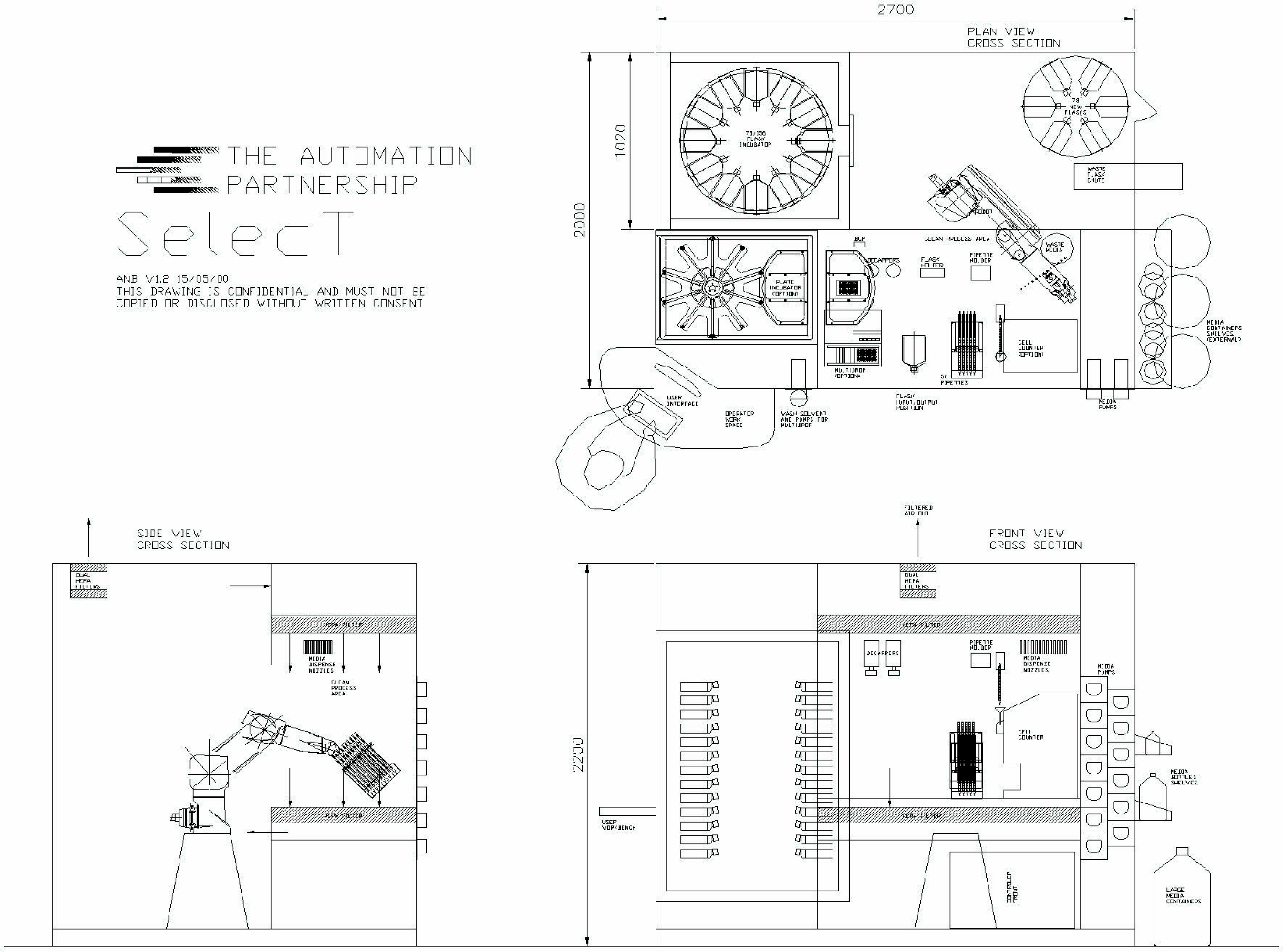
At the heart of SelecT is an automated tissue culture incubator housed within a laminar flow enclosure that is maintained at negative pressure relative to the room. An industrial robot moves flasks through the system and is capable of performing a variety of processing steps, including adding media, decanting waste liquids, pipetting cell suspensions from one flask to another, pooling contents of flasks for harvesting, and dispensing cells into microtiter plates. The robot can access any flask and move it to any defined position in the system. The tissue culture incubator — available in two sizes, to accommodate 75 or 150 T-175 flasks — maintains the cells at the proper temperature for growth and trypsinization.
The 6-axis, anthropomorphic robot operates within the clean environment at all times, reducing the chance for contamination. An array of bottles connected via pumps to the system supplies the various media ingredients and other reagents needed to maintain multiple cell lines. Employing a “cocktail bar” approach, the robot draws solution from the supply bottles to prepare specific volumes of the various media “recipies” needed to feed as many as 50 different cell lines, with on-demand mixing of up to 10 components. Non-contact dispensing further reduces the risk of contamination. A carousel within the enclosure stores clean flasks for cell splits and expansion. The robot disposes of solid waste down a trash chute and stores liquid waste in a holding tank.
For cell seeding, the robot transfers a defined volume of cell suspension to a new flask, using a clean, disposable pipette for each cell line, and mixing the suspension by repeated aspiration and dispensing. The operator can program variable dispense volumes for each flask. To harvest cells, the robot's protocol will be similar to an operator's: adding trypsin, or other reagent; incubating the flask; adding serum to block the enzyme reaction; then, pooling the resulting cell suspension in a separate flask. As the robot caps and uncaps each flask, it retains the cap, returning it to the original flask.
Cell counting and viability measurement is an optional, quality control function on SelecT. The robot transfers a sample from a suspension of harvested cells into the automated analyzer, which carries out an optical counting process based on the trypan blue exclusion principle.
For automated microplate seeding, pooled cells are poured into a reservoir, transferred via a multi-channel dispenser into microtiter plates, and stored in a separate, optional, automated plate incubator that can accommodate up to 290 plates (96- or 384-well).
Process Automation and Control
Automation of cell processing maximizes throughput and improves the consistency and reliability of results. In an automated system, incubator conditions, including temperature and CO2 levels, are regularly monitored and adjusted to stay within a user-defined range. In the SelecT system, when an operator wants to examine a sample of each cell line under the microscope to assess their condition, he need only instruct the robot to select the appropriate cell lines and retrieve a flask of each. When he determines the status and processing needs of each cell line, he can then program the system to perform any combination of functions-feeding the cells, harvesting, pooling and seeding cells into new flasks, specifying which functions to perform on which cell lines. The system will process those instructions and inform the operator what materials it will need (flasks, media, reagents) to complete the selected tasks.
When the system is loaded and ready for operation, the robot will pick the first flask from the incubator and move it to the bar code reader. Each flask has a bar code that identifies its position and contents. The system reads the bar code each time a flask is removed from the incubator, and maintains a log of what functions are performed on each flask. This creates an audit trail for each individual flask. When the robot finishes processing the first flask, it either returns the flask to the incubator or discards it as appropriate, and then selects the next flask for processing.
The SelecT system software is menu-driven and controls all processes, including tracking flask and plate bar codes, logging all operations and process parameters for each flask and batch, and calculating the number of flasks and the approximate amount of media and incubator space required for each operation. The combination of robust engineering specifications, advanced automation technology, and sophisticated process control software used to design the SelecT system has created a flexible, robust solution to multi-batch, medium throughput, cell processing for drug discovery.
SelecT Consortium Members Include:
AstraZeneca
Bristol-Myers Squibb
Parke-Davis
SmithKline Beecham