




Abstract
Abstract
Feasibility in metals has been demonstrated for a fast, accurate method for authenticating three-dimensional printed products. The method relies on spectral signatures produced from chemical taggants, yielding covert material-based fingerprinting. Fingerprints were created using a directed energy deposition multimaterial additive manufacturing system, and detected with x-ray fluorescence spectroscopy.

Introduction
T
Protection of 3D printing begins with cybersecurity measures intended to secure the digital design. Controlling access to and use of the design is necessary, but not sufficient, since it offers no protection to the physical object produced from the digital file. Conventional manufacturing anticounterfeiting strategies rely on packaging protections or placement of physical marks on the product itself. Most marks can be replicated, however, as the object can, with a 3D scanner.
When prototyping was the key use of 3D printing, the integrity of the supply chain was not an issue: the printer was in sight and the hidden properties of the prototyped object were less critical. As AM brings lightweighting and complexity advantages to scale manufacturing, however, the dangers multiply: how can you be sure that this part (medical device, wing, brake, or weapon) is made as designed, strong and secure?
As AM objects begin to travel in a supply chain, distributers and end users will demand field validation capabilities so that, for example, a part for a truck or airplane can be authenticated before it is installed. More broadly, American and global brands are even more at risk from 3D printing: how can purchasers have confidence in the quality or “limited edition” status of an object that can be scanned and replicated at will?
3D scanning, now available even on a smartphone, collects and analyzes digital data on the shape and appearance of a real object. Based on these data, 3D models of the scanned object can then be produced and then knockoffs, unauthorized and not necessarily made of high-quality material, can be easily replicated. There is a clear need to mark legitimate 3D-printed physical objects so that they can be quickly and reliably authenticated throughout the distribution chain. This is a particular concern with repair or replacement parts, especially in the areas of aerospace and defense where counterfeit parts are widely available at a fraction of the cost, but without the rigorous assurances and certifications needed to guarantee their safety. 5
There is a growing need to address protection requirements across the marketplace without escalating costs and complexity. Quantum dots 6 and microstructure manipulation 7 are effective ways of anticounterfeiting parts, but they are costly to implement and detect. Chemical fingerprinting, on the other hand, offers a low-impact solution for tagging and enables field authentication using handheld, off-the-shelf detectors. This approach to brand protection returns the anticounterfeiting advantage to legitimate manufacturers, packagers, and distributors using inexpensive, instantly verifiable chemical taggants.
Materials and Methods
Most methods for 3D printing are compatible with chemical tagging. 8 Different 3D printing media have different curing methods, but most are amenable to chemical fingerprinting. Optimally, the chemical taggants are detectable only with a chemical analyzer, not with the human eye. In the case of metal 3D printing, directed energy deposition (DED) is the best of several methods for tagging, since it permits multiple metallic materials. The detector used in this test is an x-ray fluorescence (XRF) spectrometer, 9 in this study, a desktop model. High-quality handheld XRF instruments are also now available for use in field detection.
Tagging can be covert, in particular because spectroscopic (rather than visual) detection makes it possible for the taggant layer to be below the surface of the finished 3D-printed object. This invisible tagging represents a substantial advance in security. The spot-based tagging also offers major advantages over simply mixing a taggant chemical into a single printing medium, since it makes possible a much larger number of tag options (e.g., in the top left corner, in multiple layers, or in a proprietary pattern).
InfraTrac's patented brand protection methods employ a three-step process: (1) developing suitable formulation(s) from commodity chemicals or materials, (2) applying the selected formulation so as to minimize structural concerns, and (3) verifying that the chemical code contained in the applied formulation exhibits the desired spectral absorption attributes.
Minimizing Structural Impact
Users of metal AM in particular are concerned about the structural integrity of the final product, and parts require significant testing. The chemical fingerprinting method used in this study attempts to minimize structural impact in several ways. First, the taggant material is chosen to minimize risk: no corrosion-prone or weak additives. Second, the taggant location relies on state-of-the-art choices already in use for labels, laser etching, and the like (e.g., Moog, Inc.'s work on AM parts, and parallel work in medical implants 10 ); finite element analysis provides the requisite input to optimize placement for minimal structural effect. Third, a small spot of taggant “under the skin,” or even mixed invisibly into the surface layer, is less risky than a deeply embedded or larger fingerprint would be. Finally, as National Institute of Standards and Technology (NIST), ASTM International, and others continue to develop AM standards and tests, the fingerprinting can be validated for increasingly extreme environments.
Initial Feasibility Demonstration for Metal Fingerprinting
This work describes the results of the initial feasibility testing performed by Penn State's Center for Innovative Materials Processing through Direct Digital Deposition (CIMP-3D) under the direction of InfraTrac. The aim of the feasibility study is to show how covert material-based fingerprinting can be used in metals AM, using a DED multimaterial AM system. Tests on polymer materials and other 3D printers were detailed in previous work. 8
The goal in this work was to select authentication material that is
• metallurgically compatible,
• easily detectable by XRF,
• potentially detectable by x-ray,
• will not significantly degrade material properties, and
• enables use of similar processing parameters.
Methodology for 3DP Authentication of Ti64 Parts Using Metal Taggant
Deposited coupons, on the Optomec MR-7 laser-based DED system, consisted of a matrix material and a taggant. ASTM grade 5 titanium (Ti-6Al-4V) was used as the matrix material and substrate. The feed stock powder was spherical, extra-low interstitial grade with a particle size distribution between 44 and 149 μm. The authentication material consisted of a mixture of Ti-6Al-4 V and a taggant, in this case, molybdenum. Choice of taggant for this method is broad, limited by functional concerns, including strength and stability.
Deposition (printing) took place on a laser-based, Optomec, Inc. LENS MR-7 system (Fig. 1) equipped with two powder feeders. Each powder feeder, one containing Ti-6Al-4V and the other containing the authentication material, operated in coordination with a predefined build plan. This enabled deposition of the authentication material at select locations within a part. A powder flow rate of 3 g/min was used for both the matrix and authentication materials. Argon gas flow was used to fluidize the powder at a rate of 4 lpm and to shield the laser optics at 30 lpm. Processing was conducted within an argon-filled chamber with a measured oxygen concentration below 20 ppm. A measured output laser power of 425 W and a translation speed of 10.58 mm/s were used for all deposits.
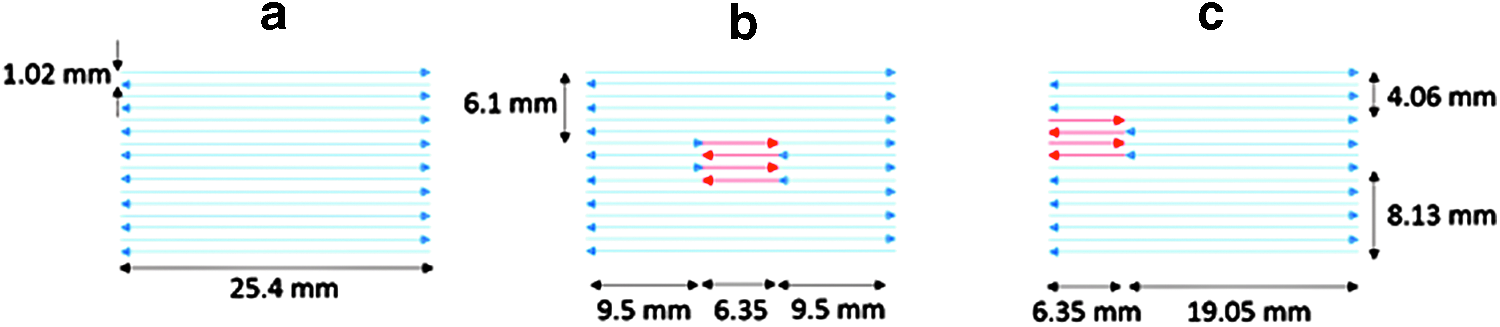
Illustration of path plan used for deposition of
Experiments were designed to determine, first, whether the taggant could be detected by XRF, and then at what positions and depths under the surface the taggant could be detected. Furthermore, was it visually detectable, either when placed at the surface as a top layer or when hidden below?
Deposits were formed using a back and forth raster on all layers. On layers with a taggant, powder feeding was switched from Ti-6Al-4V to the authentication material along the length of a raster, as illustrated in Figure 1b and c. Between each layer, the deposition head was incremented 0.254 mm upwards. The depth (layer) at which taggant material was deposited varied from the surface layer to two layers below the surface layer. The taggant material was either centered within the layer on which it was deposited (Fig. 1b) or deposited off-center, according to Figure 1c. All dimensions shown in Figure 1 are with respect to the center of each track.
In the second round of experiments, the location of the taggant mix was varied within the layer. Could the alloy be successfully detected at the side? At a distance d from the side? At distance of 2d? Does placement affect visual appearance? Does depth of the taggant mix affect detectability?
Figure 2 shows the fingerprinted metal samples following the aforementioned design of experiments.
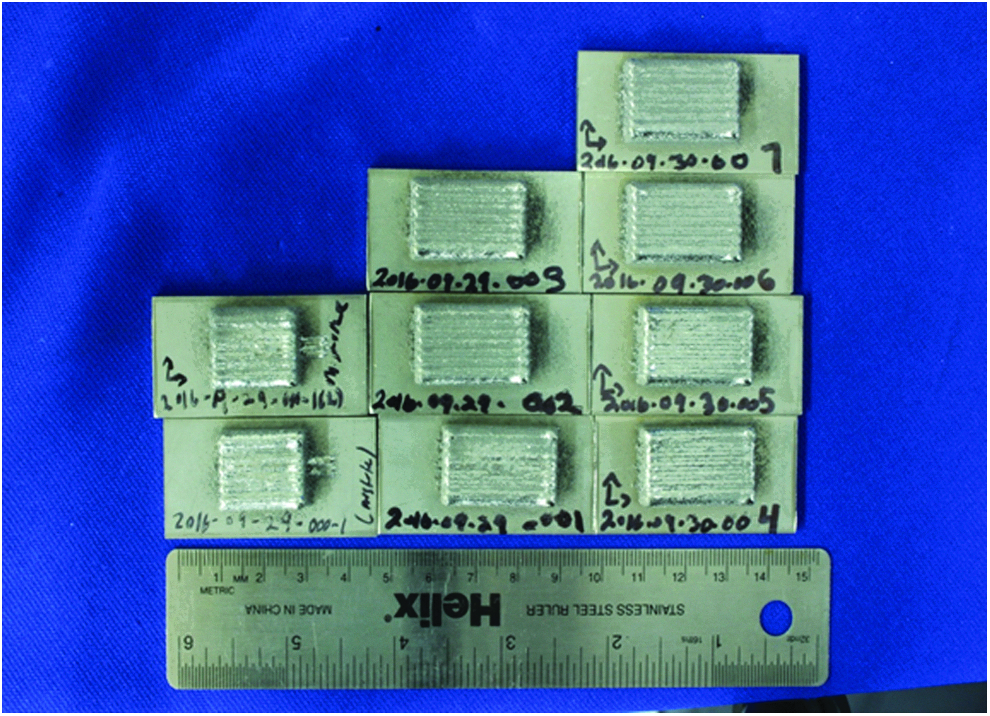
Initial Ti64 samples with taggant placed at various depths and locations. Color images are available online at www.liebertpub.com/3dp
XRF detection of the covert fingerprint was tested in a laboratory context by Nathan Valentine and Edmond Elburn in the University of Maryland Center for Applied Lifecycle Engineering (CALCE) laboratory in College Park, under the direction of InfraTrac collaborator Dr. Diganta Das (Raziki M, Das D. Efficacy of InfraTrac Taggant Technology for Electronic Component Tracking and Counterfeit Prevention. Unpublished report).
The samples were tested in a 4 × 5 grid pattern, i.e., 20 readings were taken on each sample, to see (1) if the taggant was detectable and (2) if it was quantifiable. Figure 3 shows the location and numbering scheme for inspection. The test team had no knowledge of the size or placement of the taggant. When used in validation, of course, the testers could have information on where to look and what to expect, turning the authentication task into a simpler match/no match exercise.

Location and numbering scheme used for XRF inspection. XRF, x-ray fluorescence. Color images are available online at www.liebertpub.com/3dp
XRF measurements demonstrate that variations in the taggant concentration along the surface are detectable, with partially sintered powder contributing to surface contamination. The results of XRF testing are shown in Tables 1 and 2 for taggants deposited on the surface layer in centered and off-centered locations, respectively. Juxtaposition of XRF data of surface-layer taggants and a deposit with a centered taggant buried one layer below the surface demonstrates that, while XRF can detect taggants within the surface layer, taggants buried at and below one layer below the surface (∼0.254 mm) were not detected.
Shadings highlight the presence of taggant as detected by XRF.
XRF, x-ray fluorescence.
Shadings highlight the presence of taggant as detected by XRF.
Discussion
The tested samples clearly show that it is possible to spot the taggant on the surface without any prior knowledge of its location. The surface taggant is invisible to the naked eye, but detectable by XRF. Depth, however, is a challenge. Taggant is difficult to differentiate when hidden beneath 250 μm of Ti64 material. Note that the detector gets two chances: (1) the taggant and (2) the percentage of titanium, which is lower in the tagged spots.
Machined samples (Fig. 4) still do show taggant (Fig. 5), although the resolution of the grid blurred in the initial tests. Further work is ongoing to quantify and ameliorate the effect. A likely contributor to this blurring effect is smearing, which occurs with machining of soft materials like titanium. Optimization or modifications of postprocessing steps, such as machining/grinding with sufficient lubrication or the use of an etchant, can reduce the effect of smearing.
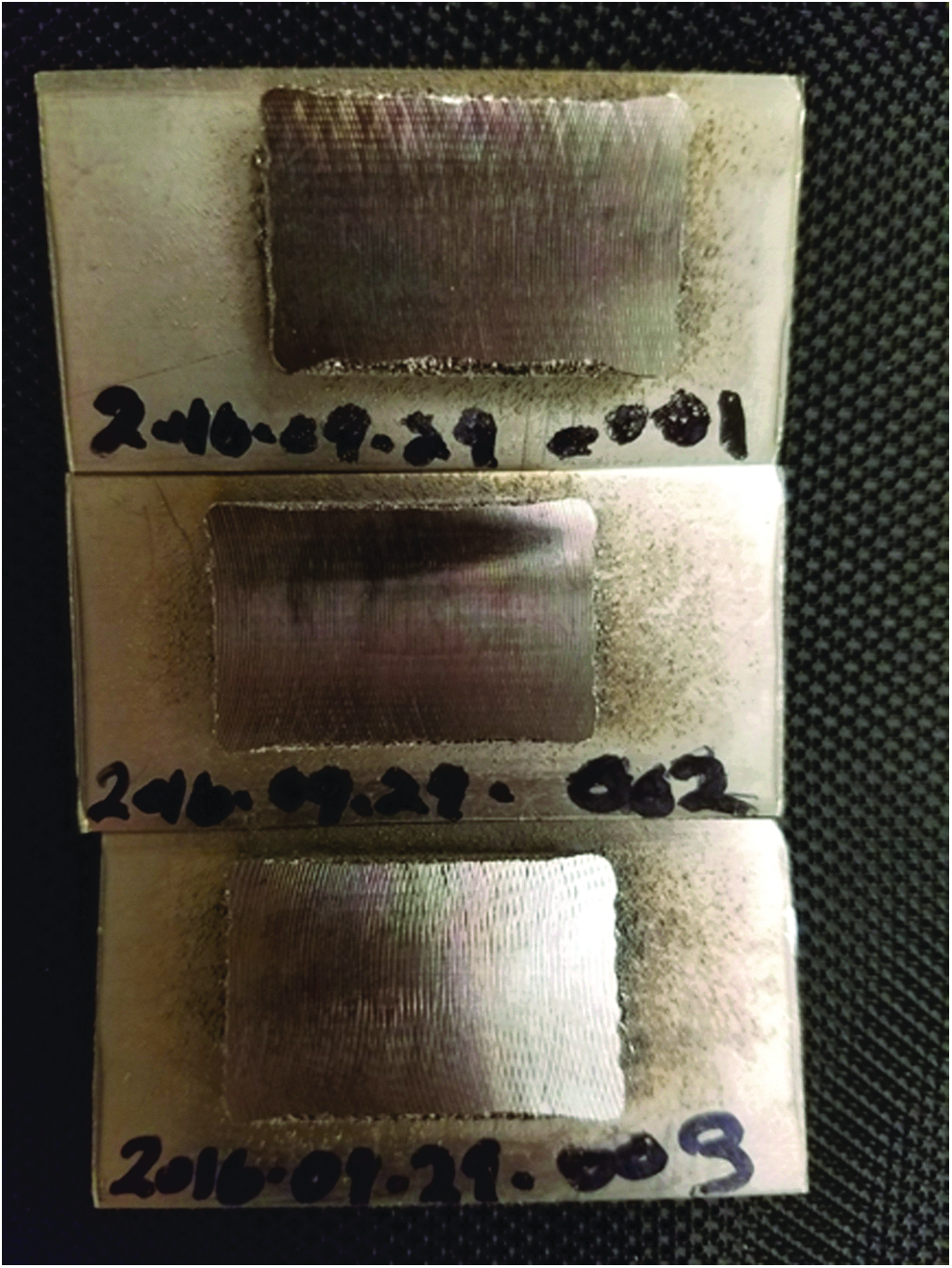
Samples 001, 002, and 003 were machined, with some effect on detectability of the taggant's position. Color images are available online at www.liebertpub.com/3dp

As Figure 5a illustrates, in machine sample 001, the taggant is hard to see. The visualization uses the decreased concentration of Ti rather than the concentration of taggant, simply for ease of presentation. The taggant visualizations show parallel results, but with more eyestrain.
Sample 002, in Figure 5b, fared better.
These results are encouraging. Preliminary results suggest that not only can a taggant mix be detected but also can be hidden in a specific predetermined position, as in a game of Battleship. Moreover, it can be quantitated as well so that a counterfeiter attempting to replicate the fingerprint would have to know about it, find exactly which spot it is in, and replicate its depth and composition correctly, along with matching the composition of the matrix materials. This helps establish barriers to reverse engineering, which will deter future counterfeiters. 11
Having established initial feasibility, further research is needed into metal fingerprinting. Now that the taggant has been detected, the model for fingerprinting needs to be further tested and adjusted to build on these successes, and to make clear what the parameters are: what can be tagged, with what, how deep, how thick, and how large a spot? Postprocessing (machining), as these tests show, is likely to play a role. Structural effects will need to be addressed, for example, by testing tagged dogbone samples to failure in a universal tester and comparing them against unaltered samples (as suggested by a reviewer). Handheld XRF capability must also be tested so that fingerprints that can be detected in the laboratory are designed correctly so that they can also be authenticated in the field, preferably by less-than-expert users.
Guiding the whole process is a focus on user requirements: who wants this tagging, how will they use it, and what must it do, for which materials and print processes, and to what quality standards, to solve their counterfeiting challenges? For example, rocket parts must endure not only high temperatures and low temperatures but also extremely fast temperature changes. In addition, vibration is a major challenge, which suggests that interlocking, not flat, layers may be required for the internal fingerprint of an additively manufactured rocket part.
Conclusion
Counterfeiting threatens to undermine confidence in the quality and reliability of AM products. Manufacturers are taking steps to secure digital design files, but those protections alone are not sufficient. The 3DP product itself must be protected if unauthorized and potentially dangerous versions are to be kept out of the supply chain. Spectroscopic detection of chemical taggants enables fast and easy field authentication of AM products at every point in the distribution stream, using handheld detectors. InfraTrac's testing of metals confirms that products constructed of industrial-quality materials in AM can be authenticated in this manner.
InfraTrac's approach to brand protection is supported by numerous patents and applications, in the United States and beyond.
Footnotes
Acknowledgment
The authors are grateful for the assistance of Dr. Diganta Das of the Center For Advanced Life Cycle Engineering at the University of Maryland.
Author Disclosure Statement
No competing financial interests exist.