




Abstract
Objectives:
This study had two aims: (1) to explore the inner experiences associated with increased production of gamma brainwaves in an initial neurofeedback experience; and (2) to measure and compare neurofeedback-enhanced increased output from the prefrontal cortical region of meditators and non-meditators, using the Peak Brain Happiness Trainer™ neurofeedback system.
Design:
This was a controlled pilot study; it involved a single session per subject.
Setting:
The research was conducted in a nonprofit laboratory in the United States.
Subjects:
There were 12 adults in 2 groups (N = 12): 6 practitioners of Transcendental Meditation™ and six controls.
Measures:
The measures were self-assessed inner experiences and measurements of clarified gamma output at the prefrontal cortical region.
Results:
(1) Self-assessed descriptions were comparable for both groups; (2) the associations of 16 supplied descriptors with the initial neurofeedback experience were comparable for both groups and showed highest scores for “happy” (p < 0.0001) and “loving” (p < 0.0001), and lowest scores for “stressed” (p < 0.0001) and “disappointed” (p < 0.0001); (3) baseline measures were comparable for both groups; (4) both groups were able to increase gamma brainwaves using neurofeedback (p < 0.01); and (5) meditators produced greater increases over controls (p = 0.02).
Conclusions:
The inner experience associated with increased clarified gamma amplitude from the prefrontal cortex apparently involves positive emotions of happiness and love, along with reduced stress. Meditators achieved greater increases in the gamma band from the prefrontal cortical region over controls during an initial neurofeedback session.
Introduction
Until recently, relatively few EEG studies on the 40-Hz rhythm have been performed because of methodological problems. Much of the gamma band signal is absorbed by the scalp and brain meninges, so that this band's measured amplitude on the skin appears to be very small, although EEG recordings made during brain surgeries have shown that, on the cortical surface, this band is much larger. Over past decades, analog EEG systems could not record fast enough above 32 Hz, but this was resolved by digital recording. A remaining problem is contamination by electromyographic (EMG) signals from muscle contraction and eye movement, which also produces a 40-Hz signal. In this study, a new computational approach, called Neureka!, a proprietary method for clarifying the 40 Hz rhythm in the EEG (signified in this article as “clarified 40 Hz”), to eliminate most of the EMG and eye-movement contamination, was used to measure the 40-Hz rhythm and also used for neurofeedback. 5
The frontal lobe of the brain is thought to be associated with more conscious aspects of mental functioning, including the powers of will and intention, the focus of attention, and the experience of oneness. 6 In certain types of yoga, meditation, and related practices, there is increased activity in the frontal lobe. Studies on meditators 7 –9 have shown that the 40-Hz rhythm, in some cases measured from the prefrontal cortical area, is intensified during meditation, and is apparently associated with feelings of kindness and compassion. A study on Tibetan Buddhist meditating monks showed enhanced emission of 25–42-Hz brainwaves from this region that correlated with heightened experiences of compassion and clarity of meditation, on a moment-to-moment basis. 9 The monks also produced more gamma band waves before, during, and after meditation than controls.
Meditation experience is correlated with increased EEG coherence 10 that stabilizes beyond meditation. 11 In many circumstances, EEG coherence may increase brain-processing capacity, which may therefore improve test performance of meditators in tasks such as neurofeedback. Indeed, the observed effects of meditation practice on brain function from various studies show increased brain-processing capacity and improvements in cognitive function. 12
Preliminary data that was collected from a number of volunteers informed this study and contributed to its design. The data, which are unpublished, suggested that increased clarified amplitudes of the gamma band from the prefrontal cortex in both meditators and non-meditators are associated with feelings of satisfaction, gratitude, compassion, and love.
This pilot study investigated practitioners of Transcendental Meditation
The purpose of the present pilot study was to explore the 40-Hz rhythm from the prefrontal cortex in an initial neurofeedback session to enhance this rhythm and to learn more about its associated inner experience. This was the first study identified that explored the 40-Hz rhythm in the EEG from the prefrontal cortex using neurofeedback. The following research questions were posed: (1) What is the inner experience associated with increased clarified 40-Hz enhanced by neurofeedback? (2) How do meditators and non-meditators compare in producing clarified 40 Hz from the prefrontal cortical region at baseline and in an initial neurofeedback session?
It was expected that advanced meditators would have greater facility than non-meditators in their awareness and description of inner states as well as being more able to engage in various states described to them, and hence, be more able to perform the tasks in this study. The purpose was not to assess 40-Hz emission during meditation, but rather, only during an initial session with 40-Hz neurofeedback.
Materials and Methods
Participants
Two groups of volunteers gave informed consent. One consisted of advanced practitioners of TM and the other group was a control group of non-meditators. Subjects were recruited by advertisement on Craigslist.org, word-of-mouth, and by e-mailing two regional colleges in the San Francisco Bay area of California. The following criteria were used:
Exclusion criteria for both groups—any psychiatric diagnoses; any diagnoses for any serious acute or chronic degenerative diseases including cancer, heart disease, stroke, and/or AIDS; any prescriptions for psychiatric drugs, except for regular doses of hormones (birth control pills, hormone replacement therapy, thyroid hormones); use of recreational drugs; consumption of more than 10 ounces of alcoholic beverages per week; a diagnosis of attention deficit disorder or attention deficit and hyperactivity disorder; complaints of “brain or mind fog” or emotional difficulties; pregnancy; prior familiarity with the Peak Brain Happiness Trainer™ (PBHT, NeuroTek
Inclusion criteria for meditators—persons from 18 to 75 years of age in good health who have 10–20 years of experience practicing TM and who practice regularly at least 3 times per week
Inclusion criteria for controls—persons from 18 to 75 years old in good health who have either no meditation experience whatsoever, or who have meditated for less than 6 consecutive months.
The meditation group (n = 6) consisted of 5 females and 1 male; age range 38–60, and mean age 51. The control group (n = 6) consisted of 4 females and 2 males, age range 31–62, mean age 49. The mean number of years of meditation practice for the meditation group was 15.7, and all meditated at least once daily. All subjects were Caucasian except for 1 female in the control group, who identified herself as part Native American.
Instruments
The PBHT was used in its single-channel feedback mode for measurement of clarified 40 Hz and for neurofeedback. Three sponge-capped recording electrodes, moistened with saline solution, were placed on the head, including one electrode at the FPz point (prefrontal cortical region of the brain), a reference electrode on the left ear, and a ground electrode on the left temple. The PBHT clarifies and measures the 40-Hz rhythm from the prefrontal cortical region by filtering out signal artifacts caused by facial-muscle tension as well as eye movement, using a proprietary software algorithm—the Neureka! Protocol—to train the subject in what is called the Neureka! experience, which Cowan hypothesizes to be related to the processing of new learning and its reinforcement by positive feelings. 13
Although the detailed method of clarifying the 40-Hz signal from muscle-related artifacts is a trade secret that will not be revealed by the inventor of this neurofeedback system, these details are unnecessary for future studies, including any replications using the same equipment. In the software algorithm, feedback is proportional to the characteristics of the input signal, with no threshold used. In relation to this, Hardt and Kamiya established in 1976 that proportional feedback is superior to threshold techniques. 14
The PBHT was interfaced with a Hewlett-Packard Pavilion notebook computer running Windows XP and Study Protocol 3 for clarified 40-Hz measurement and training within the Bioexplorer neurofeedback software, receiving input from a wireless data transmitter, mounted on an elastic headband (SensorBand™) on which the 3 electrodes (sensors) were also mounted.
Experimental procedure
Participants were tested seated at the computer in a laboratory with the experimenter present in single-blinded sessions that lasted about 1.5 hours. Electrodes were connected to each subject through the headband configuration described above. Without divulging what type of brainwave signals were being measured, a brief explanation of the procedure was provided. Subjects were instructed to keep their facial expression constant during testing, and to notify the experimenter if they had moved their facial muscles. Subjects were asked to do the following tasks in 4 stages: (1) to explore the clarified 40-Hz neurofeedback in order to describe the associated inner experience; (2) to engage for 2 minutes in each of 16 different experiential states (each of which was represented as a descriptive word or phrase), and to decide, by comparing their momentary experiences to the strength of the feedback signal, how strongly these descriptors correlated with increases in clarified 40 Hz; (3) to engage in a neutral state to measure baseline values of clarified 40 Hz; and (4) to produce their maximum value of clarified 40 Hz quickly using neurofeedback.
More detail on the 4 stages is as follows: (1) During their 15 minutes of exploration of the clarified 40-Hz neurofeedback, subjects received unlabeled feedback in the form of sound (tones that varied in pitch) and/or visual feedback (bar graphs, numerical displays of values of their brainwave signals shown in arbitrary units, and a graph of the clarified 40-Hz signal over time) provided in real-time, related to the task at hand, which was to improve their scores by changing their brainwaves. Subjects were then asked to describe, in their own words, their inner experiences pertaining to the specific times when neurofeedback indicated improved scores. The question posed to them was: “What words and/or phrases describe your inner experience when the sound or visual feedback indicates that you have raised your score in this neurofeedback program?” (2) To assess the relationship, if any, between experimenter-provided descriptors of inner experience and the clarified 40-Hz neurofeedback experience, the following was done. Sixteen descriptors of various experiences were utilized in the same randomized sequence, spoken orally to each subject, who was then given up to 2 minutes to attempt to engage in the experience associated with the word, either by recalling a particular experience that elicited it, or by other means. The 16 descriptors utilized were selected from preliminary data, with the expectation that most would be positively associated with enhanced output of clarified 40 Hz, and the rest were either neutral or negatively associated. The 16 descriptors used were, in random order: disappointed; concentrating; loving; fully aware; alert; stressed; anticipating good; resting comfortably; aha! (as in discovery); peaceful; bored; grateful; happy; mindfully watching; satisfied; and focused. The question posed to them was: “By taking note of the moment-to-moment fluctuations in the intensity of your inner experience of ___(descriptor)___ and the changes in the score, what is their relationship?” The following scale for evaluating all descriptors was provided to them to ascertain a score: −100 = extremely strong negative; −80, very strong negative; −60, strong negative; −40, moderate negative; −20, mild negative; 0, no relationship; + 20, mild positive; + 40 moderate positive; + 60, strong positive; + 80, very strong positive; and + 100, extremely strong positive relationship. The scale range from −100 to + 100 was used to offer subjects the possibility to discriminate finely between levels of experience. A follow-up question was given after their responses to each descriptor: “How successful were you at creating the experience of ___(descriptor)___ in your mind?” The following scale was provided to them to ascertain a score: 0 = no experience; 20 = mild experience; 40 = moderate experience; 60 = strong experience; 80 = very strong experience; and 100 = extremely strong experience. (3) Subjects were asked to produce a particular state for 1 minute of recording time, to obtain their clarified 40-Hz brainwave score (amplitude) in a “neutral baseline” condition, related to the “neutral mind” in Tibetan Buddhist meditation.
9
They were not told, however, that this was a “baseline” state. The following directions were given to them: “Please keep your eyes open and fixated. I would like you to maintain a relaxed, neutral state in which your emotional state is neither pleasant nor unpleasant. Try to be in the most ordinary state without being engaged in an active mental state such as voluntarily remembering or planning something or actively looking at an object.” The average values of clarified 40 Hz for the 1-minute period were recorded along with the standard deviation. (4) Subjects were cued to work with the clarified 40-Hz neurofeedback in attempt to produce the largest score for three periods of 3 seconds each, separated by 20-second rest periods. To assist the subjects, they were told the three strongest descriptors that they perceived to be related to the neurofeedback experience. Specifically, the subjects were told: “You may wish to refer back to your trial with ___(descriptor x, y, or z)___, during this task, but you are free to do whatever will work best to produce the highest score.” The three values of clarified 40 Hz for the 3-second trial periods were recorded.
Only the neutral baseline condition without feedback described in (3) was used as a control condition for comparison to the neurofeedback experience. No other condition without feedback was used. However, subjects were not told what was being measured in either condition. During the neutral baseline condition, subjects continued to wear the headband with electrodes and the software program was running, although no feedback was provided to them because the computer monitor was not shown to them and the audiofeedback was muted.
Data analysis
All data were entered into Excel spreadsheets. For (1), the subject-provided descriptions of the clarified 40-Hz feedback experience for both groups were qualitatively compared. For (2), all data for which subjects indicated they had not achieved the described state with a self-assessed score of greater than + 20 were discarded from statistical analysis. Only five of the 192 data points were eliminated—four of them were for the adjective “bored.” Then, the average scores of the two groups for each descriptor were calculated, along with standard errors, and compared using a two-tailed t-test. Given that none of these between-group tests proved significant, the groups were pooled and the means for each descriptor were tested by single-tailed t-tests to determine if they were significantly different from 0. For (4), the mean of the 3 values for each subject's enhanced clarified 40-Hz neurofeedback score was calculated. The percentage difference between the average score during clarified 40 Hz neurofeedback and the baseline measure (3) was calculated for each subject. These data were then analyzed by a 2 × 2 analysis of variance with Group (meditators versus controls) and Test Condition (baseline versus average highest clarified 40 Hz neurofeedback score) as factors.
Results
Tables 1 and 2 show the subjects' self-descriptions of the neurofeedback condition when clarified 40 Hz was enhanced.
EEG, electroencephalograph.
EEG, electroencephalograph.
Every description of the experience featured positive feelings or spiritual experiences. Joy and love were found to be the most common themes. No subject gave a negative description of the neurofeedback condition when clarified 40 Hz was enhanced.
The relationships of 11 of the 16 descriptors with enhanced clarified 40 Hz achieved through neurofeedback were significantly positive. See Figure 1. The error bars shown in Figure 1 indicate standard error.
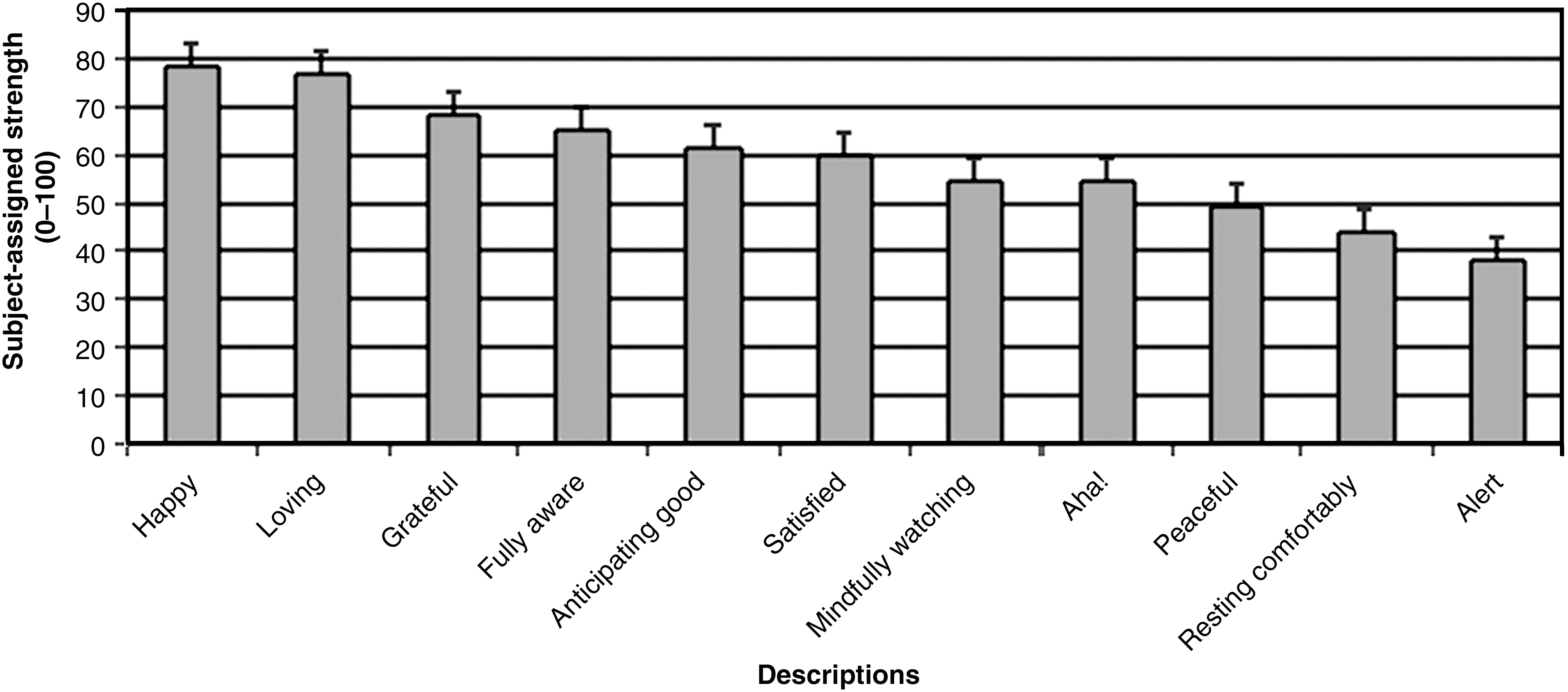
Perceived positive relationships of descriptors with clarified 40-Hz neurofeedback for all subjects pooled. Error bars shown indicate standard error.
The results were comparable for both groups for all the descriptors (all p-values >0.05). After pooling, the largest relationship quality scores were obtained for “happiness” (p < 0.0001) and “loving” (p < 0.0001). The associations for two of the descriptors, “concentrating” and “focused,” were insignificant for both groups (p > 0.05). The relationships for three of the descriptors with the clarified 40-Hz neurofeedback were significantly negative, with the largest scores for “stressed” (p < 0.0001) and “disappointed” (p < 0.0001), and comparable for both groups (all p-levels >0.05). See Figure 2. The error bars shown in Figure 2 indicate standard error.

Perceived negative relationships of descriptors with clarified 40 Hz neurofeedback. Error bars indicate standard error.
Table 3 shows mean values of scores for the descriptors for all subjects pooled, along with standard errors, t-scores and p-levels.
SE, standard error.
Baseline measurements of the clarified 40-Hz band were indistinguishable for the two groups (p > 0.05), averaging 19.25 for the meditators and 19.85 for the controls. See Figure 3. Neureka! values plotted as the dependent variable shown in the figure refer to clarified 40 Hz.
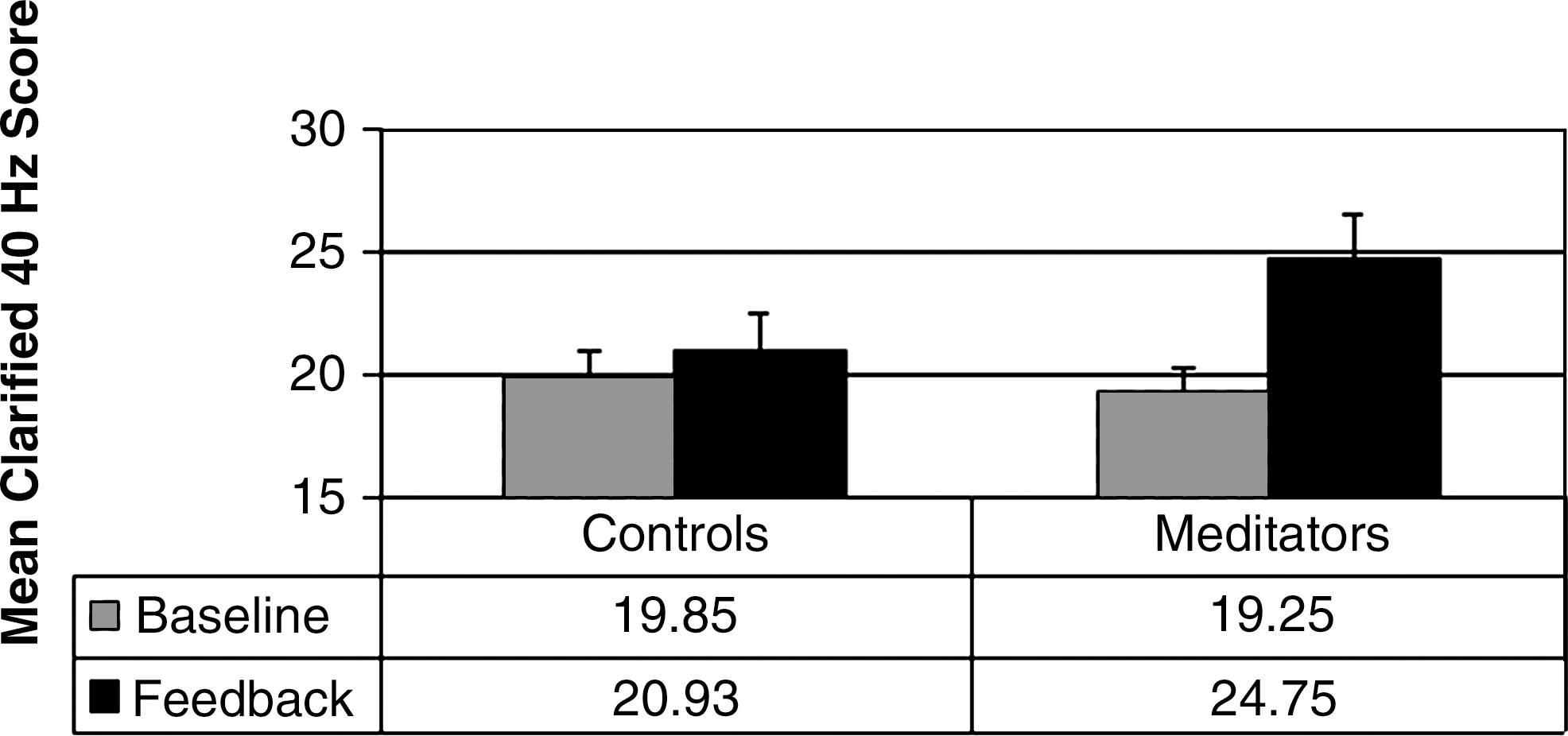
Comparison of meditators' and controls' clarified 40 Hz scores during baseline and with neurofeedback.
Both groups succeeded in increasing clarified 40 Hz significantly using neurofeedback in a single session (F(1,23) =13.39, p < 0.002 for Test Condition). The controls averaged a 5.6% increase after cueing by the researcher. However, meditators were much better at this task than controls (F(1,23) =6.03, p = 0.02), and, on average, raised their scores 28.6% above baseline, which was more than 500% greater than controls.
Discussion
The results show that the clarified 40 Hz band from the prefrontal cortical region in subjects who used neurofeedback in a single session appeared to respond to positive emotions of happiness and love, as well as to reduced stress, all three of which were discerned by both meditators and nonmeditators. These results also show that both advanced meditators and nonmeditators were able to produce measurably greater clarified 40 Hz from the prefrontal cortical region successfully in a single neurofeedback experimental session, although the meditators were able to increase the amplitude of clarified 40 Hz about five times better than nonmeditators during the neurofeedback condition.
The study suggests that the clarified 40-Hz neurofeedback of the PBHT is able to give users instantaneous, clear information about their brainwaves from the prefrontal cortical region, that may be associated with positive feelings. Therefore, this study, which is the first one of its type to explore 40 Hz from the prefrontal cortical region using neurofeedback, achieves one small step toward understanding and validating what the clarified 40 Hz neurofeedback of the PBHT may offer users. It must be pointed out, however, that this study did not explore clarified 40-Hz neurofeedback training in the manner that neurofeedback is typically used as therapy.
The data from this small pilot study appear to be robust, given that statistical significance was achieved with a small sample. However, this study had limitations. Future studies should increase the duration of the study and sample size. A possible confounder may have been the subjects' desire to please the experimenter, who was always present during the sessions, and who may have provided a positive social interaction, thus contributing to improving subjects' moods. Thus, another study should be conducted with subjects who use the clarified 40-Hz neurofeedback system by themselves with written instructions.
Unlike the results observed for Tibetan Buddhist meditators, 9 we did not find greater gamma power at baseline in TM meditators. However, TM is a very different type of meditation technique. In addition, meditation research as reported by Arenander shows that TM is associated with “a great loss of gamma and beta power and the onset of large amplitude, highly coherent and synchronous, widely distributed alpha waves.” * If gamma is not increased during TM, then it seems paradoxical that advanced TM meditators show an enhanced ability to produce clarified 40 Hz during neurofeedback. However, the clarified gamma (Neureka!) that we measured here had not been observed in previous studies. Second, the greater internal awareness and self-control found in advanced meditators may improve their performance on tasks in general. Moreover, because meditators enjoy positive feelings of love, compassion, empathy, joy, and equanimity as a result of their practice, 15 it may be that the TM meditators here were able to achieve stronger positive feelings during the task at hand, which produced higher values of clarified 40 Hz as a result of the correlation observed here. Meditation itself can produce increases in positive qualities, such as joy and compassion. 16
Conclusions
The results of the study suggest the possibility that brainwave signals associated with feelings of happiness, love, satisfaction, gratitude, awareness, mindfulness, peace, and the absence of stress, may include the gamma band from the prefrontal cortical region. Although this study did not go so far as to investigate whether clarified 40-Hz neurofeedback training could facilitate positive emotional feelings and/or reduce negative feelings over time, it points to this possibility. Further studies are needed to explore this. If this is found to be the case, then clarified 40 Hz neurofeedback from the prefrontal cortical region might prove to be important for enhancing health and wellness, because research shows that the effects of positive emotions seem to do more for health than merely counteract or cancel the effects of negative emotions. 17 Positive emotions have been shown to promote better health by boosting the immune system and providing greater resilience to recover from stress. Moreover, emotions can modulate immune system function through various neuroendocrine pathways, with negative emotions leading to inflammatory biochemical pathways that are causally linked to chronic diseases, such as cardiovascular disease and cancer, and positive emotions contributing to anti-inflammatory pathways that are protective. 18,19
Further work is called for to investigate the clarified 40-Hz neurofeedback of the PBHT in long-term studies on neurofeedback training. The results of this small initial pilot study suggest the possibility that neurofeedback training of clarified 40 Hz from the prefrontal cortical region may lead to long-term changes in positive emotions with concomitant improved health and well-being in various populations, including patients.
Footnotes
Acknowledgments
We wish to thank Jonathan D. Cowan, Ph.D., for his assistance and helpful advice, as well as the study participants for volunteering their time and effort.
Disclosure Statement
The author received the PBHT from NeuroTek in consideration for performing this study. The author has no competing personal or financial interests.
*
Arenander A. Personal communication (e-mail), December 12, 2008.