




Abstract
Background:
Nasal polyps are a common debilitating condition. Complications and the socioeconomic cost of nasal polyps and chronic rhinosinusitis means that the current medical treatment protocol is not satisfactory. Herbal decoction and acupuncture treatment for nasal polyps are rarely seen in the current English literature.
Objective:
The objective is to review this topic and to share the experience of treating a case involving recurrent nasal polyps.
Patient data:
An Australian patient suffering from nasal polyps and chronic rhinosinusitis had four surgical excisions of nasal polyps. However, the polyps kept recurring.
Method:
A Chinese herbal decoction plus acupuncture was the method of approach. The decoction was focused on the inflammatory mechanisms of nasal polyps. The decoction had additional antibacterial and antifungal properties, which may have played important roles in the treatment.
Results:
Large amounts of mucus disappeared. Nasal polyps did not recur. A recurrence has not occurred for 3½ years.
Outcome measurement:
The outcome measured the patient's symptoms and his quality of life.
Conclusions:
The application of the herbal decoction plus acupuncture effectively prevented the recurrence of nasal polyps in this case. Therefore, further research is warranted in this classic method of treatment.
Introduction
Various treatments currently used for the management of this chronic disease include endoscopic nasal-sinus surgery and oral steroids after surgery, the most common approaches. 5,6 Anti-immunoglobulin E immunoglobulin therapy in the postpolypectomy management of atopic asthmatic individuals may reduce the chance of nasal polyps recurring. 7 In a recent development, Becker and colleagues stated that intrapolyp steroid injection is associated with a significantly lower rate of complications than surgical excision of sinonasal polyps. Steroid injections also may decrease the need for further surgical intervention of polyps. 8 Nevertheless, this common treatment protocol is not effective and, as stated by Watelet and others, in case of failure of medical treatment, endoscopic sinus surgery should be proposed instead. However, some well-validated data and scientific evidence are missing, even for the most frequently used medications. 3 In summary, little information exists regarding the outcome of medical management of CRS in adults, and the current medical treatment for CRS has limitations and the need for novel treatment strategies. 9
A literature search was conducted using PubMed, EMBASE, The Cochrane Library, SpringerLink, Scopus, MEDLINE® (Ovid), BioMed Central, AMED, Science Link Japan, AcuBrief, and Chinese electronic databases such as CNKI, CQVIP, wangfadata, and Sciencepaper online. These yielded more than 2000 published articles, which revealed that there was only one case report of nasal polyps treated by acupuncture, which was written in English. However, it appeared in a methodologically deficient manner. 10 Although there were articles regarding nasal polyps treated by Chinese herbal decoction, which were written in Chinese and which appeared in CNKI, due to the different style of Chinese reporting and studying in methodology compared to English medicine databases, an appropriate evaluation for these studies has not yet been seen in these English databases.
Case Report
The author shares the experience of successfully managing an Australian patient, who has recurrent nasal polyps. Refer to Figure 1 for a flow chart of this study.
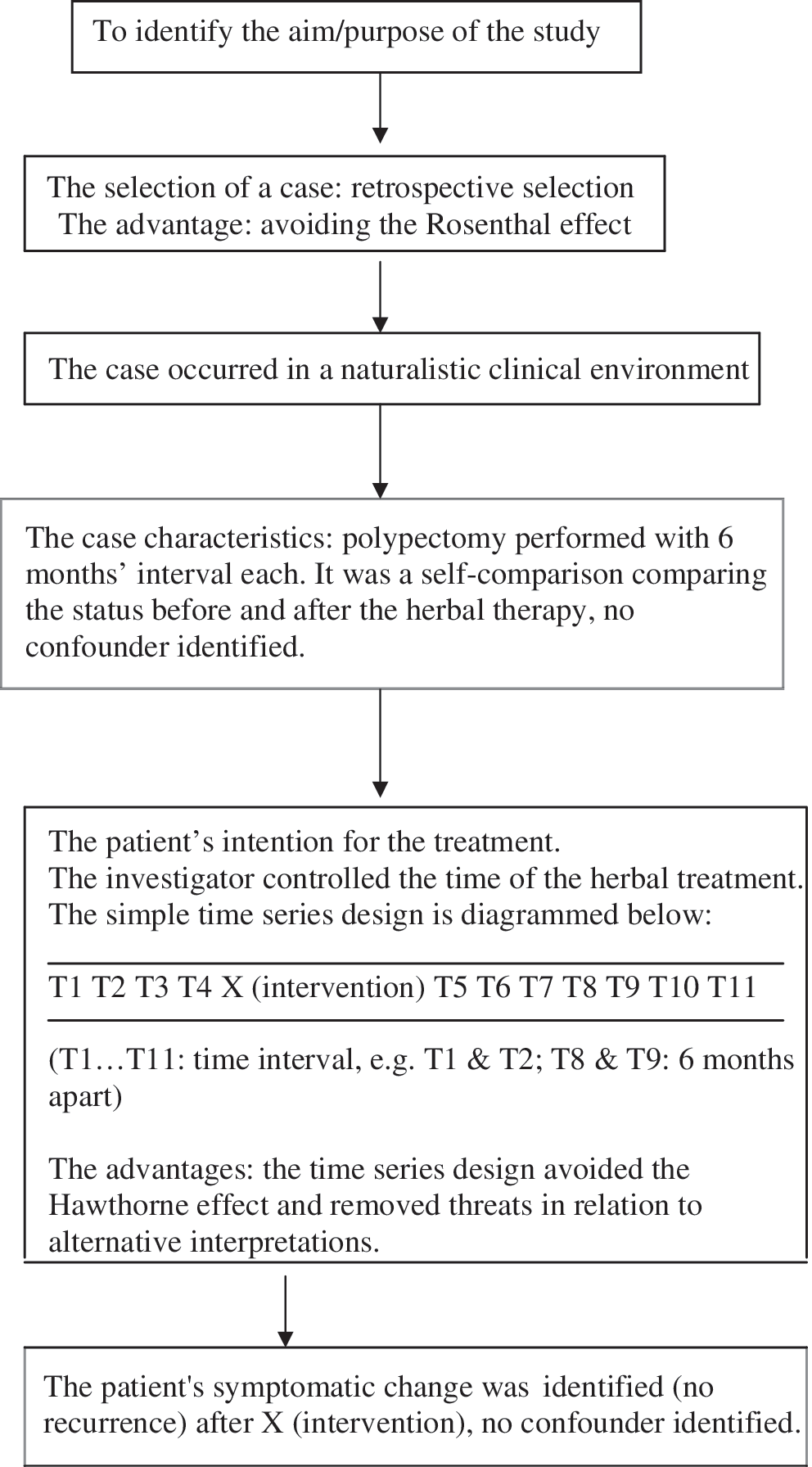
Summary of the characteristics of the study design.
Case history
A 47-year-old male patient visited M. Modern Traditional Chinese Medical Clinic in the outer east suburbs of Victoria, Australia. He had had the following symptoms: anterior and posterior nasal drip every day, felt nasal congestion, and sometimes blockage, facial pressure, facial pain, and loss of smell. The most dominant symptoms were a large amount of mucus discharged from the nose, and nasal congestion and blockages, which was affecting his breathing. Especially when sleeping, this caused frequent wakenings due to difficulties in breathing. He felt tired all the time and concentration was also affected, which was affecting his ability to work. He felt a little depressed and his quality of life was severely affected.
The patient was diagnosed with sinusitis 4 years ago based on his clinical symptoms and x-ray computed tomography (CT) scan. Eight (8) months later, he was diagnosed with nasal polyps by an ear, nose, and throat specialist. The first polypectomy was performed shortly after the diagnosis. A recurrence of nasal polyps occurred 1 year later. Another three polypectomy operations, 6 months apart, occurred to remove the recurring nasal polyps. The patient had taken oral steroids for a few weeks after each operation, and nasal steroid spray was continually taken since the first operation, and was taken for more than 2 years. After an operation, the patient had had fewer episodes of hay fever–like reactions (e.g., sudden increased symptoms of running nose, sneezing, watery eyes) and less mucus discharged from the nose. However, these symptoms still continued to occur, and became severe after 3 months and almost returned to their original severity as they were before the operation. The patient noticed two large polyps that were located about 4–5 mm from the entrance of his nose, which could be seen and felt by his fingers about 3 months after each operation since the second surgery. The fourth operation of nasal polyps excision was just 2 weeks prior to his decision to seek an alternative method of treatment (i.e., to have Traditional Chinese Medicine [TCM] treatment). He did not take steroids after the fourth operation.
On examination, apparent voice changes due to nasal congestion were noticed. Mucus with dark green color was discharged from the nose every 4–5 minutes during the consultation. A few facial pressure pain spots located near the maxillary sinus region were objectively induced.
Specimen samples taken from the nasal polyps after the operations showed under microscopy polypoid tissue fragments partly covered by respiratory-type glandular mucosa and partly stratified squamous mucosa with transitional epithelium. The epithelium showed marked infiltration by mixed inflammatory cells. The underlying stroma was edematous and contained a dense infiltrate of lymphocytes, plasma cells, eosinophils, mast cells, and neutrophils. The stroma also contained mucinous glands. Accordingly, histopathology reports indicated that all of these appearances are those of benign inflammatory polyps of allergic type.
Diagnosis and TCM assessment
The diagnosis was confirmed as recurrent benign nasal inflammatory polyps, chronic rhinosinusitis (CRS) according to evidences and clinical descriptions detailed above.
From the TCM perspective, the patient had had a pale tongue, greasy but not sticky, with exfoliate coating appearance on the front. His pulse was floating and slippery. Nasal polyps are called Nose Zhi in TCM, details of which were described by Shi-Gong Chen (
Treatment
Based on TCM assessment, the selection of acupoints is as follows: both sides of LI 20 (Yingxiang) and LU 6 (Kongzui), Extra 2 (Yingtang). The sizes of needles were 0.20-mm diameter, and 30-mm long (Carbo, AUST L52108) with standard direction and insertion. De qi is obtained after the insertion and every 4 minutes by a twisting method during a 20-minute session. The treatment sessions were scheduled once a week for 16 times.
A Chinese herbal decoction was prescribed and the details of its ingredients and daily dosage is as follows: Huang Qin 9 g (Scutellaria baicalensis), Shan Zhi Zi 9 g (Gardenia jasminoides), Pu Gong Yiong 15 g (Taraxacum mongolicum), Jin Yin Hua 9 g (Lonicera japonica), Huo Xiang 10 g (Pogostemon cablin), Chi Shao 12 g (Paeonia lactifiora), Chuan Xiong 12 g (Ligusticum sinense Oliv), Cang Er Zi 9 g (Xanthium sibiricum), Xin Yi Hua 15 g (Magnolia biondii), and Gao Cao 6 g (Glycyrrhiza uralensis). This decoction was used for 7 days every week during the period of treatment.
Outcome measurement and result
The progress of the treatment was as follows. The patient had noticed less congestion after the first session of acupuncture; heavy dark green mucous discharge occurred several times a day from the nose during day 5, and the mucus turned to yellow after 1 month. The yellow heavy mucous discharge continued to occur for another 2 months. He noticed the mucous color change to gray with little yellow; a large amount was still discharged every day when he was in the 4th month of the treatment. The patient felt no nose blockage and much less congestion and he was able to sleep all night in the 4th month. His concentration was restored and depression symptoms disappeared.
Acupuncture treatments finished after 16 sessions. The treatment continued solely with herbal decoction. The amount of mucus was 70% less compared with previous months and its color was light yellow. Gray mucous discharge only occurred twice a week starting from the 5th month and occurred once a month after the 8th month.
This herbal decoction continued to be used after 12 months of treatment and was reduced to half the dosage for a further 12 months. The patient experienced almost no symptoms except for a little light yellow mucus from time to time. At follow-up 12 months later, X-ray CT showed no evidence of the recurrence of nasal polyps. Eighteen (18) months later, it was discovered from a clinical examination that no reoccurrence status was maintained.
Discussion
Endoscopic surgery remains the treatment of choice for medically refractory CRS with or without nasal polyposis. This treatment protocol has undergone review, reassessment, and substantial refinement. 12 Allergy, polyps, and history of surgery might be significant indicators of poor prognosis after endoscopic surgery. 13 Unfortunately, the case presented here was such a situation, with poor prognosis under the current medical treatment protocol.
The present study shows that combined surgery and corticosteroid therapy is effective in the treatment of severe nasal polyps, producing significant and long-term improvements in symptoms and in the size of nasal polyps. 5,14 However, CRS may cover different disease entities, and the pathogenic mechanism remains unclear. 7,15
A proportion of patients with CRS, especially if nasal polyps are present, have a diagnosis of fungal rhinosinusitis. The diagnosis is difficult to establish because the symptoms and clinical and radiological signs are nonspecific. 16 The abovementioned patient had a large amount of green, yellow, and gray mucus, which probably indicated chronic infections in the patient, including fungal infection. This was the reason why the corticosteroid did not work for this patient.
Although nasal polyps can be removed by the string-cutting procedure as documented in TCM, 11 this technique, plus its coordinated approach (i.e., Chinese herbal decoction), was not seen in published articles outside of China. Apparently, the current medical treatment protocol has dominance in this area in Western industrialized countries.
The texture and color of the mucus was used as an outcome measurement tool in assessing the effects of TCM treatment. As stated by Gupta, Bonfils, and their colleagues, the assessment and removal of nasal and sinus mucosa are important because they relate to the recurrence of nasal polyps. 17,18
The combination of herbs used in the decoction might play a major role in preventing recurrence. S. baicalensis, G. jasminoides, T. mongolicum, and L. japonica have antibacterial properties and are commonly used for infection, including chronic infections. 19 –22 P. cablin has been used as an antifungal substance. 23 P. lactifiora and L. sinense Oliv are used as antiinflammatory agents, although their mechanisms are completely different from steroids. 24,25 X. sibiricum and M. biondii are commonly used in allergic rhinosinusitis. 26,27 In summary, this herbal decoction addressed the inflammatory mechanisms of nasal polyps. 28
Although the result of herbal therapy in this case is favorable, whether the state or function of other body systems during the herbal therapy may also play some roles are outside of this case study's scope. Nevertheless, the important clinical relevance of this study is a presentation of a patient's symptomatic change after the intervention, which is highly likely to be associated with treatment.
Studies in acupuncture for the treatment of allergic rhinitis gained much credibility. 29 –31 It was noticed that the patient's nasal congestion improved during the course of acupuncture treatment. Thus, the application of acupuncture in this case might assist the management of the allergic reaction as stated in this case's pathological report, benign inflammatory polyps of allergic type. However, the most important role of acupuncture treatment was the patient's depression status: One of the crucial aspects of his quality of life was improved.
Conclusions
The complications and socioeconomic cost of nasal polyps and chronic rhinosinusitis are given more attention in recent studies. 28 Chinese herbal decoctions for treatment of nasal polyps, an ancient approach, were almost forgotten by the mainstream treatment protocol. The application of the herbal decoction plus acupuncture achieved good management goals in this case, although the role of acupuncture was not very well defined. However, the use of the decoction to focus on the inflammatory mechanisms was a rational approach and effectively prevented the recurrence of nasal polyps. Therefore, further research is warranted regarding this classic method of treatment.
Clinical Commentary
It has been suggested that the patient's symptomatic change after the herbal therapy might also be associated with the change in the state or function of other body systems. This is one of the most difficult parts in Chinese herbal medicine research, because it represents a Black Box. The Black Box contradicts the standard of research in the current medical and pharmaceutical study protocol, which means that Consolidated Standards of Reporting Trials (CONSORT), a guide for experimental tests, is commonly used in randomized controlled trials and may not be suitable for Chinese herbal medicine research.
Footnotes
Acknowledgment
The author thanks the reviewer for their suggestion about the patient's symptomatic change after the herbal therapy.
Disclosure Statement
No competing financial interests exist.