




Abstract
Objectives:
The purpose of this longitudinal outcome research study was to determine the effectiveness of the Integrative Health Clinic and Program (IHCP) and to perform a subgroup analysis investigating patient benefit. The IHCP is an innovative clinical service within the Veterans Affairs Health Care System designed for nonpharmacologic biopsychosocial management of chronic nonmalignant pain and stress-related depression, anxiety, and symptoms of post-traumatic stress disorder (PTSD) utilizing complementary and alternative medicine and mind–body skills.
Methods:
A post-hoc quasi-experimental design was used and combined with subgroup analysis to determine who benefited the most from the program. Data were collected at intake and up to four follow-up visits over a 2-year time period. Hierarchical linear modeling was used for the statistical analysis. The outcome measures included: Health-Related Quality of Life (SF-36), the Beck Depression Inventory (BDI), and Beck Anxiety Inventory (BAI). Subgroup comparisons included low anxiety (BAI < 19, n = 82), low depression (BDI < 19, n = 93), and absence of PTSD (n = 102) compared to veterans with high anxiety (BAI ≥ 19, n = 77), high depression (BDI > 19, n = 67), and presence of PTSD (n = 63).
Results:
All of the comparison groups demonstrated an improvement in depression and anxiety scores, as well as in some SF-36 categories. The subgroups with the greatest improvement, seen at 6 months, were found in the high anxiety group (Cohen's d = 0.52), the high-depression group (Cohen's d = 0.46), and the PTSD group (Cohen's d = 0.41).
Conclusions:
The results suggest IHCP is an effective program, improving chronic pain and stress-related depression, anxiety, and health-related quality of life. Of particular interest was a significant improvement in anxiety in the PTSD group. The IHCP model offers innovative treatment options that are low risk, low cost, and acceptable to patients and providers.
Introduction
Patients are referred to IHCP from VASLC outpatient clinics and VA community-based outpatient clinics in the five-state catchment area served by VASLC. The IHCP intake process provides a holistic patient assessment with a treatment plan collaboratively developed between the patient and the IHCP intake provider (Table 1). The treatment plan comprises one or more modalities and/or classes that address patients' needs and that they have expressed an interest in pursuing. Follow-up assessments and retesting occur 6 months after intake and annually thereafter.
All IHCP therapies are research based and approved by the Veterans Affairs Salt Lake City (VASLC) Clinical Executive Board.
All IHCP therapy providers are licensed, certified in the therapy, and credentialed by the VASLC Professional Standards Board.
Retired 9/07, acupuncture currently provided by RN LAc M OM.
BDI, Beck Depression Inventory; BAI, Beck Anxiety Inventory; SF-36, Medical Outcomes Multidimensional Short Form 36.
Depression and anxiety may exacerbate experienced pain. Depressed or anxious patients may experience more pain following injury than patients without these conditions. Depression and anxiety can facilitate the transmission of nociceptive signals. 2 Anxiety and major depressive disorders occur in 28%–57% of chronic pain patients compared to 5%–26% in the general population. 3 Depressed patients have poorer treatment outcomes and amplified somatic complaints. 3 Anxiety may exacerbate a fear response and anxiety-sensitive patients may catastrophize pain-related sensations, contributing to the maintenance of chronic pain. 4
Veterans with chronic pain may be at a higher risk for depression, anxiety, and post-traumatic stress disorder (PTSD) due to exposure to military conflicts and associated psychologic stress or trauma. Twenty-five percent (25%) of veterans returning from the Iraq and Afghanistan wars receive a mental health diagnosis, primarily PTSD, but anxiety, depression, and other behavioral or psychosocial problems are frequent. 5 Psychologic and pharmacological therapies have been used to treat combat-related PTSD with only moderate success. Serotonin reuptake inhibitors, the only U.S. Food and Drug Administration–approved medication for treating PTSD, have questionable efficacy in men, particularly those with prolonged PTSD and chronic depression, leaving no reliable pharmacological treatment options. 6,7
People with chronic pain and stress increasingly are turning to CAM therapies to manage chronic conditions not improved by conventional biomedical treatments. The National Center for Health Statistics indicates that adult use of CAM increased from 36% in 2002 to 38.3% in 2007. 7 CAM and mind–body skills were used most often for musculoskeletal problems, depression, and anxiety. 8 A benchmark survey of CAM use in the VA reported that a large proportion of VA patients have conditions that have not responded well to allopathic treatments and that veterans were using CAM therapies in large numbers. 9
Clinical trials of acupuncture, a CAM therapy, have shown efficacy for treating symptoms of PTSD, anxiety, depression, and insomnia as well as pain. 10 Relaxation techniques that decrease sympathetic output and activate the parasympathetic nervous system are routinely recommended for stress and pain management. 11,12 Positron emission tomography and functional magnetic resonance imaging studies have shown that hypnosis, a mind–body therapy, can alter both sensory and affective dimensions of stress and pain and reduce depression and anxiety. 13
Although research suggests that mind–body skills and CAM therapies are beneficial for managing chronic conditions, many of these approaches are not used at conventional medical institutions. Most studies investigating CAM use only investigate the effect of using a single CAM therapy. Few outcome studies have addressed the application of multiple therapies designed to exert a synergistic effect such as those provided in the IHCP. This study was undertaken to evaluate the effectiveness of the integrative health model as implemented at the IHCP in the VASLCHCS.
Materials and Methods
The University of Utah Institutional Review Board and the VASLC Research and Development Department approved this study. We obtained data from the VA computerized patient record system for the first and up to four follow-up visits from April 1, 2001 to March 1, 2007.
The sample included all patients who had chronic nonmalignant pain and stress and who completed the intake IHCP assessment and one or more follow-up-visit outcome assessments. Patients were requested but not required to return for IHCP follow-up outcome assessments. On completion of a therapy/class series, the patient and the provider decide whether or not to continue based on benefits obtained. Thus, the number of patients having follow-up assessments decreased over time as follows: baseline intake (n = 165), first follow-up (n = 141), second follow-up (n = 32), third follow-up (n = 12), and fourth follow-up (n = 5).
IHCP is a group of services that includes 10 holistic, nonpharmacological mind–body skills and CAM therapies designed to have a biopsychosocial synergistic effect (Table 1). After referral to IHCP, patients are scheduled for intake assessment and screened for mental health concerns requiring further management (e.g., dissociative diagnosis, suicidal ideation). Patients then collaborate with their provider to select and develop a treatment plan.
Standardized clinical outcome measures included the following: The Medical Outcomes Multidimensional Short Form 36 (SF-36), the Beck Depression Inventory (BDI), and the Beck Anxiety Inventory (BAI). The SF-36 is a commonly used health-related quality of life (HRQOL) self-report measure for assessing treatment outcomes including alternative treatments. 13,14 It measures eight categories of health: General Health, Physical Functioning, Role Physical, Bodily Pain, Mental Health, Role Emotional, Social Functioning, and Vitality. The validity and reliability of the instrument for distinguishing between groups with expected health differences has been well established. 14 –16 The BDI and BAI are self-report instruments widely used for measuring the severity of depression and anxiety, respectively, with established reliability and validity for assessing group differences. 17,18 Stress was measured using a 10-point self-report numerical rating scale (NRS). Military service–related mental health disability as calculated by the VA enrollment office was used as a measure of chronicity of PTSD, anxiety, and depression. The stress NRS and service connection for mental health were obtained only at intake.
Analytical methods
The study used a post-hoc quasi-experimental design. To adjust for possible selection bias, we divided patients' data according to scores on the mental health assessment instruments for comparison: anxiety (high versus low), depression (high versus low), and PTSD (with versus without). This method assumes that no systematic differences exist between patients for belief in effectiveness of treatment or other biases based on scores on these instruments. Subgroup analyses have been used in drug clinical trials to identify those patients in whom a drug is most beneficial or harmful. 19 Using subgroups for comparison rather than a control group of non-IHCP patients can remove potential biases due to factors such as referral patterns: familiarity with IHCP or CAM modalities; belief about the therapies' effects (positive or negative); or modality placebo effects. The high anxiety group (HAG) was defined as having a BAI score ≥ 19 (n = 77) and the low anxiety group (LAG) as having a BAI score <19 (n = 82). The high depression group (HDG) had BDI scores ≥ 19 (n = 67) and the low depression group (LDG) had BDI scores <19 (n = 93). Sixty-three (63) patients diagnosed with PTSD were assigned to the PTSD subgroup and the remaining 102 patients without a PTSD diagnosis were assigned to the Non-PTSD (NPTSD) subgroup. The anxiety and depression subgroups had fewer than 165 patients due to missing BDI or BAI values.
Baseline comparisons between mental health subgroups were made using χ2 or Fisher's exact tests, as appropriate, for unordered categorical variables, a Wilcoxon–Mann–Whitney test for ordered categorical variables, and an independent samples t-test for continuous variables. The study outcomes of depression, anxiety, and HRQOL represented longitudinal continuous variables, with measurements collected at each follow-up visit. Repeated measures were modeled using hierarchical linear modeling (HLM). Outcome scores at each follow-up were subtracted from baseline intake scores to obtain change scores. We included baseline measures in the model as covariates to further adjust for baseline differences. 20 Each group (anxiety, depression, and PTSD) was modeled separately using subgroup and the subgroup-by-time interaction as predictors. Time was mean-centered at 6 months. Potential confounding variables with p < 0.20 in bivariate comparisons were included in the model and backwards eliminated for p < 0.20. This liberal p value was selected to protect against residual confounding. 21
As a benchmark for standardized effect size in the HLM models, a Cohen's d statistic was computed at 6 months, where the 6-month mean-centered time variable permitted interpretation of the group main effect. Cohen's d effect sizes were categorized as follows: small (d = 0.02), moderate (d = 0.05), and large (d = 0.08). 22 Cohen's d was calculated as the adjusted mean effect, or regression slope, divided by a standard deviation (SD) estimate. The SD estimate was made by pooling the SDs of the baseline measurements of the outcome variable for the two subgroups, using Satterthwaite's formula. 23 Ninety-five percent (95%) confidence intervals (CIs) that do not cover or cross 0 indicate a significant finding (p < 0.05). CIs that cover or cross 0 only slightly represent a trend approaching significance. All statistical analyses were performed using Stata 10.0 statistical software (StataCorp, College Station, TX). 24
Results
The subgroups did not differ significantly on demographic indicators (Table 2). However, a significantly greater percent of patients in the HDG, HAG, and PTSD subgroups had a military-related service-connected mental health disability than the comparison groups did.
BDI, Beck Depression Inventory; BAI, Beck Anxiety Inventory; PTSD, post-traumatic stress disorder; M, mean; SD, standard deviation; BMI, body–mass index.
Tables 3 and 4 show comparisons of subgroups at intake for depression and anxiety, and HRQOL, respectively. HAG had significantly higher depression scores, while HDG had significantly higher anxiety. Both HAG and HDG showed significantly higher stress levels than the comparison subgroups. PTSD patients had higher scores than NPTSD on depression, anxiety, and stress (Table 3). HRQOL measures revealed significant differences between subgroups on all factors, with HDG, HAG, and PTSD having lower scores than the comparison subgroups, with the exception of Health Transition for PTSD compared with NPTSD (Table 4).
Beck Depression Inventory scoring: 0–9 Asymptomatic/normal, 10–18 Mild–moderate, 19–29, 30–63 Extremely severe.
Beck Anxiety Inventory scoring: 0–9 Asymptomatic/normal, 10–18 Mild–moderate, 19–29 Moderate-severe, 30–63 severe.
BDI, Beck Depression Inventory; BAI, Beck Anxiety Inventory; PTSD post-traumatic stress disorder; M, mean; SD, standard deviation; NRS, Numerical Rating Scale; N/A, not applicable.
BDI, Beck Depression Inventory; BAI, Beck Anxiety Inventory; PTSD, post-traumatic stress disorder; SF-36, Multidimensional Short Form 36; M, mean; SD, standard deviation; IQR, Interquartile Range = 25th and 75th percentiles.
Treatment effects comparisons of subgroups
We present the HLM models of within-group change from intake by patient groups: PTSD, depression, and anxiety. Figures 1 –3 display results of the HLM models of within- and between-group changes over the course of the study period where significant. Table 5 reports the within-subgroup change from intake to 6 months, the time at which the greatest within-group change was found. Table 6 presents between-subgroup differences over the full study period from intake to 24 months.

Significant findings from adjusted hierarchical linear modeling outcome models comparing within- and between-group changes over time for post-traumatic stress disorder (PTSD) and non-PTSD subgroups. Ninety-five percent (95%) confidence intervals (CI) not crossing or covering 0 indicate significant within-group effects; nonoverlapping CIs indicate significant between-group differences.
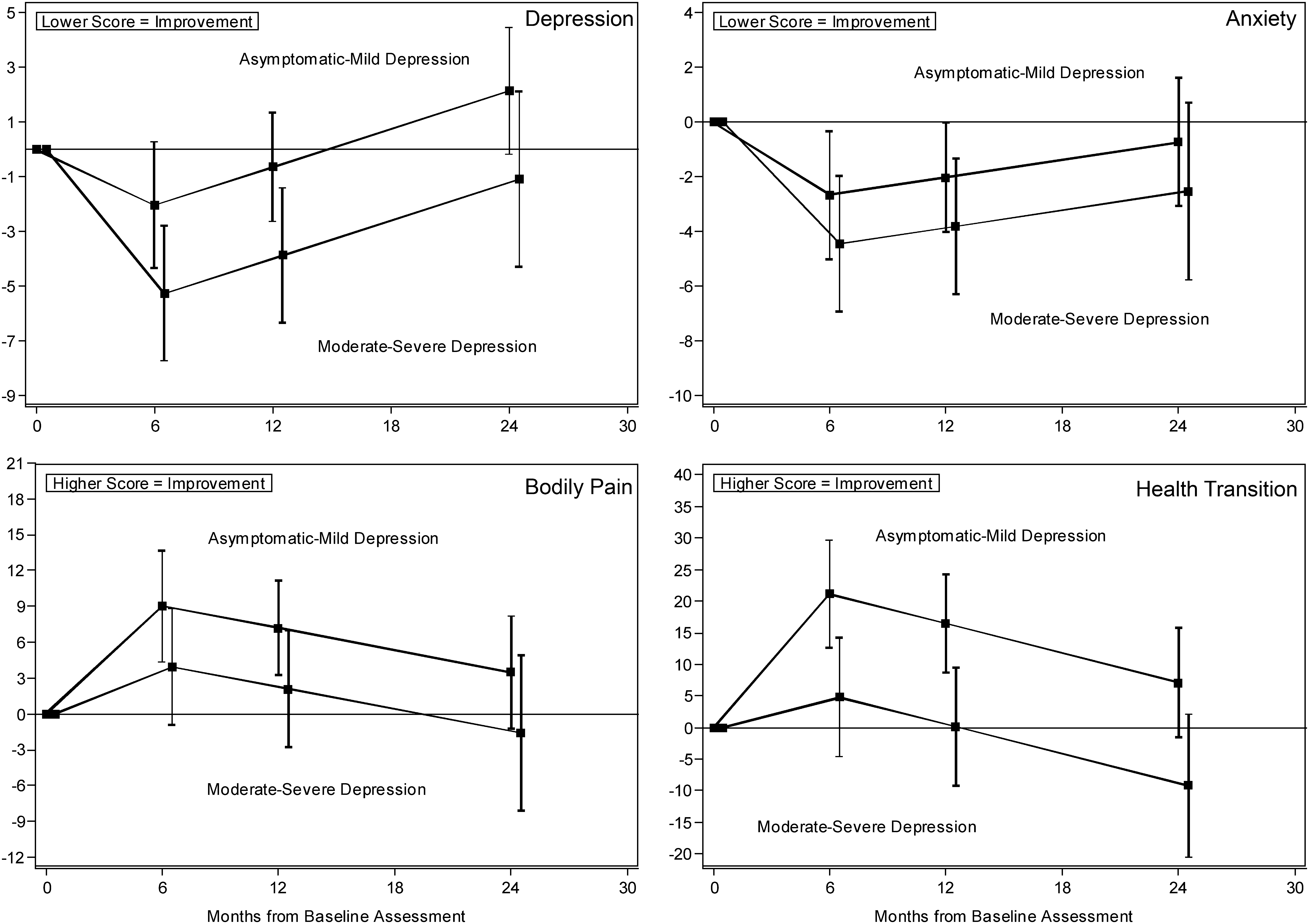
Significant findings from adjusted hierarchical linear modeling outcome models comparing within- and between-group changes over time for high and low depression subgroups. Ninety-five percent (95%) confidence intervals (CI) not crossing or covering 0 indicate significant within-group effects; nonoverlapping CIs indicate significant between-group differences.

Significant findings from adjusted hierarchical linear modeling outcome models comparing within and between group changes over time for high and low anxiety subgroups. Ninety-five percent (95%) confidence intervals (CI) not crossing or covering 0 indicate significant within-group effects; nonoverlapping CIs indicate significant between-group differences.
The following variables were included in the model as covariates: nonwhite race, marital status (combining divorced, separated, widow or widower, never married), joint pain comorbidity, history of sexual abuse, and history of hip surgery. Depression, anxiety, and PTSD were considered part of the underlying syndrome of mental health, and were not considered for inclusion in the model as covariates.
Cohen's d effect size: 0.2 = small, 0.5 = moderate, 0.8 = large.
NPTSD, non–post-traumatic stress disorder; PTSD, post-traumatic stress disorder; LDG, low depression group; HDG, high depression group; LAG, low anxiety group; HAG, high anxiety group.
Mean group differences: Multivariable hierarchical linear models with follow-up time variable mean centered at 6 months after controlling for group × time interaction and covariates; the group difference remained constant over the follow-up visits with interpretation of group differences to 24 months. Predictor variables of group and group × month interaction were used to obtain predicted values for mean change from baseline for each group. Models were also adjusted for potential confounding variables.
Cohen's d = 0.2 = small effect size, 0.5 = moderate, 0.8 = large.
PTSD, post-traumatic stress disorder; Depression, on Beck Depression Inventory; Anxiety, on Beck Anxiety Inventory; SF-36 Health-Related QoL; Short Form–36 Health-Related Quality of Life.
PTSD/NPTSD subgroups
At 6 months, anxiety and depression scores improved for both subgroups (Table 5 and Fig. 1). PTSD showed improvement in anxiety (Cohen's d = 0.41) and depression (Cohen's d = 0.31), both persisting to 12 months, with anxiety showing a trend to significance at 24 months (95% CI = − 6.0, 0.2). NPTSD showed small improvements in anxiety (Cohen's d = 0.23) to 12 months and depression (Cohen's d = 0.22) to 6 months. NPTSD improved in several HRQOL measures at 6 months, including Bodily Pain (Cohen's d = 0.52), Role Physical (Cohen's d = 0.34), Role Emotional (Cohen's d = 0.32), and Health Transition (Cohen's d = 0.55). Improvement persisted to 12 months for Bodily Pain, Role Physical, and Health Transition. PTSD improved in Health Transition (Cohen's d = 0.43) at 6 months.
Depression subgroups
At 6 months, anxiety and depression scores improved for both HDG and LDG (Table 5 and Fig. 2). HDG improvements in depression (Cohen's d = 0.46) and anxiety (Cohen's d = 0.36) both persisted to 12 months. LDG improved slightly for anxiety (Cohen's d = 0.21) and depression (Cohen's d = 0.18) at 6 months persisting to 12 months. LDG improved for Health Transition (Cohen's d = 0.80) and Bodily Pain (Cohen's d = 0.43) persisting to 12 months.
Anxiety subgroups
At 6 months, HAG saw moderate improvements for anxiety (Cohen's d = 0.52) and depression (Cohen's d = 0.41) (Table 5 and Fig. 3). The anxiety benefit persisted to 24 months and depression to 12 months. HAG also improved for Role Emotional (Cohen's d = 0.32), Vitality (Cohen's d = 0.27), Bodily Pain (Cohen's d = 0.25) and Health Transition (Cohen's d = 0.52) at 6 months, with Vitality persisting to 24 months, and Role Emotional and Reported Health Transition to 12 months. LAG improved in Health Transition (Cohen's d = 0.53) and Bodily Pain (Cohen's d = 0.45) at 6 months, persisting to 12 months.
Between-group comparisons
We centered follow-up time at 6 months, allowing the group regression coefficient to represent the mean difference in change from baseline at 6 months, controlling for group-by-time interactions and covariates. The interaction term was not significant in any model, indicating that group differences remained constant over all follow-up visits. Thus, the reported group differences represent the entire follow-up interval.
PTSD between-group comparisons revealed significant differences for Bodily Pain (p = 0.043), with NPTSD improving more (Cohen's d = 0.32) (Table 6). Comparing depression subgroups, HDG showed more improvement in depression (Cohen's d = 0.28, p = 0.057), and LDG improved more in Health Transition (Cohen's d = 0.62, p = 0.011). HAG improved more for anxiety than LAG (Cohen's d = 0.44, p = 0.001).
Discussion
This study found reduced depression, anxiety, and improved quality of life following participation in IHCP for up to 6 months or more. In the PTSD group, 61% of the patients had a service-connection disability rating of 50% or higher, indicating prolonged symptoms of anxiety and depression. For many patients, these conditions existed for over 25 years. After participation in IHCP, the PTSD group showed sustained improvements in anxiety and depression for up to 12 months, and a trend for lower anxiety to 24 months. Considering that no effective pharmacological treatment for PTSD exists and behavioral therapy has had limited success, the improvements in mood after IHCP participation may represent cause for optimism for patients suffering with symptoms of PTSD. The NPTSD group also showed improvements in depression and anxiety as well as improved quality of life for up to 12 months.
Both depression and anxiety improved in the depression subgroups, persisting for as long as 12 months for some patients. HDG had severe depression symptoms, with 53% of patients having a military disability rating of over 50% service connection, indicating symptoms lasting many years. The literature reports less successful treatment outcomes for depressed patients. Considering the chronicity of symptoms in these subgroups, ability to demonstrate sustained improvement in depression or anxiety using nonpharmacological methods is a hopeful finding.
On intake, HAG patients had prolonged symptoms of anxiety, with 49% having service disability ratings of 50%–100% due to anxiety. After participation in IHCP, HAG patients' anxiety improved significantly and lasted up to 24 months, with depression improvement lasting to 12 months. Quality-of-life indicators also improved. LAG patients showed improvement on some quality of life indicators, which lasted up to 12 months. Considering the severity and duration of anxiety symptoms in HAG, the sustained improvements associated with use of the nonpharmacological self-management techniques and CAM therapies in IHCP are a very positive and hopeful finding.
This study did not seek to determine the effectiveness of individual therapies; rather, it sought to evaluate possible benefit of the program as a whole. The IHCP incorporates the concepts of the mind–body connection, thought awareness, how to move negative thought patterns to positive, staying in the present moment, use of self-relaxation, and calming techniques that support self-efficacy and self-esteem in each therapy and class. Mind–body techniques are taught to be used as needed at home or in public places to self-regulate reactions and emotions. By using IHCP skills, patients are empowered to begin the self-management of intrusive negative or racing thoughts, and to manage pain and stress.
This study had some important limitations that must be considered. A randomized controlled trial to investigate program efficacy would provide control for threats to internal and external validity and yield more conclusive evidence about causality. However, since the mission of the IHCP clinic is to provide therapy to all veterans who might benefit, rather than as the focus of a research unit, a randomized design was not possible. Instead, a quasiexperimental comparison design was employed that could answer valid clinical questions about the overall effectiveness of the IHCP. However, such a design provides less compelling support for counterfactual inferences on treatment effectiveness. A limitation of this study, as with most longitudinal clinical studies, is patient attrition and missing data due to unequal numbers of outcome assessments among patients, and gaps in data collection for patients who chose not to complete outcome assessments or did not return for follow-up assessment (although they may have continued with IHCP therapies and classes). The statistical methods used are highly robust, making use of all available data, and not limited by missing data. However, the results could be biased if patients' failure to complete data collection were due at least in part to the success or failure of their treatment. The study relied on the use of self-report instruments that can be overly sensitive to fluctuations of mood or pain on the day of the assessment, although they can provide valid measures of subjective symptoms.
Selection bias, such as belief in a new treatment, was an acknowledged concern in the design of this study. Because IHCP was new and unique, most patients were unfamiliar with the program and the modalities used, and unlikely to have formed expectations of benefit. The concern about bias was partly remedied by categorizing patient data into subgroups according to scores on mental health assessment instruments and the use of HLM to allow all of the data available to be used in the models.
As increasingly shown in research on conventional and nontraditional therapies alike, some of the benefit found in this study may be attributed to placebo. Research on expectancy has shown that placebo responses are mediated by conditioning when unconscious physiological functions are involved, and by expectation when conscious physiological processes such as pain and motor performance come into play. 25
Retrospective investigations do not allow inferences about treatment effectiveness. Nevertheless, they may provide useful data with respect to outcomes and help to develop hypotheses for subsequent more rigorous assessment. The investigation of existing health care records is common in epidemiological and quality assessment and improvement studies and has guided clinical research for decades. 26 The value of this study lies in the fact that it represents actual clinical practice and demonstrates the synergistic effect of combination therapies and classes. The study is a strong initial step in the investigation of IHCP outcomes.
Future research using randomized controls is needed to infer cause and effect or assess treatment effectiveness. Further research would benefit from larger patient groups, a more controlled environment, close monitoring of adherence to treatment protocols, and the ability to account for changes in conventional therapies. A future investigation of the relative costs and benefits of adding adjunctive therapies compared to decreasing or discontinuing narcotic and/or other medication use, as well as an assessment of change in health care utilization due to use of self-management techniques would be beneficial.
Conclusions
This study provides evidence showing that the Integrative Health Clinic and Program offers an effective reduction in pain-related psychopathology, depression, and anxiety and may improve some aspects of HRQOL through use of nonpharmacological and nontraditional mind–body skills and CAM therapies. This offers the possibility of new and acceptable treatment options for patients. The current health care system faces increasing pressures from rising health care costs. The IHCP mind–body and CAM therapies are gender neutral, benign or low-risk, gentle, “low tech” treatments requiring no costly equipment, have minimal side-effects, are self-empowering, providing patients with skills usable whenever needed, and acceptable to patients of all ages.
The use of CAM therapies and their integration into conventional medicine continues to grow. This study helps identify patients who may gain both short- and long-term benefits from an IHCP model and may serve as a guide for how to position the delivery of these services within a large health care system. The availability of an Integrative Health Clinic can provide an innovative and beneficial approach to the management of chronic pain and stress.
Footnotes
Acknowledgments
This work is supported through the Samueli Institute with a U.S. Army Medical Research and Material Command under Award No. W81XWH-06-1-0279. The views opinions and/or findings contained in this report are those of the author(s) and should not be construed as an official Department of the Army position, policy, or decision unless so designated by other documentation. In the conduct of research where humans are the subjects, the investigator(s) adhered to the policies regarding the protection of human subjects as prescribed by Code of Federal Regulations (CFR) Title 45, Volume 1, Part 46; Title 32, Chapter 1, Part 219; and Title 21, Chapter 1, Part 50 (Protection of Human Subjects).
Disclosure Statement
No competing financial interests exist.