




Abstract
A recent methodological approach for human classification, diagnosis, and therapeutics through the combination of current Western constitutional psychology somatotypes and traditional Indian medicine (prakriti) body types and mind (manas) is herein presented. The striking similarities between psychologic somatotypes and Indian medicine body types permits proposal of a finite genopsycho-somatotyping of humans. Genopsycho-somatotyping of humans consists of a set of common physiologic, physical, and psychologic attributes related to a common basic birth constitution that remains somewhat permanent during human lifetime, since it is proposed that this birth constitution is programmed in the person's DNA (genes). This mainly provides a tool for classifying the human population based on broad and finite phenotype clusters across different ethnicity, languages, geographical location, or self-reported ancestry. In spite of any social or environmental traumatic event, I propose for males that every basic constitution has an associated identification organ, a measured property or marker, a soma, and some psyche general tendencies suggesting specific behavior or recurrent conduct. Three (3) basic extreme genopsycho-somatotypes or birth constitutions are enunciated: mesomorphic or andrus (Pitta), endomorphic or thymus (Khapa), and ectomorphic or thyrus (Vata). The method further predicts that male andrus constitution across races shares similarities in androgen (An) nuclear receptor behavior, whereas thymus constitutions are mainly regulated by T-cells (Tc) nuclear receptor behavior. Moreover, it suggests that thyrus constitutions share similarities in thyroxine (Th) nuclear receptor behavior. These proposed nuclear receptors are expected to regulate the expression of specific genes, thereby controlling the embryonic development, adult homeostasis, and metabolism of the human organism in a very profound way. The method finally predicts small differences in measured property (An, Tc, and Th nuclear receptors behavior) within a birth constitution across different races to be expected by modulation effects in melanocyte-stimulating hormone receptor behavior.
Introduction
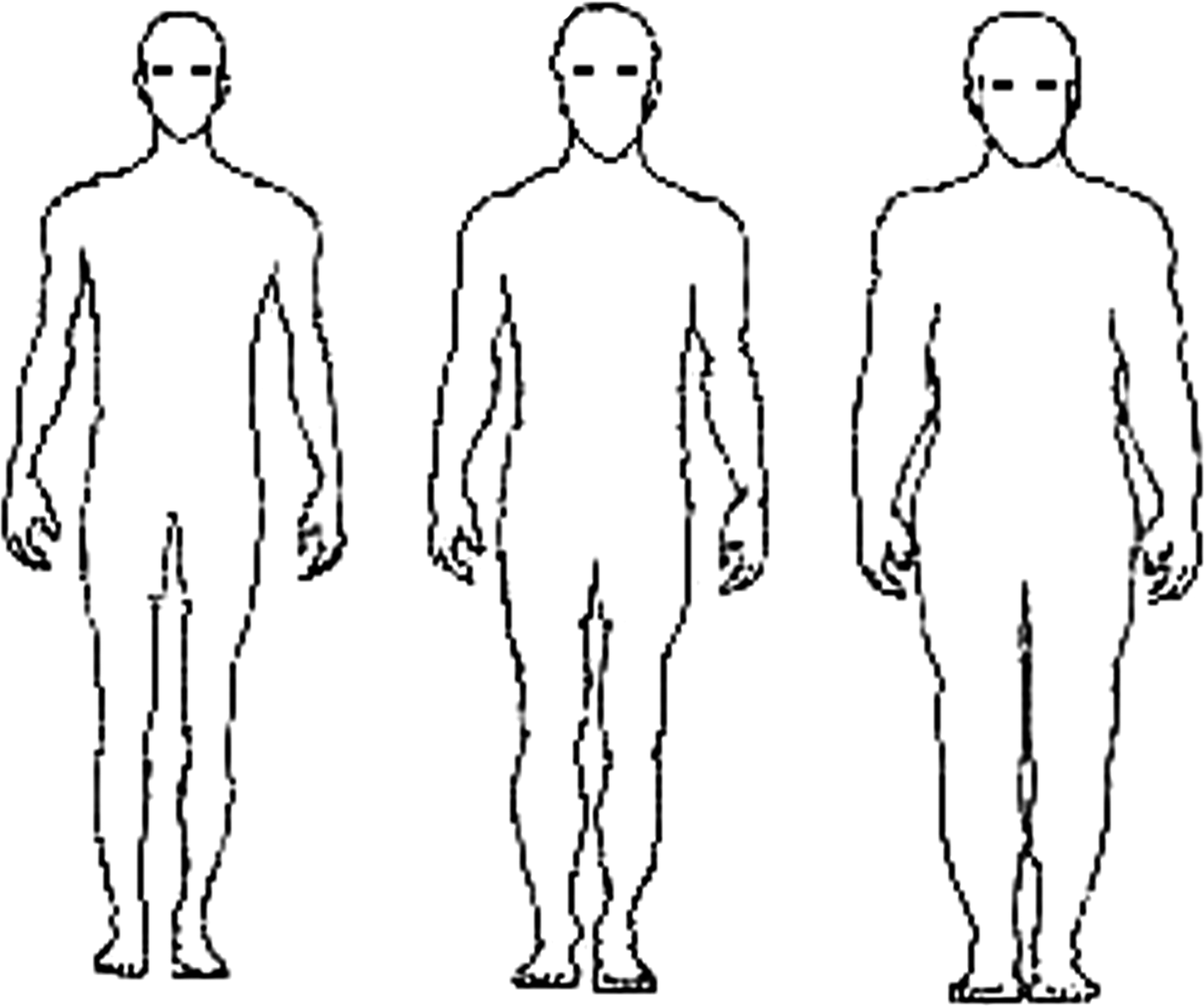
Ayurveda body types (from left to right): vata, pitta, and kapha. In concordance with constitutional psychology somatotypes: ectomorphic; mesomorphic; and endomorphic.
On the other hand, the concept of mind (psyche) is a vast subject in Indian philosophy. In that sense, mind as manas has a very important position in the Indian system of medicine. The term manas means “to think,” derived from the root man. 7,8 Furthermore, in Ayurveda, the diseases are classified into physical and mental categories. 7,8 Therefore, the concept of manas is usually correlated with that of “mind” in Western modern psychology, although the Indian philosophical concept about manas is slightly different and much more profound than the Western psychologic counterpart. Moreover, according to Indian thoughts, manas (mind) is one of the major operational concepts in the process of learning and the cause of bandha (entanglement/attachment), 7,8 since it has been said that human beings cannot learn without coordination between manas, soul, sense organs, and subjects. 8 In addition, manas has dimension, which is anu (beyond atom in its minutest aspect), and is capable of remaining atindriya (beyond sensory perception). 7,8 Moreover, the heart as well as the brain are considered to be the locations of mind by Ayurveda. In detail, the sensory and motor functions of the mind are chiefly attributed to the brain, whereas the psychologic functions, particularly the emotional aspects of the psyche, are attributed to the heart. 7,8
The striking similarities between Western constitutional psychology 5,6 and the traditional Indian system of medicine (Ayurveda) deserve special attention (Fig. 1). The idea that these general body types may correlate with general psychologic types did not originate with Sheldon. In general outline it resembles ideas found, for instance, in Plato's Republic and propounded in the twentieth century by George Gurdjieff. In addition, Friedrich Nietzsche says that “nature distinguishes” three different physiologic body types, which correspond to a Republic-esque hierarchy. 9 Sheldon's ideas may also owe something to Aristotle's concept of the soul. Roughly the three corresponding personality types proposed by Sheldon are somewhat akin to Jung's categorization of thinking, feeling, and sensing types.
Recent support for the connection between constitutional psychology somatotypes and Ayurveda body types is additionally found in the current Western view on inborn temperaments, 10 and also from the theory of frontal lobe function: the somatic markers hypothesis. 11 These similarities and striking connections suggest an inborn genopsycho-somatotype methodology in humans allowing new perspectives in human classification, which is independent of race or ethnicity, language, geographical location, or self-reported ancestry. This enunciated genopsycho-somatotyping of humans comprises three basic extreme birth constitutions mainly mediated by certain nuclear receptors: androgen, T-cells, and thyroxine. These proposed nuclear receptors regulate the expression of specific genes, thereby controlling the embryonic development, adult homeostasis, and metabolism of the organism. For males, it is proposed that every basic constitution has an “associated or distinctive organ,” a “measured property,” a “soma,” and some “psyche” tendencies in agreement with constitutional theory and Ayurveda, additionally suggesting behaviorally tendencies or recurrent conduct for every constitution, respectively.
Mesomorphic or Andrus (Pitta)
Organ: testes, measured property: androgen (An). Soma: Characterized by a high rate of muscle growth and a higher proportion of muscular tissue. They have large bones, solid torso combined with low fat levels. It is also noted that they have wide shoulders with a narrow waist. Psyche-behavior tendency when in balance: contented, enjoys challenges, strong digestion, lustrous complexion, good concentration, articulate and precise speech, courageous, bold, sharp wit, intellectual. Leadership and entrepreneurship qualities, ambitious, determined in thought, speech and action, moderate sleepers. When out of balance they can be demanding; perfectionist; tendency toward frustration, anger, or aggressiveness; tendency toward skin rashes; irritable and impatient; prematurely gray hair or early hair loss. 8
Endomorphic or Thymus (Khapa)
Organ: Thymus, measured property: T-cells (Tc). Soma: Characterized by an increased amount of fat storage, due to having a larger number of fat cells than the average person, as well as higher proportion of digestive tissue. They have a wide waist and a large bone structure. Their strong frame is apt for heavy physical work. Psyche-behavior tendency when in balance: Compassionate, emotionally steady, relaxed, methodical, good memory, good stamina, increased natural resistance to sickness. They are more likely to be stable and calm in thought, speech, and action; tend to be easygoing and supportive in relationships. Loyalty is more easily found than in other body types. They are more likely to be heavy sleepers. When out of balance: They can be complacent, tendency to dullness, present oily skin, allergies, slow digestion, lethargic, possessive, overattached, tendency to oversleep, overweight. 8
Ectomorphic or Thyrus (Vata)
Organ: Thyroid, measured property: Thyroxine (Th). Soma: Characterized by long arms and legs and a short upper body and narrow shoulders, and supposedly having higher proportion of nervous tissue. They also have long and thin muscles. Ectomorphs usually have a very low fat storage; therefore, they are usually referred to as slim. They tend to require more sleep hours compared to other body types; however, they seem to have light sleep. Their delicate frame is not suitable for heavy physical work or exhausting long exercises. Psyche-behavior tendencies when in balance: Vibrant, enthusiastic, clear and alert mind, flexible, imaginative, sensitive, talkative, quick to respond. When out of balance they tend to display excessive worry, fear and anxiety behavior tending to depression, schizophrenia, restless mind, light interrupted sleep, tendency to overexert, fatigued, constipated, underweight. 8
In addition, the race or ethnicity-associated organ is the pituitary and melanocyte-stimulating hormone (MSH) its measured property. Hence, male mesomorphic constitutions across races share similarities in androgen nuclear receptor behavior. Endomorphic constitutions are mainly regulated by T-cells nuclear receptor and share similarities in this receptor behavior. Moreover, ectomorphic basic constitutions share similarities in thyroxine nuclear receptor behavior. Small differences in measured property (An, Tc, and Th nuclear receptors) within a birth constitution across different races are to be expected by modulation effects in MSH receptor behavior. These proposed nuclear receptors are expected to regulate the expression of specific genes, thereby controlling the embryonic development, adult homeostasis, and metabolism of the organism.
Discussion
It is well-known that many functions and processes within the human body are mainly carried out for survival or reproductive reasons. The majority of these processes are regulated by hormones. Androgen is the generic term for any natural or synthetic compound, usually a steroid hormone that stimulates or controls the development and maintenance of male characteristics in vertebrates by binding to androgen receptors. This includes the activity of the accessory male sex organs and development of male secondary sex characteristics, such as increased muscle mass and strength, broadening of shoulders and chest, shoulders wider than hips, and so on. The circulating androgen levels modify human behavior because certain neurons are sensible to steroid hormones. Androgen levels have been implicated in the regulation of human aggression, 12 dominance, courage, and libido. As a matter of fact, androgens are able to alter brain structure in various species, including mice, rats, and primates, producing the sexual differences of gender. 13 Even though androgens are potentially brain modifiers, identifying and quantifying which alterations are due to androgens or estrogens have been very difficult to measure, although some studies now indicate that androgens by themselves do alter the cerebral structure. 14 Since reproduction is a very relevant function for human beings, it is reasonable to employ the behavior of this hormone as a marker for human classification, especially in the selection between dominant and submissive individuals.
The immune system function is another very relevant and important characteristic for human survival. Cell-mediated immunity is an immune response that does not involve antibodies or complement but rather involves the activation of macrophages, natural-killer cells, antigen-specific cytotoxic T-lymphocytes, and the release of various cytokines in response to an antigen. Cell-mediated immunity is directed primarily at microbes that survive in phagocytes and microbes that infect nonphagocytic cells. It is most effective in removing virus-infected cells, but also participates in defending against fungi, protozoans, cancers, and intracellular bacteria. It also plays a major role in transplant rejection. It is known that the optimal functioning of the immune system is necessary for increased biological fitness; therefore, it is reasonable to employ T-cell behavior as a second marker for human classification.
The metabolic function and its dynamics is quite an important characteristic in any human being. The thyroid, one of the largest endocrine glands in the body, plays an important role in metabolic function. This gland is found in the neck, inferior to (below) the thyroid cartilage (also known as the “Adam's Apple” in men) and at approximately the same level as the cricoid cartilage. The thyroid controls how quickly the body uses energy, makes proteins, and controls how sensitive the body should be to other hormones. The thyroid gland participates in these processes by producing thyroid hormones, principally tri-iodothyronine (T3) and thyroxine (T4). These hormones regulate the rate of metabolism and affect the growth and rate of function of many other systems in the body. Thyroxine (often abbreviated as T4), a form of thyroid hormone, is the major hormone secreted by the follicular cells of the thyroid gland. T4 is involved in controlling the rate of metabolic processes in the body and influencing physical development. Administration of thyroxine has been shown to significantly increase the concentration of nerve growth factor in the brains of adult mice. 15 Given that human beings differ in their metabolic rate and protein synthesis capacity, it is quite reasonable to employ this hormone behavior as a third marker for human classification.
The melanocyte-stimulating hormones (collectively referred to as MSH or intermedins) are a class of peptide hormones that in nature are produced by cells in the intermediate lobe of the pituitary gland. Synthetic analogs of these naturally occurring hormones have also been developed and researched. They stimulate the production and release of melanin (melanogenesis) by melanocytes in skin and hair. MSH signals to the brain have effects on appetite and sexual arousal. 16 An increase in MSH will cause a darkening in humans too. Melanocyte-stimulating hormone increases in humans during pregnancy. This, along with increased estrogens, causes increased pigmentation in pregnant women. Cushing syndrome due to excess adrenocorticotropic hormone may also result in hyperpigmentation. Different levels of MSH are not the major cause of racial variation in skin color. However, in many redheaded people, and other people who do not tan well, there are variations in their hormone receptors, causing them to not respond to MSH in the blood. Therefore, it is quite reasonable to assume that within a birth constitution but across different races, there would be a modulation effect in MSH receptor behavior that could explain the small differences in marker property (An, Tc, and Th nuclear receptors behavior).
Recent psychologic and neuroscience studies support the link of personality (or temperament) with certain biologic or physiologic characteristics such as sympathetic tone variations in the cardiovascular system (due to heart rate pattern), including specific nervous system configurations within the human body (including brain) accounting for different temperaments and behaviors. Kagan and Snidman 9 show the existence of inborn temperament across diverse cultures, linking cardinal traits to neurochemical activation patterns involving the autonomic nervous system. Surprisingly, in their comparison between inhibited (high reactive for babies) and uninhibited (low reactive for babies) children, the inhibited was a little more likely to possess a tall, lean body mass, narrow face, and light blue eyes. 10 This striking similarity with the ectomorphic (Sheldon) or vata birth constitution (traditional Indian medicine) is no longer a coincidence but assures the enormous potential of the genopsycho-somatotyping methodology in humans. In addition, Damasio 11 posits goal-directed behavior as primarily directed by heavy somatosensory input from the internal milieu. Therefore, it is reasonable to consider a role for different patterns of somatosensory input in persons with different body types.
Conclusions
I suggest that this endocrinological perspective that takes into consideration the Western constitutional psychology for Ayurvedic genomics may provide a novel insight for further studies in human classification. Proper scientific exploration of this genopsycho-somatotyping of human methodology, including carrying out detailed and extensive experiments, is required. However, I anticipate wider implications of this methodology in human genetics, health, pharmacogenetics, psychology, physiology, and biology.
Footnotes
Disclosure Statement
The author declares that neither personal nor competing financial interests exist.