




Abstract

Introduction
Survey Results
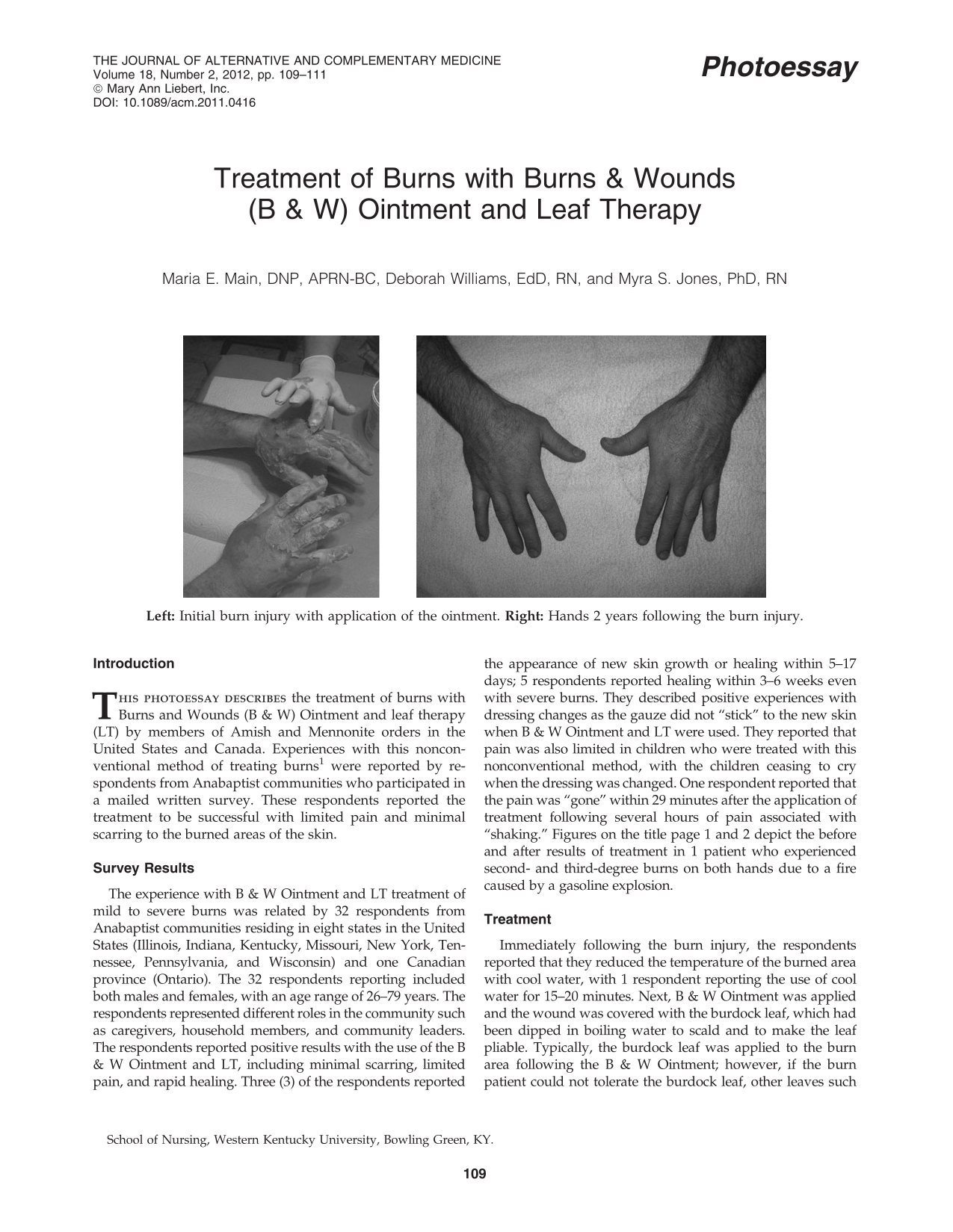
The experience with B & W Ointment and LT treatment of mild to severe burns was related by 32 respondents from Anabaptist communities residing in eight states in the United States (Illinois, Indiana, Kentucky, Missouri, New York, Tennessee, Pennsylvania, and Wisconsin) and one Canadian province (Ontario). The 32 respondents reporting included both males and females, with an age range of 26–79 years. The respondents represented different roles in the community such as caregivers, household members, and community leaders. The respondents reported positive results with the use of the B & W Ointment and LT, including minimal scarring, limited pain, and rapid healing. Three (3) of the respondents reported the appearance of new skin growth or healing within 5–17 days; 5 respondents reported healing within 3–6 weeks even with severe burns. They described positive experiences with dressing changes as the gauze did not “stick” to the new skin when B & W Ointment and LT were used. They reported that pain was also limited in children who were treated with this nonconventional method, with the children ceasing to cry when the dressing was changed. One respondent reported that the pain was “gone” within 29 minutes after the application of treatment following several hours of pain associated with “shaking.” Figures on the title page 1 and 2 depict the before and after results of treatment in 1 patient who experienced second- and third-degree burns on both hands due to a fire caused by a gasoline explosion.
Treatment
Immediately following the burn injury, the respondents reported that they reduced the temperature of the burned area with cool water, with 1 respondent reporting the use of cool water for 15–20 minutes. Next, B & W Ointment was applied and the wound was covered with the burdock leaf, which had been dipped in boiling water to scald and to make the leaf pliable. Typically, the burdock leaf was applied to the burn area following the B & W Ointment; however, if the burn patient could not tolerate the burdock leaf, other leaves such as lettuce, grape, cocklebur, plantain, dandelion, chickweed, and spinach were substituted. The most common reason for discontinuing the burdock leaf and substituting other leaves was a localized skin reaction. After the leaf application, the area was wrapped in gauze to cover the burn site. The procedure was repeated 3–4 times per day. Respondents reported that patients treated with this method repeatedly voiced little pain when compared to conventional medical treatment for burns. According to the respondents, skin grafting was not generally needed when this method of treatment was utilized, because the burns healed rapidly and with little scarring.
B & W Ointment Ingredients
The ingredients of B & W Ointment include honey, lanolin, olive oil, wheat germ, marshmallow root, aloe vera gel, wormwood, comfrey root, white oak bark, lobelia inflata, vegetable glycerin, beeswax, and myrrh (Fig. 1). According to a pamphlet describing B & W Ointment, it was formulated to be used as a covering after a loss of body skin in combination with scalded herbal leaves. 2 The pamphlet also describes the benefits of the specific ingredients. For example, honey, one of the main ingredients of the B & W Ointment, is antibacterial and a detoxifier. 2 Olive oil is used as carrier to transport other herbal ingredients. 2 Wheat germ promotes healing and reduces scarring. 2 White oak bark relieves itching, acts as an astringent, and has reported antiseptic action. 2 Blessed lobelia soothes sore muscles and can be used to treat muscle spasms and even earaches when used in tincture form. 2 The beeswax in this preparation is used to keep the mixture firm in warm climates. 2

B & W Ointment.
Sources including scientific references and medical studies reveal that ingredients found in B & W Ointment have demonstrated specific benefits. For example, the topical use of honey has been found to improve healing in mild-to-moderate superficial and partial-thickness burns compared with some conventional dressings. 3 Olive oil in combination with honey and beeswax has been found to be efficacious in conferring antibacterial activity against Staphylococcus aureus and Candida albicans. 4 In a randomized controlled trial, comfrey root extract ointment reduced back pain. 5 Comfrey root has also been identified as having anti-inflammatory effects. 6 The use of aloe vera has been traced back 6000 years for wound healing and treatment of various skin disorders. 7 The application of aloe vera cream is effective in reducing pain and healing time in patients after hemorrhoidectomy. 8 The oil of smooth wormwood has shown both antibacterial and wound-healing activity. 9 Wheat germ oil is rich in vitamins E, A, and D and is known for its antioxidant properties. 10 Myrrh has astringent properties and has been used topically for treatment of mild inflammation in the mouth and throat. 11
Common Burdock
Common burdock (Arctium minus) is a biennial plant that can reach heights of 6 feet with heart-shaped leaves; at maturity the plant produces burs that commonly attach to clothing or animal fur (Fig. 2). 12 The plant can be found in many states within the United States and is also common in southern Canada. 13 Burdock is believed to have a high content of vitamins and minerals, may be taken internally, and is available in diverse preparations including pills, tinctures, teas, or dried roots. 12

Common burdock.
Although the B & W Ointment and LT are commonly used in the Anabaptist communities, they are rarely noted in the medical literature. The Anabaptist community members, particularly children, are at risk for burns due to the use of open flames in cooking, heating homes, and in performing other work-related tasks both inside and outside the home. 14 As found in the survey, this burn therapy is commonly used in the Anabaptist communities. Even though the communities have limited access to technology for disseminating information about the B & W Ointment and LT for treatment of burns, they are successful in relating experiences among members via the written and spoken word. John Keim is known in the Anabaptist communities for his treatment of burns using this method. 1 He is considered the father of the movement and is known for his travels to many Anabaptist communities over the past decade, sharing his writings and stories about the method and positive outcome of this nonconventional treatment.
Conclusions
According to the survey results, Anabaptist community members elect to use the B & W Ointment and LT as a form of treatment for mild to severe burns. The use of home remedies including this therapy may be the desired method of treatment, as many of the members live 30 or more miles from a health care provider and most do not have health insurance. If the burn patient is experiencing complications such as dehydration, shock, infection, or large third-degree burns, the community members generally seek medical care.
Respondents reported having negative or nonsupportive reactions from health care providers when describing their treatment choice for burns. One reported that s/he concealed the use of the nonconventional home treatment, removed the B & W Ointment and LT, and reapplied the conventional prescribed ointments before returning to the health care provider. Community members who responded to the survey desired to increase awareness of the positive results achieved with the B & W Ointment and LT for the treatment of burns. The respondents hope that increased awareness of this treatment will result in increased acceptance by medical professionals. Collaboration between health care providers, one local hospital in south central Kentucky, and Anabaptist community members has resulted in the community members being allowed to use the B & W Ointment and LT when requested.
Footnotes
Acknowledgments
This study received no grant support. This material is the result of work supported with resources and the use of facilities in the School of Nursing at Western Kentucky University.
Disclosure Statement
No competing financial interests exist for the authors.