




Abstract

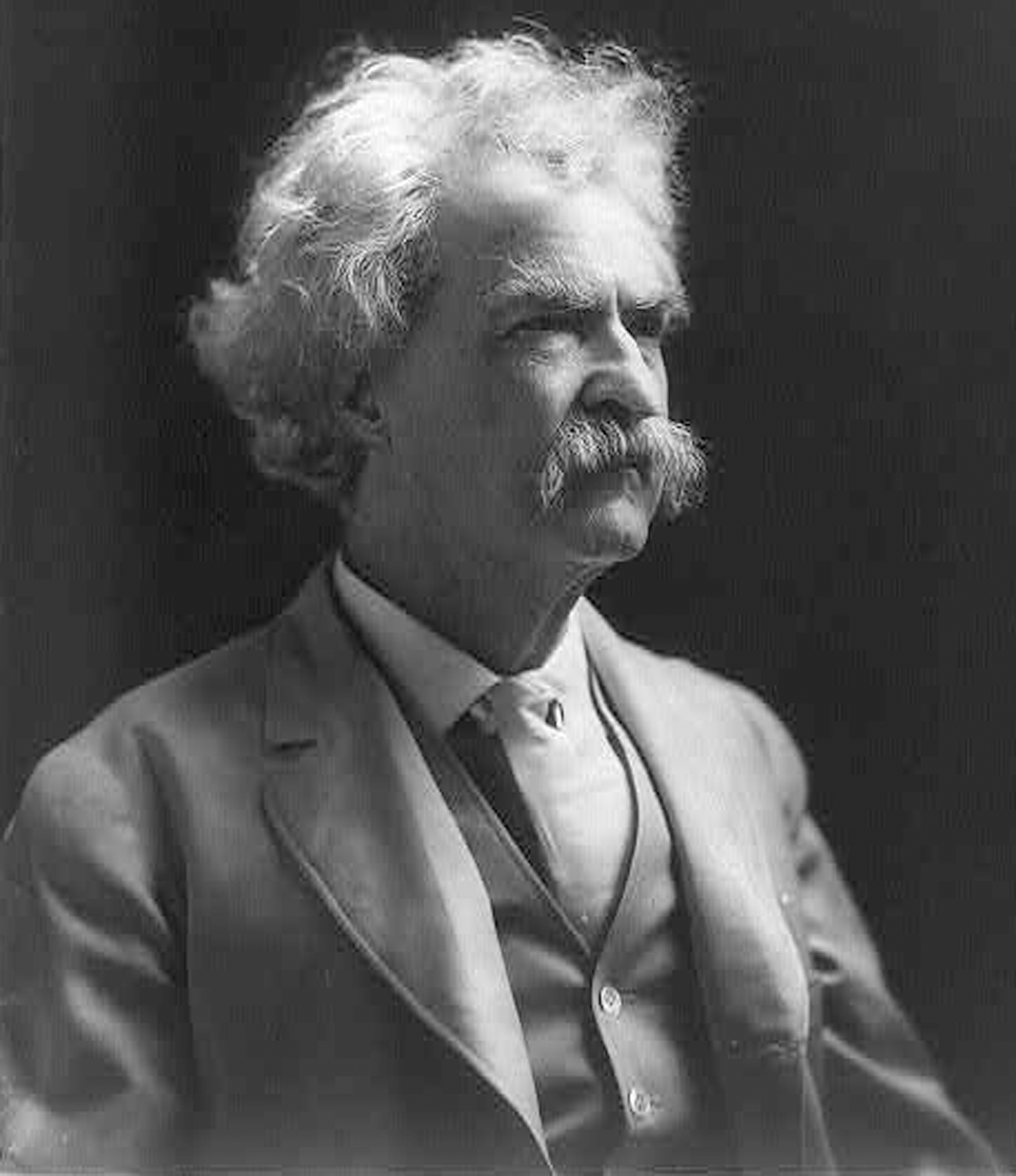
Mark Twain (Source: Library of Congress).
It would be easy enough to declare the “watermelon-cure” a literary invention created by Twain for the sake of his story. After all, watermelon was Mark Twain's favorite fruit, as he describes it in one of his stories: The true Southern watermelon is a boon apart, and not to be mentioned with commoner things. It is chief of this world's luxuries, king by the grace of God over all the fruits of the earth. When one has tasted it, he knows what the angels eat. It was not a Southern watermelon that Eve took; we know it because she repented.
2
In reality, the use of fruit as a “cure” was more than literary fabrication. Fruit was considered to be part of a healthy diet in the nineteenth century, as it is now, and some fruits were believed to have curative effects for specific diseases. The “grape-cure,” the most popular of the nineteenth century fruit-cures, was used for respiratory disorders such as bronchitis and pneumonia, and even for early stages of tuberculosis. It was a common feature at European health spas, as reported by the London Review of 1862. 3
Some viewed fruit-cures more generically. In 1881, Dr. T. L. Nichols proclaimed that a “strawberry-cure,” “raspberry-cure,” or “gooseberry-cure” would be equally effective. 4 In 1897, Dr. Felix Oswald agreed that any regionally available fruit (wild red raspberries in Michigan, strawberries in Texas) should work as well as a grape-cure, and he suggested “it would be a good plan to establish a watermelon cure in such places as Macon, Georgia.” 5
The Medical Brief of 1900 strayed further from claims of specificity, and proposed that doctors prescribe fruit-cures to distract their most demanding patients, particularly those who are “seldom seriously ill, but always more or less unwell,” and who “worry the life out of you because you can not get them well and keep them so.” 6
Fruit-cures aside, Twain's personal correspondence of the time showed that he was getting warmed up for a public criticism of the medical profession. The refractory seizures of his daughter Jean had “made no real and substantial progress in the past 3 years,”
7
he complained in August 1899, a year before he wrote “Two Little Tales.” In a letter of January 1900, Twain blamed physicians for his beloved daughter Susy's death from meningitis in 1896, in terms he would recycle when writing his “chimney-sweep story.” I am not afraid of doctors in ordinary or trifling ailments, but in a serious case I should not allow any one to persuade me to call one. Our Susy died of cerebro-spinal menengitis [sic]—and as soon as it manifested itself, her physicians gave her up. It was assassination through ignorance. …Outside of certain rather restricted limitations they are all quacks without an exception.
7
Twain continued the accusatory barrage in February 1900: I am convinced that of all the quackeries, the physician's is the grotesquest and the silliest. And they know they are shams and humbugs. They have taken the place of those augurs who couldn't look each other in the face without laughing.
8
The “chimney-sweep story” is, at its core, an intense outpouring of Twain's pent-up anti-medical emotions. The story describes an army being ravaged by dysentery with no effective remedy. The Emperor asked the prominent physicians “Were they properly healers, or merely assassins?”; they admitted the futility of their treatments and confessed that “No medicine and no physician can cure that disease. … They merely do damage.” When the Emperor contracted the disease, he called “the assassins” back to hasten his death: “The will of God be done. … Let us get over with it.” The doctors “felt his pulse, and looked at his tongue, and fetched the drugstore and emptied it into him, and sat down patiently to wait” for his anticipated death. 1 At the last moment, a chimney-sweep recommended the “watermelon-cure” and saved the Emperor (Fig. 1).
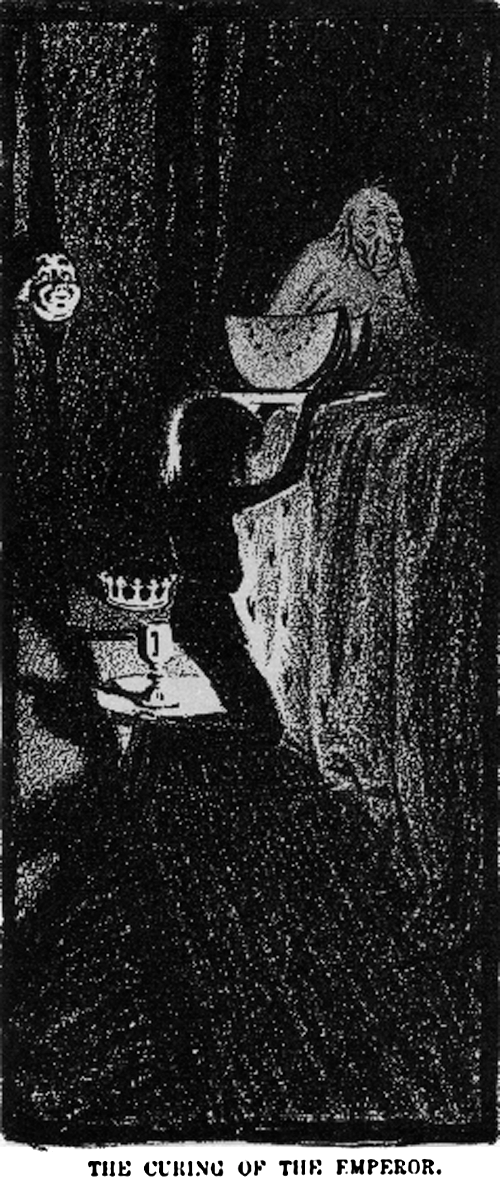
The Curing of the Emperor (Source: Mark Twain. Two Little Tales. In: The Century Magazine 1901;63:31).
Was the “watermelon-cure” a creation of Mark Twain in late 1900, invented to attack the ignorance of the medical profession? It was not. For Twain, it was a valid treatment; he had seen the watermelon-cure work for his own family, and he recommended it to friends.
The “watermelon-cure” appeared in the medical literature 30 years before Twain wrote his “chimney-sweep story.” In the Boston Medical and Surgical Journal of 1869, Dr. S. G. Weber reported a man “in the habit, when troubled in summer with a commencing diarrhoea, of eating largely of the best and largest watermelon he can find; he says it invariably checks the diarrhoea.” Weber promoted the watermelon-cure with enthusiasm: “It would certainly be one of the pleasantest medicines we could prescribe. … We give lemonade and neutral salts, why not give watermelon?” Later that year, Dr. B. E. Cotting confirmed Weber's observations. 9 The Medical Record of August 14, 1886 advocated “The Watermelon Cure” as a “cheap but effective substitute for grapes” in the treatment of “chronic intestinal catarrh” and similar maladies. 10
Twain had been familiar with the “watermelon-cure” for at least 7 years before he wrote the “chimney-sweep story.” In September 1893, he reported it to be effective therapy for the dysentery suffered by his wife Olivia (“Livy”): “When it is summer time she eats a slice or two of fresh ripe watermelon, & scores a victory. If it is winter time—then there's trouble!”
11
In his autobiography, Twain confirmed watermelon's benefits for Livy as he attacked the dangerous traditional methods of her doctors: Annually, during many years, Mrs. Clemens was promptly cured of desperate attacks of that deadly disease, dysentery, by the pleasant method of substituting a slice of ripe, fresh water-melon for the powerful and poisonous drugs used—frequently ineffectually—by the physician. In no instance, in the long list, did the eating of a slice of water-melon ever fail.
12
In February 1899, Twain recommended the watermelon-cure to his journalist friend, Poultney Bigelow. Twain described Bigelow's dire situation in a letter of August 3, 1899, with a sense of desperation that anticipated his fictional Emperor's plight. I was aware that dysentery and the doctors had been hard at work at him 7½ months, and that in the first days of May his case had been given up as hopeless. … I knew that in the early part of May he had then been for weeks in his bed, and was no longer able to turn over. I had written him in February that he must find a ripe watermelon or die…As I don't believe a doctor can cure any really serious disease except by accident, and that he can't touch dysentery when it is bad, I supposed that he was going to die, for certain.
7
Twain continued to make similar comments in his personal correspondence after the publication of the “chimney-sweep story.” In a February 1902 letter to Francis Skrine, author of Life of Sir William Wilson Hunter, he speculated that “a fresh ripe watermelon” would have cured Hunter's debilitating dysentery, and then explained how he had cured Livy from a “bad attack” in the summer of 1901 with the “one watermelon left in New York.” He proposed it could prevent soldiers in South Africa and India from dying of dysentery, but doubted that the medical profession would allow its use. 13
The source of Twain's knowledge of the “watermelon-cure” is unknown. A report in The Medical Brief of 1905 raises the possibility that he discovered it during the years he lived in Hartford. A physician in Hartford, Conn., had a patient who was very sick with dysentery, and after the patient was a little better he wanted some watermelon. The doctor strictly forbid him having it and said it would kill him if he ate it. That night the patient said to his nurse, “Give me some watermelon,” and he had what he wanted. Next morning when the doctor came in he looked at his patient and said: “Sir, you are decidedly better.” “Yes, sir, but not much credit to you, doctor. I had all the melon I wanted and have been better since.” From that on, the doctor recommended watermelon in such cases.
14
In 1905, four years after publishing the “chimney-sweep story,” Twain was still unable to convince any physician to try the therapy. This question of prejudice is very important. There are lots of people who don't believe that a slice of ripe watermelon will cure dysentery. It cures my personal friends every time, but I'll bet if I tried to teach the gospel of ripe watermelon to a hospital full of dysentery patients and would sell watermelons for three cents a dozen they'd put me out of the institution.
15
Twain was particularly distressed at the medical profession's prohibition of watermelons in military camps. I have never been able to get a physician, or anybody else, to try it. During the civil war any one caught bringing a watermelon into a military camp down South, where the soldiers were dying in squads from dysentery, was sharply punished. Necessarily the prejudice against the water-melon was founded upon theory, not experience, and it will probably take the medical fraternity several centuries to find out that the theory is theory only, and has no basis of experience to stand upon.
12
He repeated this complaint in the “chimney-sweep story.” Tommy, the chimney-sweep's friend, explained that “wherever there's a soldier-camp and dysentery, the doctors always put up a sign saying anybody caught bringing watermelons there will be flogged with the cat till he can't stand.” 1
The physicians' position was not entirely indefensible. Before the microbiological basis of common diarrheal diseases was recognized, fruit was often blamed as a source of disease. During an east coast cholera epidemic in 1832, the Board of Health banned watermelons from Washington, DC. A newspaper writer protested the prohibition, suggesting that physicians were “perfectly ignorant” of the real cause of cholera, and “every opinion expressed by them [was] speculation and conjecture.” 16 Retrospectively, there may have been some validity to the physicians' concerns: Campylobacter, Shigella, Salmonella, or pathogenic Escherichia coli are now known to be capable of contaminating watermelons and causing disease. 17
From a twenty-first century perspective, it is appealing to think that watermelon may have been beneficial to dysentery victims through replenishing fluid and sugar (or by other undefined mechanisms), despite the absence of any evidence of antimicrobial action. In any case, Twain was absolutely convinced it was effective, and his strong belief caused him to hold the doctors responsible for the deaths of untold numbers of soldiers in the military camps, as he made clear in the “chimney-sweep story”: “I know it—the idiots!” said Jimmy, with both tears and anger in his voice. “There's plenty of watermelons, and not one of all those soldiers ought to have died.”
1
For Mark Twain, in 1901, the medical profession's unwillingness to use a therapy he believed to be effective raised other questions. If doctors were unwilling to consider a treatment as simple as a watermelon, what other lifesaving therapies might they similarly reject? Could the doctors have prevented the death of his daughter Susy from meningitis by being more open-minded about possible therapeutic options? That was the most troubling question of all, and was the one he would never completely get out of his mind.
Footnotes
Acknowledgments
This work was originally presented at the Sixth International Conference on the State of Mark Twain Studies, Elmira College Center for Mark Twain Studies, Elmira, NY, on August 7, 2009.
Disclosure Statement
No competing financial interests exist.