




Abstract
Background:
It is not clear what information is needed on labels of natural health products and dietary supplements to support informed consumer choice and use of these products.
Aim:
The purpose of this review was to explore if/how label information impacts consumer decision-making about food, over-the-counter drugs, and natural health products/dietary supplements and to make recommendations about how this evidence may be applied to natural health products/dietary supplements.
Method:
A narrative analysis of a systematic review was performed. Medline and Embase databases were systematically searched to identify relevant studies from 1985 to February 2018 for all available English-language articles. This was supplemented with hand searches of the reference lists of review articles.
Results:
One hundred and fifty-one studies met the inclusion criteria, and after excluding review articles, 127 were included in the analysis. The findings from the studies were categorized into three main themes: (1) impact of labeling on consumer behavior (the majority of studies found that changes in label format or information had little to no effect on consumer behavior such as purchasing); (2) consumer comprehension of label information (significant proportions of consumers were unable to accurately interpret information found on natural health product/dietary supplement, over-the-counter medication, or food labels); and (3) label formatting/design, including standardization of information in fact tables (standardization, front-of-pack, and contrasting color panels were preferred and best attracted consumer attention).
Conclusions:
Many consumers did not regularly read product labels, nor understand the information they read on those labels. There was evidence that consistency of information was preferred by many consumers. Font size clearly impacted consumers' ability to read and understand the information on labels and this needed to be balanced with the amount of information required on labels. There was evidence that symbols that are simple and used sparingly are helpful in providing direction to consumers. Finally, regardless of what information was on the label, changing labels alone was unlikely to have a significant impact on consumer behavior.
Introduction
Consumers around the world use a wide range of self-care products to manage minor ailments, prevent illness, and enhance their health and well-being. Natural health products, dietary supplements, and traditional or herbal medicines form a significant component of this market. It is estimated that 80% of the World's population uses these kinds of products 1 and 95% of the population in developing countries. 2
The World Health Organization's Traditional Medicine Strategy 2014–2023 recommends regulation of natural health products/dietary supplements as a means to enhance the quality, safety, and effectiveness of products available for consumers. 3 Approaches to regulation of these products vary significantly. 4 A number of countries have created unique regulatory categories in an attempt to provide appropriate regulation, including the Natural Health Products Regulations in Canada, 5 Dietary Supplement Health and Education Act in the United States of America, 6 Therapeutic Goods Act in Australia, 7 and Traditional Herbal Medicinal Products Directive, also known as the EC Directive 2004/24/EC, in Europe. 8
A recent public consultation of Canadian self-care products (natural health products, cosmetics, and nonprescription drugs) identified a number of challenges for regulators. One of the key issues identified is how best to determine what information is needed on labels to support informed consumer choice and use of these products. 9 Early consultation with consumers revealed that Canadians do not consider themselves well informed when purchasing self-care products. 10,11 Based on their public opinion research, the Canadian government identified concerns that the current labels do not meet the needs of Canadians and this led to an ongoing consultation process to modernize the regulations. The idea for this review was born from the recognition that any proposed regulatory changes should be informed by existing scientific evidence.
The purpose of this review was to explore if/how label information impacts consumer decision-making about food, over-the-counter (OTC) drugs, and natural health products/dietary supplements and to make recommendations about how this evidence may be applied to natural health products/dietary supplements.
Method
A narrative analysis of a systematic review was performed. Medline and Embase databases were searched to identify studies using the search terms in Table 1 (full search strategy available in Appendix A1) from 1985 to February 2018 for all available English-language articles.
Search Terms (Connected with AND)
Inclusion and exclusion criteria
Table 2 provides a summary of the inclusion and exclusion criteria using the patient/population, intervention, comparison, outcomes, and setting (PICOS) convention. Studies were included if they were conducted in Canada, the United States, and Australia and explored how consumers interact with (read, understand, and make choices or decisions about) food or self-care product labels for products that they self-select. Although it was recognized that the use of label information for food choices may be different from choices of OTC medications and natural health products/dietary supplements, label criteria identified across multiple product types were thought to be important to identify. Exclusion criteria were as follows: studies of children only; nutrition information provided by restaurant menus, caterers, movie theaters, or fast-food restaurants; advertisements or marketing, including shelf labels and store signage; studies focusing only on genetically modified foods; food allergy or precautionary allergen labeling; marijuana product labeling; alcoholic beverage labeling; and fair trade, organic, or sustainable product labeling. Conference presentations, abstracts, unpublished dissertations/theses, or any other works not published in peer-reviewed journals were also excluded.
PICOS Criteria for Inclusion and Exclusion of Studies
PICOS, patient/population, intervention, comparison, outcomes, and setting.
All articles identified in the search were reviewed by N.B. to determine if they met the inclusion and exclusion criteria. A tiered review strategy was used beginning with a review of titles, followed by a review of abstracts, and finally a review of full texts (Fig. 1). H.B. reviewed a random sample of 5–10 articles from each category (food, OTC, and dietary supplements/natural health products) to confirm the accuracy of their categorization for inclusion. In addition, N.B. identified ∼10 articles whose inclusion status was unclear and decisions were made through discussion.
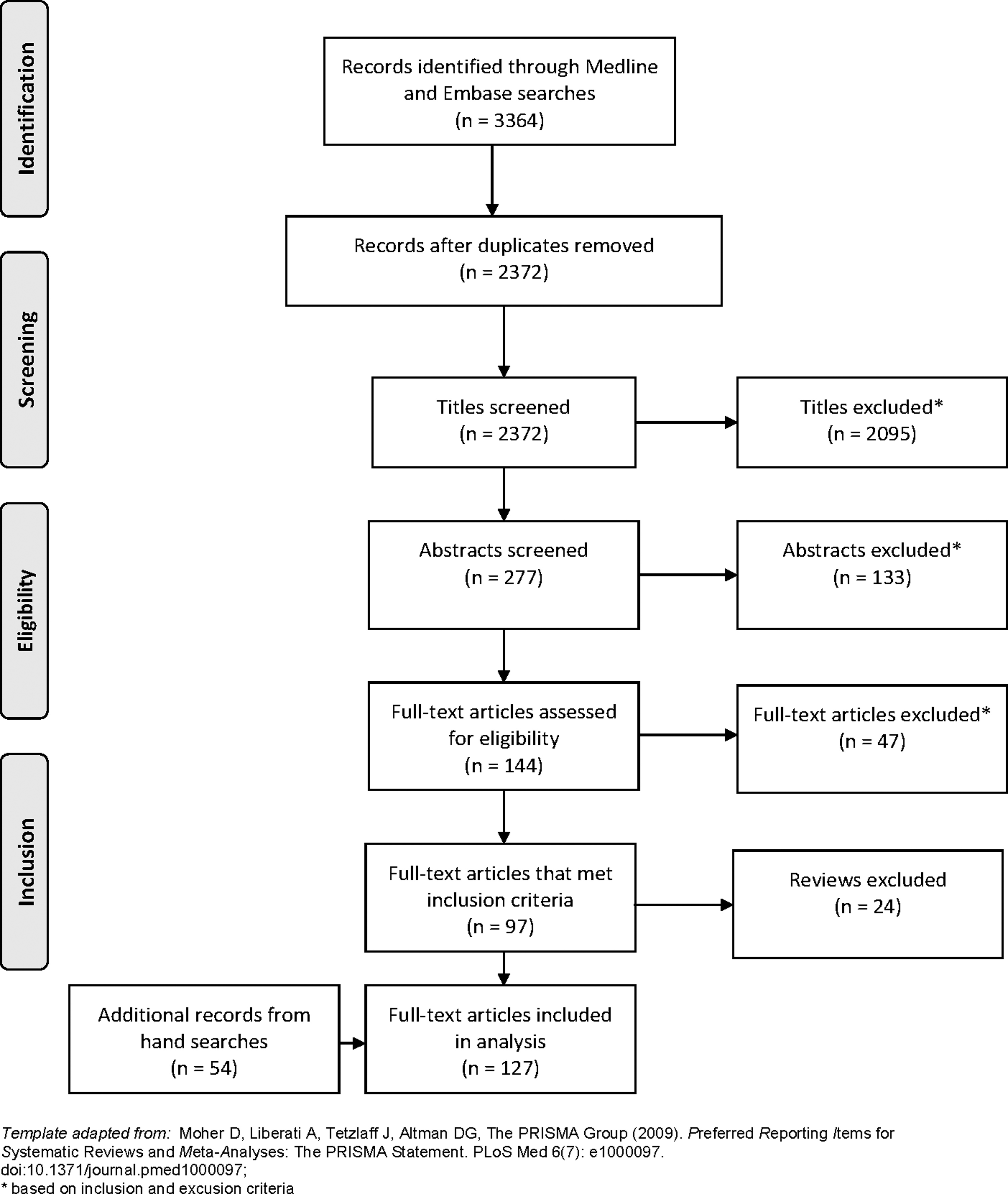
Flow diagram of the literature search process to identify the final sample.
Finally, hand searches of reference lists were conducted for all the articles meeting inclusion criteria in the two categories with the lowest number of articles (natural health products/dietary supplements and OTC drugs). In addition, the reference lists of all food label review articles from the last 5 years (2014–2018 inclusive) identified in the search were hand searched to identify any additional articles meeting inclusion criteria.
Methods of analysis
Given the range of interventions and study designs, a quantitative analysis (such as a meta-analysis) was not possible and thus a narrative analysis was conducted. Each article that reported primary research (i.e., excluding review articles) that met inclusion criteria in the systematic process described above was reviewed to identify objectives, participants, and conclusions, as well as key themes that emerged from the results and/or conclusions. Topics that were identified in multiple studies and across multiple product types were prioritized.
Results
Study characteristics
The search strategy identified 3364 articles. After screening, a total of 151 studies met inclusion criteria, of which 127 that described original research (i.e., excluding review articles) were included in the analysis (Fig. 1). The vast majority of articles were about food labels (n = 99). There was limited research on OTC drug labels (n = 25) and very little on natural health product/dietary supplement labels (n = 3). A summary of the key characteristics and findings of all the studies included in the review can be found in Supplementary Appendix 1a–c in the Supplementary Data.
The findings from the studies were categorized into three main themes discussed below: (1) impact of labeling on consumer behavior; (2) consumer comprehension of label information; and (3) label formatting and design, including standardization of information in fact tables.
Impact of labeling/label information on consumer behavior
Forty-seven studies identified in this review provided evidence about the impact of labeling on consumer behavior. The majority found that changes in label format or content had little to no effect on consumer behavior such as purchasing. 12 –27 Several studies noted that although no labeling interventions had impact, consumers were price sensitive. 12,28 For example, increasing prices of unhealthy foods significantly decreased purchase or selection of these products. 12
The few studies reporting that food label information had the potential to impact behavior were primarily surveys identifying associations between consumers' reported attention to labels and their reported behavior or purchase intentions. 27,29 –36 For example, several studies found an association between those reporting higher use of nutrition labels and those reporting healthier diets. 29,31,37 However, studies also indicated that only one-third to one-half of the participants reported usually or often reading food labels. 29,37 –40 One study concluded that when consumers indicate they use labels, it often means they read the labels, but do not process the information so that it is actually useful in their decision-making. 41 In a study in which half of the participants reported reading food labels (53% in the survey reported that they checked labels most times or always), the quality of ingredients and the provenience of the product, as well as the presence or absence of additives, were identified as more important than the nutrition fact panel in their decision-making. 40
One experimental study reported that a traffic light color-coding approach to food product labeling increased the attention paid to label information and was also associated with changes in purchasing decisions consistent with the color coding of labels. 42 Two studies noted that the addition of warnings impacted food purchase decisions 43,44 ; other labeling interventions (multiple traffic lights, daily intake guides, and nutrition information panels) did not significantly impact food purchases. 43 One study reported that the components of OTC medication labels that received the most attention from consumers in real-world or simulated shopping settings were front-of-pack warnings and usage instructions on medications. 28
Multiple studies suggested that purchasing and product use behavior were complex and offered suggestions as to why changes in labels are rarely associated with changes in behavior. Several studies indicated that consumers tend to purchase familiar products 28 and commonly fail to read key information on the label before making a purchasing decision. 28,39,45,46 One study identified two different models for consumer decision-making: habit based (behavior based on previous patterns) and deliberation based (considering options and weighing alternatives), but did not attempt to quantify which was more common or how label information may impact these kinds of decision making. 28 Another study suggested that consumers focused on one food ingredient on the label when making product choices—seeking to determine if the product contained a certain threshold amount of that ingredient—and did not give attention to other types of information on the label. 47
Some studies of OTC medications or natural health products identified the importance of the advice of a health care provider in consumer decision-making. 28,48,49 Another suggested that fact labels on foods only received significant attention when in-store signage was present, drawing attention to the existence and meaning of the label. 50 Consumer motivation or attitude was also generally associated with greater use of label information. 51 –54
Consumer comprehension/understanding of label information
Sixty-six studies identified in this review provided evidence related to consumer understanding of product labels. Many studies found that significant proportions of consumers were unable to accurately interpret information found on food, OTC medication, or natural health product/dietary supplement labels. 40,53,55 –65
A number of factors were found to impact consumers' understanding of product labels, including font size and space between lines 66 –72 ; contrast between font and background color 66,71,73 ; language comprehension level/health literacy 49,66,72,74 –79 ; quantification/numeracy skills 55,57,59,63,80 –82 ; and prior knowledge/beliefs, such that people did not read the labels closely (or at all) or that their interpretation of label information was biased by their prior beliefs. 24,45,57,83,84 Commonly, more education was associated with greater understanding of label information, 64,81,85 –88 although not all studies reported this (e.g., refs. 57,89 ); and older age was generally associated with poorer understanding 52,67 –69,81,86,90 (often due to inability to read small font sizes). One study of the list of ingredients on food product labels reported that 26% of labels were difficult to read and 67% were very difficult to read according to their assessment using a validated typographical scoring system. 71
A number of studies provided evidence of consumers misinterpreting label wording or symbols intended to convey specific meanings. 56,88,91,92 For example, consumers did not seem to be able to differentiate between levels of qualified health claims on foods in a meaningful way 56,84,93 and consumers who do not read food fact tables were reported to frequently misinterpret other information on the label. 94
The studies most likely to report that consumers were able to understand label information were those focused on OTC medication labels. 95 –99 One reason for these positive findings may be that these study designs were more likely to ensure that participants actually took the time to read the label carefully. 96 –99 It was not clear how findings from experimental study designs requiring OTC medication label reading may translate to real-world product decision-making.
Simplifying the information on labels was reported to help increase consumer understanding. 100 Other strategies thought to help consumers make sense of the information provided on labels were using meaningful categories on food product labels (e.g., high/medium/low-sugar content compared with number of grams of sugar) 23 and providing specific dosage times (i.e., 8 am and 8 pm, as opposed to twice per day) on OTC medication labels. 77
Label formatting and design
Fifty-one articles identified for this review provided evidence related to consumer preferences for specific types of label formats, efficacy of specific formats with respect to drawing consumer attention, enhancing understanding, and impacting behavior change. Overall, consumers gave conflicting preferences not only for more information and contextualized information 48,87,101,102 but also larger fonts 70,103 –105 as well as simpler 86,106 –110 and consistent 104,111 information.
There was general consensus that the front-of-pack component of the label receives more attention from consumers 14,50,111 –114 ; and some indication that this component of the label influences consumer decision-making more than other parts of the label. 14,46,115 –117 Some studies described a shortcut effect when consumers relied too much on front-of-pack labeling, which resulted in decreased attention paid to the more comprehensive information found on other parts of the label and resulted in misunderstanding or inaccurate consumer perceptions about the product. 24,112 In contrast, one study reported that the information in the food fact table was more influential than front-of-pack label claims when consumers evaluated products. 118 There was also evidence that color (especially a panel in a contrasting color from the rest of the label) attracted consumer attention. 12,73,103,112 –114,119 –124
There are multiple studies comparing a wide range of symbol systems on food products, including traffic lights, health star ratings, infographics, and caution/warning symbols. 12,18,20,21,42,43,46,107,111 –113,115,121,125 –133 Overall, there was evidence that these may influence some consumer choices. There was also significant evidence that they were often not well understood. There did not appear to be any consensus on whether one symbol system was definitively better than all the others because they all appeared to have strengths and weaknesses. For example, with the traffic light system, consumers inherently understood that the red traffic light signals stop or risk and the green traffic light signals something good or positive, but often misunderstood the nuances associated with orange/yellow and found it difficult to interpret multiple traffic lights for specific ingredients (e.g., refs. 18,42,121,131 ).
Multiple studies suggested that consumers preferred label information to be presented in a consistent standardized order; however, the specific preferred information and ordering were not consistent across trials. 69,74,134 –136 Eight studies specifically investigated the use of standardized fact tables on medications or foods. Overall, there was evidence that standardization is likely to be beneficial 23,69,111,134 –138 and these tables appeared to be generally liked and trusted by consumers. 104,118,131,134,135,138,139 Several studies noted associations between consumer-reported use of fact tables and self-reported better or healthier choices. 29 However, as with all other label formats, there was little evidence that information provided in fact tables impacted consumer choices directly. 131 In addition, multiple studies have documented that consumers face challenges in understanding, interpreting, and using the information provided in these tables. 47,61,140
Discussion and Conclusion
The findings showed that consistency of information is preferred by many consumers, suggesting that a standardized way of reporting required information (e.g., fact tables) can be recommended for natural health product/dietary supplement labels. However, it is unlikely that a single set of required information will be applicable for all the different types of natural health products or dietary supplements (e.g., herbs, vitamins, probiotics, essential fatty acids, and combinations of these). It may be desirable to strive for one fact table design for each of the core types of products included within the natural health product category.
This review found that font size clearly impacted consumers' ability to read and understand the information on labels and that this needed to be balanced with the amount of information required on labels. Research on proposed label design, ideally in real-world or simulated shopping settings, 141 –143 should be conducted to determine a compromise that best meets consumer needs for natural health products/dietary supplements, which may differ significantly from foods and possibly from OTC products.
There was evidence from the review that symbols that are simple and used sparingly are helpful in providing direction to consumers. One key challenge for Canadian natural health products is helping consumers understand the difference between products regulated with traditional compared with nontraditional health claims. The regulatory pathway and types of evidence required for these two classes of products are very different. 5 For example, traditional claims are based on evidence that demonstrates traditional use of medicinal ingredients based on the belief systems, theories, and/or experiences specific within a single recognized system of traditional medicine (e.g., Traditional Chinese Medicine, Ethnomedicines of the First Nations, Ayurvedic Medicine, and Traditional Herbal Medicine) and not on modern scientific evidence. 144 It would appear that this information is important to clarify to support informed consumer decision-making. The creation of a symbol (e.g., a green leaf) to clearly identify products approved for sale based on traditional evidence might be helpful.
Like all studies, this review has a number of limitations. The majority of studies identified for the review were of food labels. It is not clear if consumers engage with information from food labels fundamentally differently than for OTC medications or natural health products/dietary supplements. There were relatively few studies of OTC medications found for this review; however, there was significant overlap in findings of the OTC medicine studies with studies of food labels, which suggested that consumers' interactions with product labels may have some common underlying themes across multiple product categories.
Another limitation to this review was the wide range of study designs and outcomes identified in the literature search, which made it difficult to use a standardized quality assessment to rate the quality of each study. In addition, given that 54 additional articles were identified from hand searches, it appeared that the original search strategy was not very sensitive. These issues were mitigated by the large number of articles that were included in the review and a focus in the article on only the strongest themes emerging from multiple studies. It is possible that some informative results are thus missing from the article.
Regardless of what information is on the label, it is clear from this review that changing labels alone is unlikely to have a significant impact on consumer behavior or decision-making. Since most people do not regularly read product labels, interventions aimed at encouraging consumers to more routinely use the label as a source of information are needed. Based on the finding in the review that many consumers simply choose familiar products based on prior knowledge, interventions that target habit-based decision-making may be most effective. For example, developing nudges (e.g., shelf signs) to encourage and reward individuals for reading the label or interventions that encourage deliberation could be most useful. 28 Awareness-raising communication campaigns and creation of decision aids (personalized and just in time, for example, an app on a smart phone) are also recommended. In-store education programs such as the one described by Dukeshire et al. may be useful 145 ; however, more studies are needed to investigate if this kind of intervention results in behavior changes. Another approach may be to develop education for health care providers to support their participation in enabling consumers to engage in better decision-making. 28,48,88,146 Overall, evidence suggests that some kind of communication campaign will be needed to increase consumer awareness and understanding of labeling information. 19,59,147
In conclusion, this review found that consumers did not regularly read product labels, nor understand the information they read on those labels. It was also not clear if the information that consumers obtained from product labels impacted behavior, including purchase and product use decisions. Despite these challenges, there was some consensus that several approaches to product labels can aid consumers in making more effective and informed choices about medication and foods and these findings can inform label requirements of natural health products or dietary supplements.
Footnotes
Author Disclosure Statement
No competing financial interests exist.
Ovid Medline Search Strategy
| # | Searches | Results |
|---|---|---|
| 1 | (consumer* adj4 behavio!r*).mp. [mp = title, abstract, original title, name of substance word, subject heading word, keyword heading word, protocol supplementary concept word, rare disease supplementary concept word, unique identifier, synonyms] | 20,234 |
| 2 | (consumer* adj4 choice*).mp. [mp = title, abstract, original title, name of substance word, subject heading word, keyword heading word, protocol supplementary concept word, rare disease supplementary concept word, unique identifier, synonyms] | 1317 |
| 3 | (consumer* adj4 perception*).mp. [mp = title, abstract, original title, name of substance word, subject heading word, keyword heading word, protocol supplementary concept word, rare disease supplementary concept word, unique identifier, synonyms] | 1036 |
| 4 | (consumer* adj4 decision*).mp. [mp = title, abstract, original title, name of substance word, subject heading word, keyword heading word, protocol supplementary concept word, rare disease supplementary concept word, unique identifier, synonyms] | 751 |
| 5 | (consumer* adj4 attitude*).mp. [mp = title, abstract, original title, name of substance word, subject heading word, keyword heading word, protocol supplementary concept word, rare disease supplementary concept word, unique identifier, synonyms] | 652 |
| 6 | (consumer* adj4 preference*).mp. [mp = title, abstract, original title, name of substance word, subject heading word, keyword heading word, protocol supplementary concept word, rare disease supplementary concept word, unique identifier, synonyms] | 1127 |
| 7 | (consumer* adj4 satisfact*).mp. [mp = title, abstract, original title, name of substance word, subject heading word, keyword heading word, protocol supplementary concept word, rare disease supplementary concept word, unique identifier, synonyms] | 941 |
| 8 | (consumer* adj4 accept*).mp. [mp = title, abstract, original title, name of substance word, subject heading word, keyword heading word, protocol supplementary concept word, rare disease supplementary concept word, unique identifier, synonyms] | 1596 |
| 9 | 1 or 2 or 3 or 4 or 5 or 6 or 7 or 8 | 25,068 |
| 10 | nutrition* label*.mp. | 680 |
| 11 | food label*.mp. | 3597 |
| 12 | (food adj3 packag*).mp. | 5020 |
| 13 | exp vitamins/ | 2,99,923 |
| 14 | vitamin*.mp. | 2,42,610 |
| 15 | exp cosmetics/ | 39,916 |
| 16 | cosmetics.mp. | 11,721 |
| 17 | cosmeceutical*.mp. | 511 |
| 18 | homeopathic.mp. | 2403 |
| 19 | probiotic*.mp. | 20,330 |
| 20 | Lactobacillus.mp. | 33,014 |
| 21 | Bifidobacterium.mp. | 7354 |
| 22 | fish oil.mp. | 8367 |
| 23 | omega 3*.mp. | 18,270 |
| 24 | herb*.mp. | 1,22,799 |
| 25 | exp plant extracts/ | 1,43,136 |
| 26 | plant extract*.mp. | 98,541 |
| 27 | exp Plants, Medicinal/ | 56,520 |
| 28 | medicinal plant*.mp. | 14,828 |
| 29 | Chinese herb/ | 36,642 |
| 30 | chinese herb*.mp. | 40,677 |
| 31 | traditional chinese medicine.mp. | 14,368 |
| 32 | natural health product*.mp. | 350 |
| 33 | nutraceutical*.mp. | 4614 |
| 34 | dietary supplement/ | 45,786 |
| 35 | supplements.mp. | 71,908 |
| 36 | functional food*.mp. | 5942 |
| 37 | fortified food*.mp. | 793 |
| 38 | (non-prescription or nonprescription).mp. | 7125 |
| 39 | (over the counter or OTC).mp. | 9973 |
| 40 | (behind adj3 counter).mp. | 85 |
| 41 | 10 or 11 or 12 or 13 or 14 or 15 or 16 or 17 or 18 or 19 or 20 or 21 or 22 or 23 or 24 or 25 or 26 or 27 or 28 or 29 or 30 or 31 or 32 or 33 or 34 or 35 or 36 or 37 or 38 or 39 or 40 | 8,12,176 |
| 42 | 9 and 41 | 1632 |
| 43 | limit 42 to yr = “1985 -Current” | 1588 |
| 44 | limit 43 to English language | 1537 |
| Embase search strategy | ||
|---|---|---|
| 1 | (consumer* adj4 behavio!r*).mp. [mp = title, abstract, heading word, drug trade name, original title, device manufacturer, drug manufacturer, device trade name, keyword, floating subheading word] | 1090 |
| 2 | (consumer* adj4 choice*).mp. [mp = title, abstract, heading word, drug trade name, original title, device manufacturer, drug manufacturer, device trade name, keyword, floating subheading word] | 1589 |
| 3 | (consumer* adj4 perception*).mp. [mp = title, abstract, heading word, drug trade name, original title, device manufacturer, drug manufacturer, device trade name, keyword, floating subheading word] | 1212 |
| 4 | (consumer* adj4 decision*).mp. [mp = title, abstract, heading word, drug trade name, original title, device manufacturer, drug manufacturer, device trade name, keyword, floating subheading word] | 899 |
| 5 | (consumer* adj4 attitude*).mp. [mp = title, abstract, heading word, drug trade name, original title, device manufacturer, drug manufacturer, device trade name, keyword, floating subheading word] | 3990 |
| 6 | (consumer* adj4 preference*).mp. [mp = title, abstract, heading word, drug trade name, original title, device manufacturer, drug manufacturer, device trade name, keyword, floating subheading word] | 1299 |
| 7 | (consumer* adj4 satisfact*).mp. [mp = title, abstract, heading word, drug trade name, original title, device manufacturer, drug manufacturer, device trade name, keyword, floating subheading word] | 1276 |
| 8 | (consumer* adj4 accept*).mp. [mp = title, abstract, heading word, drug trade name, original title, device manufacturer, drug manufacturer, device trade name, keyword, floating subheading word] | 1694 |
| 9 | 1 or 2 or 3 or 4 or 5 or 6 or 7 or 8 | 11,027 |
| 10 | nutrition* label*.mp. | 899 |
| 11 | food label*.mp. | 1627 |
| 12 | (food adj3 packag*).mp. | 9441 |
| 13 | exp vitamin/ | 6,32,237 |
| 14 | vitamin*.mp. | 3,37,434 |
| 15 | exp cosmetic/ | 1,01,823 |
| 16 | cosmetics.mp. | 11,510 |
| 17 | cosmeceutical*.mp. | 841 |
| 18 | homeopathic.mp. | 4188 |
| 19 | probiotic*.mp. | 31,419 |
| 20 | Lactobacillus.mp. | 43,171 |
| 21 | Bifidobacterium.mp. | 11,680 |
| 22 | fish oil.mp. | 17,892 |
| 23 | omega 3*.mp. | 31,834 |
| 24 | herb*.mp. | 1,59,010 |
| 25 | exp plant extract/ | 1,87,442 |
| 26 | plant extract*.mp. | 1,30,326 |
| 27 | exp medicinal plant/ | 2,06,413 |
| 28 | medicinal plant*.mp. | 92,069 |
| 29 | Chinese herb/ | 4395 |
| 30 | chinese herb*.mp. | 13,642 |
| 31 | traditional chinese medicine.mp. | 20,092 |
| 32 | natural health product*.mp. | 531 |
| 33 | nutraceutical*.mp. | 7285 |
| 34 | dietary supplement/ | 5123 |
| 35 | supplements.mp. | 51,563 |
| 36 | functional food*.mp. | 7731 |
| 37 | fortified food*.mp. | 1540 |
| 38 | (non-prescription or nonprescription).mp. | 13,991 |
| 39 | (over the counter or OTC).mp. | 15,097 |
| 40 | (behind adj3 counter).mp. | 123 |
| 41 | 10 or 11 or 12 or 13 or 14 or 15 or 16 or 17 or 18 or 19 or 20 or 21 or 22 or 23 or 24 or 25 or 26 or 27 or 28 or 29 or 30 or 31 or 32 or 33 or 34 or 35 or 36 or 37 or 38 or 39 or 40 | 13,57,672 |
| 42 | 9 and 41 | 1751 |
| 43 | limit 42 to yr = “1985 -Current” | 1731 |
| 44 | limit 43 to English language | 1674 |