




Abstract
Abstract
Background:
The therapeutic mainstays of cancer remain surgery, radiotherapy, and chemotherapy. However, radiotherapy and chemotherapy are often associated with serious side-effects, such as nausea and vomiting. Acupuncture has been used widely to treat disorders in clinical practice for at least 3000 years. According to the National Institutes of Health (NIH) Consensus Statement, chemotherapy-induced nausea and vomiting are suitable for acupuncture intervention.
Objectives:
The goal of this review is to analyze the applications of acupuncture for treating cancer and to look ahead at the potential advantages of acupuncture for patients with cancer.
Materials and Methods:
The PubMed database was searched for articles on acupuncture therapy and neoplasms. The different distributions of scientific papers were analyzed preliminarily.
Results:
The articles found showed that acupuncture was used to address various symptoms related to different types of cancer.
Conclusions:
The results of clinical trials in acupuncture have provided important clues in oncologic practice. The evidence suggests that acupuncture is a safe and effective therapy for managing cancer and treatment-related symptoms, such as nausea and vomiting and fatigue caused by chemotherapy. As more evidence emerges, the potential advantages of acupuncture in tumor treatment will eventually be clear.
Introduction
I
Acupuncture has been used widely to treat disorders in clinical practice for at least 3000 years. 3 According to the National Institutes of Health (NIH) Consensus Statement, chemotherapy-induced nausea and vomiting are suitable for acupuncture intervention. 4 The goal of this review is to analyze the applications of acupuncture for treating cancer and to look ahead at the potential advantage of acupuncture for patients with cancer.
Materials and Methods
First, the search words in the Medical Subject Headings (MeSH) database were determined. The cancer-related search word was determined as
Results
As shown in Figure 1, a total of 2,249,143 articles were found using the search query
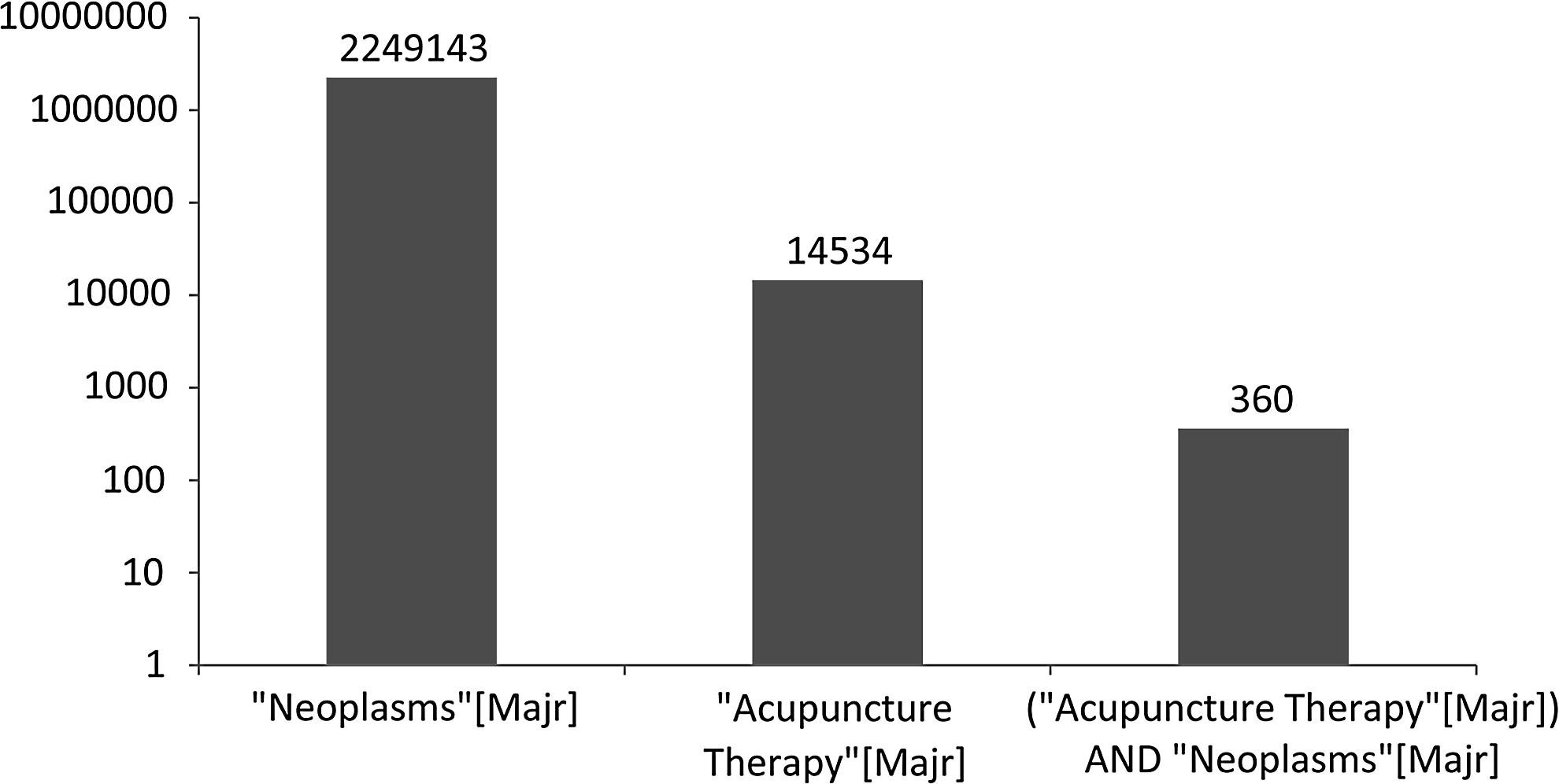
Number of articles retrieved in the PubMed database with the different search queries.
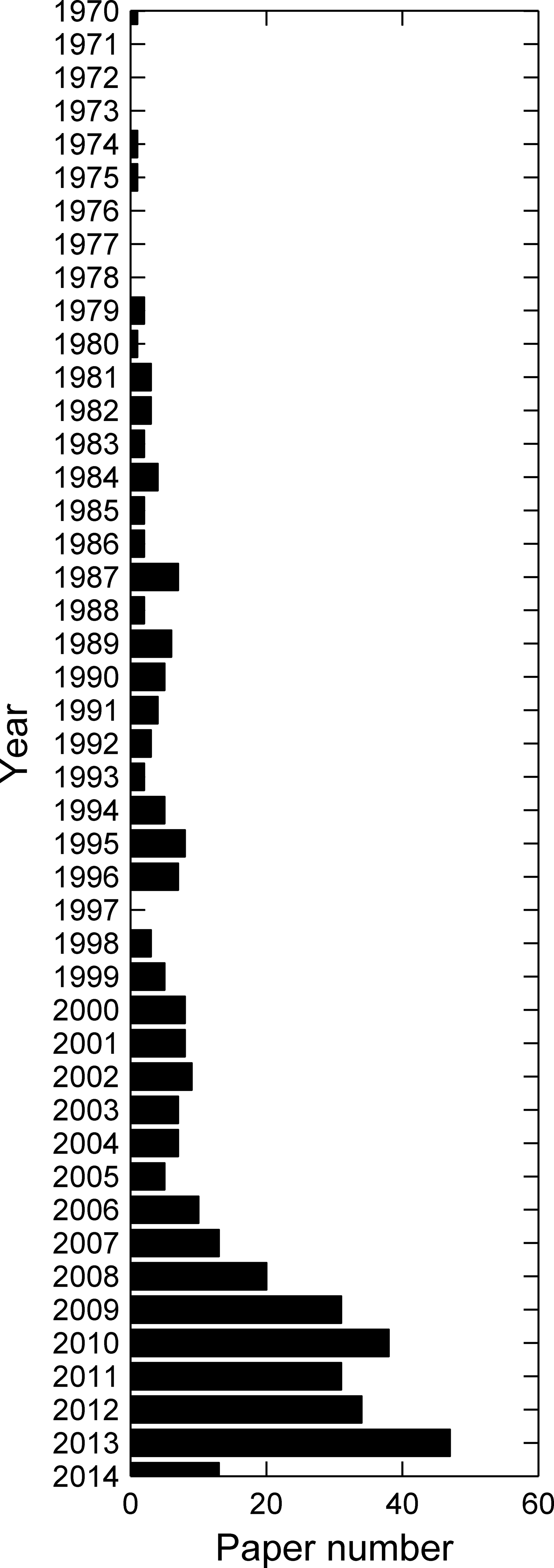
Yearly distribution of 360 articles retrieved with the search query
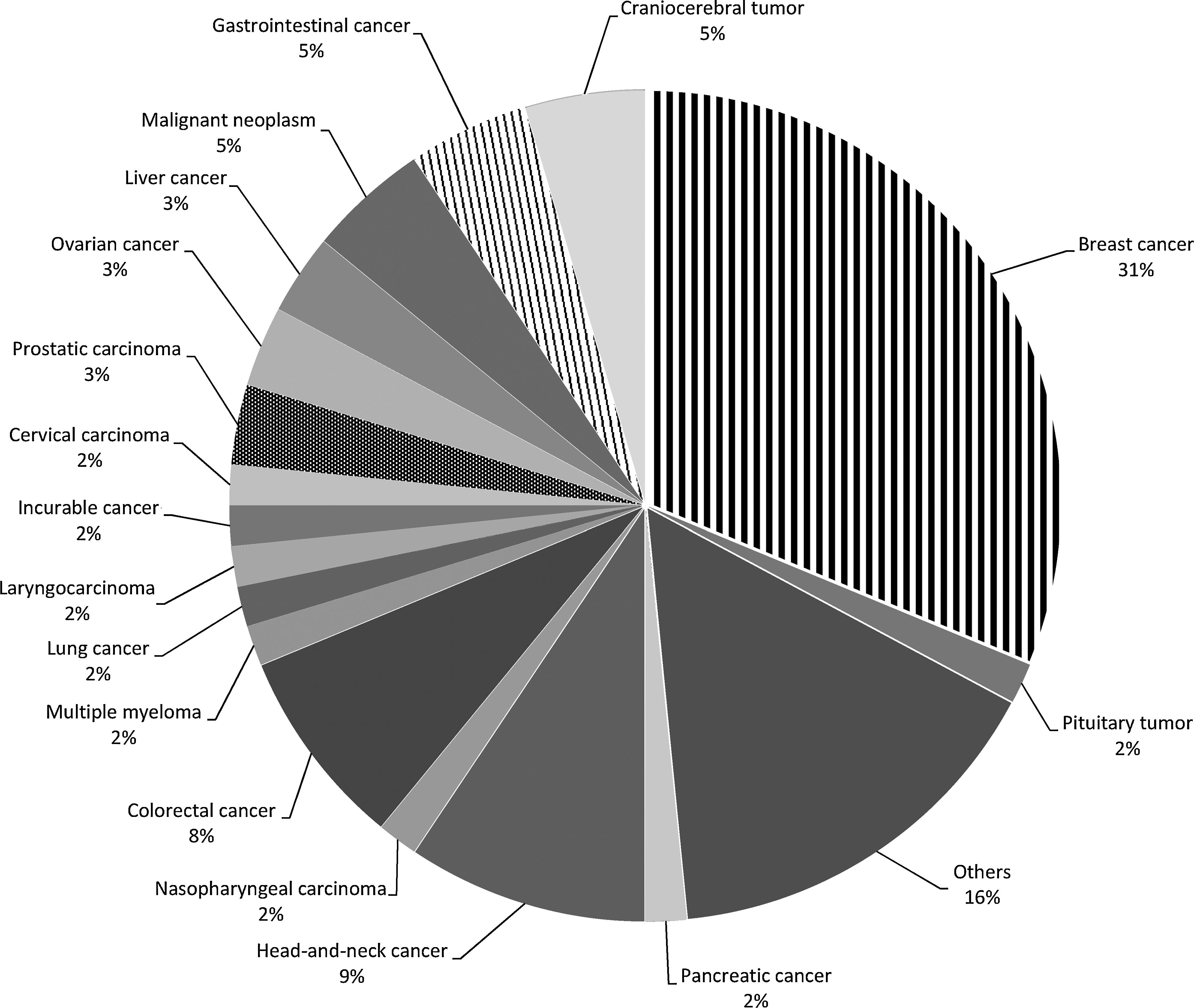
Proportional distribution of the 64 articles related to clinical trials.
This table contains details from the 64 articles, grouped according to the kinds of cancer that was treated.
AIMSS, aromatase inhibitors-associated musculoskeletal symptoms; HF&NS, hot flashes and night sweats; HRQoL, health-related quality of life; GI, gastrointestinal; QoL, quality of life; EA, electroacupuncture; NK, natural killer;
Discussion
Although acupuncture has been widely used in China to treat disorders in clinical practice for at least 3000 years, this modality has come under scientific investigation only recently. In 1976, the U.S. Food and Drug Administration (FDA) classified acupuncture needles as investigational devices (Class III), 69 resulting in a number of research studies on the effectiveness and safety of acupuncture. Taking into account the study period, this trend has been confirmed in acupuncture for cancer-related diseases, and, since 1979, the article numbers have been increasing gradually (Fig. 2). In 1997, the National Institutes of Health (NIH) held a Consensus Development Conference on Acupuncture to evaluate its safety and efficacy. The panel stated that “there is clear evidence that needle acupuncture treatment is effective for postoperative and chemotherapy nausea and vomiting.” 4 The panel also stated that there are “a number of other pain-related conditions for which acupuncture may be effective as an adjunct therapy, an acceptable alternative, or as part of a comprehensive treatment program,” 4 and agreed that further research is likely to uncover additional areas in which acupuncture intervention will be useful.
These actions by the FDA and NIH have resulted in the upsurge of acupuncture exploration and the establishment of a number of active programs for acupuncture. This led to a further increase of scientific articles about acupuncture and cancer since 2000 (Fig. 2).
From the literature reports, one can conclude that acupuncture for tumor treatment is a new and challenging field in oncology. From Table 1, it is clear that acupuncture is usually used to deal with the symptoms related to various kinds of cancers. However, there are no clinical trials of acupuncture as a direct cancer treatment. All clinical trials either use acupuncture to alleviate drug side-effects or to relieve symptoms.
The use of acupuncture in this special field can be attributed to the statement of the Consensus Development Conference on Acupuncture. 4
Conclusions
The results of clinical trials in acupuncture have provided important clues in oncologic practice. The evidence has suggested that acupuncture is a safe and effective therapy for managing cancer and treatment-related symptoms, such as nausea and vomiting and fatigue caused by chemotherapy. It is expected that, as more evidence continues to emerge, the potential advantages of acupuncture in tumor treatment will eventually be clear.
Footnotes
Acknowledgments
The scientific investigations were supported by the Austrian Federal Ministries of Science, Research and Economy and of Health (project title: “Evidence-Based High-Tech Acupuncture and Integrative Laser Medicine for Prevention and Early Intervention of Chronic Diseases”), and the German Academy of Acupuncture (DAA). Dr. Wang is currently working at the Medical University of Graz via scholarship from Eurasia Pacific Uninet. Dr. Litscher is also a visiting professor at the Institute of Acupuncture and Moxibustion at the China Academy of Chinese Medical Sciences in Beijing.
Disclosure Statement
No competing financial interests exist.