




Abstract
Abstract
Background:
Reactive oxygen species (ROS) and reactive nitrogen species (RNS) can act as both intra- and intercellular messengers and be produced exogenously and endogenously. Enhanced production of ROS and RNS causes oxidative stress (OS) leading to damage in lipids, proteins, glucides, DNA, and RNA. Treatment strategies to reduce OS levels may reduce their side-effects. The traditional healing method of acupuncture has been widely used to treat many medical disorders.
Objective:
This article is an overview of the therapeutic effects of acupuncture on OS-induced major gene regulation and epigenetic modification.
Methods:
Databases searched included PubMed, ScienceDirect, and Google Scholar (publications in English and other languages with English abstracts) from 1966 to June 2015. Publications that were irrelevant, duplications, or that contained duplicated data were excluded.
Results:
Changes were reviewed in the expression levels and in the epigenetic status of genes reported in 55 published works in which acupuncture was used to treat OS-related conditions.
Conclusions:
Accumulating evidence demonstrates the reducing effects of acupuncture therapy on stress-induced biomarkers. These effects are mediated, at least partially, by modulating the expression and epigenetic status of specific genes. However, antioxidative effects, specifically epigenetic modifications caused by acupuncture, should be clarified more by further studies.
Introduction
I
Enhanced production of ROS causes oxidative stress (OS), leading to damage in lipids (lipid peroxidation and damage to membranes and lipoproteins), proteins (aggregation and fragmentation and enzymes' inhibition), glucides, DNA (DNA-strand breaks and mutations leading to cancer), and RNA.1–3,9,10 Both purine (adenine and guanine) and pyrimidine (cytosine and thymine) react with OH− to form specific products.
Epigenetic alterations are regulated by mechanisms, including DNA methylation; chromatin conformation; histone modifications; RNA silencing11–14 ; and specific modifications, including acetylation, methylation, phosphorylation, and ubiquitination.11–14 DNA methylation occurs almost exclusively in the context of CpG dinucleotides. The CpG dinucleotides tend to cluster in regions known as CpG islands. In general, CpG-island methylation is associated with gene silencing.11–14 The amino terminals of core histone are subjected to several types of multivalent modifications, including acetylation, methylation, phosphorylation, ubiquitination, sumoylation, etc. Histone modifications, recognized as post-translational modifications (PTMs), are critical for regulating chromatin structure and function, which can affect transcription, recombination, DNA repair, replication, and chromatin organization.11–14
OS-induced DNA damages include 8-hydroxy-2′-deoxyguanosine (8-OHdG) excretion, microsatellite DNA instability, histone deacetylation, mitochondrial dysfunction, telomere shortening, and DNA methylation.1,3 The 8-OHdG is formed by HO2− addition to the C-8 position of guanine. Other DNA bases are also oxidized similarly by HO2−.
The most oxidative-damaged DNA bases result from AT↔GC transition and GC↔TA transversion. These mutations, if unrepaired, can lead to changes in protein gene expression. Protein modifications caused by ROS/RNS [reactive nitrogen species] include formation of carbonyls, dityrosine, and nitrated and chlorinated tyrosines. Nitrated, chlorinated, and brominated tyrosines have been detected in high levels in diseased tissues in patients with inflammatory diseases. 1 Intracellular oxidative signals may provide a molecular mechanism that modulates expression of inflammatory genes. Thus, ROS may act as specific regulators in the signal-transduction network to relay environmental and physical signals generated at cell membranes to nuclear regulatory signals, resulting in modulation of inflammatory gene expression.15,16
Relatively recent studies have indicated that OS can produce both genetic and epigenetic changes in the genome, as well as aging-associated diseases.17–21 Antioxidants are the most important defense against ROS and RNS through enzymatic (e.g., superoxide dismutases [SODs], catalases [CATs], and peroxidases [POXs]) and nonenzymatic antioxidants, such as water-solubles (glutathione, albumin, urate, hypotaurine, tyrosine, and vitamin C) and lipid solubles (vitamins E and A, and polyphenols). 5 Secondary defense systems are enzymes of repair; de novo synthesis of damaged molecules, such as 8-oxoguanine glycosylase (OGG1); and chelating agents, such as albumin, transferrin, ceruloplasmin, and other proteins.5,22,23 Some antioxidants are found in vegetables and foods but can be destroyed by long-term storage or prolonged cooking. 24 In addition, oral antioxidants, such as drugs and medications, have side-effects, including allergic reactions or other problems, such as toxic side-effects in cardiac myocytes.1,25,26
Acupuncture has been widely used to treat >300 diseases in the areas of internal medicine; surgery; gynecology; pediatrics; illnesses of the sense organs, such as tinnitus, otitis media, toothache, and myopia; dermatology27–33 ; neck pain34,35; chronic knee pain 36 ; pressure ulcers37,38; and obesity.27–34
Relatively recent experimental studies have demonstrated that acupuncture decreases OS39–44 by modulating OS biomarkers such as 8-OHdG, antioxidative enzymes, pro-oxidants,45–48 lipid peroxidation, and malondialdehyde (MDA) content.49–55 In addition, this therapeutic method also activates the antioxidant system.46,53–61 It has been shown that acupuncture can reduce OS in different conditions. This issue needs further research to be understood deeply.46,49,62
This article summarizes the therapeutic effects of acupuncture on OS-induced major gene regulation and epigenetic modifications, and provides an overview of the effects of acupuncture on gene expression and epigenetic changes in OS-related conditions, as well as studies with contents in the same field of study.
Methods
The literature search was based on electronic searches in PubMed, ScienceDirect, and Google Scholar. Initially, the search word
The search covered 1966 to June 2015, and included English-language articles and other-language publications with English abstracts. References within relevant articles were also obtained for review.
A total of 31,558 articles were selected for use in this review. Irrelevant or duplicate publications or those with duplicate data were excluded and the remaining 83 articles were reviewed. Twenty-eight articles were excluded because they were irrelevant with respect to acupuncture and/or cognition. Ultimately, 55 studies were included in this review (Fig. 1). Inclusion criteria were studies that were closely related to the protective effects of acupuncture on gene expression and epigenetic changes in OS-related diseases; had contents that were in the same field of study; and were published relatively recently or in authorized journals.
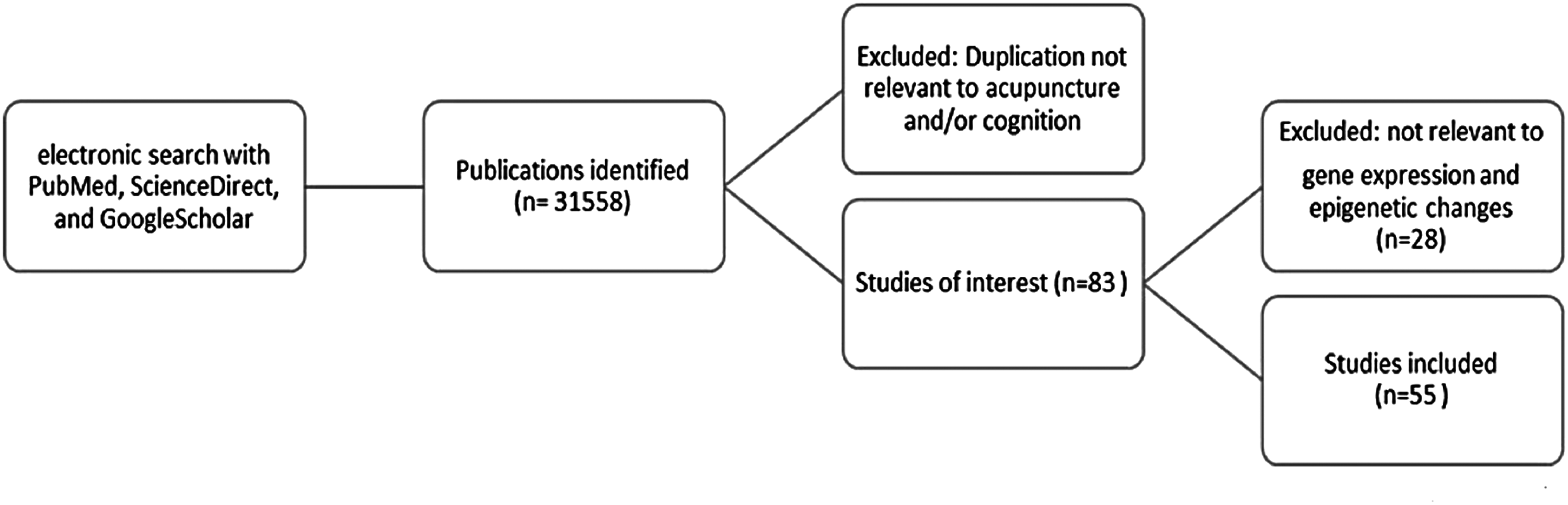
Literature search. The search covered 1966 to June 2015. A total of 31,558 articles were reviewed, and 83 articles were selected among which irrelevant, duplicate, or publications with duplicate data were excluded; 55 articles remained at the end for review.
In this review, the underlying mechanism of an acupuncture-induced antioxidative effect and genetic and epigenetic changes are discussed, based on studies conducted and published in relatively recent years.
Results
In 83 published works, the current authors investigated gene expression and epigenetic changes reported in articles in which researchers used an acupuncture method to treat OS-related conditions. A total of 55 articles were included in this review. The results are summarized in Table 1.
The principal acupoints according to Standard International Nomenclature for the intervention group were 63 Hegu (LI 4), 64 Quchi (LI 11), 64 Tianshu (ST 25), 65 Gulai (ST 29), 66 Zusanli (ST 36),39,40,48,49,55,57,64,67–80 Fenglong (ST 40),81,82 Sanyinjiao (SP 6),51,67,70,73,78,82 Xuehai (SP 10),39,48,74,79 Shenmen (HT 7),54,83,84 Feishu (BL 13),55,68,85 Fengmen (BL 12), 85 Taixi (KI 3), 40 Neiguan (PC 6),86–91 Zhongchong (PC 9), 92 Fengchi (GB 20),57,76 Yanglingquan (GB 34),39,44,48,93–96 Xuanzhong (GB 39), 44 Taichong (LR 3),39,48,51,59 93,94,96–98 Zhangmen (LR 13), 99 Yaoshu (GV 2), 99 Dazhui (GV 14),85,99–102 Fengfu (GV 16),92,103 Baihui (GV 20),39,42,51,52,80,82,100–102,104 Shuigou (GV 26),82,92,95,103 Qihai (CV 6),65,74,79 Zhongwan (CV 12),49,74,79 and Danzhong (CV 17).74,79
Discussion
Previous studies proved that acupuncture decreased OS39–44 by modulating oxidative stress biomarkers, such as 8-OHdG, antioxidative enzymes (including SOD) and pro-oxidants (such as ROS and RNS).45–48 Acupuncture prevented lipid peroxidation and activated the antioxidant system. 56 Articles on experimental studies reported that acupuncture could attenuate lipid peroxidation and MDA content effectively 49–55 by reducing H2O2 content and increasing antioxidant enzyme activities, such as those involved with SOD, CAT and glutathione peroxidases (GSH-Px).46,53–55,57–61 Acupuncture also potentiated the disulfide-reducing activities of the thioredoxin (Trx) system by increasing Trx expression. The Trx system (consisting of Trx reductase [TR], Trx, and nicotinamide adenine dinucleotide phosphate [NADPH]) prevented proteins from oxidative modification.76,105
Acupuncture not only increases activity of the enzymatic antioxidant and superoxide anion46,50–54,57–61 but could also strengthen expression of CuZnSOD [copper–zinc SOD] and MnSOD [manganese-dependent SOD],49–51 regulate the ratio of glutathione and glutathione disulfide in mitochondria, 50 and raise the level of the respiratory control index and phosphorus:oxygen ratio. 50
Acupuncture also decreases acetylcholinesterase (AChE) activity by increasing activities of enzymatic antioxidants, which therefore could reduce alcoholism-induced memory deficit effectively. 54 Acupuncture might produce neuroprotective effects in mice striatum by reducing 1-methyl-4-phenyl-1, 2, 3, 6-tetrahydropyridine (MPTP)–induced toxicity, such as OS, 44 and regulate protein expressions of cystic fibrosis transmembrane conductance regulator and the CIC-2 chloride channel. 87
Some researchers indicated that laser acupuncture (LA) could enhance enzymatic antioxidant activities and decrease AChE function but has failed to diminish MDA level in this area. 84 Other researchers showed that LA could decrease OS by reducing AChE, monoamine oxidase B, and MDA by inducing GSH-Px. 83
Santos et al. confirmed that both classical acupuncture and electroacupuncture (EA) could decrease systemic (plasma) and local (ovary) OS myeloperoxidase activity, and increase lipid peroxidation (MDA concentrations) at systemic and local levels. 67
Acupuncture not only has preventive and repairing effects through antioxidation (OX) and anti-OS action 106 but also decreases inflammatory responses.53,66 Investigators have suggested that acupuncture could strengthen protection of cells and inhibit apoptosis and anti-OS through regulating expression of genes. 107
Experimental findings also showed that EA upregulated expression of heat shock proteins (HSPs) such as HSP84, HSP86, HSP90, and HSP7046,59,74,107–110 and potentiated transcription of HSP70 mRNA,92,109,111,112 expression of the Bcl-2 gene (suppressing apoptosis),53,65,69,71,73,79,91,100,113–115 insulin-like growth factor-I (IGF-I) mRNA and protein levels, 40 nerve-growth factor (NGF) mRNA, 95 caspase-3,53,101 caspase-8, 101 Sax, 115 and redox effector factor (Ref-1) that consequently produced antioxidant effects. 62
Furthermore, EA suppresses and/or upregulates expression of the c-fos protein (nuclear phosphoprotein)71,77,78,90 and its mRNA. 78 EA downregulates expression of Bax (a gene for antagonizing Bcl-2),53,65,71,73,79,91,100,114,115 leading to a decrease in the Bax/Bcl-2 ratio,53,65,71,114 the P53 gene (accelerating apoptosis),80,82,111,112,116,117 interleukin (IL)–1 mRNA expression, IL-β levels, 53 IL-2, 64 and IL-6. 55 EA also suppressed tumor necrosis factor-α (TNF-α),53,55,64,72,95,101,103,111,112,118,119 DNA damage, 53 inhibited formation of free radicals, and reduced overload of intracellular Ca2+.64,103,111,112,118
Other investigators believed that acupuncture could downregulate expression of the glial fibrillary acidic protein, 101 S100B, 101 nuclear factor-kappaB (NF-kappaB: p50), 101 phospho-p38 mitogen-activated protein (MAP) kinase (p-p38 MAP kinase), 101 TNF receptor type 1-associated death domain, 101 Fas-associated death domain, 101 fas, 65 and FasL (also named Apo-1 or CD95). 67 Acupuncture has also led to a decreased fas/FasL ratio (an important pathway of cell apoptosis), 65 and levels of nitric oxide synthase and apoptosis43,75,81,96,101,104; inhibited NADPH oxidase activation 52 ; and increased NF-E2 related factor 2 (Nrf2) expression 55 and Nrf2/ARE pathway activity 55 ; and resulted in upregulated HO-1 expression.55,68,120
Acupuncture regulates expression of Gs mRNA. 89 Both mRNA and protein expression of P-selectin were downregulated by acupuncture treatment. 121 P-selectin plays an essential role in initial recruitment of leukocytes to a site of injury during inflammation. When endothelial cells were activated by molecules, such as histamine or thrombin, during inflammation, P-selectin moved from an internal cell location to the endothelial cell surface.
Acupuncture decreases expression of other related OS genes such as glutathione S-transferase [GST], 110 fibroblast growth factor [FGF], 110 and the NF-kappa-B p65subunit4 gene. 110 Acupuncture could be a potential intervention to retard molecular events that occur with aging in mammal genes that are closely related to oxidative damage,107,122,123 through regulating expression of Hsp84, Hsp86 and YB-1, hence having an antiaging effect74, 107,122 and resisting free-radicals and inflammation, and lessening apoptosis effects of related genes.122–126
In addition, acupuncture might protect the myocardium by influencing the functional module of PPM1B [protein phosphatase, Mg2+/Mn2+ Dependent, 1B], SUCLG1 [succinate-CoA ligase, α subunit], GOT2 [glutamatic-oxaloacetic transaminase 2], MDH1 [malate dehydrogenase 1, NAD (soluble)], PDP1 [pyruvate dehydrogenase phosphatase catalytic subunit 1], FH [fumarate hydratase], CPB2 [carboxypeptidase B2], YWHAZ [tyrosine 3-mono-oxygenase/tryptophan 5-mono-oxygenase activation protein, zeta], S100A9 [S100 calcium-binding protein A9], ATP1B1 [ATPase, Na+/K+ transporting, beta 1 polypeptide], TnI [troponin I], MYL3 [myosin light chain 3], CASQ2 [calsequestrin 2], and Mb [myoglobin]. This mainly involves oxidative phosphorylation, electron transfer of mitochondria, electron transfer coupling of ATP synthesis, energy metabolism, phosphate metabolism, univalent inorganic cation transfer, coenzyme metabolism, and so on.85,88,127
It had been shown that acupuncture downregulated expression of CTLA2α [cytotoxic T-lymphocyte–associated protein 2α], EG383229, PBPB [penicillin-binding protein B], and UBE2L6 [ubiquitin-conjugating enzyme E2L6]; and also upregulated EG665033, ENSMUSG00000055323, Obox6 [oocyte-specific homeobox6], PBP2 (penicillin-binding protein 2), and TMEM150 [transmembrane protein 150A] in a mouse model of Parkinson's disease. 94
In relatively recent years, some researchers have suggested that acupuncture could exert its therapeutic effect through epigenetic regulation, perhaps as methylation of DNA, modification of histone, and micro-RNA expression.98,128 These researchers implied that acupuncture might act through epigenetic changes and subsequent action on their targets,98,128 such as the miRNA[microRNA]–339/SIRT2 [NAD-dependent protein deacetylase sirtuin-2]/NF-kappaB/FOXO1[Forkhead box protein O1] axis 98 and upregulated expression levels of γ-GCS [γ-glutamylcysteine synthetase], protein γ-GCSh mRNA, and γ-GCSI mRNA, which might contribute to acupuncture's effect in protecting cerebral cortical cells from injury by clearing away excessive oxygen-free radicals. 102
Researchers who investigated genomewide gene expression effects of EA pretreatment at an acupoint on myocardial ischemia reperfusion (I/R) injury rats detected that RNA-seq results showed that 275 genes were upregulated and 317 genes were downregulated under I/R conditions, compared to what occurred in an EA group. 86 KEGG [Kyoto Encyclopedia of Genes and Genomes † ] pathway analysis indicated that these genes were involved in multiple pathways, including ECM, MAPK signaling, apoptosis, cytokine and leukocyte pathways, OS, cardiac-muscle contraction, gap junction, vascular smooth-muscle contraction, hypertrophic, nucleotide-binding oligomerization domain receptors (NOD)–like receptor, and P53 and B-cell receptor pathways. 86
The researchers also found that EA repressed NPPB [natriuretic peptide B] expression and increased CACNA1C [calcium channel, voltage-dependent, L type, α1C subunit] expression, suggesting protection against OS. 86 Microarray analysis showed that 23 miRNAs had significant differences in acupuncture-treated, compared to untreated, rats. 97 These 23 miRNAs, such as miRNA-339, miR-223, and miR-145, could have regulated 2963 target genes that were enriched in at least 14 pathways. 97 A proteomic assay showed that, in an acupuncture-treated group, compared to a nontreated group, seven proteins were downregulated: HSP90; synapsin-1; pyruvate kinase isozyme; NAD-dependent deacetylase sirtuin-2; protein kinase C inhibitor protein 1; ubiquitin hydrolase isozyme L1; and myelin basic protein. Six proteins were upregulated: glutamate dehydrogenase 1; aldehyde dehydrogenase 2; glutathione S-transferase M5; Rho GDP dissociation inhibitor 1; DJ-1 protein; and SOD. 59 The altered expression of proteins by acupuncture has been confirmed by enzyme-linked immunosorbent, Western blot, and qRT-PCR assays. 59
Moreover, the current authors suggest that future studies on the underlying mechanisms of acupuncture therapy for preventing and treating OS via epigenetics may be a new approach and a new direction in the field.98,128 The abovementioned effects of acupuncture may contribute to its beneficial action when treating side-effects of OS in a clinic setting.
Conclusions
The accumulated evidence reviewed above demonstrates the therapeutic effects of acupuncture for reducing oxidative effects by modulating OS-induced biomarkers (such as 8-OHdG 45 and MDA), antioxidative enzymes (including SOD and catalase), 46 and pro-oxidants (such as ROS, and RNS) through the redox system, antioxidant system, anti-inflammatory system, and signaling pathways. Moreover, acupuncture might act through modulation of expression levels 93 and epigenetic status of genes to generate biologic effects. However, more recent acupuncture research on the expression of OS genes and specifically their epigenetic modifications is ongoing. We still have inadequate knowledge about how acupuncture works. It should be investigated further by other studies.
Footnotes
Acknowledgments
Sara Darbandi, PhD(cand), and Mahsa Darbandi, PhD(cand) wrote and revised the manuscript for this article. Mohammad Reza Sadeghi, PhD, Pooneh Mokarram, PhD, Mahnaz Heidari, PhD(cand) Hamid Reza Khoram Khorshid, MD, PhD, and Ali Akbar Owji, PhD, also revised the manuscript for this article.
Author Disclosure Statement
No competing financial interests exist for the authors.