




Abstract

A
Although the concept of the meridian system has been recognized and accepted in Oriental medicine, this concept has not been verified and eludes scientific investigations by Eastern and Western research. Western medicine believes acupuncture is part of the neuronal system. The acupuncture needle serves to stimulate peripheral nerves, sending signals to the central nervous system by poorly understood mechanisms to initiate the healing process. 1
Past issues of Medical Acupuncture have published new and exciting information about the Primo Vascular System (PVS).2,3 The PVS is stated to exist in vertebrate and invertebrate animals and plants. Some scientists suggest that the PVS may parallel or constitute an anatomical framework for the alleged acupuncture meridian system. The PVS is thought to be composed of small tubes called “primo nodes” that have a high concentration of DNA, gathered and connected by a primo-vessel system. 4 A primo fluid containing a high amount of basophilic granules flows in the primo vessels. 5 There are many other proposed biologic, electrical, and electromagnetic properties of this unique system. 4
Small egg-shaped cells, called “sanals,” containing DNA have been found inside the primo vessels. DNA is said to emit bio-photons that are nonthermal energy emissions in the ultraviolet and visible electromagnetic light spectra. Sanals and primary nodes may emit bio-photons by virtue of their DNA, but this has not been proven. Research implies the possibility that, if this light emission exits from these structures, it may be a form of communication and information exchange between these components and other cells. 5
An emerging concept involving the future of acupuncture, may involve PVS, bio-photons, and subtle electric fields in living organisms. An article published by John Hubacher, MA, entitled “The Phantom Leaf Effect: A Replication, Part 1” demonstrates the existence of an electrical field in a leaf. 6 As mentioned above, the PVS system is also found in plants. The same subtle electric fields also exist for vertebrates and invertebrates. What is unique about this article is a demonstration that a subtle electric field exists coinciding with the amputated portion of a leaf.
The article describes what occurs when a high voltage is applied to a metal plate behind a photographic film upon which a leaf has been placed. The electricity is applied for a fraction of a second. The result is a corona discharge, in other words, a circle of light surrounding the leaf that is produced as electrons jump back and forth between it and the photographic plate. As the electrons move from the film to the photographic plate, they group into streams, and, when the electricity flows in the opposite direction, the electrons produce pools or balls of light. 7 This is also known as Kirlian photography. 7
In his article 6 Hubacher shows a normal leaf prior to amputation (Fig. 1). When the leaf is cut at its distal end in a transversal manner and the severed portion discarded, there is still an electrical emission/field from the amputated leaf (Fig. 2). In other words, the leaf's electrical field is now extended into space. This field disappears over time as the leaf dies. 6 Many post amputation patients may still perceive that their amputated limbs are intact and painful. When a sharp instrument, such as a knife is passed through a patient's amputated area, acute pain is experienced despite the patient being experimentally blinded to the instrument and isolated from air movement. Is the sharp instrument disturbing a subtle electrical field that is emitted from the amputated area—as is observed in the leaf—and producing pain?
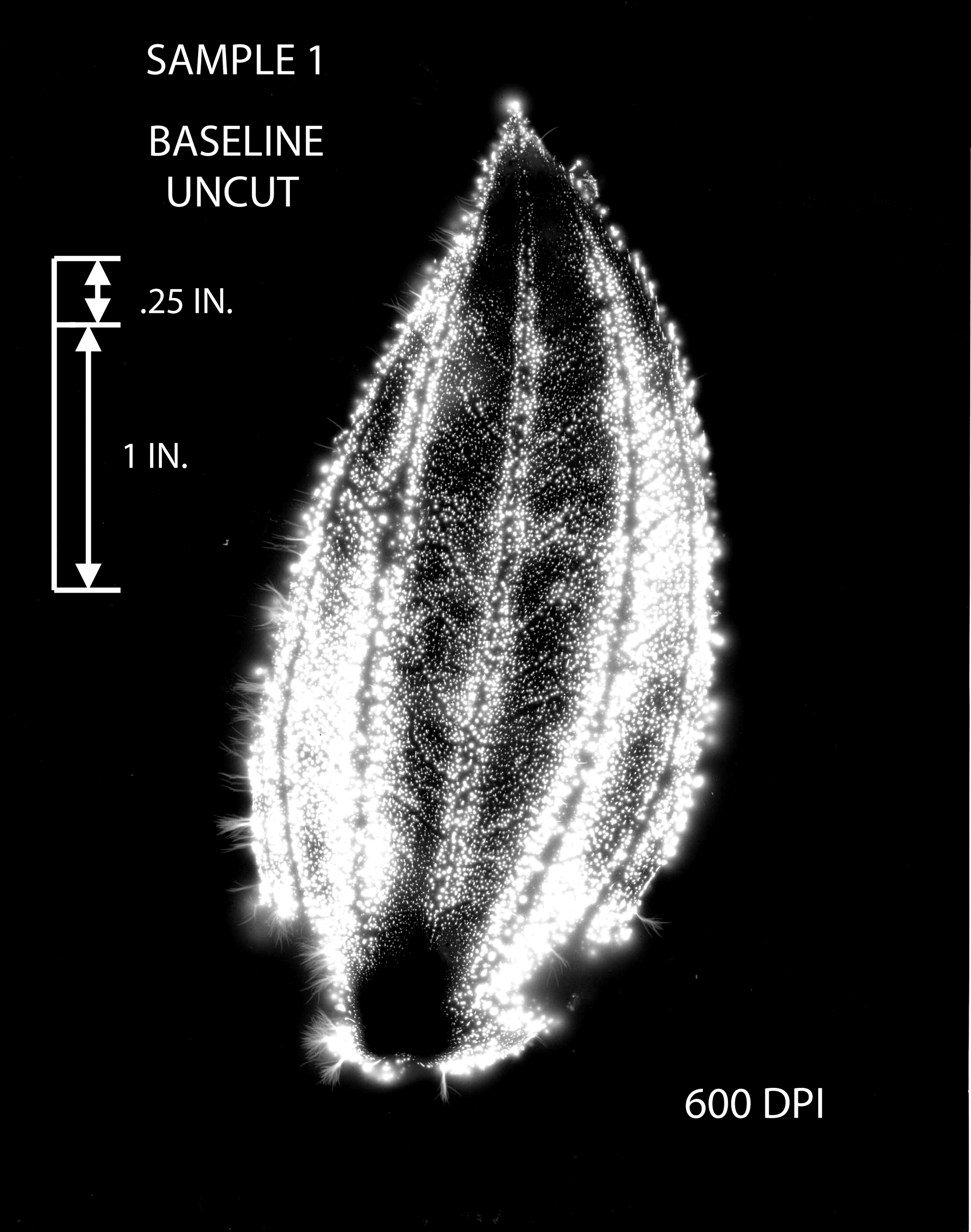
Baseline of leaf prior to amputation. Courtesy of, and with permission from, John Hubacher, MA. 6

Phantom leaf evident post amputation. Courtesy of, and with permission from, John Hubacher, MA. 6
All of these observations are challenging future research questions: Does the PVS have a relationship with acupuncture points and meridians? Are there certain bioelectrical properties that emulate what the ancients called “Qi” with the characteristics of Yin and Yang or “vital energy”? Might acupuncture help resolve the pain of patients, post amputation, by influencing the PVS? When we needle an acupuncture point, is there an associated PVS mechanism that might relate to healing? Do bio-photons permit the exchange of information between cells? These are intriguing questions that might be answered in the future and unleash more power from acupuncture.
Footnotes
Acknowledgments
I wish to thank Kwang-Sup Soh, PhD, and John Hubacher, MA, for their kind assistance in helping me prepare this editorial.