




Abstract

Introduction
I
Figure 1
The exchange began at Beijing University, in 2009, when Dr. Niemtzow demonstrated Battlefield Acupuncture (BFA) 1 to a group of faculty members and students. He later learned that physicians from the PLA were in the audience. Dr. Niemtzow was also invited to serve as a guest chairperson at an Asian academic discussion on acupuncture. Coupled with his prescient recommendation that BFA be part of a future Sino–American military exchange, teaching this technique at military hospitals in Beijing is what ultimately helped open the door to the establishment of a series of officially sanctioned, Sino–American Military Acupuncture Exchanges. Details of the four official exchanges are provided later in this Photoessay.
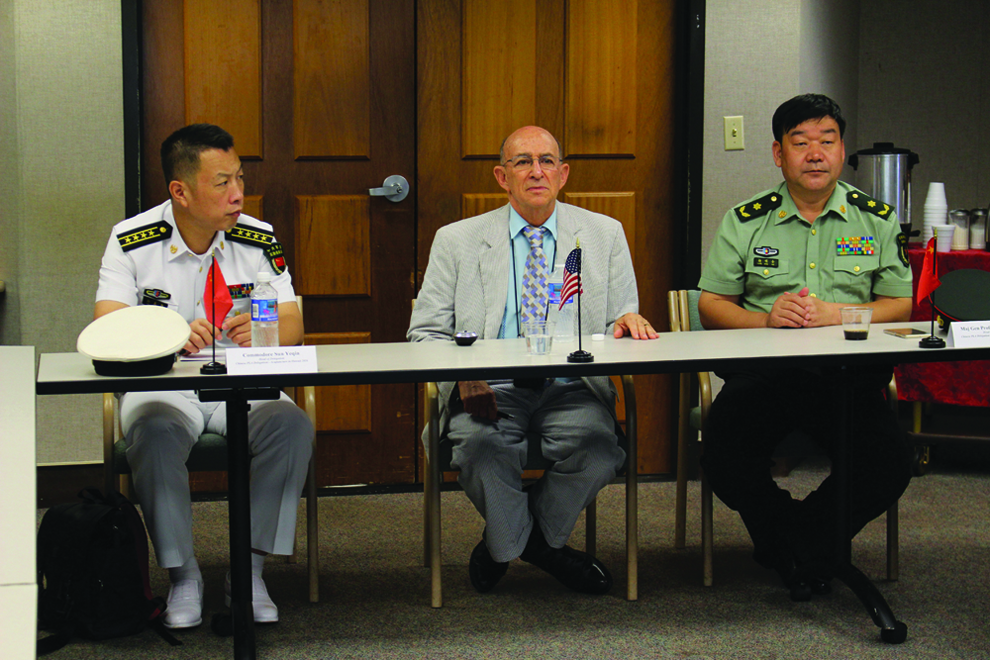
Richard C. Niemtzow, MD, PhD, MPH (center), organizer of the Sino–American military acupuncture exchanges. Commodore Yeqin Sun (left) and Major General Minghui Yang (right).
The Sino–American relationship is one of the most important bilateral relationships in the world. 2 The strong relationship that developed between U.S. and Chinese acupuncture physicians has proven to be one of the most important military to military relationships to date between the U.S. and Chinese militaries. For many reasons, it has long been recognized that promoting military medical exchanges between countries can help foster and maintain international tranquility, while promoting a nonconfrontational spirit. 2 The past three Sino–American Military Acupuncture Exchanges did not have as an incentive the promulgation of “winning hearts and minds” between the two militaries nor to “enhance global stability and security” but came about because of the simple desire of the Chinese military to learn BFA. 2 It was the true endeavor of military physicians on opposite geographic locations of the globe to come together, perhaps somewhat as a responsibility of warriors, 2 but more as a desire to exchange information that would benefit the common denominator—the patient. And, we did come together on four occasions:3–5
(1) October 20–27, 2012. 3
The Beijing University of Chinese Medicine assisted with the hosting of an exchange at the Affiliated Hospital of the Air Force Aviation Medicine Research Institute in Beijing, China. Highlights of the interaction with the PLA included the teaching and demonstration of BFA. “The enthusiasm and camaraderie that emerged was clearly genuine.” The PLA, in turn, shared presentations on the application of acupuncture and moxibustion in the Chinese military. The PLA discussed how medical kits containing a supply of basic acupuncture needles and moxibustion sticks are routinely provided to military troops. When treating post-traumatic stress disorder (PTSD), the PLA noted that acupuncture is regarded as second-line therapy, with the teaching of “acceptance” as the foundational intervention. When used, acupuncture can assist in addressing “negative attitudes” as well as remediating physical injuries. 3
(2) December 8–9, 2014. 4
The second exchange took place in Bethesda, MD, at the Uniformed Services University of the Heath Sciences. The PLA physicians presented lectures focusing on the use of Eye Acupuncture to treat acute pain, Tongue Acupuncture as a means of addressing mental disease, and Scalp Acupuncture for relieving sleep-related disturbances. The PLA physicians stated that extensive self-care/buddy care is given to Chinese military troops to prevent and treat motion sickness and fatigue. We also discussed our common interests in preventing and managing altitude sickness, jet lag, and aircrew fatigue. As was mentioned in the October 2012 exchange, more details were provided about the specific content of the acupuncture kits that PLA troops receive—including cow herb (Vaccaria hispanica) seeds for Auricular Acupuncture, press needles, silicone gel cups, and scrapping plates as well as a Traditional Chinese Medicine cupping kit and a user-friendly acupuncture manual.
(3) September 21–24, 2015. 5
Our third exchange took place at the 301 PLA General Hospital, in Beijing, where we were greeted by the director, Major General Guo Quan Ren. The 301 PLA, which is the largest military hospital in China, employs more than 10,000 individuals, and provides more than 15,000 patient visits and 300 surgical procedures daily. Medical care is open to all—including military members, and their families, as well as nonmilitary general public patients. We observed a variety of novel acupuncture treatments: Knife Acupuncture, which is useful for chronic neck or back pain but has also been used to alleviate conditions as diverse as chronic cough and vertigo; and Balance Acupuncture, which is useful for addressing conditions such as acute headache, low-back pain, and vertigo. We also observed how this technique is useful for treating frozen shoulder and its ability to treat pain in a matter of ∼3 minutes. Another interesting technique, Wrist Acupuncture, was new to many of us for the treatment of chronic cough and breathing problems. Yet more, we observed Floating Needle and Moving Needle techniques. We also observed the application of Tongue Acupuncture for the treatment of anxiety and depression, and were shown a moxa fumigator—a device used to direct moxa vapors toward a particular part of a patient's body. 5
(4) September 13–15, 2016.
The 4th Sino-American Military Acupuncture Exchange took place in Hawaii.
Figure 2
During this latest exchange, our PLA colleagues had the opportunity to visit Tripler Army Medical Center, Honolulu, Hawaii, which provided an opportunity to see how integrative medicine is delivered to members of our American military. This was unique for the Chinese as integrative medicine in the United States is truly more integrative than what was observed at the 301 PLA Hospital. Both are effective, but ours may have the advantage of providing a greater opportunity for patients to experience the benefit of a “one-stop” clinical experience.

People's Liberation Army physician acupuncturists seated on one side of the conference table.
Figure 3
During this most recent exchange, our Chinese colleagues lectured on some of the different forms of cupping. For example, Bamboo Cupping involves soaking the bamboo cups in various herbal preparations prior to application. Jinlin Qiao, MD (China), of the Chinese Navy General Hospital presented information from his book, “Holographic Embryo Acupuncture,” 7 and lectured about the use of 11 points on the hand, several of which could be used to treat pain and emotional instability—features commonly associated with PTSD.

American and Chinese military acupuncture physicians visit Tripler Medical Center's integrative medicine services
Figure 4
The American delegation delivered a series of presentations focusing on acupuncture-related treatments for concussion headaches and PTSD. The former involved treatment of concussion headaches that were the subject of an article that was published in Medical Acupuncture. 6 PTSD involved a tapping technique based on energy blockage of the meridians. Tapping on selective acupuncture points released the blocked energy flow in the meridians. (Introduction to Emotional Freedom Techniques [EFT] for Veterans and Active Duty Soldiers. Robert Schwarz, PsyD, Tapping Conference, Alexandria, VA, May 25, 2016, private communication)
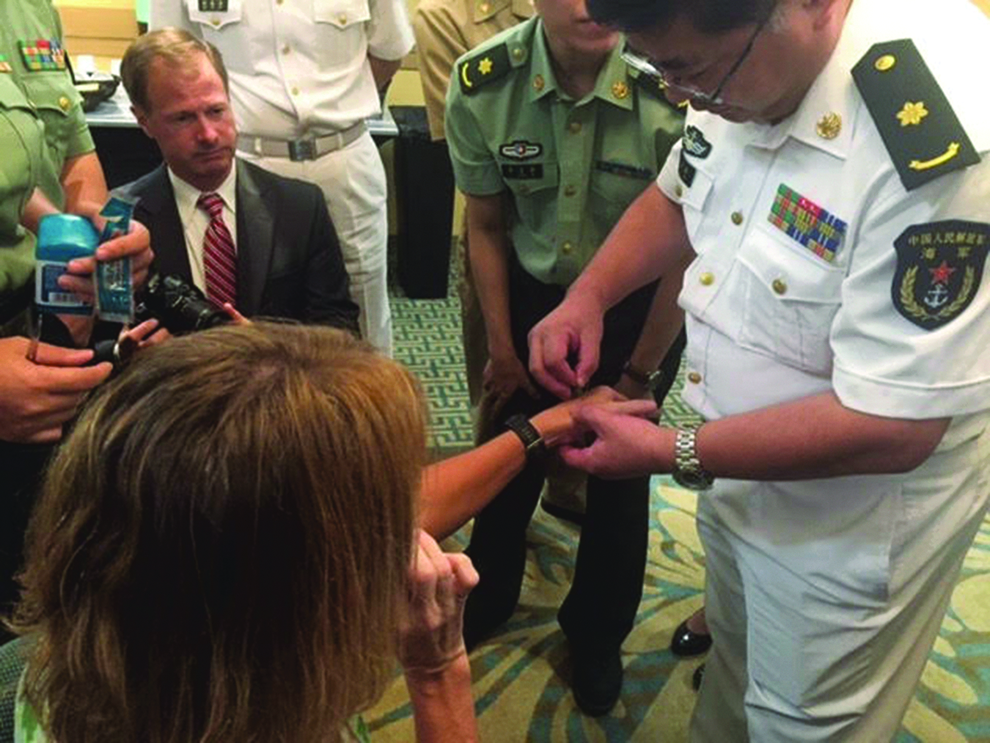
Jinlin Qiao, MD (China), demonstrates needles placed on the hand to treat “emotional instability,” which is commonly associated with post-traumatic stress disorder.
Strategic and Tactical Objectives Associated with Continued Sino–American Military Acupuncture Exchanges
The most important aspects of the 4th exchange were comments on the strategic and tactical objectives associated with continued U.S.–Chinese Military Acupuncture Exchanges. Realization of the potential of medicine to promote such understanding can demonstrate its ability to benefit not just the individuals, but their societies as well. 2
PLA Perspective: Value of the Bilateral Acupuncture Exchanges
In a discussion with the Chinese PLA, the PLA considered that key points learned from the exchanges over the years were the following:
• Approach to teaching BFA to medical students • American-style rapid acupuncture techniques • Rapid treatment of headaches/migraines • Xerostomia treatment techniques for patients with cancer • Phantom-limb pain treatments • Piezoelectric techniques • Neurostimulation for pain control using Calmare® • Possible PTSD exchange/contributions to a special issue of the Medical Acupuncture journal • BFA for natural disaster victims.
U.S. Military Perspective: Value of the Bilateral Acupuncture Exchanges
The U.S. Military Acupuncture participants gained knowledge:
• Insight regarding use of acupuncture in the Chinese military • Acupuncture kits given to soldiers for prevention • Management of anxiety on the battlefield • Disaster and humanitarian discussions • Sharing of specialized acupuncture techniques • Rapid pain relief • Tongue acupuncture • Recognition that the PLA has trained thousands of medical specialists who are proficient in using both traditional and modern therapy • Initiation of collegial/academic connections lectures at the Beijing University School of Chinese Medicine and Chinese Academy of Chinese Medical Sciences.
Conclusions
Chinese President, Xi Jinping, met with U.S. President Barack Obama on Saturday ahead of the Group of 20 (G20) summit in China's eastern city of Hangzhou, on September 3, 2016. The consensus and outcomes reached by the two sides are as follows in particular about the Military Acupuncture Exchanges: “Section 13. Military to Military Relations: The military medicine departments of the two sides will cohost the 1st China–U.S. military medical experts exchange on acupuncture therapy in China in 2017, and cohost the Asia Pacific Military Health Exchange in China in 2018.” 8
It was the hope of all of us involved that the exchanges would not only consist of sharing acupuncture knowledge, but would serve in a small way as a further building block for friendship between the two countries. The last photograph (Fig. 5) portrays the tradition of the “salute” showing friendly intentions.
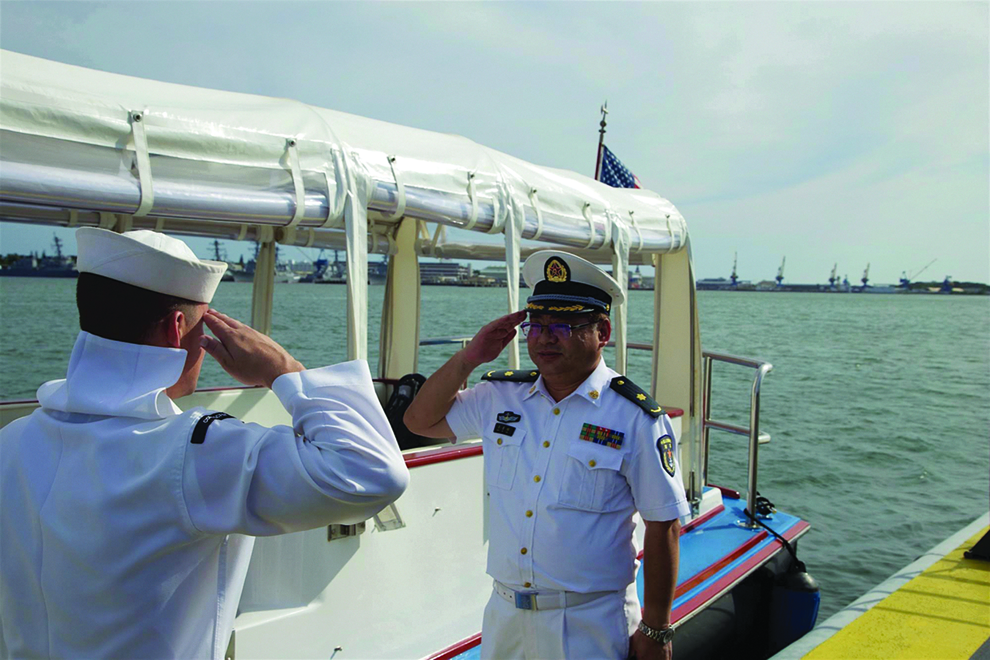
Jinlin Qiao, MD (China), of the Chinese Navy saluting a United States sailor as they embark to take a tour of Pearl Harbor.