




Abstract

Glossitis is an inflammation of the tongue. The inflammation can cause swelling, change of color (usually red or purple) and develop variable appearances on the surface of the tongue.
The causes include allergies (to food, medications, and oral care products), infection (Herpes simplex, bacteria, or yeast), injuries (from dentures or burns), irritants (tobacco, alcohol, and spices), immunologic disorders (such as Sjogren's syndrome, lichen planus), vitamin B deficiency (B2, B3, B6, and folate), and other miscellaneous disorders (glucagonoma, Whipple's disease, carcinoid syndrome, acquired immunodeficiency syndrome, sprue, and celiac disease).
There are various kinds of glossitis, including:
Atrophic glossitis (a smooth glossy tongue surface, caused by loss of papillae) Median rhomboid glossitis (a depapillated region in the central area of tongue) caused by oral candidiasis Geographic tongue due to patchy depapillation. This can appear to move, giving a changing map picture Geometric glossitis in which there is a deep fissure in the middle of the tongue, with branches; this condition is usually seen in immunocompromised people (e.g., patients with leukemia Strawberry tongue caused by hyperplastic fungiform papillae, associated with bacterial infections.
A review showed prevalence ranges of 0.1%–14.3% for geographic tongue, 1.3%–9.0% for atrophic glossitis, and 0.0%–3.35% for median rhomboid glossitis. 1
Modern biomedical treatment involves oral hygiene; avoidance of spicy food, alcohol, tobacco and other irritants; treating the underlying causes; diet changes; and addressing nutritional and vitamin deficiencies.
Steroid ointments—such as Kenalog® in Orabase®—are effective for producing short-term benefits.
Glossitis in Chinese Medicine
In Chinese Medicine, the tongue is a window of the internal environment, and the pathology of the internal organs are usually reflected on the tongue. In a patient with glossitis, the tongue is usually red and can be swollen. The representations of internal organs on the surface of the tongue are shown in Figure 1; the usual areas of color change according to the pathology of internal organs are shown in Figure 2.
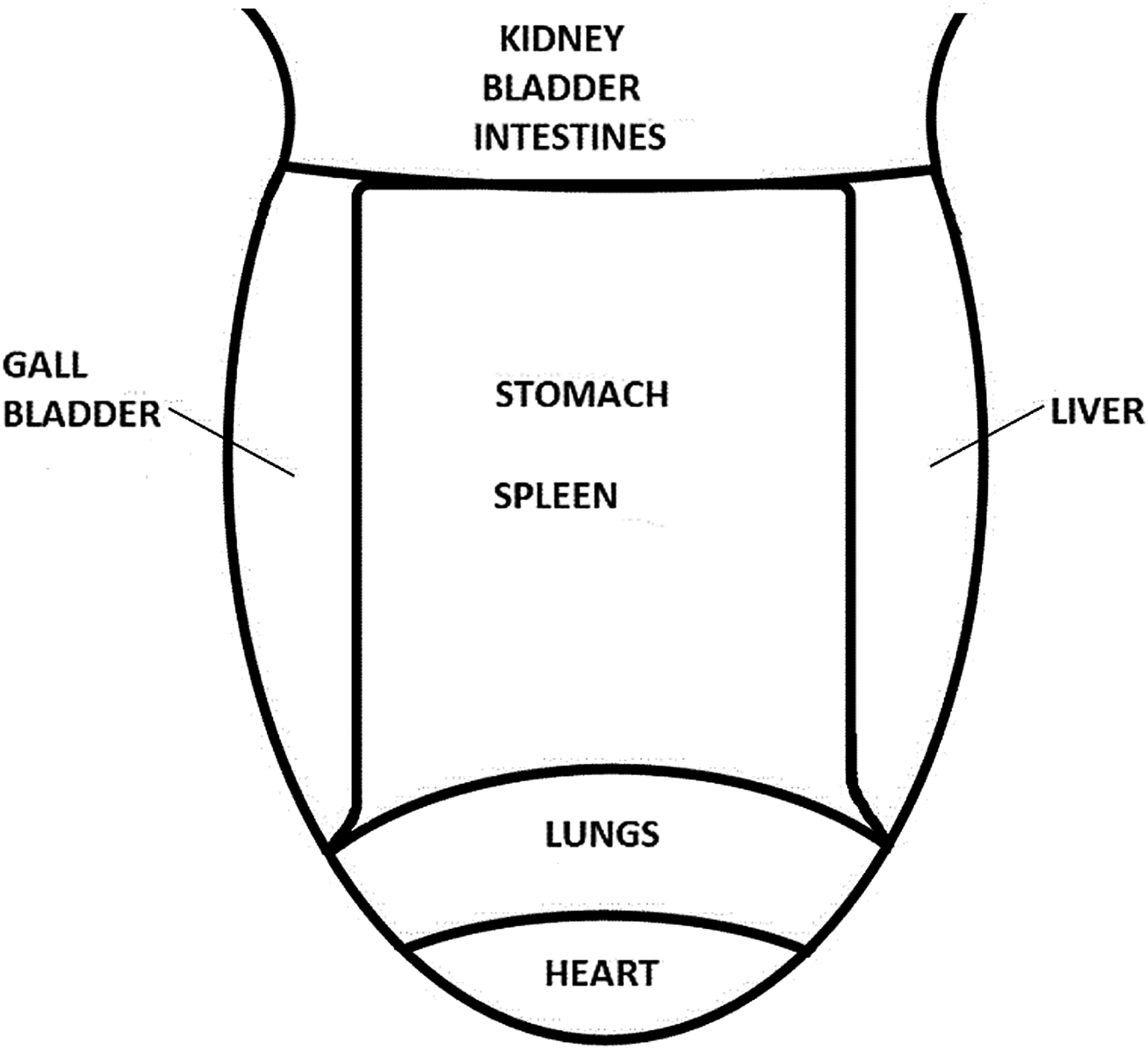
Internal organ representation on the tongue.

Specific areas of the tongue that indicate organ Heat.
A red tongue almost always indicates Heat/Fire (Fire is extreme Heat); if the whole tongue is red and the tip is more red, this is generalized Heat and severe Heart Heat. Red sides along the edges of the tongue indicate Liver Heat. Redness confined to the central section of the edge of the tongue indicates Spleen Heat. Redness just proximal to the tip of the tongue is Lung Heat. Redness in the middle section of the tongue indicates Stomach Heat. Red points on the tongue indicate severe Heat. A Purple tongue almost always indicates Blood Stasis. It takes a long time for the Stasis to give the tongue a purple color, and, hence, this is more common in the elderly. The commonest area where purple discoloration occurs is in the Liver area, which indicates Blood Stasis in any organ affected by the Liver Meridian. Hence, Stasis in the Ovary/Uterus, is usually reflected in the Liver area. Blood Stasis in the Breast, Lung, and Heart is usually seen in the chest area behind the tip of the tongue.
Swelling of the tongue is caused by Stagnation of fluid transport, which is Dampness. As internal fluid transport is a function of the Spleen, swelling of the tongue is caused by Spleen Deficiency. As the fluid Stagnation becomes chronic, the fluid condenses to form Phlegm. In both of these conditions the tongue is swollen. The differentiation is determined according to the appearance of the tongue coating. In Dampness, the coating is smooth and slippery; in Phlegm, the coating is rough and sticky.
Treatment
A popular textbook of clinical acupuncture recommended that the following points be used to treat patients who have glossitis: GV 20; GV 28; Jinjin; Yuye Extra Points; LI 4; LI 11; GV 14; and SP 10. 2 The current author has used these points and found them effective for treating acute glossitis. In chronic glossitis due to the pathology of the internal organs, these points provide temporary relief but the problem returns. This is similar to the temporary relief obtained from steroid ointments. To achieve lasting benefit, the underlying pathology has to be targeted and the details for this are given in Table 1.
Signs, Symptoms, & Treatment of Disorders Manifesting with Glossitis
The fundamental basis of acupuncture treatment for pain and swelling of the tongue was discussed by Sun. 3
There are not many studies showing the effectiveness of acupuncture for treating glossitis. Noh et al. reported positive effects of acupuncture in 5 cases of glossitis. 4
Illustrative Case
A 77-year-old man presented with glossitis of 3 months' duration. He complained of burning in his epigastrium, excessive hunger, mouth ulcers, and a feeling of heat. There was generalized redness over his tongue, with patches of papillary loss (a geographic tongue) and scattered areas of purple discoloration. The redness and burning sensation were more in the Stomach area of his tongue. The tongue coating was slightly yellow. A diagnosis of Stomach Fire leading to early Blood Stagnation in the Stomach was made.
This patient was treated with acupuncture, only using GV 20, GV 28, Jinjin, Yuye, LI 1, LI 11, GV 14 and SP 10 for symptomatic relief (4 treatments), followed by SP 4 left and PC 6 right to open the Penetrating Vessel to address Blood Stagnation; LI 11 to reduce general Heat; ST 44, ST 21, ST 34, and LI 4 to reduce Stomach Heat, all using the reduction method; and CV 12 and CV 13 were stimulated using the even method to subdue the Rebellious Stomach Qi. These points addressed the pathology of this patient's condition.
Treatment was given on alternate days for 4 weeks, followed by twice per week treatment for 3 weeks. This resulted in significant improvement (80%–85%) reduction of symptoms.
Further improvement was not forthcoming. On further questioning, he reported consuming sizable amounts of cashew nuts every day. This was stopped, and his recovery was near complete.
This case illustrates the fact that the points for symptomatic relief that can be used in all cases often provide only temporary results and the pathology persists. The points addressing the pathology often provide long-term relief, but the ultimate cure is obtained only after the causative factor is removed.
Some cases can be extremely resistant to treatment, especially those associated with lichen planus.
Footnotes
Address correspondence to:
Poovadan Sudhakaran, MBBS, PhD
MastACU, MastTCM
26 Tuckers Road
Templestowe, 3106
Australia
Email: