




Abstract

HOW DO YOU TREAT GROIN PAIN IN ADULT PATIENTS WITH ACUPUNCTURE AND/OR CHINESE HERBS, IN YOUR PRACTICE
Supposedly, such acupuncture microsystems as Dr. P. Nogier’s Auriculotherapy and/or Dr. Yamamoto’ New Scalp Acupuncture (YNSA) are great methods to suggest for treating the above disorder.1,2 In Auriculotherapy, the potential points may include auricular inguinal, external genitalia, analgesic, thalamus, Darwin, etc. 1 In YNSA, the potential points may include D I, basic points, and basal ganglia, the appropriate meridians, the projections of the cranial nerves, etc. 2 However, the above can be used only after their activity is confirmed using a detector or vascular autonomic signal (VAS).
The ICBA subordinates to the meridian theory.3,4 The Leg Shao Yin (KI) and Jue Yin (LV) meridians are located in the groin and therefore, considered the “sick” meridians. Consequently, to dissipate the groin pain, the above are to be affected.3,4 The Hand Jue Yin (PC) meridian interrelates with both “sick” or unbalanced meridians. Puncturing the Hand Jue Yin (PC 3) in the elbow fold seems to be the simplest and the most effective option for the following reasons. By the ICBA principles, PC 3 represents a qualitatively good projection of the groin onto the upper limb (Fig. 1). 4
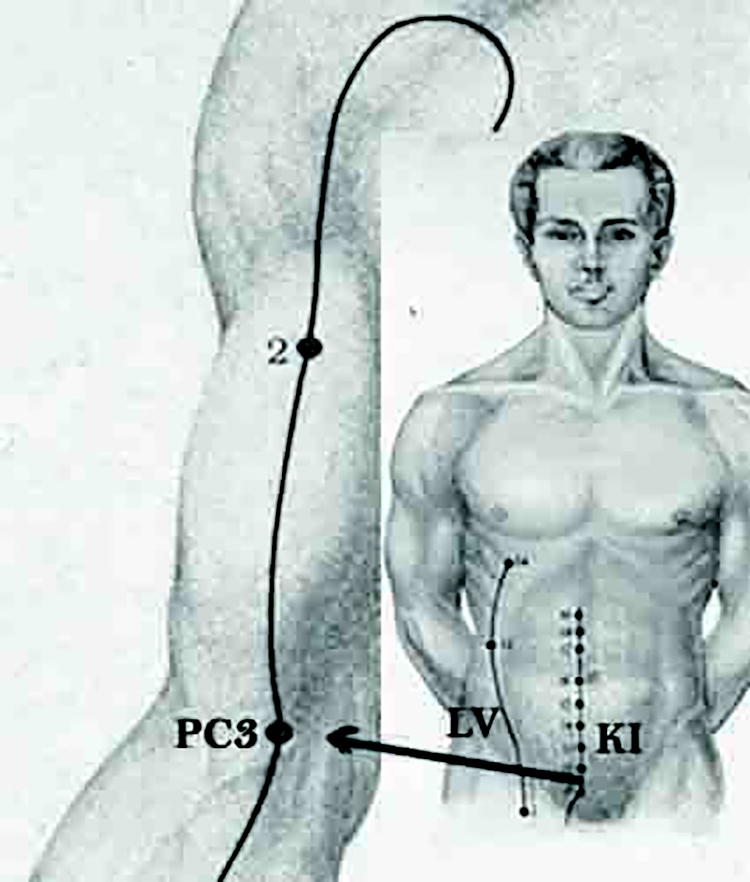
A groin projection onto the upper limb.
The above neighbors with the Leg Shao Yin (KI) in Chinese clock (System 5) (Fig. 2). 5 On the other hand, it shares name and forms a layer with the Leg Jue Yin (LV) meridian (System 1).4,5
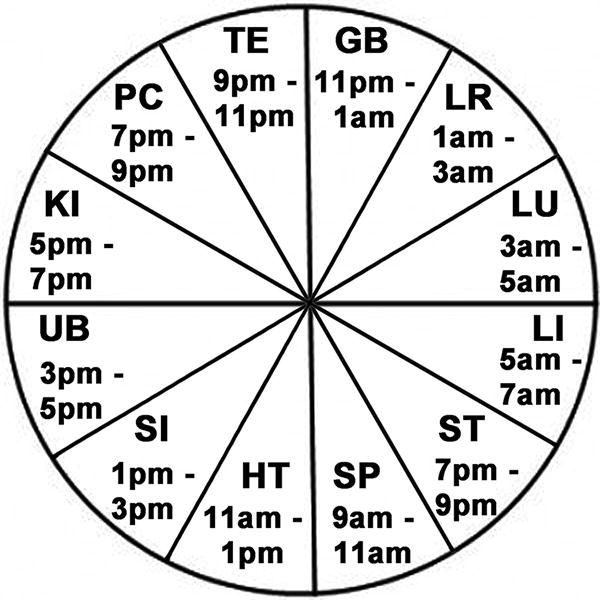
Chinese Clock.
As suggested by Prof. Maurice Mussat, the Jue Yin meridian of Chinese Medicine is an equivalent of Sympathetic Nervous System (SNS) of Western Medicine. 6 Excitingly, it has been shown that activation of the SNS in the brain usually suppresses pain. 7
It is important to emphasize that considering all the described above, the instantaneity of the decrease of the groin pain characteristics is anticipated to reflect the accuracy of treatment.4,5
CLINICAL EXAMPLE
A 62-year-old Caucasian male attended acupuncture treatment for the Chief Complaint (CC) of moderate, bilateral (central) groin pain. The patient suffered from the CC for about 6—7 months. His X-ray and computer tomography analysis did not reveal any pathological findings. In addition, a slight depression was considered the patient’ Secondary Complaint (SC).
First, following the appropriate YNSA accepted diagnostic standard operation procedure (SOP), a left Basic D point was punctured using 0.25 × 30 cm silicon coated needle for 10 minutes 2 (Fig. 3).
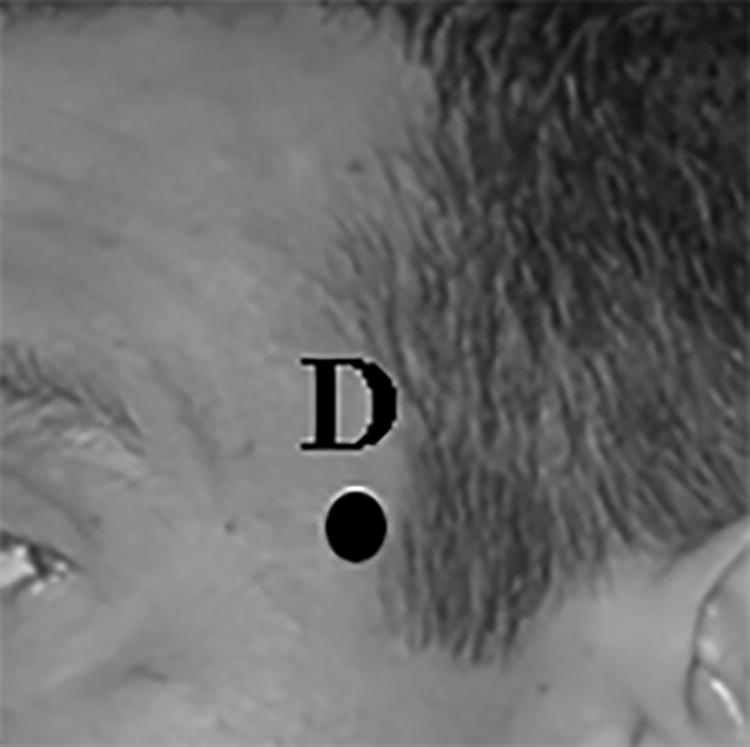
YNSA Basic D point.
The first session Auriculotherapy, targeted rather the SC-related psychosomatic aspect. The above included a VAS detection of the following points (Fig. 4):

Auricular Points. 1. α-depression, 2. Sympathetic master point, 3. α-aggressiveness.
α-depression point, on the dominant right side using golden auricular semi-permanent needle (ASPg),
Sympathetic master point on the dominant right side using golden auricular semi-permanent needle (ASPg),
α-aggressiveness point, on the dominant right side using classic auricular semi-permanent needle (ASPc);
The first session changed the intensity and character of the CC to fluctuating mild, and dissipated the SC.
The following 3 ICBA sessions were performed once in two days, starting the next day post YNSA and Auriculotherapy session. Since the CC was central, the Hand Jue Yin Quze (PC 3) was punctured bilaterally with 0.22X30 cm silicon coated needles, for 45 minutes 5 (Fig. 1). Post third ICBA session a complete dissipation of the CC with no following recurrence was achieved.
AUTHOR DISCLOSURE STATEMENT
The author has no interests to disclose.