




Abstract
Background:
The integration of new technologies into medical education is transforming the learning landscape, particularly in acupuncture education. The necessity for remote learning due to the pandemic has accelerated the development of digital tools, such as anatomical software, to replace traditional in-person classes. In response to these changes, Dongguk University in Korea has developed AcupointDG, a three-dimensional (3D) visualized anatomy model software designed to enhance the understanding of acupoints and their associated neurovascular musculature. This software provides a comprehensive view of the human body’s anatomical structures related to acupuncture points and links to relevant research, aiding students in gaining a realistic and evidence-based understanding of acupuncture. The main features include detailed 3D anatomical representations and direct access to scientific literature through PubMed and Research Information Sharing Service (RISS).
Conclusions:
The use of this software in the Acupoint and Practice class has resulted in significant educational outcomes, including student publications and presentations at international conferences. Future updates aim to further integrate research trends with anatomical visualization, enhancing the educational experience and professional development of acupuncture students.
INTRODUCTION
The field of medical education is currently undergoing a period of rapid transformation due to the advent of new technologies, which present significant challenges in their integration into the learning process. 1 Additionally, the necessity for social distancing due to the pandemic has made it difficult to conduct in-person anatomy classes, leading to the development of anatomical software as an alternative teaching method. 2 Recently, the neuroanatomical characteristics of specific acupoints have been elucidated. 3 Furthermore, the insertion of acupuncture needles can carry inherent risks, including tissue damage and side effects. 4 Therefore, in acupuncture education, it is essential to conduct rigorous evidence-based studies to gain insights into this treatment, with particular emphasis on the anatomical structures using new technologies.
For these reasons, it is imperative to gain a comprehensive understanding of the physiological and anatomical effects of acupuncture for effective acupoint training. However, it is challenging to grasp the three-dimensional (3D) structure of the human body from a textbook alone. To further facilitate this learning experience, the Acupoint and Practice class at Dongguk University in Korea developed a 3D visualized anatomy model software named AcupointDG and used it in the class. This article introduces the features and applications of this software on acupuncture education.
EDUCATION USING THE SOFTWARE ACUPOINTDG
The objective of this software AcupointDG is to provide students with a more realistic understanding of the human body and its connection with acupoints (see Fig. 1). To achieve this, the software offers two key functions: (1) detailed information on acupoint-related neurovascular and muscular structures, and (2) links to research studies on each acupoint. With advancements in technology, 3D educational software has become increasingly viable, and several 3D medical applications have been developed for medical education (e.g., Human Anatomy Atlas, Acupuncture, etc.). However, few of these applications effectively link anatomical structures with acupoints, which is crucial for acupuncture practice, and even fewer incorporate related research. Addressing these gaps, AcupointDG has been designed to provide precise acupoint locations based on 3D anatomical structures and to enhance educational value by offering efficient access to acupoint-specific research. Developed by educators at a university, this software meets both the practical and academic needs of students and is updated regularly. Users, including educators and learners, can easily find and download AcupointDG for Android and iOS by searching it in the App Store (iOS) or Play Store (Android), allowing them to teach or study and practice using their mobile devices (phones, tablet, or laptop).
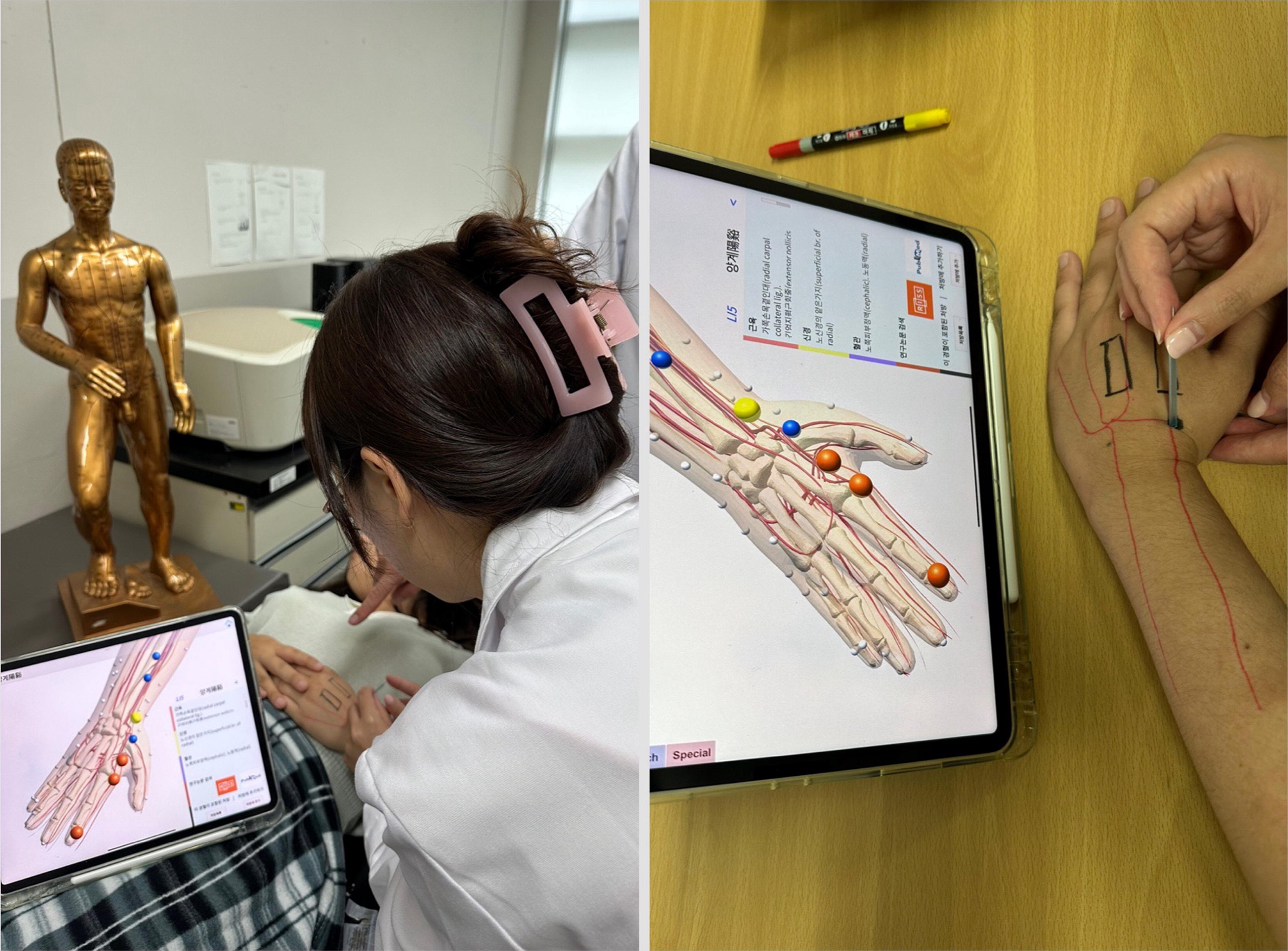
Students in the Acupoint and Practice class at Dongguk University using the “AcupointDG” software. The image shows students determining the precise location of acupoints and performing acupuncture based on the detailed anatomical information provided by the software.
MAIN FUNCTION OF THE SOFTWARE: (1) ACUPOINT-RELATED NEUROVASCULAR MUSCULATURE
It is imperative that practitioners possess accurate anatomical knowledge to ensure the safety of acupuncture procedures and understand its anatomical effects. This software allows users to view the anatomy in three different states: the skin, muscles, and internal structures (blood vessels, nerves, and bone). The 3D representation of the bones, blood vessels, and nerves, along with the corresponding acupoints, provides a comprehensive understanding of the anatomical details. Upon clicking on an acupoint, the corresponding muscles, nerves, and blood vessels are displayed, facilitating precise needling in accordance with the exact anatomical indicators. Selecting each acupoint reveals its efficacy and the primary characteristics associated with it. Additionally, searching by efficacy identifies the appropriate acupoints for each disease (see Fig. 2). This feature is useful for determining the optimal acupoints for various conditions.

The main feature of the AcupointDG software: visualization of neurovascular musculature. The figure demonstrates the search function where key anatomical structures and their associated acupoints are toggled for detailed viewing and study.
MAIN FUNCTION OF THE SOFTWARE: (2) LINKS TO RESEARCH ON EACH ACUPOINT
In the Acupoint and Practice class at Dongguk University, students explore research trends related to acupoints through the analysis of scientific literature. The software provides direct links to PubMed and RISS, allowing users to find relevant literature on each acupoint (see Fig. 3). This feature enables students to quickly access the latest research trends for each acupoint. Following their studies, students are required to write journal reports and take exams where they describe their findings and discussions. As a result of this education, a number of students in the acupuncture class have published papers in scientific journals as undergraduates 5 and presented posters at international conferences (e.g., Society for Neuroscience 2024).
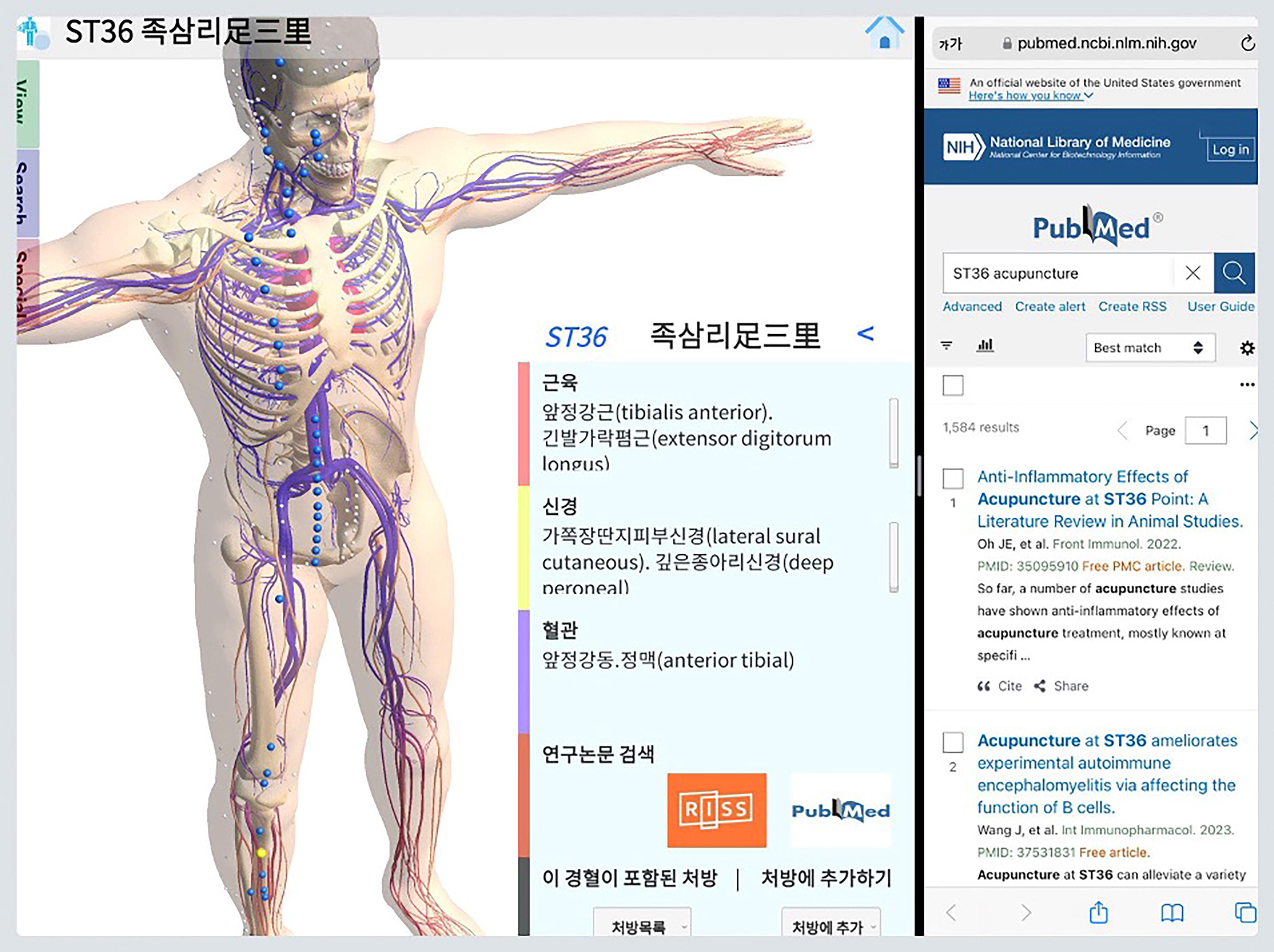
Another key feature of the AcupointDG software: direct access to research articles related to each acupoint. The figure illustrates how students can instantly view and study scientific literature pertinent to specific acupoints, integrating research into their learning process.
DISCUSSION
This software can serve as an educational tool to assist acupuncture students in visualizing anatomical structures in 3D and accurately positioning acupoints. It also supports learning about the effects of acupuncture treatments in conjunction with recent literature. The unique benefit of this software is its integration of anatomy-based education on acupoints with relevant research findings. In addition to formal assessments, informal feedback from students, researchers, and practitioners highlights AcupointDG’s practical utility in an educational setting. For instance, students reported enhanced engagement and comprehension of complex anatomical structures, while practitioners and researchers noted improvements in clinical communication and alignment with current research. This user feedback underscores the potential of AcupointDG to bridge theoretical knowledge with practical application, supporting evidence-based acupuncture education. Future updates will include features to visualize acupoint effects based on current research trends and to map the connections between acupoints and anatomical markers documented in scientific journals. Such features are expected to significantly advance the training and professional development of physician-acupuncturists.
CONCLUSIONS
The AcupointDG software developed by Dongguk University represents a significant advancement in acupuncture education, providing students with a realistic and detailed understanding of the human body’s anatomy in relation to acupoints. The integration of 3D anatomical visualization with direct access to scientific literature enhances the learning experience and supports evidence-based practice. This tool not only facilitates accurate and safe acupuncture practice but also encourages students to engage with current research trends, leading to improved educational outcomes and professional development. Future enhancements to the software will further solidify the connection between anatomical indicators and acupoints, underscoring the importance of research-based education in acupuncture training.
Footnotes
AUTHORS’ CONTRIBUTIONS
S.-H.K.: Writing—original draft preparation. S.-N.K.: Supervision and writing—review and editing.
AUTHOR DISCLOSURE STATEMENT
No interests to disclose.
FUNDING INFORMATION
No funding was received for this article.