




Abstract
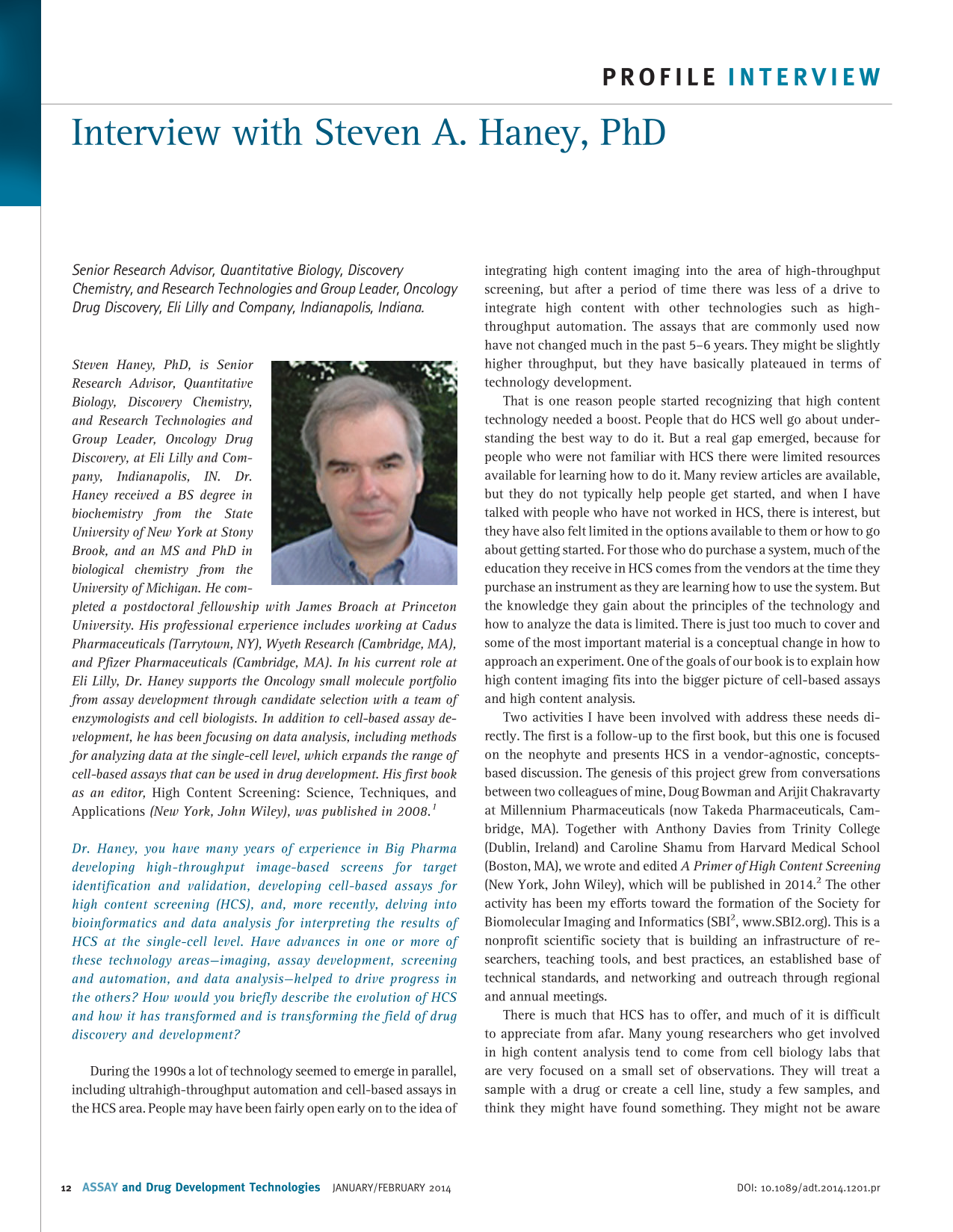

Steven Haney, PhD, is Senior Research Advisor, Quantitative Biology, Discovery Chemistry, and Research Technologies and Group Leader, Oncology Drug Discovery, at Eli Lilly and Company, Indianapolis, IN. Dr. Haney received a BS degree in biochemistry from the State University of New York at Stony Brook, and an MS and PhD in biological chemistry from the University of Michigan. He completed a postdoctoral fellowship with James Broach at Princeton University. His professional experience includes working at Cadus Pharmaceuticals (Tarrytown, NY), Wyeth Research (Cambridge, MA), and Pfizer Pharmaceuticals (Cambridge, MA). In his current role at Eli Lilly, Dr. Haney supports the Oncology small molecule portfolio from assay development through candidate selection with a team of enzymologists and cell biologists. In addition to cell-based assay development, he has been focusing on data analysis, including methods for analyzing data at the single-cell level, which expands the range of cell-based assays that can be used in drug development. His first book as an editor, High Content Screening: Science, Techniques, and Applications (New York, John Wiley), was published in 2008. 1
Dr. Haney, you have many years of experience in Big Pharma developing high-throughput image-based screens for target identification and validation, developing cell-based assays for high content screening (HCS), and, more recently, delving into bioinformatics and data analysis for interpreting the results of HCS at the single-cell level. Have advances in one or more of these technology areas—imaging, assay development, screening and automation, and data analysis—helped to drive progress in the others? How would you briefly describe the evolution of HCS and how it has transformed and is transforming the field of drug discovery and development?
During the 1990s a lot of technology seemed to emerge in parallel, including ultrahigh-throughput automation and cell-based assays in the HCS area. People may have been fairly open early on to the idea of integrating high content imaging into the area of high-throughput screening, but after a period of time there was less of a drive to integrate high content with other technologies such as high-throughput automation. The assays that are commonly used now have not changed much in the past 5–6 years. They might be slightly higher throughput, but they have basically plateaued in terms of technology development.
That is one reason people started recognizing that high content technology needed a boost. People that do HCS well go about understanding the best way to do it. But a real gap emerged, because for people who were not familiar with HCS there were limited resources available for learning how to do it. Many review articles are available, but they do not typically help people get started, and when I have talked with people who have not worked in HCS, there is interest, but they have also felt limited in the options available to them or how to go about getting started. For those who do purchase a system, much of the education they receive in HCS comes from the vendors at the time they purchase an instrument as they are learning how to use the system. But the knowledge they gain about the principles of the technology and how to analyze the data is limited. There is just too much to cover and some of the most important material is a conceptual change in how to approach an experiment. One of the goals of our book is to explain how high content imaging fits into the bigger picture of cell-based assays and high content analysis.
Two activities I have been involved with address these needs directly. The first is a follow-up to the first book, but this one is focused on the neophyte and presents HCS in a vendor-agnostic, concepts-based discussion. The genesis of this project grew from conversations between two colleagues of mine, Doug Bowman and Arijit Chakravarty at Millennium Pharmaceuticals (now Takeda Pharmaceuticals, Cambridge, MA). Together with Anthony Davies from Trinity College (Dublin, Ireland) and Caroline Shamu from Harvard Medical School (Boston, MA), we wrote and edited A Primer of High Content Screening (New York, John Wiley), which will be published in 2014.
2
The other activity has been my efforts toward the formation of the Society for Biomolecular Imaging and Informatics (SBI
2
,
There is much that HCS has to offer, and much of it is difficult to appreciate from afar. Many young researchers who get involved in high content analysis tend to come from cell biology labs that are very focused on a small set of observations. They will treat a sample with a drug or create a cell line, study a few samples, and think they might have found something. They might not be aware what the possibility of doing these types of studies at the level of high-throughput screening using high content assays could enable them to do, and what it takes to do this. They may come to this approach late in their research, rather than thinking early on about looking at the biology from the point of view of a high content screen, how they would develop such a screen, and how they could use high content analysis to learn something new about the system they are studying.
Established researchers tend to be very comfortable with the technology they are using. They may look for kinase activity using a Western blot, for example, or when studying diabetes they may monitor glucose or insulin levels. There is a tendency to view HCS as a different technology for gathering the same type of information they are used to collecting. They may also miss the breadth of things that can occur within the context of a single phenotypic processes. For example, it can be common to develop multiple independent assays for cellular energy levels, apoptosis, senescence, and mitotic catastrophe when a compound is used to treat cells, but it can be easier and more informative to characterize these in a single assay that could reflect the heterogeneity of the responses to a single treatment. Cell subtyping and assays to understand cell heterogeneity are not well established in general, because it is so common to focus on a single end-point.
In the oncology area, there are a lot of differences in how cells respond to treatment, even within the same tumor type. When people pick a cell line for a cell-based assay, sometimes they are looking for the one that is most prone to apoptosis. That has led to a recognized bias in the way studies are performed, resulting in a lack of translational relevance for the results. The lack of reproducibility does not imply that the research is not technically correct, it means that the assay was performed in such a narrow sphere—for example, in one cell line—that it lacks clinical applicability, and the results generated in such a limited context are not relevant to broader questions. Several things need to be done to address this problem. One way to achieve greater clinical relevance is to do experiments with more cell lines; another way is to develop assays that are more sensitive to the changes that cells go through.
In the area of diabetes, if you are looking at increased insulin secretion in islet cells, there are complications that may occur, such as beta-cell hyperplasia. High content phenotypic analysis is able to identify changes in cells at the single-cell level that can alert you to potential downstream problems, such as cell size and shape, the relationship of cells to each other, or colony formation. All of these characteristics are inherently tracked in high content analysis. The richness of the data set powers researchers to build in sentinel assays for problems that may need more study, but without explicitly designing additional assays. This is one of the advantages of image-based analysis; it allows you to create a safety net for unanticipated consequences of your perturbation.
This is because even basic image analysis will capture multiple features. For any label (a specific protein, nuclei label, etc.), a lot of data are captured—size, shape, texture, and proximity to each other. These data are readily available in HCS in a way that is not true of other cell-based assays. You can track and quantify these along with the primary phenotype. You may find that one set of compounds gives the phenotype you are after without perturbing your cells, whereas another does so as well but also perturbs the cells. This gives you an early heads-up that you may need to understand these changes as part of the decision criteria. Otherwise you could miss the opportunity to catch problems at an early stage.
You mentioned the Society for Biomolecular Imaging and Informatics, for which you currently serve as Secretary and Member of the Board of Directors. How did you become involved with this new society and what are its mission and activities?
It took quite a while to get this organization up and running. For a number of years there was a productive meeting on high content analysis that was run by Cambridge Healthtech. It became a key meeting at which to do a lot of networking, but there were accessibility barriers, particularly for people who were curious about the technology but not actively pursuing it. The meeting was quite expensive and did not have the cell biology base or rigor to focus on challenges and emerging trends in the field. That is the kind of thing a professional society is for—to focus on the core areas that need further development and to be accountable for making progress.
Paul Johnston (University of Pittsburgh) and Joe Trask (The Hamner Institutes) got together and decided to make the push needed to get things started. Mark Collins and I joined shortly afterwards to help define the mission and scope of the society, which overlapped with some of the legal matters of starting a nonprofit organization. Once we had filed most of the essential paperwork, we expanded the Board of Directors to bring in some great labs that could help build the scope and begin planning the growth of SBI 2 . Even after all of this time, it is still very early days. There are a lot of things we need to do, but we have set a line in the sand by selecting October 10, 2014, as the start date for the first annual meeting. Our current efforts are aimed at building the resources and reach of the society by then. We have had a few regional meetings, and so far people seem to understand why we need this and have been engaged and interested in helping develop additional roles and activities. We envision the Society contributing to the development of new technologies, approaches, and opportunities in a way that will help the field grow. We regard it as an essential part of the SBI 2 mission to engage new and established researchers in ways that will help them understand the range of HCS studies and to have a path forward for developing image-based studies.
In particular, how is HCS enabling quantitative biology, and can you provide some examples of how the ability to obtain quantitative information at a single-cell level can increase the value and utility of the data acquired from HCS for target validation or drug candidate selection?
Quantitation has been the key to HCS all along. Robust numbers not only validate observable phenotypic changes, but they possess the potential to identify new relationships. Most people focus on a particular end-point, even in the context of HCS. Even for some RNA interference (RNAi) screens and smaller scale screens, it is typical to focus on a single end-point. That is part of the gap I described and one of the signs that the field is not growing fast enough. People are not using this capability. What are the barriers? What can we do to address these barriers and make them less isolating?
Going back to the oncology model and cell death, consider what it means if you treat a cell and get a strong apoptotic response. The compound might make a very good therapeutic, but it might also be doing other things to the cell. It is important to know if it is killing cells in multiple ways and what is the actual set of responses across all the cells in that treatment condition. If you focus only on the cells that undergo apoptosis, you might ignore the group of survivors. In fact, the therapy might only be moderately effective and create a survivor population. The question to focus on is how are cells dying in culture, and the ability to obtain quantitative results allows you to do that. Quantitation also makes it possible to ask more detailed questions about the biology of systems.
The quantity of data created by high content image analysis is certainly an issue. While image analysis is become more user friendly, some of that ease of use comes at the expense of exploring the data. There are some open source image analysis tools available, but they tend to have fairly high learning curves. The algorithms that are easier to use tend to be more rigid. The way forward is not necessarily to make image analysis simpler, but instead to develop better tools, resources, and networking opportunities to enable people to learn what they need to know and to be able to do it better. However the steps and processes are modified to make them easier to use, it is important to preserve the capability to go back to the raw data and to view the original images.
What makes HCS particularly useful for performing RNAi? What types of information can be acquired using image-based high throughput siRNA screens? What are the specific challenges in applying HCA to RNAi screens?
HCS is a great fit for RNAi screening, partly because both became established at the same time, and because HCS was recognized by people doing RNAi screening as something that could address critical problems for them. RNAi screening had a number of confounding effects, including off-target effects, and a lot of them were made worse by traditional cell-based assays, such as enzyme assays for proliferation and apoptosis. This is in part because these responses are pleiotropic; a lot of things can cause a cell to apoptose. If the RNAi reagents you are using have a lot of off-target effects, you can generate a hit list that becomes unwieldy and overloaded with false positives. HCS brought attention to specific assays. For example, if you were looking for something that modified a kinase, by using a precise assay you could look at how the kinase phosphorylates a target almost in isolation, essentially the cellular corollary to a biochemical assay.
In its new Phenotypic Drug Discovery, or PD 2 initiative, Lilly is for the first time providing access to its internal panel of disease-relevant phenotypic modules. These can be interrogated as cellular systems instead of specific targets to search for lead compounds with desired activity in a relevant biological context without predisposed bias toward a mechanism or mechanisms of action. What advantages do cell-based assays and HCS technology bring to this strategy?
The PD
2
initiative (now expanded into Open Innovation Drug Discovery, or OIDD,
What happens when you start getting into new biology, novel chemical space, and nontraditional drug targets? OIDD emphasizes outreach to academic partners that have developed compound libraries based on novel scaffolds through their own research interests. We then test those compounds in a number of assays. If one or more hit against one of the targets, Lilly and the academic partner have the chance pursue it together; the academic partner has significant control in this process. This approach provides academic labs looking into novel compound space an opportunity to be able to do the biological assays in areas in which there is a chance to develop into meaningful therapeutics.
What led you to pursue a career in drug discovery and high content screening and to your current position at Eli Lilly?
Early on it was clear in the functional genomics department at Wyeth where I was working that high content analysis was of interest. We decided to purchase an instrument, and we acquired a Cellomics VTI imager (one of two that Wyeth purchased). At that time HCA was just moving into high-throughput screening, but this second instrument was used to study target biology. We did a lot of RNAi screens and a lot of method development in the imaging area. From there I went to Pfizer, in the Target Generation Group at the Pfizer Research Technology Center in Cambridge, and worked on a very interesting project, together with human geneticists, statisticians, and cell biologists that took advantage of the information coming out of the Human Genome Project, mostly from genome-wide association studies, and later, next-generation sequencing studies. The genes that were identified as being related to these diseases were so novel that we didn't even know how to study them. Rather than use transformed cell lines, the cell biologists developed assays to study these genes in primary cells, and we applied HCA to study these novel genes in two projects in particular: type 2 diabetes and liver cancer. For the type 2 diabetes project, we were able to identify roles for 4 of the 30 genes in hepatic glucose regulation. 3 In liver cancer, we developed a coculture system with cancer cells and primary hepatocytes in which we were able to model biological events that were impossible to study with any method other than quantitative imaging (publication in progress).
—Interview by Vicki Glaser