




Abstract

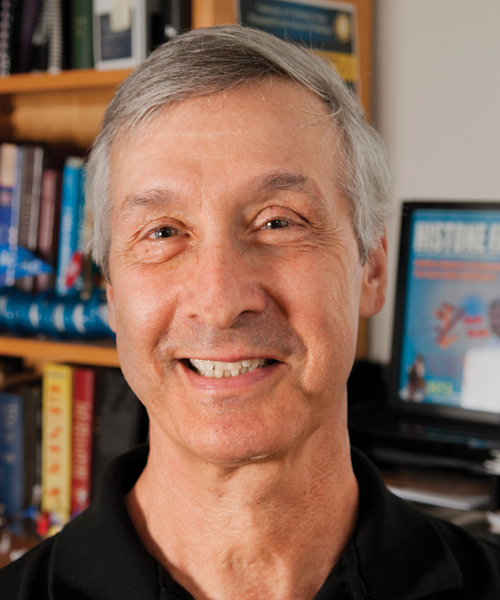
C. David Allis, PhD, is Tri-institutional Professor and Joy and Jack Fishman Professor, Laboratory of Chromatin Biology and Epigenetics, at The Rockefeller University in New York City. Dr. Allis received his PhD from Indiana University and performed postdoctoral work in the laboratory of Martin Gorovsky at the University of Rochester. He is a member of the National Academy of Sciences and the American Academy of Arts and Sciences.
In all honesty, I wouldn't have used the term “epigenetics” until maybe midway through my career. I had certainly heard of the term. I believe it traces back to Conrad Waddington, a developmental biologist credited with coining the word. He was trying to understand how different phenotypes in a multicellular organism came about from a single genome. He proposed that there was some kind of epigenetic landscape above and beyond the DNA.
As a graduate student, I was interested in developmental biology. Toward the end of my doctoral work, we had a mandatory set of seminars, and I happened to pick a topic that was centered on histone proteins and chromatin biology. I thought it went really well, and maybe that's where the “hook” came from.
I decided to look for a postdoc where I could combine my new interest in chromatin and histone biology with my interest in developmental biology problems. After visiting a couple of labs, I became enchanted with one in particular at the University of Rochester in New York. It was the lab of Martin Gorovsky, who is now retired, and who had pioneered and developed methods to grow a single-celled model organism called Tetrahymena. It's a pond water organism that has many beating cilia. What is quite unique about Tetrahymena is that it has two nuclei, and in parts of the organism's lifecycle, the two nuclei are developmentally related. (There was my development fix!) One of the two nuclei is heavily transcribed, containing hyperaceylated histones, whereas the other nucleus is completely silent with, in contrast, hypoacetylated histones, much like an inactive X chromosome in a female mammalian nucleus. It serves the role as the sexual nucleus; it's like the sperm and egg all in one package.
Marty and his colleagues had pioneered methods to separate these two nuclei. I thought it was really interesting that this organism had tried to be multicellular, and although it had failed in that regard, it still had these two nuclei. I learned the methods to separate the two nuclei from his group, and I proceeded to study the histones in as great a resolution and as analytically as was possible at that time. I saw lots of differences, and some have led to career-long research interests. Later, once I had my own lab, Jim Brownell, then a PhD student, used the Tetrahymena model to purify the first ever transcription-related acetyltransferase enzyme activity. It was engorged and very active in this one particular nucleus, the one with hyperacetylated histones.
I think there will be continuously fascinating developmental links to epigenetic regulation. The field continues to grow and expand, and it now also involves stem cell biology and reprogramming of cells. Nobel Prizes have been awarded to researchers such as Shinya Yamanaka and John Gurdon for their insights into bona fide transcription-reprogramming elements that recognize the DNA template and activate or silence genes that direct cells to maintain pluripotency.
It looks like there will be epigenetic factors involved in reprogramming as well, involving some of these Yamanaka factors, as they are called. The factors are somewhat inefficient, and people think that one thing that may well contribute to this barrier is the epigenetic layer. If it were possible to access that better and find ways to make chromatin fiber more accessible, those factors might work better.
It's fun to be just old enough to appreciate that chromatin is now somewhat of a hot topic. A broad-based, worldwide scientific community is doing fantastic work in this area. I could not have foreseen the importance of this field in the early stages of my career. My colleagues and I often ended our grants with a throwaway sentence saying that we hoped our research would impact human biology and human disease. All my grants in the early days were funded through the General Medicine branch of the National Institutes of Health (NIH). Cancer is now out front among the disease areas in which epigenetic miscues have been documented, and therapeutic drugs against some of these enzyme systems have been moved through clinical trials, with promising clinical outcomes. I could never have seen that coming, but now that it's here, it is fantastic.
One of the most groundbreaking discoveries happened 2 years ago. If came from two labs that work on childhood pediatric cancers. They found the link between the oncogenic problem and specific mutations, and not just in epigenetic regulators. If you think of an epigenetic “signal” as a covalent mark, mutations can occur in three different types of molecules or molecular complexes, which we describe as “writers” (which put groups on, e.g., acetyl transferase), “erasers” (which take groups off, e.g., deacetylase), and “readers” (noncatalytic protein complexes that read the marks and that have evolved a little pocket that can snugly fit the covalent modification in a site-specific way). All of these have become attractive drug targets.
In late 2012/early 2013, two labs discovered that the histone proteins themselves were carrying mutations, what we now refer to in my lab as “oncohistones.” Histones come in multigene families, with numerous copies of each gene. Who would have thought that a histone mutation might occur, no less that it would occur in only one allele, and in only one copy of that family. These mutations were found in pediatric brain tumors of the most devastating types. Some of these tumors are in the brain stem, and there is no surgical or radiotherapy solution—they are a death sentence. The mutated histone packaging proteins are now being intensely studied because they are providing the first possible molecular pathway for drug targeting, or at least for discovering the fundamental mechanisms behind tumor formation.
Studying histone mutations in cancer is one of the more active projects currently underway in my lab. The clinical folks we collaborate with worldwide and here in New York, and in particular at Memorial Sloan Kettering Cancer Center (MSKCC), are paying more and more attention to these histone mutations. These “oncohistone” mutations are being found in growing numbers of tumors. You could question whether they are actually oncogenic—whether they really cause cancer. In some tumors, they have to work with other mutations, but we have unpublished data to show that these mutations by themselves can cause tumors. In some cases, they may really be oncohistones.
The puzzle remains that these tumor cells also have wild-type, completely normal, nonmutant copies of these histones. This is driving questions about the cell of origin and why these tumors are so specific to one anatomical region. We know that the mutations affect lysine in these different cancers, and you couldn't pick a sexier amino acid to be mutated than lysine! In most cases, the mutation causes a change from lysine to methionine, called a K-to-M change. Only certain mutated lysines correlate to particular tumors, and the change is always a K-to-M.
I have had the privilege of going to some workshops with the clinicians that treat the kids with these tumors, and it's very motivating. We have many questions still to answer, including what are the mechanisms underlying oncohistone development, and how do those impact the writers, readers, and erasers of these modifications? We are also working on more sophisticated proteomic methods to look at covalent modifications.
It was important for the field to be able to do genome-wide analyses to identify where these modifications are occurring and to look for patterns that are nonrandom. How do the enzymes know where to put them? As the technology advanced, people started to see genome-wide nonrandom arrangements. They could then ask whether those changed in disease. The community has done a fabulous job of doing epigenetic profiling.
Genome-wide profiling used to take millions of cells. You had to take the entire nuclear genome, fragment it, come in with an antibody directed against your favorite modification, do an immunoprecipitation, and then collect the DNA and sequence it. This is now getting down to a single-cell level, and in some cases, molecular events can be followed in real time. Remarkably small numbers of cells can now be epigenetically profiled. Tumors tend to be heterogeneous, and we need to be able to identify the cells of origin that have become tumorigenic.
Advances in microscopy are enabling imaging of chromatin dynamically at the level of the single cell. For example, we can visualize groups of genes involved in a particular pathway that come together in a certain region and are then exposed to epigenetic modifications that enhance transcription activity or, alternatively, silence that group of genes at different stages of development or cell function, for example. The continuing miniaturization of imaging of chromatin markers for epigenetic profiling will enhance the ability to study how drugs affect gene activation or silencing. Also, computational methods are getting so much more advanced, further enabling genome-wide profiling.
The tide is definitely changing. I see growing knowledge and interest among physicians in this epigenetic language and its link to disease. We have done a lot of work with Rich Cummings and Constellation Pharmaceuticals' structural biology group, which can crystallize these proteins. We have benefited from the ability to crystallize the more established epigenetic regulators, whether erasers, writers, or readers, to try to learn the details of how they carry out the chemistry they perform, and then make small molecules to inhibit them. Sometimes a histone mutation turns on genes that were silent. And sometimes the same mutation does just the opposite in a different setting—turning off a gene that you want to be turned on. This certainly complicates things.
Every time we and a few other really good biochemistry groups try and pull out enzymes of interest to us, it seems as if we get a complex for which there is already an associated neurological syndrome. If you think about it, what would likely be the area of the body that has most evolved to exploit the epigenetic layer? It might be brain cells. Once they are established, they're kind of fixed; they don't change. Yet, the need to adapt to all the things that change us seems to require a “plasticity” for which epigenetics seems well suited.
I think the field of neuroscience is starting to pay increasing attention to epigenetics. This makes people think hard about complex psychiatric and developmental disorders that plague our society such as addiction, depression, or autism. Some studies have tried to look at animal models and see whether the brain changes with certain inputs.
One of the postdoctoral fellows in my lab is following up on a popular anticancer drug that targets a reader and was discovered by Jay Bradner and colleagues at Dana Farber. We wanted to know if the drug has any impact on learning and memory. It does, and it perturbs a lot of the genes responsible for neuronal stimulation and excitation.
This type of research sometimes dovetails with studies on diet that look at not only your diet, but also what your parents ate and even what your grandparents ate. In some cases, researchers have modeled this by carefully controlling diet and have found associations with methylated histone modifications, for example, which have been passed on through the sperm and have affected not only the F1 generation but also the F2 generation.
I think a lot of people attribute the “modern era” of chromatin biology to the year that my group and Stuart Schreiber's group at Harvard published the first identity of the enzymes that modify chromatin, which was 1996. It's remarkable to me that we have almost hit the 20-year anniversary since we published that work in Cell. Now, histone mutations have been identified, and the field is moving so quickly. There are big pharmaceutical endeavors and consortiums and focused clinical research efforts in this area now.
As an example, I'm working closely with the group at the Center for Epigenetic Research established at MSKCC last summer. One of the projects we are focusing on with MSKCC is a novel histone modification called histone crotonylation. It is similar to an acetyl group but has two more carbons and a double bond. We explored the associated readers, writers, and erasers, and found that the reader is a novel domain that has not been previously associated with any kind of modification. It seems highly specific just for crotonyl and it is closely associated with leukemia. In leukemia, there is typically a break in a chromosome where a new domain—a so-called fusion or translocation partner—is attached, and several of these fusion partners carry this new domain with the crotonyl reader function. We're currently teaming up with MSKCC and we're doing the biochemistry work, which has already led to the discovery of this new reader, a structure that shows why the crotonyl group is being preferentially read. All of this is a work in progress, and I can't begin to tell you where we'll be in 5–10 years! It is going to be a very exciting field to follow. I feel very fortunate to be part of a field that is now receiving so much attention with far-reaching implications in human biology and health.