




Abstract
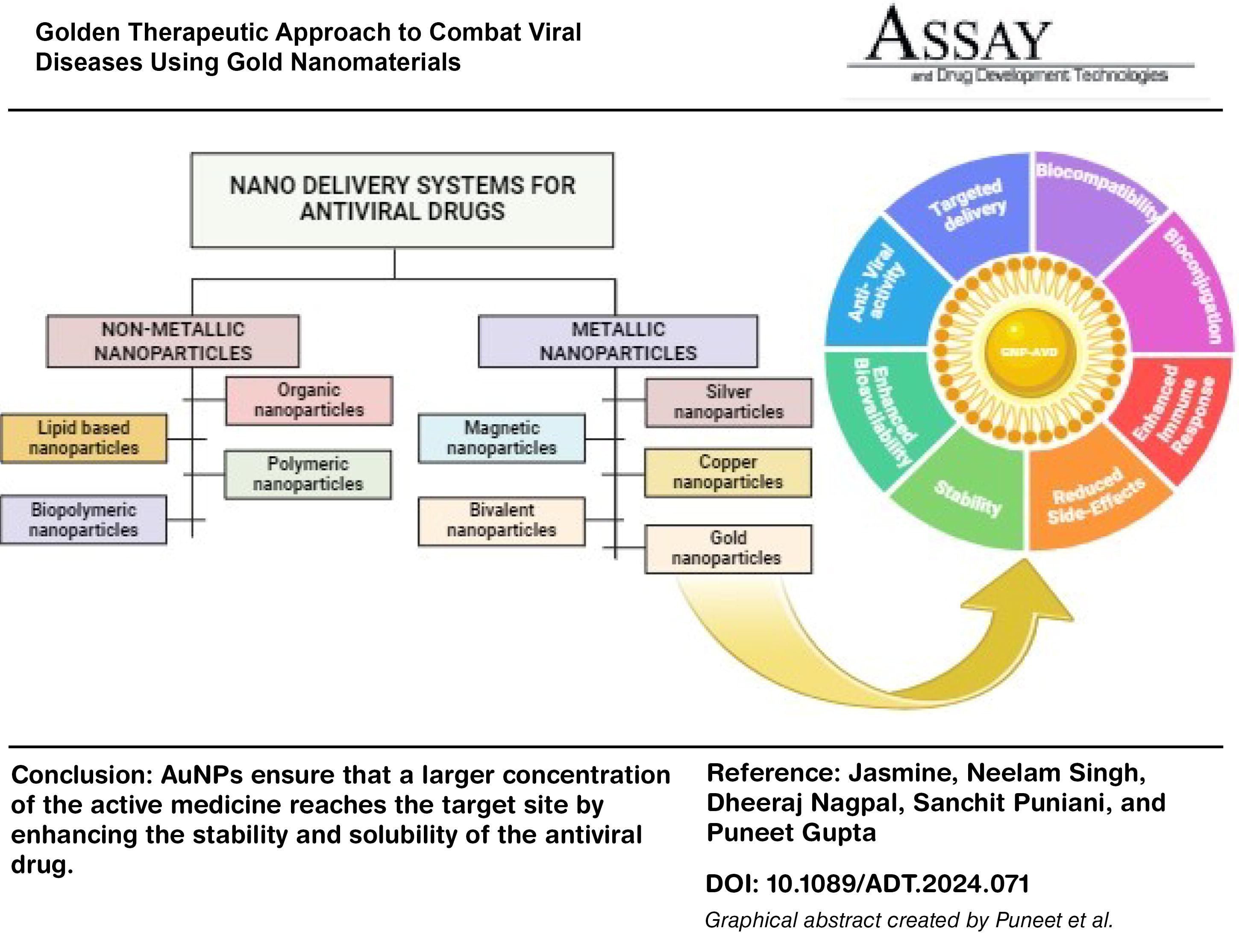
Gold nanoparticles (AuNPs), due to their unique properties and surface modification abilities, have become a promising carrier for a range of biomedical applications. AuNPs have intrinsic antiviral characteristics because of their capacity to enhance drug distribution by making antiviral medications more stable and soluble, which assures that higher quantities reach the intended site. Through surface changes, AuNPs can bind directly to viral particles or infected cells, increasing therapeutic efficiency and reducing side effects. AuNPs efficiently damage cell membranes and hinder viral reproduction within a host cell. Furthermore, because of their large surface area-to-volume ratio, which enables many functional groups to connect, improving interaction with virus particles and ceasing their multiplication. By altering dimensions and morphology or conjugating it with additional antiviral drugs, AuNPs can array their synergistic antiviral activity. Thus, the development of AuNP conjugated therapy presents a promising avenue to address the demand for novel anti-viral therapeutics against infections resistant to several drugs.
INTRODUCTION
Antiviral medications are crucial for preventing a variety of contagious viral infections, including COVID-19, hepatitis, influenza, and HIV, as they work by focusing on distinct stages of the viral life cycle to arrest its replication and reduce symptoms. 1 These drugs function by obstructing the replication of viral DNA or RNA, inhibiting viral attachment and invasion into host cells, and interfering with the assembly and release of newly replicated viral particles. 2 Protease inhibitors, integrase inhibitors, neuraminidase inhibitors, nucleoside and nucleotide reverse transcriptase inhibitors, and others are classes of antiviral medications that target distinct viral enzymes. 1 –80
Antiviral medications are important because they can minimize ailments duration, lessen symptoms, and avoid repercussions. However, the emergence of antiviral resistance poses a serious problem, underscoring the significance of following treatment plans and using medications responsibly. 4 Neuraminidase inhibitors are utilized for severe influenza, remdesivir has been licensed for severe COVID-19 cases, direct-acting antivirals are useful for hepatitis C, and antiretroviral treatment (ART) is approved for HIV, 5 However, in order to prevent drug resistance and increase treatment efficacy, further research and ethical usage are required. 6 The efficacy and safety of antiviral drugs are severely constrained by issues such as poor bioavailability and off-target side effects, poor gastrointestinal absorption, fast metabolism, and binding to plasma proteins all contribute to low bioavailability. 7 Remdesivir, for instance, is used to treat COVID-19; nevertheless, it has been linked to problems with the kidneys and liver. Off-target effects can potentially contribute to treatment resistance when viruses adapt to unwanted drug interactions. 6
Improving drug formulations for increased bioavailability and reducing side effects with targeted delivery methods are essential for maximizing therapeutic approaches and enhancing patient outcomes. 8 In order to produce a safer and more effective way to incorporate antiviral medicines and eventually lower the worldwide burden of viral infections, gold nanoparticles (AuNPs) are an option as they provide a synergistic effect in the treatment of viral disease. 2,8 They can be designed for targeted delivery to certain cells or tissues, resulting in selective administration of drugs. 8 Beyond drug delivery, they are useful in diagnostics and regenerative medicine. Nanoparticles’ flexible characteristics make them a powerful tool for improving the efficacy and safety of pharmaceuticals, particularly in antiviral therapy and other disorders. 3,9
AuNPs have distinctive features that make them extremely promising for delivery and antiviral compositions. 10 Their scalable dimensions, spanning from 1 nm to more than 100 nm in diverse shapes such as spheres and rods, enable modification for particular uses. 11 Although AuNPs have a higher surface area compared to volume ratio, they may attach several functional groups for targeted delivery and have a high drug loading capacity. 12 Moreover, surface plasmon resonance (SPR) in AuNPs may be controlled by changes in size and shape, offering novel applications for sensing, photothermal treatment, and imaging. Another significant factor is biocompatibility, as gold is often regarded as biocompatible and AuNPs have demonstrated less toxicity in different research. 13,14
AuNPs coated in sialic acid to prevent influenza virus attachment, multivalent AuNPs to stop HIV fusion, and dendronized anionic AuNPs to effectively suppress HIV are a few examples of antiviral formulations. 15 Owing to their nontoxicity and biocompatibility, AuNPs are an excellent and adaptable antiviral therapeutic platform that may be used in clinical settings. 16 Furthermore, nanoparticle formulations can lower drug toxicity by influencing biological distribution and pharmacokinetics, avoiding drug accumulation in nontarget organs. 17 AuNPs have inherent antiviral characteristics that directly interfere with viral activities while also providing dual modes of action. 18 Eventually, nanoparticle-based formulations can aid in the fight against drug resistance by enhancing distribution and better targeting of resistant virus strains. This capacity to overcome resistance to drugs highlights nanoparticles’ potential to revolutionize antiviral therapy. 19 –21
CLASSIFICATION OF NANO FORMULATIONS
Classification of nano formulations has been summarized in Table 1.
The Preparation, Properties, and Classification of Nanomaterials
AuNPs
Due to their exceptional optical, electrical, and chemical characteristics, AuNPs are a highly adaptable class of nanomaterials. 32 (66). Moreover, AuNPs can be functionalized with a variety of biomolecules to enable antiviral therapy 33 and their affinity to biological molecules and use as drug-carriers in the cells with increased specificity. Functionalization strategies typically involve the use of various groups including oligo or polyethylene glycol (PEG), bovine serum albumin, oligo or polypeptides, oligonucleotides, antisense or sense RNA molecules, antibodies, cell surface receptors, and other similar molecules, as illustrated in Figure 1.

Illustration of functionalization of gold nanoparticles with DNA, antibodies, enzymes, proteins, quantum dots, etc. Image created with BioRender.com.
Types of AuNPs and Properties
Gold nanoshell
Gold nanoshells are specific types of AuNPs with a thin, hollow gold shell surrounding a dielectric core that is usually made of silica or polymer. These nanoshells are extremely appropriate for photothermal and photoacoustic applications because they can be tailored to absorb light within the near-infrared (NIR) spectrum by varying the core diameter and shell thickness. 34,35 Their therapeutic efficacy and targeting capabilities can be enhanced through the application of techniques such as PEGylation and antibody conjugation. Furthermore, gold nanoshells show (Fig. 2) potential in drug delivery systems. By utilizing their adaptability in surface modification, they can enable precise distribution to target areas, improving therapeutic effects. 35
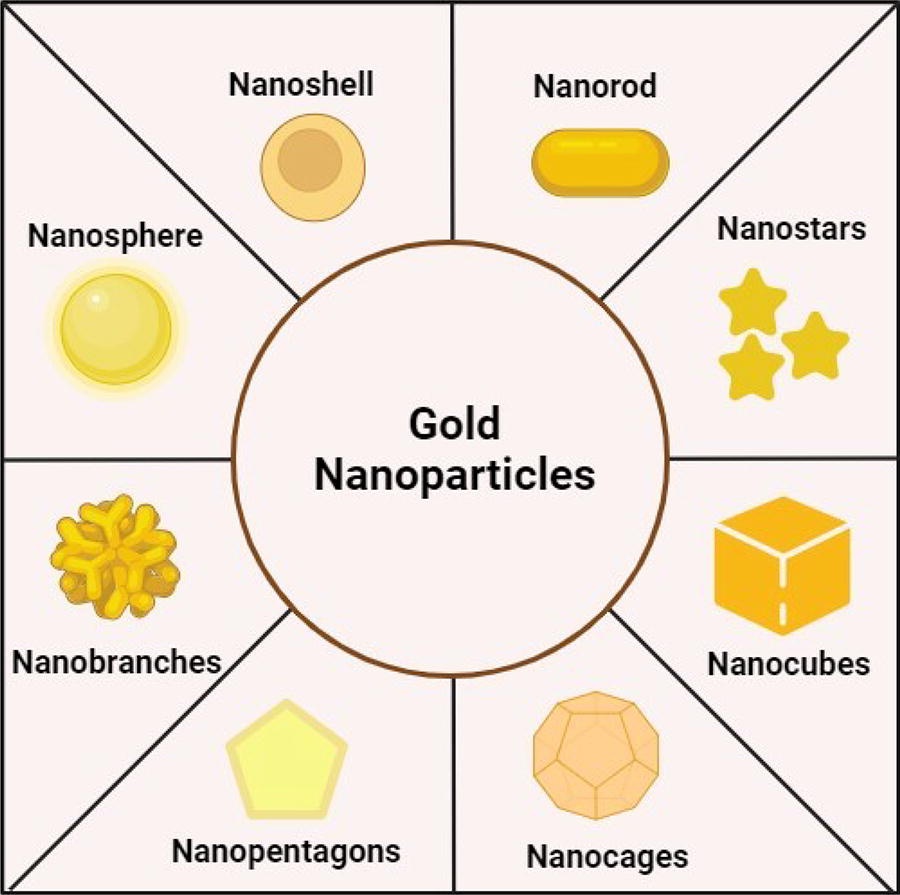
A schematic showing the most common gold nanoparticle assemblies and their morphologies. Image created with BioRender.com.
Gold nanorods
The elongated nanoparticles known as gold nanorods have a high aspect ratio and unique optical features that are ascribed to their peaks for longitudinal and transverse surface plasmon resonance (LSPR and TSPR). The LSPR peak can be adjusted for a certain NIR light absorption by changing its diameter and length. 36 They are very useful in photothermal therapy, especially in the treatment of viral disease, because of their tunability. Because of their distinct plasmonic behavior, gold nanorods are used in imaging and diagnostic procedures in addition to therapeutic applications, where they improve the accuracy of medical therapies. 37
Gold nanostars
A unique variety of AuNPs known as “gold nanostars” are distinguished by their morphology, which resembles stars. Compared with other nanoparticle sizes, this particular shape offers superior NIR light-absorbing capabilities because of its larger surface area. 38 Gold nanostars’ structural characteristics enhance their optical characteristics and increase their therapeutic potential, which makes them ideal for use in photothermal treatment applications. Furthermore, their large surface area makes it easier for them to functionalize with drugs or targeting ligands, which improves their effectiveness in targeted drug administration and medical imaging. 39
Gold nanocubes
Cubic-shaped AuNPs are distinguished by their high surface-to-volume ratio. The unique LSPR peak displayed by these nanostructures can be precisely adjusted for particular uses. The enormous surface area of gold nanocubes has proven useful in catalysis, improving reaction efficiency. 39 They are also used in surface-enhanced Raman spectroscopy (SERS), where the Raman signals are amplified greatly by their plasmonic characteristics and shape, making molecule detection and analysis more sensitive. Targeted medication distribution and imaging are two biological applications that highlight the versatility of gold nanocubes. 38
Gold nanospheres
The spherical nanoparticles called gold nanospheres are distinguished by a distinctive LSPR peak and consistent size distribution. Gold nanospheres are widely employed in biomedical imaging and catalysis, and are frequently used as a standard for evaluating the optical characteristics of various gold nanoparticle shapes. 40 They have also been studied for their use in immunoassays and molecular diagnostics, as well as for their function as carriers for drug delivery systems. 41
Gold nanobranches
The branching structure of gold nanobranches greatly expands their surface area. Due to the many LSPR peaks produced by this structure, gold nanobranches are very useful for processes such as catalysis and SERS.47 Their increased surface area also makes it easier for them to be used in the delivery of drugs and biological sensing, where they can offer therapeutic agents substantial loading capacities. 40
Gold nanocages
The hollow, cage-like nanoparticles known as gold nanocages have special optical qualities such as SERS and an extensive surface area. These characteristics render gold nanocages appropriate for use in biological imaging and catalysis. With the help of their tunable optical characteristics and hollow structure, they enable considerable loading of drugs, targeted drug delivery, and photothermal therapy to be used. 35
Gold nanopentagones
Because of their unique geometry, gold nanopentagons are pentagonal-shaped nanoparticles that show several LSPR peaks. Their performance in SERS and catalysis applications is improved by their large surface area. 42 In addition, because of their improved surface reactivity and binding properties, gold nanopentagons have shown potential in environmental monitoring and hazardous material detection. 34
Methods of Synthesis
Chemical reduction method
The process of chemical reduction is a commonly used approach to formulate AuNPs. It includes the use of a reducing agent to reduce gold salts, usually hydrogen tetrachloroaurate (HAuCl4), resulting in the formulation of AuNPs. The reducing agent transfers electrons to the gold ions (Au3+) in this procedure, turning them into elemental gold (Au0) and creating nanoparticles in the process. This approach is well known for being straightforward and effective. 42
Turkevich method
The Turkevich method is a well-known method, in which sodium citrate functions as a stabilizing and reducing agent to produce spherical nanoparticles with an average diameter of 10 to 20 nm. Sodium borohydride (NaBH4) combined with thiol stabilizers is an additional noteworthy technique called the Brust–Schiffrin approach, which yields smaller nanoparticles in organic solvents. 42
Green synthesis
Green synthesis techniques generate AuNPs by using ecologically friendly chemicals or biological systems. This method is becoming more popular since it uses nontoxic reagents and is environmentally beneficial. 43
Plant Extracts
A variety of plant extracts have the ability to stabilize and reduce. For instance, it has been reported that tea leaf extract can be used to reduce HAuCl4 and produce stable AuNPs. 43
Microbial Synthesis
Gold ions can be reduced by some microbes, including fungi and bacteria, to create nanoparticles. The large-scale manufacturing capacity and sustainability of this biological technique are its main advantages. 43
Seed-mediated growth method
The process of preparing minute seed particles and then allowing them to develop into larger nanoparticles is known as the seed-mediated growth method. 44
Preparing the Seeds
A powerful reducing agent such as NaBH4 is used to synthesize small gold seeds, measuring 1–3 nm. 44 After that, the seeds are put into a mixture that contains gold salt, ascorbic acid, and a small amount of reducing agent. Depending on the reaction conditions, this step enables the controlled development of AuNPs into a variety of forms and sizes. 44
Physical methods
Physical procedures such as evaporation-condensation, laser ablation, and photochemical reduction are frequently used to create AuNPs. 34
Laser Ablation
In this technique, a liquid medium is present while a powerful laser pulse is applied to a gold target. Nanoparticles are formed by the condensation of ablated gold atoms. With this method, pure nanomaterials can be produced without the need for chemical reagents. 34,45 The process of evaporation-condensation entails heating a gold source to cause the gold atoms to evaporate, after which they condense to produce nanoparticles. By altering both pressure and temperature, one may change the dimension of the nanoparticles. 37
GOLD NANO FORMULATIONS IN VIRAL INFECTION
Significant antiviral capabilities have been demonstrated by AuNPs against a wide range of viruses, including SARS-CoV-2, the pathogen that causes COVID-19. AuNPs can imitate the receptors on host cells that viruses seek for entry, so “trapping” viruses and blocking cellular infection. 46 This is one of the main antiviral mechanisms. Furthermore, AuNPs prevent the expression of viral genes and proteins, which hinders the virus’s capacity to multiply and spread within host cells. 28 Positively charged AuNPs are especially effective at upsetting critical subcellular structures such as lysosomes and the cytoskeleton, which are necessary for viral reproduction. The surface charge characteristics of AuNPs play a critical role in their antiviral activity. Lentivirus and human coronavirus OC43 are two examples of enveloped RNA viruses that are severely inhibited by this disruption. 47 These AuNPs based formulations have the potential to combat new and re-emerging infections in addition to the current viral threats. 48
Mechanism of Action of AuNPs in Inhibition of Viral Replication
Through a variety of processes, AuNPs have shown strong antiviral characteristics, suggesting that they may be useful against a wide range of viruses, including SARS-CoV-2. 49 Disrupting virus–cell interactions is one of the main mechanisms; AuNPs resemble host cell receptors and lure viruses to bind to the nanoparticles instead. 48 Through localized pressure created by this binding, the virus’s structure is distorted and damaged, rendering it inactive and preventing cellular invasion. Moreover, AuNPs block the expression of viral genes and proteins, which is essential for RNA viruses such as SARS-CoV-2 because it prevents viral RNA synthesis and packaging. 50 This further hinders viral reproduction within host cells. Furthermore, AuNPs target common viral characteristics such as envelopes or capsids, exhibiting broad-spectrum antiviral activity, 47 (Fig. 3). The goal of ongoing research is to maximize these qualities for secure and efficient clinical uses. 44

Scheme of a virus infecting a cell and interaction between gold nanoparticles with viral DNA/RNA to prevent its replication. Image generated with BioRender.com.
The interaction between viruses and host organelles may be disrupted by nanomaterials through different pathways, Table 2.
Gold Nanoparticles Against Some Viral Infections and Mechanisms
AuNPs, gold nanoparticles.
Mechanism of Antiviral Action of AuNPs
Viral entry inhibition
By preventing viral proteins from binding to cell receptors, AuNPs can prevent viruses from penetrating host cells. This is because AuNPs can interfere with the binding and entry process by imitating or interacting with viral receptors on cell surfaces. 57 For instance, research has demonstrated that AuNPs inhibit viral proteins on the cell membrane, preventing the herpes simplex virus (HSV-1) from adhering to Vero cells. This decreases overall infectivity and cell-to-cell transmission. 57
Preventing viral replication
AuNPs may obstruct the replication of viruses once they have invaded host cells. The nanoparticles disrupt important enzymes needed for viral replication or interact with the RNA or DNA of the virus. According to certain studies, AuNPs, for example, interfere with viral genetic material, which prevents replication. 46
LSPR effect
AuNPs have the ability to produce a localized electric field, which is a special phenomenon known as the LSPR effect. Viral structural integrity may be weakened by this field’s ability to damage capsids or viral envelopes. For encapsulated viruses, this near-field interaction works very well, preventing them from infecting the host. 58
The primary approach that AuNPs work against viruses is by interacting chemically and physically with their structures. Direct binding to viral capsids or envelopes is made possible by their small size and large surface area, which might result in structural alterations that deactivate the virus (Fig. 4). By interacting with viral surface proteins, AuNPs can also stop viruses from attaching, and entering host cells. According to some research, functionalized AuNPs provide a flexible antiviral approach by limiting replication pathways or inhibiting certain viral enzymes. 59

Antiviral mechanism of gold nanoparticles involves:
Gold Nano Formulations of Antiviral Drugs
The use of ART considerably increases the estimated lifespan and quality of life of HIV-infected individuals, although eradicating latent HIV reservoirs remains difficult. This study conducted by Fotooh Abadi et al., 2023, 60 examines a novel arrangement of tenofovir (TNF) and AuNPs to overcome limitations in current ART. TNF-tethered AuNPs were found to be completely safe in cell viability, genotoxicity, hemolysis, and histopathology tests. Importantly, this combination has roughly 15 times more anti-HIV1 reverse transcriptase activity than native TNF, as well as substantial anti-HIV1 protease activity. In vivo biodistribution experiments have shown that AuNPs could successfully reach numerous tissues and organs, addressing the issue of insufficient drug delivery to HIV reservoirs. These data, published for the first time, reveal that TNF-AuNPs have multifunctional anti-HIV1 actions and show potential as a novel next generation therapeutic platform for AIDS treatment. 60
In a consequence of the worldwide COVID-19 epidemic, multiple vaccination techniques have been developed to generate strong immune responses. The study conducted by Dalibera et al., 2023, 61 synthesized nanoparticle vaccines by covalently linking self-assembled 24-mer ferritin with the receptor binding domain and/or heptad repeat subunits of the SARS-CoV-2 spike (S) protein. In comparison to monomer vaccinations, nanoparticle vaccines produced greater counteracting antibodies and cellular immunological responses. In animals, immunization with receptor binding domain (RBD) and/or receptor binding domain hepted repeat (RBD-HR) nanoparticles drastically decreases viral load in the lungs after infection. Furthermore, these nanoparticle vaccinations induced neutralizing antibodies and cellular immunological responses to additional coronaviruses. Nanoparticle vaccinations elicited sustained neutralizing antibodies, as well as T and B cell responses, in rhesus macaques for more than 3 months before boost immunization. These findings indicate that the prepared nanoparticle vaccines are an intriguing approach to defend against SARS-CoV-2 and possibly other viruses of the same family. 61
The widespread emergence of multidrug-resistant bacteria needs the development of more potent antibacterial drugs. The study by Hashem et al., 2022, 64 describes the synthesis, characterization, and antibacterial effectiveness of chitosan-modified AuNPs (Chi/AuNPs). Colloidal AuNPs were synthesized via a chemical reduction technique, with chitosan serving as both a stabilizing and reducing component. Chi/AuNPs had synergistic effects, damaging bacterial membranes through cell wall penetration, enhanced membrane permeability, apoptosis, DNA damage, disruption of metabolic pathways, such as ATP production pathway, damage of electron transfer chain or Reactive oxygen species (ROS) generation. 62 Another pathway includes a higher affinity of gold towards protein leading to agglomeration of AuNPs to bacterial cell wall leading to attachment of AuNPs to membrane protein. When inclusion bodies of AuNPs (IB-AuNPs) are formed, the bacterial membrane is disrupted, and they bind to cytoplasmic proteins that have an affinity for IB-AuNPs, which ultimately causes the bacterium to die, 62,63 while demonstrating considerable antibacterial action. The maximum inhibitory impact was against Pseudomonas aeruginosa at 500 µg/mL, with a zone of inhibition of 26 ± 1.8 mm. The least effective was against Staphylococcus aureus, with a zone of inhibition of 16 ± 2.1 mm. Furthermore, Chi/AuNPs showed antifungal efficacy against Candida albicans with a MIC of 62.5 µg/mL. The sulforhodamine B (SRB) assay found an IC50 value of 111.1 µg/mL for cell viability and proliferation. In vitro wound-healing models demonstrated rapid and successful healing, establishing Chi/AuNPs as attractive candidates for improved bandage materials. 64
Rawat et al., 2021, 65 formulated biodegradable AuNPs containing cabotegravir (CAB), with pectin (PEC) acting as a reducing and stabilizing agent. The CAB-GNPs were created using a modified Turkevich method and optimized using the Box-Behnken design. In vitro drug release tests resulted in around 63% CAB release in simulated gastric buffer and near about 46% in physiological buffer. Cytotoxicity studies and antibacterial studies indicated that the prepared nanoparticles were safe, with lower toxicity than pure CAB. These data imply that PEC-based CAB-AuNPs are a promising CAB delivery strategy, with the potential to improve HIV prophylaxis. 65
The green synthesis of nanoparticles is a viable alternative due to its cost-effectiveness and environmental safety. Priya et al., 2021, 66 investigated the anti-HIV potential of AuNPs manufactured from the plant Calophyllum inophyllum (CI), which has known anti-HIV capabilities. Nanoparticles were created from the fruit (CIF) and foliage (CIL) of CI and evaluated on HIV-1 strains. CIF-AuNPs showed significant anti-HIV activity, having an EC50 value near 0.090 ng/mL, but CIL-AuNPs had very little activity. Cytotoxicity tests on Vero cell lines demonstrated that both nano compounds exhibited negligible cytotoxicity at all studied doses. These findings indicate that CIF-AuNPs, combining the therapeutic qualities of CI with the advantages of nanomaterials, require additional exploration for in vivo applications. 66
The upsurge in resistance of influenza viruses (IVs) to antiviral medications needs the development of novel antiviral targets that are effective even after genetic modifications. Hemagglutinin (HA), a preserved surface protein required for IV interaction and merging of the membrane with host cells, is a viable target. The study conducted by Kim et. al 2020, 53 used a surfactant-free emulsion approach to create porous gold nanoparticles (PoGNPs) that utilize gold-thiol interactions with HA’s disulfide bonds, increasing the nanoparticles’ surface area for these interactions. PoGNP dosing significantly reduced IV infectivity, boosting Madin-Darby canine kidney cell lines (MDCK) cell survival to 96.8% in cells infected with H1N1, H3N2, and H9N2 strains vs. 33.9% in untreated controls. PoGNP inhibited viral entry by generating conformational changes in HA (Table 2). 53
Halder et al., 2018, 67 studied the antiviral activity of quasi-spherical gold nanoparticles (GNPs) against HSV infections. The GNPs were characterized as face-centered cubic crystalline structures. GAuNps’ antiviral activity against virus in Vero cells was dose-dependent, for HSV-1 and HSV-2. GAuNps reduced viral adherence and invasion into cells, with different inhibition percentages depending on the exposure period. GAuNps showed significantly decreased cytotoxicity compared to acyclovir, indicating the possibility of an effective substitute in antiviral treatment. 67
Borker et al., 2017, 68 also describe a one-pot sustainable production of non-cytotoxic AuNPs with PEC as a stabilizing and reducing component. PEC-reduced nanoparticles of gold (PEC-AuNPs) were produced. Their capacity to carry the antiviral medication zidovudine was examined. In vitro investigations demonstrated significant cellular uptake of PEC-AuNPs by macrophages, which was seen using confocal microscopy and measured using atomic absorption spectra. In vivo tissue distribution investigations in Wistar rats revealed PEC-AuNPs’ potential to target HIV reservoir locations. These findings emphasize the potential of PEC-AuNPs for applications in imaging in the treatment of cancer, notably with tumor-associated macrophages. 68
For extensive industrial use and medical applications, environmentally conscious synthesis methods of NPs are required. The study by Dzimitrowicz et al., 2016, 69 analyzes and optimizes the usage of aqueous extracts of plants Melissa officinalis, Mentha piperita, and Salvia officinalis to synthesize AuNPs under controlled circumstances. The effect of extract from plant type, precursor concentration, and temperature on AuNP generation and size was investigated using dynamic light scattering, UV absorption spectrophotometry, scanning electron microscopy, and transmission electron microscopy. M. piperita extract produced the smallest AuNPs under optimal circumstances. Attenuated complete reflection Fourier transform infrared spectroscopy revealed that multiple groups participated in the synthesis, while the Folin–Ciocalteu assay emphasized the phenolic molecules play a vital effect. In addition, treating bio reduced AuNPs with atmospheric pressure glow micro discharge resulted in increased agglomeration and size. 69
ART has considerably increased the average lifespan and quality of life for HIV-1 patients, but it has limitations such as resistance to drugs and inadequate penetration into specific anatomical compartments. Improving antiretroviral delivery could help to address these difficulties. This work by Garrido et al., 2015, 70 focuses on the usage of inorganic AuNPs as scaffolding for combining antiretroviral compounds. These AuNPs allow for entrance into a variety of cell types and exhibit antiviral action due to an HIV integrase inhibitor on their outermost layer. Importantly, the study confirmed that these AuNPs can penetrate into the brain in vivo without causing harm. These findings imply that AuNPs have tremendous promise as an innovative approach for improving HIV therapy, potentially overcoming multiple drawbacks of existing ART by increasing drug delivery and effectiveness through various biological barriers. 70
Paradowska et al., 2021, 71 showed that nonfunctionalized AuNPs show antiviral properties towards HSV type 1. When administered as a pretreatment, AuNPs dramatically reduced HSV-1’s cytopathic effect (CPE) in Vero cells in a time- and dose-dependent order. This antiviral action was discovered within the safe concentration range for AuNPs. Notably, smaller AuNPs surpassed larger nanoparticles in terms of lowering HSV-1 CPE. Smaller nanoparticles’ higher efficiency is thought to be due to their near-field contact with the virus envelope. These data imply that AuNPs, especially those with smaller diameters, have potential as therapeutic agents for HSV-1 infections, providing an innovative strategy for antiviral therapy by exploiting their size-dependent characteristics and non-toxicity. 71
Babaei et al., 2021, 1 targeted the anticancer and antiviral properties of AuNPs against the influenza A virus and human glioblastoma cell lines. In vitro tests employing hemagglutination inhibition, (3-[4,5-dimethylthiazol-2-yl]-2,5 diphenyl tetrazolium bromide) assay (MTT), tissue culture infectious dose 50, flow cytometry, and scratch tests revealed strong antiviral and anticancer activity. At doses of up to 0.5 μg/mL, AuNPs were well tolerated by MDCK cells and significantly suppressed virus infectivity, especially when administered before or during infection. AuNPs also triggered apoptosis and inhibited the proliferation and migration of cell lines in time-dependent ways. These results emphasize AuNPs’ possibilities as promising medicines for antiviral and anticancer therapy, calling for more investigation into their mechanisms of action. 1
El-Sheekh et al., 2020,
72
investigated the antiviral effectiveness of biologically produced nanoparticles against drug-resistant viruses, namely HSV type 1. Both blue-green algal strains, Spirulina platensis, and Oscillatoria sp. produced silver oxide and AuNPs, respectively. Both forms of nanoparticles reduced HSV-1’s CPE in Vero cells, achieving a 90% reduction at 31.25 μL, with Ag2O|AgO-NPs showing a higher reduction rate than Au-NPs. These results highlight the potential of green nanotechnology for producing antiviral medicines against HSV-1.
72
Melendez-Villanueva et al.,
As per Mehranfar et al., 2020, 73 simulations based on molecular dynamics were used to assess the antiviral effectiveness of the AuNPs modified with different groups of compounds, including undecanesulfonic acid (Mus), 3-mercaptoethylsulfonate (Mes), octanethiol (Ot), and an additional peptide, against SARS-CoV-2. The crystal structure of angiotensin-converting enzyme 2 (ACE2) served as a guide for the novel peptide’s structure, with an emphasis on the 15 amino acids that interact most strongly with the SARS-CoV-2 receptor binding domain. The findings showed that all functionalized AuNPs interacted strongly with SARS-CoV-2’s RBD. Notably, the AuNPs functionalized with the new peptide formed a complex that was more stable with the RBD than the normal receptor, ACE2. Several analyses indicated that these developed AuNPs, especially those modified with the new peptide, show potential as powerful antiviral drugs against COVID-19. 73
Nasrolahi Shirazi et al., 2013, 74 developed cyclic peptides with alternating arginine and tryptophan residues to create cyclic peptide-capped gold nanoparticles (CP-AuNPs). The tryptophan residues aided in the reduction of AuCl4 − to produce CP-AuNPs, whereas the arginine residues captured chloroaurate anions. Differential interference contrast microscopy revealed that capped AuNPs dramatically improved the cellular transport of fluorescence-labeled lamivudine over the medication alone. Flow cytometry showed that AuNPs boosted the cellular uptake of fluorescence-labeled lamivudine, emtricitabine, and stavudine in SK-OV-3 cells, with lamivudine uptake around 12- and 15-fold higher in CCRF-CEM and SK-OV-3 cells, respectively. Confocal imaging revealed that AuNPs improved doxorubicin retention and nuclear localization in SK-OV-3 cells after about 24 h of treatment. These findings indicate that AuNPs can be useful noncovalent prodrugs for antiviral and anticancer drug delivery. 74 Antiviral activity of some functionalized AuNPs is summarized in Table 3. The perspective of AuNPs against respiratory viruses has been compiled in Table 4.
Antiviral Activity of Functionalized Gold Nanoparticles
HSV, herpes simplex virus; Mus, nudecanesulfonic acid. Mes, 3-mercaptoethylsulfonate; Ot, octanethiol.
Gold Nanoparticle Effectiveness Against Respiratory Viruses
ACE2, angiotensin-converting enzyme 2; AuNPs, gold nanoparticles.
CONCLUSION
AuNPs’ main benefit in antiviral therapy is that they can improve medication distribution. AuNPs ensure that a larger concentration of the active medicine reaches the target site by enhancing the stability and solubility of the antiviral drug.
Through surface changes, AuNPs are able to bind directly to viral particles or infected cells, boosting therapeutic efficacy and minimizing negative effects. This allows for tailored delivery of the medication. PEC-stabilized AuNPs, for instance, have been demonstrated in experiments to efficiently target HIV-positive cells, and porous AuNPs can reduce the influenza virus’s contagiousness by interacting with the viral HA. In addition, AuNPs have inherent antiviral qualities. Multiple functional groups can connect to them thanks to their large surface area-to-volume ratio, which improves their contact with viral particles and prevents viral multiplication. By enhancing the immune system in addition to directly targeting the virus, this multimodal strategy produces a synergistic impact that further improves treatment outcomes.
FUTURE PROSPECTS
Even with these encouraging outcomes, several obstacles need to be addressed before AuNPs may be properly utilized in antiviral therapy. The efficacy and safety of nanoparticles can be impacted by variations in the shape and size of the particles due to the variations in synthesis techniques. Furthermore, even though the effectiveness of AuNPs has been shown in numerous research conducted in vitro, more thorough in vivo investigations are required to assess the pharmacokinetics, biodistribution, and long-term safety of AuNPs. In order to produce AuNPs with uniform shape, size, and surface qualities, it is imperative to develop standardized and scalable synthesis procedures. Green synthesis techniques, such as the use of plant extracts, provide a sustainable substitute and ought to be investigated and improved. Comprehensive in vivo research is desperately needed to evaluate the pharmacokinetics, biodistribution, and possible toxicity of AuNPs.
Antiviral therapy will undergo a revolutionary change with the formulation of multifunctional AuNPs that possess the ability to stimulate immune response, deliver medicines, and perform diagnostic functions. Investigating the potential synergistic effects of AuNPs in conjunction with other antiviral medications or therapeutic approaches can enhance treatment results. It is crucial to set precise regulatory policies and procedures for the clinical application of AuNP-based treatments. The development and approval of AuNP-based antiviral medicines will be facilitated by cooperation between researchers, doctors, and regulatory agencies. AuNPs can be used in personalized medicine techniques to customize patient therapies according to their unique genetic profiles and viral infections. This will reduce side effects and increase therapeutic efficacy.
Footnotes
AUTHORS’ CONTRIBUTIONS
J.: Writing original draft, investigation, data curation, methodology. D.N.: Software, validation, resources, visualization. N.S.: Writing—review and editing, supervision. S.P.: Formal analysis, software. P.G.: Conceptualization, project administration, validation, formal analysis.
DISCLOSURE STATEMENT
No competing financial interests exist.
FUNDING INFORMATION
No funding was received for this article.