




Abstract
Abstract
The current landscape of Adverse Outcome Pathways (AOPs) provides a means of organizing information relating to the adverse effects elicited following exposure to chemicals. As such, AOPs are an excellent driver for the development and application of in silico models for predictive toxicology allowing for the direct relationship between chemistry and adverse effects to be established. Information may be extracted from AOPs to support the creation of (quantitative) structure-activity relationships [(Q)SARs] and to increase confidence in grouping and read-across. Any part of an AOP can be linked to these various types of in silico models. There is, however, an emphasis on using information from known molecular initiating events (MIEs) to create models including 2-D and 3-D structural alerts, SARs and QSARs. MIEs can be classified according to the nature of the interaction, for example, covalent reactivity, oxidative stress, phototoxicity, chronic receptor mediated, acute enzyme inhibition, unspecific, physical and other effects. Different types of MIEs require different approaches to their in silico modeling. Modeling Key Events and Key Event Relationships is useful if they represent the rate limiting step or key determinant of toxicity. Modeling of metabolism and chemical interactions will become part of AOP networks, which are also driving species-specific extrapolation and respective adaptation of models. With more information and data being captured, in silico approaches will increasingly support the application of knowledge from AOPs to build weight of evidence and support risk assessment, for example, in the context of Integrated Approaches to Testing and Assessment (IATAs).
Introduction
A
The development of the (toxicological) pathway concept, not least stimulated by the 2007 National Research Council's report, 2 has seen a growth in the number of assays and hence data available, for example, those directly associated with pathways such as from high throughput/content assays such as Tox21/ToxCast 3 and omics4–6 or those that may be applied indirectly from existing in vivo and other data.7–9 These assays have provided an explosion in the number of pathway related data available, which could form the basis of either strategies to predict toxicity, or be used to develop computational models. However, there has been no overarching means of interpreting, rationalizing, or utilizing these data. As such, the Adverse Outcome Pathway (AOP) concept was developed in part as a response to the call for toxicology to become pathway orientated, but also to assist in the utilization of data from such assays. 10
It is appreciated that AOPs are a conceptual framework to support the prediction of toxicity, a full description of AOPs is not given here but is available from various authors.10–19 In practical terms AOPs will assist in the organization of data, assays, mechanistic knowledge, and models to predict toxicity within the paradigm of 21st Century Toxicology. The ability to use the pathway-derived data to extract further information and knowledge is one of their advantages, especially when they can be formalized into computational models.20,21 When associated with chemical structure, these models, also called in silico approaches, can provide a direct linkage between chemistry and adverse effect, leveraging the content of the AOP to support the meaning and interpretation of the model.22,23
In silico models to predict toxicity vary from 2-D structural alerts derived from structure-activity relationships (SARs), to more complex quantitative structure-activity relationships (QSARs) capable of predicting toxic potency. 24 This article explores the linkage of these models, as well as grouping and read-across, to AOPs. At the outset it is already well acknowledged that AOPs can support computational modeling. 21 In addition, the use of AOPs to support computational modeling deriving structural alerts25–28 for toxicity prediction, or as part of a grouping strategy leading to read-across and for QSAR development, is well established. 29 Other computational approaches, beyond the ab initio risk assessment consideration, that utilize and extend the AOP framework are the development of Integrated Approaches to Testing and Assessment (IATAs).13,18,30–38
The Links Between In Silico Models and the Different Steps of an AOP
Figure 1 illustrates that models, or in silico approaches, may potentially be utilized at all stages of the AOP to provide knowledge and information (it should be noted that the structure of the generic AOP shown in Figure 1 is illustrative only and many AOPs do not include exposure or proceed to the ecosystem level). There are many purposes to the use of models within the AOP framework; these include:
• providing data and information,
• capturing the knowledge of the AOP, and
• extrapolation and prediction.

Schematic of a generic Adverse Outcome Pathway (from source to ecosystem) with the types of in silico models that may be associated with each Key Event. AOP, Adverse Outcome Pathway; (Q)SARs, (quantitative) structure-activity relationships; PBPK, physiologically based pharmacokinetic; QIVIVE, quantitative in vitro to in vivo extrapolation.
Computational, or in silico, models for toxicity prediction are many and varied. The focus of this article is the relationship of chemistry-based models for toxicity prediction with AOPs. Briefly, as discussed in more detail below, in silico models are especially useful to capture and predict the molecular initiating event (MIE) of an AOP, such as binding to biological molecules or receptors, and thus predict which chemicals can potentially be associated with adverse effects triggered by the MIE. (Q)SARs can also model Key Events or Key Event Relationships further downstream in an AOP, which is relevant for toxicity prediction in particular if these events are rate-determining steps in an AOP. In this case biokinetic modeling will support the prediction of which steps in an AOP actually take place in specific exposure situations, and can contribute to the prediction of which target organs a chemical will be distributed to and the actual target organ concentrations. Modeling exposure related to the source and models determining, for example, oral or skin absorption or bioavailability as a whole, will support quantification of the effects occurring as a result of the AOP. Overall, a higher level of modeling, such as multiscale modeling, will be required to capture all elements of the AOP to link exposure to risk. Extending the consideration of adverse outcomes to the individual, population, or ecosystem level will allow for models to be created for more complex adverse effects.
Figure 2 summarizes the main differences where models may drive the development of AOPs and vice versa. It illustrates that on one hand AOPs can support the building of predictive models, to base them on mechanistic information and give them relevance for toxicity assessment, and on the other hand, computational models can help to compile AOP pathways. When both robust mechanistic information and computational models are available, this will allow for the better prediction of relevant adverse effects or their use in an IATA. As such, the ultimate aim of building models and organizing mechanistic information within the AOP framework is to provide relevant prediction of adverse effects to allow for adequate chemical safety assessment.
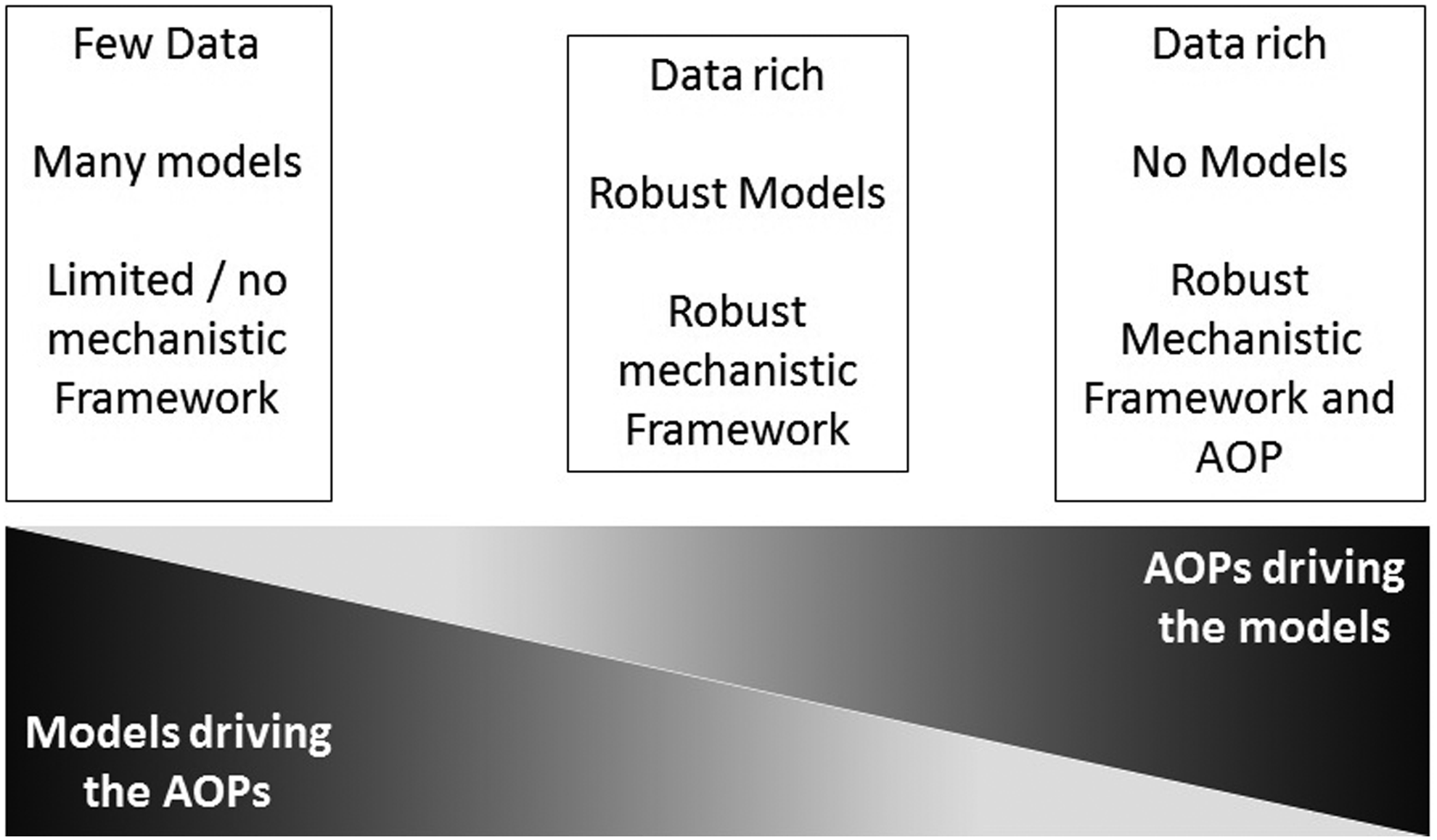
Main differences where models may drive the development of AOPs and vice versa.
It is important to also consider that there will be a cyclical process whereby models will be developed on the basis of a (putative) AOP, which will then be refined as more information is passed back to the model—likewise this will assist in the refinement of the AOP. More broadly, the relationship between AOPs and in silico chemistry based models can be considered as being:
(i) models using information derived from the AOP, (ii) models that support the use or application of information from the AOP, for example an AOP being used to provide evidence for the ab initio risk assessment of a substance and build a mode-of-action hypothesis,
39
(iii) AOPs supporting the mechanistic interpretation of a model or providing evidence to build a weight of evidence to support risk assessment (cf. read-across case studies).40–43
This article attempts to provide an overview of the types of models that may be applied at different stages of the AOP, taken in the broadest context from sources to ecosystem, with a particular focus on the mechanistic and toxicological aspects. However, this article focuses on the mechanistic aspects of the AOP, it does not consider exposure modeling, in silico models for the apical endpoint [e.g., traditional (Q)SARs] or ecosystem level models.
Predictive Models Based on AOP-Related Mechanistic Information
Models of the MIE
Information from the MIE is one of the key drivers for in silico models derived from an AOP.25–28 Before computational modeling approaches are considered, it should be recognized that there are different types of MIEs and each may require a different modeling approach. These have been summarized in general terms in Table 1, along with examples and the types of models that can be derived from the different types of MIE.22,23,44–74 Table 1 provides by no means an exhaustive list and practitioners will no doubt wish to expand this according to their needs and experience. The key to understand why this is important is in the concept of, if the MIE is known, then an appropriate model can be developed for it.
It is acknowledged that AOPs in this category do not have a chemical interaction. This category of MIE is included in this table to enable any framework to categorize AOPs to be fully inclusive of all possible interactions. It should be noted that non-chemical interactions may need to be defined separately.
DFT, Density Functional Theory; MIE, molecular initiating event; QSAR, quantitative structure-activity relationship; PPAR, peroxisome proliferator-activated receptor.
On the basis of knowledge of different types of MIEs, it is thus possible to classify AOPs with regard to the type of MIE. To illustrate the types of MIEs, Table 2 lists the citable AOPs (at the time of preparation of the article) listed on the AOP Wiki (https://aopwiki.org), 75 which is one component of the OECD-sponsored AOP Knowledge Base (AOP-KB, http://aopkb.org). 76 This wiki represents the central repository for all AOPs developed as part of the OECD AOP development effort by the Extended Advisory Group on Molecular Screening and Toxicogenomics. The AOP Wiki is not, of course, a complete list of AOPs with many others becoming available. However, what is clear from Table 2 is that the majority of citable AOPs on the AOP Wiki are for what is termed “chronic receptor mediated” toxicity, with a smaller number classified as being “covalent reactivity.” This is probably due to the AOPs being defined, at least at the start of the process of their compilation, around common, well-known and familiar modes of action. Table 2 was also supplemented by literature examples of AOPs where none were available as being citable from the AOP Wiki. It must be appreciated that these literature AOPs are likely to be less developed (in the formal sense of the AOP Wiki) at the time of writing.12,29,62,67,77,78
Where available “citable” AOPs from the AOP Wiki (https://aopwiki.org) have been used in preference to those available in the literature.
It is striking from Table 1 that the majority of models derived from AOPs utilize 2-D approaches to capture molecular fragments responsible for toxicity. There is a rich history of such “structural alerts” and their conversion into usable computational models. 20 There are many good reasons for this, for example, they are easy to define and comprehend—hence aiding in their transparency. Technologies such as SMARTS strings have made chemistry fragments easy to code and be handled computationally. 79 They have also been developed into a number of commercially and freely available expert systems. Most notable among the freely available systems is the OECD QSAR Toolbox, which for some endpoints, 80 for example skin sensitization, provides a direct linkage to the AOP and the possibility to build a read-across argument on the basis of data from the AOP.81,82 They are particularly suited when a structural fragment drives a particular chemical and/or biological interaction, for example, covalent binding to DNA or proteins.44,45 The disadvantage is that 2-D structural alerts implicitly are not able to capture 3-D properties and configurations that are required for receptor binding. 2-D alerts, for example, those coded as SMARTS strings, can be extended and made more sophisticated when considered as “chemotypes”, i.e., alerts extended with further information on molecular structure such as atomic charges; these chemotypes may be coded in the so-called Chemical Structure Reactivity Markup Language (CSRML).3,83
Receptor mediated MIEs leading to toxicity are more difficult to capture in terms of models. However, there is a growing appreciation of the needs for such models to assist in the prediction of chronic toxicity. 3-D or conformationally dependent properties can, to a limited extent, be captured with extended SMARTs strings that represent particular scaffolds.22,23 However, this is a relatively crude approach that may be suited for grouping and read-across but less for toxicity prediction when understanding stereoisomerism may be important. Chemotypes are more suitable for the capture and modeling of 3-D effects as they can supplement 2-D structural alerts with other properties. 83 Most suited, although requiring the greatest level of expertise for application, are techniques derived from drug design, for example, molecular modeling of the receptor-ligand interaction and/or development of toxicophores.57,58 There are also many reported studies (beyond the scope of this article) on modeling effects associated with endocrine disruption—most notably binding to the estrogen receptor. As an example, the recent CERAPP project, where a large variety of mostly QSAR-type models were developed, demonstrates the relevance of this approach. 84 Extending the endocrine disruption paradigm, the work of Wu et al. 59 mapped and compiled known mechanisms of developmental toxicity, supporting them with data and structural alerts. This is a scheme that allows for the interpretation and prediction of developmental toxicity rapidly, but at this time is, at best, only partially supported by AOPs. However, this approach maps out where development of AOPs is required.
There are a variety of modeling approaches relating to toxicities associated with unspecific MIEs, that is where there is no single definable interaction analogous to receptor binding or covalent interactions. For instance, models may be based on 2-D properties associated with giving the molecule the capability to act in the required manner, for example, the amine functionality promoting membrane accumulation leading to phospholipidosis.68,69 Alternatively, models may be related to the properties that govern an unspecific effect, for example hydrophobicity being the determining feature for nonpolar narcosis. 66
Overall, there is a need to identify the MIE and appropriate modeling techniques for it—this is crucial information that can be derived from an AOP. (Q)SARs should be benchmarked against the MIE to ensure that the modeling approach is valid for the endpoint of interest. Inappropriate modeling approaches run the risk of spurious and overfit models.
Models of key events and key event relationships
As indicated in Figure 1, the modeling of Key Events is further along the AOP toward apical endpoints and may be considered more relevant and quantitative than the MIE. Models may be developed for data derived from assays relating to individual Key Events, these may, for instance, be in the form of QSARs. However, there are two distinct issues in the modeling of data for Key Events, namely the difficulty in obtaining such data (although initiatives such as ToxCast and other High Throughput Screening projects may assist here) 3 and their relevance, especially when considered in isolation from the MIE, in comparison to, for instance, the MIE itself. However, when relevant data are available that are founded in the preceding Key Events within the AOP, the modeling of Key Events and Key Event Relationships may provide a more quantitative prediction of (adverse outcome) potency providing they are the rate limiting step. In addition, should a Key Event or Key Event Relationship not occur routinely following interaction with the MIE, and require further stimulation, for example, another MIE or reaching a critical concentration (a Point of Departure for the Key Event), then models may provide more useful information than one based on the MIE alone. However, should the Key Event provide no more meaningful information than the MIE, then it may be more appropriate to model the MIE as it is more fundamental and likely to be more rapid and less expensive to obtain data for.
Any models for Key Events will be similar to those for MIEs, that is, 2-D structural alerts for specific molecular fragments, toxicophores for receptor interactions. However, there are relatively few assay data available relevant to Key Events and even fewer, if any, models. One good source of information has been from the Ames test and related assays for genotoxic carcinogenicity. The Ames test in this instance is a good surrogate for the MIE involving interaction with DNA but less likely to be appropriate for the later Key Events in this AOP. Another source of data would be for skin sensitization where there is a well developed AOP 13 and where the AOP has been converted into an IATA. 33 Despite the proliferation of assays for the different stages of the AOP, with the exception of models for protein reactivity,49,85 no viable models for example for h-CLAT or other intermediate effect events have been published. Thus, in silico models would have the potential to eventually replace assays within the IATA, but have not yet been fully recognized, such models would assist in hazard identification and ultimately risk assessment. The reliability and relevance of in silico models to predict an endpoint within an IATA will be increased if the models are mechanistically based and cover different steps of an acknowledged AOP in the context of a consensus approach, that is, concordant results with independent prediction models.
There is also the possibility to model Key Event Relationships, such models may assist in the quantification and understanding of the relationship. The benefit here is that should the Key Event Relationship be the rate limiting step then a model for that specific relationship, which may resemble a QSAR or quantitative activity-activity relationship (QAAR), could hold the key to making a quantitative prediction of potency. Currently there are few, or no, examples of (Q)SAR or QAAR models for Key Event Relationships, although some in silico models for Key Event Relationships are becoming available, especially in the form of quantitative AOPs (qAOPs)—as described in the next section.
Ongoing efforts to formalize relationships in AOPs through ontologies 86 and to capture response-response relationships and corresponding data, for example, in the Effectopedia module of the AOP-KB (http://effectopedia.org) 87 will further support future model development in this area.
Models related to the whole AOP
It is conceivable that the ultimate aim of modeling the AOP may result in the development of an algorithm, or sequence of models, 21 to include all steps of an AOP. However, it is recognized that this is a long-term aspiration and will not, necessarily, be required if there is the possibility to predict the adverse outcome itself with a defined level of confidence. Currently, there are no chemistry-based approaches, i.e. (Q)SARs, that attempt to describe the AOP as whole. In the longer term, there may be value in this as it may assist in the implementation of models from the AOP in the form of IATA.88,89 However, there will be limited value going beyond chemistry-based models for the MIE and possibly the rate-limiting Key Event Relationship. There is increasing interest in qAOPs that attempt to formalize the Key Event Relationships from the MIE to the Adverse Outcome, for example, Conolly et al. 89 developed a qAOP that linked the inhibition of cytochrome P450 19A aromatase (the MIE) to population-level decreases in the fathead minnow. The qAOP itself consisted of three linked computational models for relevant parts of the AOP.
A further approach that has yet to be fully applied to AOPs is that of multilevel or multiscale modeling. 90 These approaches attempt to derive interconnected models for each component of the AOP in a manner that is representative of the overall AOP. As such it is a data hungry approach. These models may be fed with data from public data sources such as ChEMBL22,23,91–93 and ToxCast/Tox21. 94 The use of ToxCast data in this context remains an opportunity and a challenge, with more data and a better appreciation of how to use the data required. 95
Specific Considerations for In Silico Modeling with Regard to AOPs
Transformations and interaction of chemicals
Until now, metabolic activation has seldom been considered as part of an AOP, however, it is necessary for chemistry-based in silico modeling (and the use of information from an in vitro assay) if a realistic toxicological profile is required and only the parent structure is available. For instance, it is important to determine whether the parent molecule will be metabolized into a more toxic form or detoxified. A large number of in silico approaches are available to predict potential metabolites, 96 some freely available and others may require payment. The performance of such predictive methods is not always ideal with over-prediction of metabolites being one problem, and the difficulty to identify stable metabolites and kinetics/rates of transformation being another. 97 There is, however, the possibility that knowledge of metabolic events in AOPs may provide better knowledge to support improved toxicity prediction.
Another possibility to use knowledge from AOPs to support the capture of information and development of in silico models is with effects such as chemical interactions. In this case, should a key stage of an AOP require the inhibition of an enzyme (either from the target or another molecule), this knowledge could be incorporated into a model. As yet, there are no approaches that have used the information from an AOP in this way—this is something that would be of immense benefit for understanding and modeling drug–drug interactions as well as predicting effects from combined exposure to chemicals, taking into consideration possible synergistic effects—even over time—which are not accounted for when evaluating chemicals individually.
As AOPs evolve naturally from linear constructs to networks of inter-related effects, 21 metabolism and interactions will become integral to the development of AOP networks within an ontology framework, a formalized way to organize AOP knowledge and capture AOP relationships. 86 This provides the possibility, for example, to include models for metabolism, particularly the ability to bind to a CYP or enzyme and the rate of binding/inhibition. In addition, models will be required to predict relevant metabolites that may go elsewhere in the AOP network, or to completely independent AOPs. The other possibility is that knowledge of metabolism, metabolite formation, and rates of formation that is contained within the AOP network will provide information for the models themselves, thus the AOP will drive the model.
Interspecies relationships of toxicity and sensitivity
AOPs provide a rational means to extrapolate toxicity across species. The relative similarity of acute aquatic potency within groups of compounds acting by a similar mechanism of action, especially nonpolar narcosis, has been known for many years 98 and can be applied to successful QSAR development. 29 Similarly, the need to take care of other mechanisms of action, particular those associated with species-specific metabolism 99 or reactivity 100 is important and can be related to the individual AOPs. While generalist extrapolation approaches may work for lethal potency, more sophisticated modeling will be required for receptor mediated responses. Knowledge of the essential receptors in an AOP can help drive the extrapolation of AOPs from one species to another. Thus, while AOPs are chemical-agnostic they are also species-specific and therefore can drive the adaption/applicability of predictive models. The web-based SeqAPASS tool is one such approach, utilizing information on receptor homology to allow for extrapolation of effects, being wholly supported by the AOP.101,102
Models for exposure and bioavailability—adding value to AOPs
While not strictly part of the AOP, computational models for exposure and bioavailability are useful for their implementation. 103 These can impact at various points while using information from an AOP. Models for exposure and bioavailability also vary in their complexity. Another area of progress is the development of Aggregate Exposure Pathways that will provide information to derive models from. 104
There are a number of SAR approaches that can be used to screen out compounds that are not likely to reach the site of the MIE. Very commonly used (especially as a drug design tool) is the Lipinski Rule of 5105 and various adaptions. 106 The premise here is that a small number of easily calculated properties can identify compounds with low solubility which is taken as being indicative of poor oral absorption—thus, if this is required for systemic exposure, then risk assessment may be able to discount oral exposure as a likely route to stimulate the AOP. In a similar manner, Ates et al. developed a small number of physicochemical properties that are seen to be determinants of poor absorption through the skin. 107
There are also QSARs for effects such as bioavailability that may be used as part of the risk assessment process. In addition, QSARs can provide an estimate of exposure following absorption through the skin,107,108 blood-brain barrier, 109 cornea, 110 and various other membranes. 96 While such QSARs may be useful, to assess organ level concentrations following different types of exposure and doses requires the use of physiologically based kinetic models.111,112
AOP-Derived Models Driving Grouping and Domain Definition
In addition to supporting models such as (Q)SARS, the information from MIEs is a key means of grouping compounds providing a mechanistic basis and transparency.113,114 In silico 2-D profilers of structural alerts, built on knowledge of MIEs, have provided a means to group compounds for a number of adverse outcomes including skin sensitization 79 ; respiratory sensitization 46 ; phospholipidosis68,69; mutagenicity44,115; hepatotoxicity 116 ; reproductive toxicity, 59 and testicular toxicity. 117 Successful grouping allows for read-across to fill data gaps for these types of endpoints.
The MIE can also be used to define the chemical domain of an AOP through intelligent testing using assays derived around the MIE. For instance, the definition of mechanistically derived domains of reactivity, as measured by in chemico testing, has been shown to assist in the identification of chemical domains associated with protein reactivity, which in turn may be related to effects such as skin sensitization or elevated acute toxic potency.118,119
The value of AOPs to support read-across was demonstrated in a series of case studies.40–43 The case studies demonstrated how the read-across hypothesis and justification were strengthened with knowledge of data from New Approach Methodologies that were related to an AOP. 120
Conclusions and Recommendations
AOPs provide a framework to organize information within the context of 21st Century Toxicology. As such, they are a good driver for the creation, development, and application of in silico models to predict toxicity. Indeed, AOPs provide the direct mechanistic relevance and transparency that is a prerequisite for in silico models of toxicity. The ability to be able to reference back to an AOP has been shown to be crucial for the justification of grouping and read-across and to allow for the development of IATA. As further information and data are captured, in silico models provide the means to create knowledge and apply it in a rational manner to predict toxicity.
Currently, most in silico models from AOPs are derived from the MIE. Qualitative models can be derived from knowledge of the MIE, in theory with limited knowledge and without data to support the hypothesis, for example, an alert for skin sensitization may be developed on the basis of only a single data point if there is a clear mechanistic (i.e., organic chemistry) understanding. Quantitative models for the MIE, as well as for Key Events and Key Event Relationships require a more complete data set with information from a greater number of compounds covering a range of activity and properties. MIEs, in terms of modeling, can be classified into a number of types (Tables 1 and 2). It is useful to classify MIEs in this manner. Capturing the type of MIE will allow for possibilities for modeling from an AOP to be identified; these could be stored in the AOP Wiki in the first instance and then progressed to Effectopedia and tools such as the OECD QSAR Toolbox. To maximize the use of information from AOPs there should be a shift to storing information on the MIE in a manner that could be translated into an in silico model, for example, classifying MIEs in tools such as Effectopedia and providing a direct linkage from there to a chemistry-based model. Currently, most in silico models derived from the MIE are based on 2-D descriptions of chemistry (with some notable exceptions). Most models are for MIEs associated with receptor binding, with covalent interactions also well represented.
Key Events and Key Event Relationships may also prove useful for modeling, however, with notable exceptions such as receptor binding data and endpoint data such as those for the Ames assay, there is a lack of data. The lack of data is particularly acute for “intermediate” Key Events and Key Event Relationships, that is those between the MIE and the adverse outcome. With increasing data becoming available in the framework of 21st Century Toxicology and high-throughput measurements, such data gaps may be filled in the future. However, they will only be useful if they represent the rate limiting step or key determinant of toxicity. These should form the basis of QSARs in particular as there is a desire to make the predictions more quantitative. The accurate prediction from chemical structure of metabolites and their rates of formation have historically been very difficult; this is an area where improvements are required, especially as networked AOPs become a reality.
Modeling of the whole AOPs, or qAOPs, will also require further data. At the moment a multitude of full chemistry-based computational models for a complete AOP seems unlikely. However, consideration of the AOP framework, especially as the new and/or updated tools become available, will both support model development and allow for the identification of gaps where either models or AOPs are required.
In conclusion, ideally in silico models will ultimately allow for the complete replacement of toxicological testing whereby only a chemical structure is required to make a hazard and/or risk assessment—however, we are a long way from achieving this. As the frameworks provided by AOPs (or whatever framework is utilized) to organize information and data become more sophisticated, the needs of modeling and the intimate and intricate relationship between the AOP and the models should not be forgotten but should be at the heart of AOP development and data capture.
Footnotes
Author Disclosure Statement
No competing financial interests exist.