




Abstract
Introduction:
Allelopathic effects have a wide range of action, at the genetic and biochemical level, favoring the germination and survival of plants and, often, helping as a phytosanitary strategy in reducing infections that generate loss in the agro-industrial sector. However, in addition to pesticides, metabolites of natural origin have been identified as an important tool in combating phytopathogenic microorganisms and, due to their symbiotic activities in the environment, growth promoters of several plant species. This study aims to assess the antimicrobial activity against Burkholderia cepacia, allelopathic, and phytotoxic potential of the (+)− usnic acid (UA).
Materials and Methods:
The experiments were conducted in laboratory conditions using the compound at different concentrations and the test organism were Solanum lycopersicum.
Results:
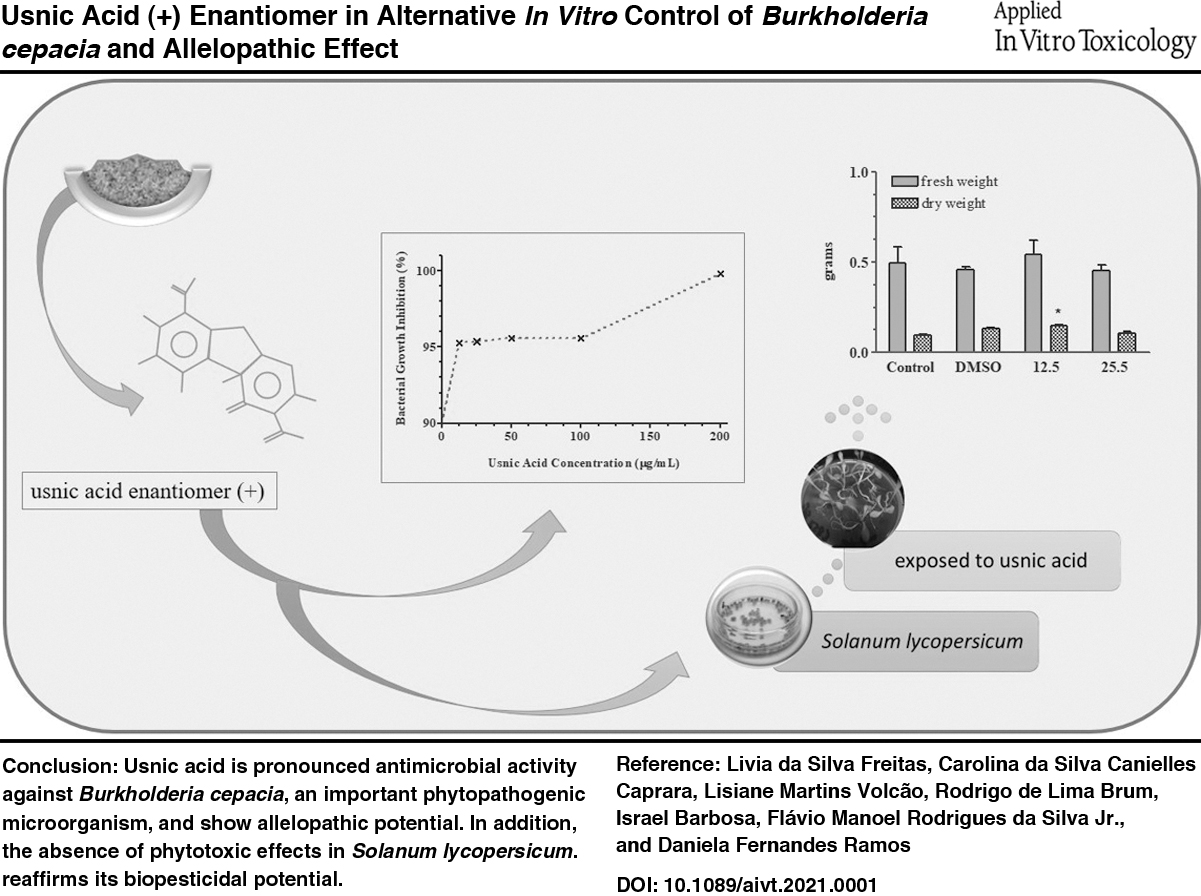
The compound at 12.5 μg/mL was able to reduce >90% of the evaluated bacterial population and any significant toxic effects were observed on the germination.
Conclusion:
In addition, at 25 μg/mL, the UA did not interfere in the fresh and dry weight of the tomato, corroborating the potential of this compound as a biocontroller, since it does not cause a pronounced phytotoxic effect, selectively assessing a pathogenic microorganism.
Introduction
The use of pesticides in agriculture has been the focus of research around the world in recent years, both in the search for reducing the costs of agricultural production and in the problem involving their toxicity health.1,2 In this context, Brazil has acquired a prominent position in these discussions, in view of the high consumption and the variety of pesticides detected in Brazilian soils. 3
Despite the benefits from the use of pesticides, such as increased crop yields and reduced prices from agricultural products, the detection of their residues in different spheres of the environment and in food has raised concerns.4,5 Thus, the search for safe and quality food has been the main reason for the use of alternative methods of phytopathogen control. Some of these methods have been known since antiquity, through the use of botanical insecticides and plant derivates, applied directly to the grains to be cultivated.6,7
Plants and microorganisms are rich sources of thousands of secondary metabolites, with ∼200,000 already identified and countless to discover. 8 The high structural diversity and wide biological activity of natural products has attracted attention from multiple areas of agriculture, chemistry, biology, and health. Several natural products have been among the most important antibacterial, antifungal, and anticancer agents today and, in addition, they have been successfully applied in the pharmaceutical industry. 9
As an integral and essential part of ecosystems, and an important producer of secondary metabolites, lichens have been used in folk medicine for centuries, even though the ecological impact of these metabolites has not been fully described. 10 The usnic acid (UA), 2,6-diacetyl-7,9-dihydroxy-8,9b-dimethyl-1,3-(2H, 9H) dibenzofuran, is an allochemical compound resulting from the metabolism of lichens. It has important characteristics such as low synthesis cost, simple extraction, and hydrophobia. In addition to an antiviral, antibacterial, antihelmintic, antifungal, and antitumor properties of this compound.11–20
Burkholderia cepacia is a bacterial species with properties useful in agriculture, as a growth promoter and in the inhibition of others phytopathogenic microorganisms. 21 However, it has been pointed out as an opportunistic or obligatory phytopathogen that affects several agricultural cultivars, through nodular induction, which has still been little studied with regard to its suppression and control. 22 More specifically, this a primary onion pathogen, and opportunistic for cultivars such as tomatoes, beans, and peas. 23 This article aims to determinate the antibacterial potential of the UA enantiomer (+) in B. cepacia, and its effect on the germination and growth of the test organism Solanum lycopersicum.
Materials and Methods
Chemical procedures
The UA (2,6-diacetyl-7,9-dihydroxy-8,9b-dimethyl-1,3-(2H, 9H)-dibenzofuran-furandione) was purchased from Sigma-Aldrich®. The UA was solubilized per the manufacturer's recommendations at 10 mg/mL in dimethylsulfoxide (DMSO), obtained by fine chemical Vetec LTDA (Duque de Caxias, RJ, Brazil).
Effect of UA in the B. cepacia inhibition
For the antibacterial analysis, we determined the minimal inhibitory concentration (MIC) through the Broth Microdilution Test, 24 using serial dilutions of UA (800–12.5 μg/mL) performed in Muller Hinton Broth (MHB—HIMEDIA®). Muller Hinton Agar (HIMEDIA) was used to cultivate the bacteria 24 hours (37°C) before the test. For the test, an inoculum of Burkholderia cepacia ATCC 17759 was prepared in saline solution (0.85% of NaCl) at a density to 0.5 MacFarland turbidity standards (108 CFU/mL—DO600 = 0.08–0.1), and through subsequent dilutions, a final concentration of 5 × 10⁵ CFU/mL per microplate well. The plate was incubated for 24 hours at a temperature of 36 ± 1°C, and after this period, resazurin reagent (0.02%) was used as an indicator of cell viability.
The plate was incubated again in the same conditions for 90 minutes. The indication of cell viability occurs by changing in the color of the reagent, according to the resorufin oxy-reduction process (blue → pink). To determine the percentage of B. cepacia inhibition due to different concentrations of UA, the optical density was read after adding of the resazurin at a λ = 620 nm (Eq. 1). The minimal bactericidal concentration (MBC) was obtaining according,
25
where a fraction of 5 μL per well, which showed visible inhibition of bacterial growth (blue) was cultured in a new microtiter plate containing MHB (195 μL) and incubated for 24 hours (36 ± 1°C). Sterility control of the compound, solvent (DMSO), and culture medium (MHB) were performed, as well as a positive viability control of the test microorganism.
Phytotoxicity assay
The bioassay for analyzing the effects of UA on S. lycopersicum were performed as described in OECD, 26 with some modifications. The seeds were exposed to five compound concentrations (200–12.5 μg/mL) and control groups (sterile distilled water and DMSO 0.25%). Petri dishes with filter paper containing 6.0 mL of their respective treatment (in three replicates) were used, and subsequently 20 seeds are included per plate.
The plates were incubated in temperature at 22 ± 2°C for 10 days. The germination rate (GR) and the germination rate index (GRI) were determinate by the daily count of germinated seeds (radicular protrusion of 3–4 mm). The results were expressed by the mean of the replicates and calculated according to Equations (2) and (3). Where G, the number of germinated seeds with primary root emission; G1, seeds counted at the first count; G2, seeds counted at the second count; G3, seeds counted at the third count; N, days number of seeding; N1, days number of seeding of the first count; N2, of the second count; N3, of the third count.
27
The allelopathic effect index was estimated according to Gao et al
28
by Equation (4), where C is the control GR and T is the treatment GR. At the end of the germination test, the initial growth, measured by the length of the aerial part obtained by the distance between the insertion of the basal portion of the root to the apex of the aerial part, was measured, whereas the root length was determined by measuring the distance between the apical and basal parts. The results are expressed in mm seedlings. Finally, using a precision analytical balance, the wet and dry weight of the seedlings was determined.
Statistical analyses
All the experiments were conducted entirely randomly with three repetitions. Using GraphPad Prism 4 program for statistical data analysis, the results are presented as mean ± standard deviation. One-way analysis of variance was implemented followed by the Tukey's test with significance at a level of 5%.
Results
Antibacterial potential
The UA was able to inhibit the growth of B. cepacia in all concentrations used in the study, obtaining an MIC ≤12.5 μg/mL. As for the percentage of bacterial inhibition exposed to UA, we can observe an IC90 < 12.5 μg/mL (Fig. 1). According to the bactericidal activity test, it was not possible to establish the MBC of UA against B. cepacia (MBC >800 μg/mL).

Relationship between bacterial growth inhibition of Burkholderia cepacia and germination of Solanum lycopersicum L. exposed at different usnic acid concentrations (μg/mL).
Phytotoxicity analyses
The seeds germination of S. lycopersicum analysis showed that there was no significant difference between control and treatment with 100 μg/mL of UA. In the control group, the germination was 100%, whereas at 100 μg/mL of the compound this value decreased to 76.7%; in contrast, at the higher concentration evaluated (200 μg/mL) there was no germination (Fig. 1).
We can observe an increase of the 2 × in the GR of tomato seeds at 100 μg/mL in relation to the control group (sterile water distilled). These results are inversely proportional to the GRI (Table 1). The increase in GR indicates an increase in the number of days required for the seeds germination, whereas a reduction in GRI (seed number germinated per unit time) indicates a decrease in the vigor of these seeds. The Figure 2 shows the values of the index of allelopathic effect on the germination of tomato seeds exposed to UA, and demonstrates a positive relationship when exposed to concentrations between 25 and 100 μg/mL of the compound. Added for this, it was not possible to observe significant changes in the evaluated growth parameters (root and initial growth) in tomato seedlings exposed to concentrations of 12.5–50 μg/mL of UA (Table 1).

Allelopathic index of Solanum lycopersicum L. seeds treated with usnic acid compound. Each point is the mean of three replicates.
Values of Germination (%), Germination Rate (Days), Germination Rate Index, and Early Seedling Growth (mm) of Solanum lycopersicum L. Exposed to Usnic Acid Compound
Data are means ± SD (n = 3).
Similar letters within the same column indicate statistically similar bond strength results at 5% significance level.
CV, coefficient of variation; DMSO, dimethylsulfoxide; GR, germination rate; GRI, germination rate index; SD, standard deviation.
The weight results in Figure 3 showed that only the 12.5 μg/mL concentration caused a significant difference in seedling dry weight compared with the control group and the maximum concentration (p = 0.0262). It is important to note that the dry weight could be an indicative of the vigor of these seeds. Despite this, there was no significant difference in the total fresh weight of the seedlings exposed to UA (p = 0.5332).

Changes in average seedlings fresh and dry weight (grams) of Solanum lycopersicum L. exposed to usnic acid compound. Data are means ± standard deviation (n = 3). *Treatments with statistically significant difference (p < 0.05). DMSO, dimethylsulfoxide.
Discussion
Antibacterial potential is an important attribute of different compounds in the search for products that can be used in the formulation of natural biological pesticides. The bioactive properties of UA have been described for >50 years, with lysis effects on bacterial and fungal cell walls, including having an effect greater or equal than to traditional antibiotics, isolated or in synergism. 29
Some studies have evaluated the mechanisms of antibacterial action of UA in different bacterial species, demonstrating from the inhibition of DNA and RNA synthesis, to the reduction of amino acid biosynthesis and protein synthesis, leading to cell wall damage.11,30 The UA is a compound that has an important property, the ability to inhibit bacterial Quorum Sensing,31,32 a crucial mechanism for the infection and establishment of bacteria in plant organisms. 33
During the present investigation, we did not observe any significant toxic effects of UA (+) enantiomer on the percentage and rate of germination, up to a concentration of 100 μg/mL, as well as, there was no change in seedling growth. Although the allelopathic effect of a plant species is useful in the formulation of natural growth regulators for weeds or biological herbicides, 34 this does not apply when we want a product that has an effect only on the phytopathogenic microorganism.
The UA has been suggested as a phytotoxic in leaves and root of various species, associating its activity to several metabolic pathways of these plants, including reducing the production of phytohormones.35,36 However, the enantiomerism of these compounds is responsible for the divergence of existing results between different studies in relation to phytotoxicity, these being attributed, in most cases, to the negative enantiomer.28,37 It has been shown that left-handed UA caused a dose-dependent toxicity in Lactuca sativa and Allium cepa, and caused a decreased in the amounts of chlorophyll and carotenoids However, the same authors have not demonstrated this activity for (+)− UA. 36
In our study, we observed no effect on fresh or dry weight at the maximum concentration of the compound. This fact shows us how convenient it is to use of the UA to inhibit the growth of B. cepacia, since the required concentration of the compound to inhibit the bacterial specie is much lower than that used in the phytotoxicity test.
Conclusion
We conclude that (+)− UA inhibits the B. cepacia growth in all concentrations tested. Added for this, the compound had no negative effects on the germination parameters of S. lycopersicum, as well, it was possible to observe a positive allelopathic effect on these seeds. It is important to note that the maximum concentration of the compound did not cause significant changes in the fresh and dry weight. Therefore, we reinforce that this set of results allows us to conclude that UA is a safe and promising compound in the biological control of tomatoes.
However, more studies are needed to translate these results to application in the agriculture, in laboratory scale (using the others biocontroller application pathways and analyzing the interference of UA in complex microenvironments where the tomato will be planted) and in industrial scale, in the plantations naturally contaminated with the B. cepacia.
Footnotes
Acknowledgments
This study was supported by National Council for Technological and Scientific Development (CNPq) and Coordination for the Improvement of Higher Education Personnel (CAPES).
Authors' Contributions
C.S.C.C., L.M.V., and D.F.R. contributed to the conception and design of the experiments. L.S.F., I.B., and C.S.C.C. contributed to the acquisition of data. L.M.V., R.L.B., and F.M.R.S. performed the analysis and interpretation of data. D.F.R., L.M.V., R.L.B., and F.M.R.S. were involved with the writing and revision of the article. All authors gave final approval of the version to be published.
Ethical Statement
The study was carried out on plants. In Brazil, there is no need for approval of this type of study from Ethics Committee.
Author Disclosure Statement
This study was supported by the National Council for Scientific and Technological Development (CNPq) (Grant No. 428243/2018-5).