




Abstract
Introduction:
A proper thyroid hormone homeostasis plays a crucial role in the human development and basal metabolic rate and disruption of thyroid hormone homeostasis may lead to severe neurodevelopmental and physical adverse effects. To improve identification of thyroid hormone system disruptors, the validation of multiple fast, low-cost, robust, sensitive, animal-free, and human-relevant thyroid in vitro assays was coordinated by the European Union Reference Laboratory for alternatives to animal testing. The thyroid peroxidase (TPO) enzyme plays a critical role in the thyroid hormone synthesis and is a potential target of xenobiotics. In this study, the development and in house validation of an in vitro assay for evaluation of chemicals for the potential interference with TPO-catalyzed iodination is reported.
Methods:
First, an analytical method to quantify in vitro monoiodotyrosine formation by Ultra-Performance Liquid Chromatography with Tandem Mass Spectrometry was validated. Assay reproducibility was assessed using six chemicals in at least five valid runs. Next, 30 blinded chemicals were tested to evaluate the performance of the method to identify potential TPO disruptors. The chemicals were unblinded after experimental completion and compared to previously reported data.
Results and Discussion:
24 out of 30 test chemicals inhibited TPO by >20% (i.e., TPO-mediated iodination disruptors). Seventeen test chemicals produced a maximum TPO inhibition of >90%. Seven test chemicals produced a maximum TPO inhibition between 20 and 90%. Six test chemicals produced a maximum TPO inhibition below 20% (i.e., non-disruptors). Interestingly, this assay identified four chemicals as TPO inhibitors that were previously classified as non-inhibitors based on assays that only evaluate TPO-catalyzed oxidation, suggesting specific disruption of TPO-mediated iodination.
Introduction
The thyroid hormones thyroxine (T4) and triiodothyronine (T3) play a crucial role in the human development as they are essential for normal maturation of the nervous system in the fetus and infant, are required for normal bodily development by facilitating the secretion and response to growth hormone (GH) and are the single most important determinant of the basal metabolic rate. 1 Disruption of the thyroid hormone homeostasis may lead to severe neurodevelopmental and physical defects which is well recognized by the EPA/ECHA identifying various molecular initiating event (MIE) leading to adverse outcomes. 2
One possible MIE for disruption of thyroid hormone homeostasis is inhibition of the thyroid peroxidase (TPO) enzyme which plays a critical role in the thyroid hormone synthesis. TPO is present on the apical membrane of thyroid follicular cells where it reduces hydrogen peroxide (H2O2), thereby elevating the oxidation state of iodide to an iodinating species and iodinates tyrosyl residues in the thyroglobulin (Tg) glycoprotein. 3 Initial iodination of Tg produces monoiodotyrosine (MIT) and diiodotyrosine (DIT) that are still linked to Tg. Subsequent oxidation of MIT and DIT through TPO can couple two residues of DIT to form T4 or couple one MIT and one DIT residue to produce T3, both of which remain linked to Tg. When thyroid hormones are needed, hormone-rich Tg is taken up into thyroid epithelial cells by endocytosis and digested by proteases which results in the release of T4 and T3 into the blood circulation through the action of their transporters. Chemicals can potentially suppress TPO-catalyzed iodination and/or coupling and in that way alter thyroid hormone homeostasis in vivo. Known inhibitors of TPO include flavonoids, isoflavones, pesticides, industrial chemicals and antihyperthyroid drugs such as 6-propyl-2-thiouracil (PTU) and methimazole (MMI). 4
To evaluate the inhibitory effect of chemicals on TPO enzyme activity, various in vitro screenings assays have been developed based on the TPO-catalyzed oxidation of indicator dyes, e.g., guaiacol, 5 luminol, 6 and Amplex UltraRed (AUR).6–8 Such assays provide information about the oxidation capacity of TPO and other oxidases, but do not evaluate iodination and phenolic coupling, two other distinct and important reactions catalyzed by TPO. 3
Inhibition of TPO-catalyzed iodination can be determined by using
Alternatively, animal free and human relevant TPO containing fractions can also be prepared from thyroid cell lines that endogenously express TPO enzyme 6 or genetically modified cell lines that overexpress human recombinant TPO enzyme. 12 The latter has the advantage that the TPO enzyme is expressed at much higher levels compared to other inherently present oxidases in the cell and are considered to yield highly specific TPO enzyme fractions.
The current work describes the development and validation of an animal free, rapid, in vitro screening method detecting inhibition of TPO-catalyzed iodination using cell lysate from a recombinant human follicular thyroid carcinoma cell line stably expressing human TPO (FTC-238-hrTPO) and the detection of MIT formation by Ultra-Performance Liquid Chromatography with Tandem Mass Spectrometry (UPLC-MS/MS). It is important in this context to realize that TPO-catalyzed iodination comprises of two steps, namely the oxidation of iodide through TPO to the iodinating intermediate and the subsequent iodination of the substrate
This work was part of a project within the European Union Network of Laboratories for the Validation of Alternative methods (EU-NETVAL) under coordination of the European Union Reference Laboratory for alternatives to animal testing (EURL ECVAM) to develop and validate various in vitro methods targeting the different modes of action (MoA) of thyroid hormone signaling disruption. This comprised 18 in vitro methods covering molecular initiating events of different human-relevant adverse outcome pathways of the hypothalamic–pituitary–thyroid axis.
The TPO-catalyzed iodination method validation was conducted in two parts. In the first part, the method’s reproducibility was assessed by testing six known chemicals in five valid runs. In the second part, the reliability and relevance of the method was evaluated by testing a set of 30 blinded chemicals in at least 2 valid runs.
Materials and Methods
Standard operating procedures
Based on the method optimization and standardization, a set of standard operating procedures (SOPs) has been created which provides details on the test system, materials, apparatus, method, and data evaluation and have been approved for use by EURL ECVAM (Ispra, Italy). Furthermore, standard forms and Excel-based calculation sheets have been created which can be used during the assay performance and data interpretation. The first SOP (entitled “CRL SOP 001- General introduction on TPO assay”) provides general information regarding the definitions, materials and methods needed to perform the TPO-catalyzed iodination assay and links the other SOPs which describe the various aspects of the TPO-catalyzed iodination assay (Supplementary Data S1).
Materials
The reagents and materials that are used for the TPO-catalyzed iodination assay have been specified in “CRL SOP 001- General introduction on TPO assay” (Supplementary Data S1). Chemicals and materials that were obtained from other sources or used in addition to those listed in the SOP are explicitly stated in this article. Additional information on the test chemicals used in Part 1 and Part 2 of the study are shown in Supplementary Table S1 and Supplementary Table S2, respectively.
Cell lines
The FTC-238-hrTPO and FTC-238 wildtype (WT) cells (RRID: CVCL_2447) were kindly provided by Professor Josef Köhrle from the Institut für Experimentelle Endokrinologie, Charité Universitätsmedizin Berlin, Germany. The FTC-238 human follicular thyroid carcinoma cell line was established from a lung metastasis of a follicular thyroid carcinoma from a 42-year-old male. The cells are polymorphic showing flat polygonal to spindle-like morphologies. The FTC-238 cells have been modified genetically to incorporate human recombinant TPO and a neomycin resistance gene. Prepared cell lysates of hematin-stimulated FTC-238-hrTPO cells contain active human thyroid peroxidase. 13 FTC-238-hrTPO cells were cultured in Iscove’s (Iscove’s Modified Dulbecco’s Medium) selection medium with phenol red and 10% (v/v) heat-inactivated fetal bovine serum, 50 mg/mL geneticin, 100 U/mL penicillin and 100 µg/mL streptomycin. Two days prior to cell lysis, cells were stimulated with 1 µg/mL hematin. Cell lysis was performed by resuspending the cells in 0.1% sodium deoxycholate followed by centrifugation at 11,350 g for 5 minutes at 4°C after which the supernatant was collected and stored in aliquots in the ultra-low (−80°C) freezer. The protein content of the FTC-238-hrTPO cell lysates was determined using the PierceTM BCA Assay kit. Details regarding the preparation of the cell culture medium, culturing of the cells, preparation of the cell lysates and determination of the protein concentration can be found in CRL SOP 002, CRL SOP 003, CRL SOP 004, and CRL SOP 005 in the Supplementary Data S1, respectively.
Control, reference and test chemical preparation
PTU, a specific TPO-catalyzed iodination suppressor, 4 was included as a reference chemical (i.e., positive control), while bis-(2-ethylhexyl)-phthalate (DEHP) was used as a negative control. Appropriate solvent controls were included when necessary. An overview of all controls used in the TPO-catalyzed iodination assay has been shown in Table 1.
Overview of Control Conditions Used in the TPO-Catalyzed Iodination Assay
All controls were measured in triplicate. All controls were included in each TPO experiment.
DMSO, dimethyl sulfoxide; FTC-238-hrTPO, follicular thyroid carcinoma cell line stably expressing human TPO; PTU, 6-propyl-2-thiouracil; TPO, thyroid peroxidase.
The procedure to evaluate the solubility of a chemical for testing in the TPO-catalyzed iodination assay is described in CRL SOP 007 (Supplementary Data S1). The preferred solvent for the TPO-catalyzed iodination assay is dimethyl sulfoxide (DMSO) with ultrapure water as alternative for e.g., inorganic salts.
Control, reference and test chemical stock solutions as well as their respective spiking solutions were prepared according to CRL SOP 007 and CRL SOP 008 in Supplementary Data S1.
Assay optimization
The TPO-catalyzed iodination assay setup was based on studies published by Doerge et al.,5,9,14 Freyberger and Ahr
10
and Price et al.
11
As properties may vary between different batches of FTC-238-hrTPO cell lysates, an experiment was performed to evaluate the dependency of the MIT formation on the amount of cell lysate used in the incubation and the incubation time itself. For this purpose, incubation mixtures were prepared in duplicate on ice by mixing potassium phosphate buffer (0.1 M, pH 7.4), potassium iodide (final concentration 150 µM),
Using the same assay set-up as described above, additional optimization experiments were performed to optimize the concentrations of potassium iodide and
TPO-catalyzed iodination inhibition assay
Following optimization of the assay conditions, the TPO-catalyzed iodination inhibition assay was performed to evaluate the possible suppressive effect of test chemicals on the TPO-catalyzed iodination. In addition to the test chemicals of interest, vehicle control, assay buffer control (no vehicle control), no peroxide control (ultrapure water instead of H2O2), non-enzymatic iodination control, negative control (DEHP at a final concentration of 1 mM) and reference chemical control incubations were included (Table 1). Incubation mixtures were prepared on ice by mixing potassium phosphate buffer (0.1 M, pH 7.4), potassium iodide (final concentration 150 µM),
Composition of Incubation Samples and Controls
DEHP, bis-(2-ethylhexyl)-phthalate; FTC-238-hrTPO, follicular thyroid carcinoma cell line stably expressing human TPO; PTU, 6-propyl-2-thiouracil; TPO, thyroid peroxidase.
MIT quantification
MIT formation was quantified using a UPLC-MS/MS method as described in CRL SOP 009 (Supplementary Data S1) as a direct measurement of TPO activity. Prior to routine use of the analytical method for quantification, the method was validated for the selectivity, carry-over, accuracy and precision, 10-fold dilution integrity and stability of processed samples was evaluated.
MIT calibration standards were prepared in potassium phosphate buffer (0.1 M pH 7.4) to validate the carry-over and the linearity of the analytical method. The selectivity was investigated using double and blank samples which contained potassium iodide buffer, FTC-238-hrTPO cell lysate,
For sample analysis, a Waters (Waters, Milford, MA, USA) Acquity UPLC I-Class system was used which was equipped with a Waters BEH C18 1.7 µm 2.1 × 50 mm column set at 40°C and connected to a Water Xevo TQ-S or TQ-XS mass spectrometer. The UPLC system was operated in gradient mode at a flow rate of 400 µL/min [A: 0.1% formic acid (FA) in ultrapure water; B: 0.1% FA in acetonitrile; isocratic step at 5% B for 0.2 minutes, up from 5% to 50% B in 1.0 minutes, up from 50% to 95% B in 0.3 minutes, isocratic step at 95% B for 0.4 minutes, down from 95% to 5% B in 0.1 minutes followed by column reconditioning at 5% B for 0.5 minutes]. The injection volume was 3 µL, and the total run time was 2.5 minutes. Detection was performed by electrospray ionization (ESI) in the positive mode using multiple reaction monitoring based on transitions of 307.75 > 134.9 (cone voltage 20 V, collision energy 26 eV) and 313.75 > 140.9 (cone voltage 20 V, collision energy 26 eV) for MIT and MIT-13C6, respectively.
Calibration standards (ranging from 0.0761 up to 75.0 µM) and quality control (QC) samples (0.150, 0.750 and 60.0 µM) were always included for each analytical run. Details regarding the preparation of the calibration standards and QC samples and examples of proposed UPLC-MS/MS injection sequences can be found in CRL SOP 009 (Supplementary Data S1).
Data evaluation
Data were processed according to CRL SOP 010 (Supplementary Data S1). The percent of TPO-catalyzed iodination compared to the average TPO-catalyzed iodination in the vehicle control samples (= full activity) was calculated for each individual sample (vehicle control, no vehicle control, no peroxide control, negative control (DEHP), reference chemical (PTU) and test chemical samples) using the following equation:
CA = Concentration of the Analyte.
If applicable, the IC50 value was calculated by plotting the percentage of control activity versus the logarithm of the concentration fitted by the Hill curve model (variable slope, 4 parameters) using GraphPad Prism (GraphPad Software 8.4, San Diego, USA) and the following equation:
In which the variables were defined as follows:
Y = Percent of the control activity
X = Logarithm (base 10) of the concentration
Top = Top of the curve in same units as Y
Bottom = Bottom of the curve in same units as Y
Log IC50 = Logarithm of concentration at which 50% of maximum response is observed
HillSlope = Slope factor of the Hill curve
Reproducibility assessment
The literature was screened for potential suppressors of the TPO-catalyzed iodination as well as chemicals without any expected effects to test the suitability of the method. The following six chemicals were used to assess the robustness and reliability of the method to determine the inhibition of human TPO-catalyzed iodination: PTU, flavanone, methimazole, N,N,N,N-tetramethylthiourea (TMTU), naringenin, and sulfamethazine. Except for flavanone (negative), these chemicals have been reported to inhibit TPO-catalyzed iodination through different mechanisms (additional details are provided in Supplementary Table S1).
At least five valid and independent TPO-catalyzed iodination experiments were performed for each chemical. During each experiment, the six chemicals were tested at eight concentrations together with vehicle controls, no-vehicle controls, no-peroxide controls, non-enzymatic iodination controls and the negative control DEHP (at a single concentration). All conditions were measured in triplicate. DMSO was used as the vehicle and the concentration of vehicle in the incubations was kept constant at 1% (v/v). An overview of the control conditions included for each independent experiment is presented in Table 1. In order for an experiment to be considered valid, acceptability criteria were set for both analytical sample analysis (Table 3) and the TPO-catalyzed iodination assay itself (Table 4).
Summary of the Results of the Analytical Method Validation of MIT in Incubation Samples
No response or ≤20% of the mean response of the lowest calibration standard.
No response or ≤5% of the mean response of the internal standard (IS).
The double blank consisted of incubation mixture without cell lysates.
The analytical blank consisted of potassium phosphate buffer (0.1M pH 7.4) .
QC-L, QC-low (0.150 µM); QC-M, QC-Medium (0.750 µM); QC-H, QC-high (60.0 µM); QC-DI, 10-fold QC-dilution before addition of stop solution (600 µM before dilution).
MIT, monoiodotyrosine; QL, quality control.
Summary of the Acceptance Criteria and Results
Iodination as compared to the average activity of the vehicle control samples (=100%).
LOQ, Limit of Quantification; PTU, 6-propyl-2-thiouracil; TMTU, N, N, N, N-tetramethylthiourea; TPO, thyroid peroxidase.
For each experiment, a chemical was considered negative when the percentage of TPO-catalyzed iodination compared to the average activity in the vehicle control samples was >80% for any concentration whereas a chemical was considered positive when the percent of TPO-catalyzed iodination compared to the average activity in the vehicle control samples was ≤80% for at least one concentration and was showing a dose-dependent effect. The experimental outcome was considered inconclusive for a chemical in all other cases.
Blinded chemical assessment
After the full description of the assay procedures in SOPs and successful assessment of the robustness and reliability of the in vitro method to determine the inhibition of human TPO-catalyzed iodination during the development and validation phase, the effects of in total 30 chemicals were assessed in a blinded manner. The 30 chemicals were provided by EURL ECVAM and remained blinded to all involved study personnel throughout this study. Sealed envelopes containing instructions in case of an accident were provided and were kept on site. Additional details and tested concentrations are provided in Supplementary Table S2.
For each chemical, at least two valid and independent (i.e., performed on separate days, with an independently prepared set of control samples) TPO-catalyzed iodination experiments were performed. During each experiment, the chemicals were tested at eight concentrations together with vehicle controls, no-vehicle controls, no-peroxide controls, non-enzymatic iodination controls, the negative control DEHP at a single concentration and a complete dose-response curve for the reference chemical PTU. All conditions were measured in triplicate. Either DMSO or milli-Q water (MQ) was used as vehicle [final concentration of 1% (v/v)]. Acceptability and data interpretation criteria were similar as those described for the reproducibility assessment. If possible, chemical concentrations were refined for the second experiment based on the result obtained during the first experiment. The chemicals were unblinded only after completion of the study.
Results
Assay optimization
Analytical method validation
An assay to study the TPO-mediated conversion of
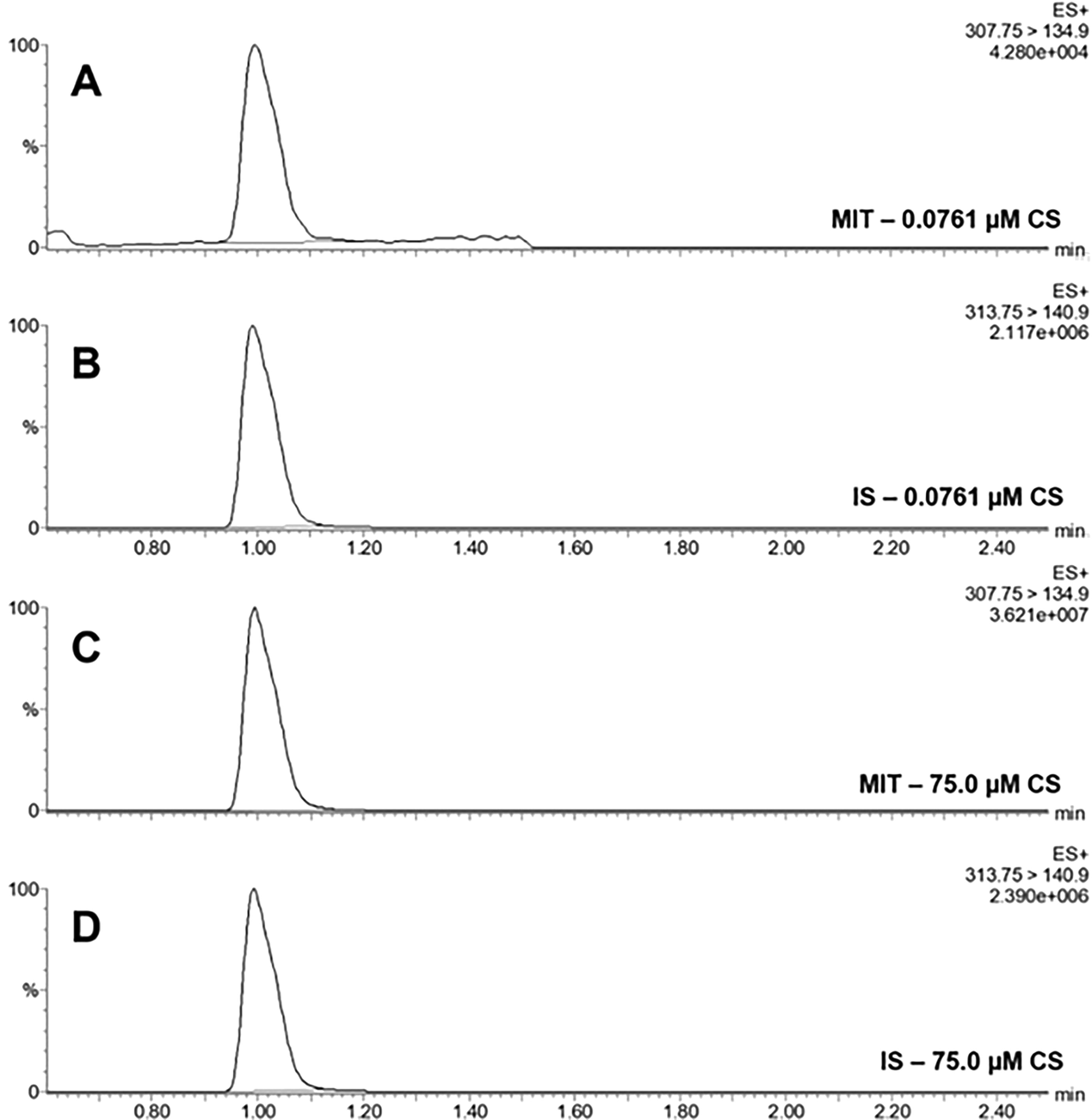
Representative UPLC-MS/MS chromatogram for MIT analysis. UPLC-MS/MS chromatograms for MIT
TPO assay development
As MIT can be formed in a non-enzymatic and enzymatic way,
15
it was critical for this study to identify the parameters solely resulting in TPO-mediated enzymatic MIT formation. Optimization of the assay conditions was undertaken to improve assay performance and reliability. In particular, the concentrations of iodine and sodium thiosulfate, FTC-238-hrTPO cell lysate protein content and incubation time,
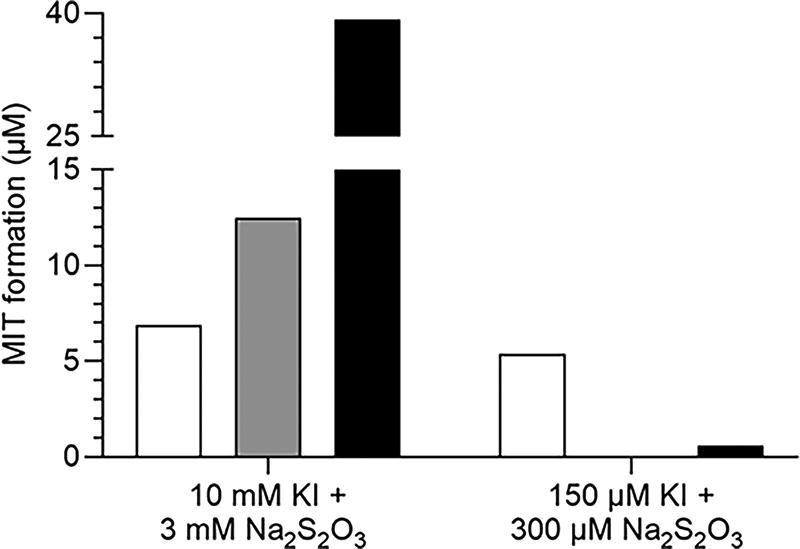
Effect of potassium iodide and sodium thiosulfate on MIT formation FTC-238-hrTPO lysate (white bar; 100 µg/mL), heat-inactivated FTC-238-hrTPO lysate (gray bar; heated at 95°C for 15 minutes; 100 µg/mL) and milli-Q water (MQ, black bar) were incubated for 15 minutes at 37°C in the presence of either 10 mM of 150 µM potassium iodide (KI) after which reactions were stopped by the addition of half a reaction volume of methanol containing either 3 mM or 300 µM sodium thiosulfate (Na2S2O3). All incubations were performed in duplicate and the average of the two replicates is presented. MIT, monoiodotyrosine.
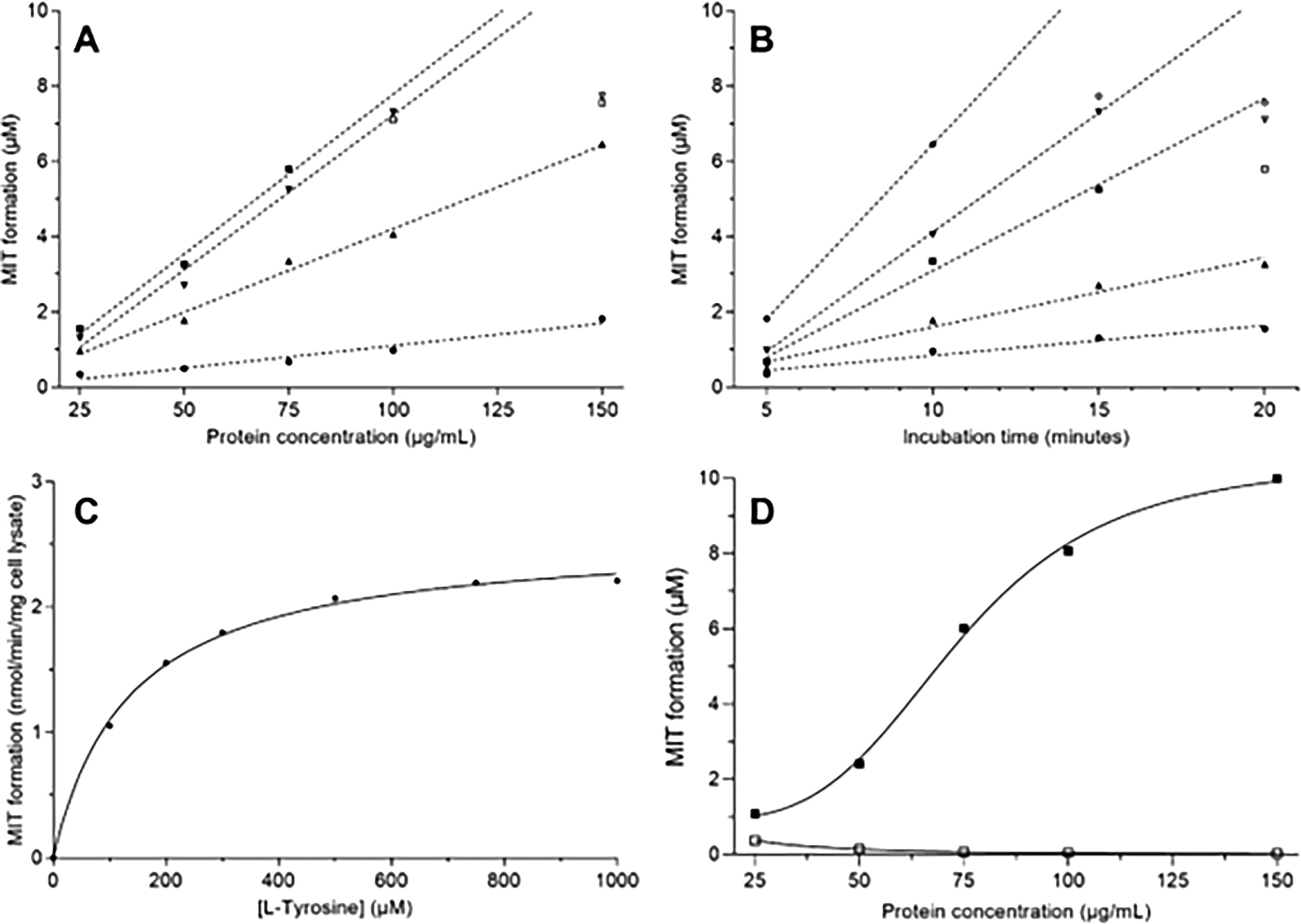
Optimization of assay conditions To evaluate the protein- and time-dependency of MIT formation, incubations were performed using different concentrations of FTC-238-hrTPO cell lysate and different incubations times.
The next step during assay optimization was to evaluate the enzyme kinetics for the FTC-238-hrTPO-mediated MIT formation by performing incubations with different concentrations of
To confirm that the MIT formation was mediated by the recombinant hrTPO, incubations were performed with FTC-238-hrTPO cell lysate and the corresponding FTC-238-WT cell lysates. As shown in Figure 3D, significant MIT formation was only observed in the incubations with the FTC-238-hrTPO cell lysate which proved that product formation was hrTPO-dependent.
Reproducibility assessment (part 1)
To evaluate the robustness and reliability of the method to determine the inhibition of human TPO-catalyzed iodination, six chemicals (PTU, flavanone, methimazole, TMTU, naringenin and sulfamethazine) were selected for which the highest soluble concentrations in the stock solution and spiking solutions were determined. Based on the solubility assessments, a 10 mM stock solution was used for each chemical as highest chemical spiking concentration in the TPO inhibition assay experiment (final concentration in incubation mixture: 100 µM). Due to the known potency of PTU, a maximum incubation concentration of 31.6 µM was used.
All analytical and TPO-catalyzed iodination assay acceptability criteria were met or accepted after evaluation (Table 4). For sulfamethazine, the mean percent TPO-catalyzed iodination of the lowest chemical concentration varied between 99% and 113% for four out of five experiments whereas the mean percent TPO-catalyzed iodination of the lowest chemical concentration in the fifth experiment was 123%. The latter value was slightly outside the acceptance range of 80%−120%; however, results for this experiment were also accepted as the overall curve shape was similar to that of the curves obtained for the other experiments.
The results for the six chemicals have been depicted in Figure 4 and summarized in Table 5. Based on the outcome of the five valid TPO-catalyzed iodination experiments, PTU, methimazole, TMTU, naringenin, and sulfamethazine were positive and suppressed the

Inhibition of thyroid peroxidase (TPO)-catalyzed iodination by selected chemicals Evaluation of the potential to suppress TPO-catalyzed iodination by selected chemicals [flavanone, methimazole, N, N, N, N-tetramethylthiourea (TMTU), naringenin, and sulfamethazine] and the reference chemical 6-propyl-2-thiouracil (PTU). Five independent assay runs with three technical replicates per concentration and chemical were performed (data shown as mean percentage of control activity ± SD per concentration).
Results of the TPO-Catalyzed Iodination Inhibition Assay for Selected Chemicals
The highest concentration at which the stock and subsequent dilution in incubation buffer resulted in the formation of a clear solution.
Based on the solubility result, a stock concentration of 10 mM in DMSO was selected for Flavanone, Methimazole, TMTU, Naringenin and Sulfamethazine. As PTU is a known inhibitor of TPO, the highest tested incubation concentration was 31.6 µM. An overview of all tested concentrations and additional details is provided in Supplementary Table S1. NC: No IC50 value could be calculated as the mean percentage of TPO-catalyzed iodination compared to the average activity in the corresponding vehicle control samples was not less than 80% for any of the concentrations evaluated. PTU, 6-propyl-2-thiouracil; TMTU: N,N,N,N-tetramethylthiourea; TPO, thyroid peroxidase.
TPO-catalyzed iodination in a dose-dependent manner with averaged IC50 values of 1.61 µM, 384 nM, 1.51 µM, 442 nM, and 11.4 µM, respectively. Flavanone was negative and did not suppress the TPO-catalyzed iodination.
Blinded chemical assessment (part 2)
After the successful assessment of the robustness and reliability of the TPO-catalyzed iodination assay, the effects of 30 randomized chemicals were assessed in a blinded manner during in total 13 individual experiments.
First, solubility of the test chemical in an appropriate solvent and dilution in incubation buffer was evaluated. All test chemicals were dissolved in DMSO, with the exception of Divanadium Pentoxide, which was dissolved in MQ. Stock and spiking solutions were prepared for each test chemical based on the highest soluble concentration in the solubility assessment. The incubation concentrations, which resulted from 100-fold dilution of the stock solution in incubation buffer, are listed in Table 6.
Results of the TPO-Catalyzed Iodination Inhibition Assay for Blinded Chemicals
All test chemicals were dissolved in DMSO with the exception of divanadium pentoxide, which was dissolved in MQ
Mean percent of TPO-catalyzed iodination activity remained above 50%, data was extrapolated to determine the IC50 value.
NC: No IC50 value could be calculated as the mean percentage of TPO-catalyzed iodination compared to the average activity in the corresponding vehicle control samples was above 80% for any of the concentrations evaluated. An overview of the concentration ranges used for each chemical, CAS number and supplier is provided in Supplementary Table S2.
PFOS, Perfluorooctanesulfonic acid; PTU, 6-propyl-2-thiouracil; TETRAC, Tetraiodothyroacetic acid; TPO, thyroid peroxidase; TMTU, N,N,N,N-tetramethylthiourea.
For Part 2, the analytical and assay acceptability criteria (Table 4, based on the criteria used in the Part 1) were met in all experiments. The results for the 30 blinded chemicals, which also included the reference chemical PTU, have been summarized in Table 6. Corresponding TPO-catalyzed iodination curves can be found in the Supplementary Figures S1. For 29 out of the 30 chemicals, the results obtained during the first and second experiment led to the same classification. Sorafenib, Tetraiodothyroacetic acid (TETRAC), 2,4,6-tribromophenol, ketoconazole, PTU, 3,3’,5,5’-tetrabromopisphenol A, silicristin, genistein, ampicillin, 2-mercaptobenzothiazole, salsalate, triclosan, perfluorooctanesulfonic acid (PFOS), TMTU, 2,2’,4,4’-tetrahydroxybenzophenone, pentachlorophenol, mefenamic acid, GC-1/sobiterome, ethylene thiourea, diclofenac, resorcinol, niflumic acid, and rosmarinic acid were positive in both experiments and suppressed the TPO-catalyzed iodination in a dose-dependent manner. Divanadium pentoxide, cadmium chloride, perchlorate, dibutyl phthalate, amiodarone, and aspirine were found to be negative in both experiments and did not suppress the FTC-238-hrTPO-catalyzed iodination. Divanadium pentoxide in fact induced TPO-catalyzed iodination (194% at highest concentration).
For desipramin, the observed percentage of TPO-catalyzed iodination at the highest chemical concentrations was 74% (positive classification) of the activity of the corresponding vehicle control during the first experiment whereas it was 81% (negative classification) of the vehicle control activity during the second experiment. A third experiment was performed during which the activity was 80% (positive classification) of the vehicle control activity. Overall, this borderline compound was classified as being positive based on two positive and one negative classification.
Discussion
General discussion
The current work describes the development and validation of a rapid, animal free, in vitro screening method of detecting inhibition of TPO-catalyzed iodination using human FTC-238-hrTPO cell lysate and the detection of MIT formation by UPLC-MS/MS. The method specifically measures the TPO-dependent formation of MIT using the substrate
The TPO enzyme possess different enzyme activities involving iodine oxidation, iodination and phenolic coupling. Various in vitro TPO inhibition assays have been developed and usually enzyme fractions such as microsomes from the thyroid of human, rat, pig, or other species are used as source of enzyme. 12 Most commonly, these assays quantify TPO-mediated oxidation through spectrophotometric analysis using substrates such as guaiacol, luminol, or AUR.7,8 In the guaiacol assay, guaiacol is oxidized to 3,3′-dimethoxy-4,4′-biphenylquinone, an amber-colored product which can be detected spectrophotometrically. The luminol assay detects TPO-mediated oxidation of luminol and uses luminescence of the oxidation product as a read-out. Another assay is based on TPO-catalyzed oxidation of the non-fluorescent Amplex UltraRed to a fluorescent proprietary resorufin-like molecule Amplex UltroxRed and is also widely used to evaluate TPO activity.7,8
Such assays provide information about the oxidative capacity by TPO and other oxidases, but the major downside of these assays is that they do not evaluate iodination and phenolic coupling; two other distinct and important reactions catalyzed by TPO.
3
Chemicals that specifically disrupt the iodination and phenolic coupling activities of TPO may not be classified as TPO disruptors in assays that rely solely on oxidation activity. To evaluate the multifaceted catalytic functions of TPO comprising mono- and di-iodination activities as well as investigation of TPO-catalyzed coupling of iodinated tyrosyl rings, a battery of simple in vitro assays was developed successfully to monitor the conversion of
An attractive alternative exists in the form of cell lines that endogenously or through genetic modification (over)express human recombinant TPO enzyme.6,12 Not only can TPO-containing fractions of these cell lines replace the need for large numbers of animals, but they are also human-relevant and can yield much higher and more specific TPO enzyme fractions. Based on the available literature, we have tried to combine the best from all available methods leading to the development and validation of an animal free, rapid in vitro screening method of detecting inhibition of TPO-catalyzed iodination using human FTC-238-hrTPO cell lysate and the detection of MIT formation by UPLC-MS/MS. The established method covers two of the three TPO-related reactions (oxidation and iodination).
Method development and optimization
As MIT can be formed in a non-enzymatic and enzymatic way, 15 it was critical for this study to identify experimental conditions solely resulting in TPO-mediated enzymatic MIT formation.
Several assay parameters that had a critical effect on assay performance were investigated, including the potassium iodide and sodium thiosulfate concentrations, cell lysate concentration, incubation time and
Similarly, protein content and incubation time were optimized to ensure that the assay is performed under conditions of linear formation of MIT. The observed non-linearity at higher cell lysate concentrations or when using longer incubation times can be explained by the fact that MIT in these cases is further metabolized by TPO into DIT. 3 In addition, inactivation of TPO through H2O2 after prolonged incubation may be considered.
Since batches of cell lysate can vary in their protein content, this dependency investigation needs to be performed for every new batch of lysate that is generated.
Then, concentrations of the substrate
Finally, by comparing the formation of MIT in FTC-238-hrTPO lysates versus lysates obtained from FTC-238 wild type cells, we showed that the conversion of
Assay reliability—part 1
Following optimization of the assay conditions, robustness and reliability of the TPO-catalyzed iodination assay was successfully assessed using a set of six chemicals. For five of these, interactions with TPO were previously described. 8 Flavanone, the basic ring system of flavonoids that is devoid of functionalities that are known to interact with TPO was included as a putative negative control together with the TPO inhibitor naringenin. Each test chemical was tested in at least five separate independent experiments. The analytical and assay acceptance criteria were met in all runs, except that iodination at the lowest concentration sulfamethazine in one experiment exceeded the acceptance criterion by only 3%. It was concluded that this did not impact the quality of the experiment, as the curves were comparable across all five experiments.
PTU, MMI, TMTU, 10 the flavanone derivative naringenin 5 and sulfamethazine 6 were positive as expected and suppressed the TPO-catalyzed iodination in a dose-dependent manner with averaged IC50 values of 1.61 µM, 384 nM, 1.51 µM, 442 nM and 11.4 µM, respectively. The positive classification and observed IC50 values are comparable to those previously reported by Price et al. 11 (2020), Paul et al. 7 and Jomaa et al. 6 for MMI, PTU and sulfamethazine. In contrast, TMTU, which inhibits thyroid hormone synthesis and was positive in the current assay was previously classified as negative. 8
For naringenin, a much lower IC50 was observed in the current study compared to those reported by Jomaa et al. (55.5–59 µM) which is likely due to phenolic function or resorcinol moiety that are considered responsible for the TPO-inhibiting properties of flavonoids like naringenin.
Flavanone was negative and did not suppress the TPO-catalyzed iodination. The results from each independent run were highly consistent for each test chemical, indicating that the TPO-assay is a consistent and robust method under optimized conditions.
Blinded analysis—part 2
Next the effects of 30 blinded chemicals were assessed to determine the inhibition of human TPO-catalyzed iodination across in total 13 experimental runs. The acceptance criteria were met in each experimental run, highlighting the robustness of the TPO-catalyzed iodination assay.
Strikingly, TPO-catalyzed iodination compared to the average activity in the vehicle control samples was less or equal to 80% for at least one concentration in 24 out of 30 chemicals, classifying 80% of the molecules as TPO inhibitor. Compared to earlier studies, using a similar cut-off criterium of 80% residual TPO activity 8 283 out of 1074 chemicals were identified as TPO inhibitor using the AUR assay, classifying 26% as TPO inhibitor.
This apparent discrepancy and very high percentage of positives found in the current method can be due to several reasons. The set of blinded chemicals was put together by EURL ECVAM as a selected group of thyroid-related chemicals to be used in multiple in vitro assays to study perturbations of thyroid-related Molecular Initiating Events. 16 Additionally, chemicals were tested up to the solubility limit with a maximum assay concentration of 1 mM, while in the Friedman study 8 chemicals were only tested at a single concentration of 87.5 µM. Testing at lower concentrations may yield classifications that are more physiologically relevant. However, when we would interpret the results of this method using 100 µM as top concentration (Log-4), the number of chemicals classified as TPO inhibitors remains relatively high at 21 of 30 (70%). Even if we would classify the chemicals using 10 µM as the highest concentration (Log-5), 16/30 (53%) would be classified as TPO inhibitors, suggesting that selection of the test chemicals likely played a role. Elimination of potential cytotoxic chemicals, resulting in non-specific enzyme inhibition, was performed by Friedman and may have contributed to a lower overall percentage of positively classified chemicals, however, this was not within the scope of this study as the method is cell-free.
A key difference lies in the fact that the AUR method used by Friedman et al. relies on the TPO-mediated oxidative conversion of Amplex UltraRed, and can therefore only determine inhibition of oxidation activity, whereas the current method can detect inhibition of both the TPO-catalyzed oxidation of iodide and subsequent iodination through quantification of MIT formation using UPLC-MS/MS. The importance of this difference is highlighted by the fact that several chemicals that were negative in the Friedman study were identified as potent TPO inhibitors in this study (Table 7). TMTU for example, strongly inhibited TPO (99% inhibition at highest concentration; mean IC50 =1.61 µM) but was negative in the Friedman study. TMTU has been reported as a specific inhibitor of TPO-catalyzed iodination in vitro. 10
Comparison of Results from the TPO-Catalyzed Iodination Assay Compared to Results from the TPO AUR Assay
Inhibition for the current study was calculated as: inhibition = 100-[iodination%].
Result derived from a single experiment; tested concentration ranges were fine-tuned in the second experiment for some compounds to determine the IC50 value.
NC: No IC50 value could be calculated as the mean percentage of TPO-catalyzed iodination compared to the average activity in the corresponding.
AUR, Amplex UltraRed; NT, not tested; PFOS, Perfluorooctanesulfonic acid; PTU, 6-propyl-2-thiouracil, TPO, thyroid peroxidase; TETRAC, Tetraiodothyroacetic acid; TMTU, N,N,N,N-tetramethylthiourea.
Similarly, TETRAC (IC50 = 2.18 µM), Diclofenac (IC50 = 188.5 µM) and PFOS (IC50 = 54.5 µM) were classified as TPO inhibitors in this study, but not by Friedman et al. While the IC50 of Diclofenac was higher than the concentration in the Friedman study (87.5 µM), Diclofenac would have been classified as positive based on the nearest concentration tested (100 µM; 63% iodination). Several other chemicals, including 3,3’,5,5’-Tetrabromopisphenol A, Genistein and Triclosan were classified as TPO inhibitors in both studies, but displayed greater inhibition in the TPO-catalyzed iodination assay than in the TPO AUR assay. Most likely, these differences are due to additional inhibition of the TPO iodination activity by the test chemical, which cannot be detected in assays that only target the oxidation activity of TPO. On the other hand, PFOS was tested positive in a TPO inhibition assay not employing iodination. 15
The observed (weak) inhibitory action of diclofenac, mefenamic and niflumic acid may be explained by their chemical structure as secondary aromatic amines. Primary aromatic amines and aryl amines like amitrole have been known as effective TPO inhibitors for decades. The TPO-inhibitory activity of secondary aromatic amines with bulky substituents has not been studied yet, but it appears conceivable that bulky substituents may not fully abolish the inhibitory potential of the aromatic amine function.
Interestingly, divanadium pentoxide induced TPO-mediated iodination (max. induction 194%). No clear mechanistic explanation for why divanadium pentoxide induced TPO-induction iodination could be found in the literature, although some studies note the induction of pro-inflammatory cytokines in thyroid cells upon exposure to divanadium pentoxide. 17 However, as this study utilizes thyroid cell extracts rather than intact cells, the most likely explanation is that divanadium pentoxide directly induced TPO activity and any further (mechanistic) explanation would be speculative.
It must also be kept in mind that the iodinating intermediate formed by TPO is a powerful oxidant similar to iodine solution. This may explain the unexpected positive result for ampicillin, which was initially included by EURL ECVAM as a likely negative chemical for all Modes of Action together with aspirin (chemical selection in described in Bernasconi et al. 2023 18 ) Initially, in the 1940s, penicillins were quantified by iodometry (quantitative hydrolysis followed by oxidation of hydrolysis products with excess iodine and back-titration of residual iodine with thiosulfate). Following hydrolysis of ampicillin in the assay buffer subsequent oxidation of cleavage products through the iodinating intermediate would occur at the expense of iodination and decrease MIT formation.
Similarly, such oxidation reactions may also explain (unexpected) inhibitory effects of other chemicals, especially of those with (a) phenolic function(s). (Halo)peroxidase-catalyzed oxidation of tribromophenol, pentachlorophenol, but also desipramine has been described.19–21 While the current assay can identify disruptors of both the oxidation and iodination activities of TPO, it cannot distinguish between the two without supporting data (e.g., from an oxidation-only assay like the TPO AUR). However, this drawback is only relevant for mechanistic considerations, while it is advantageous for a screening approach as a broader range of interactions is covered. Another potential limitation of the current design is the use of relatively high test chemical concentrations (based on the highest soluble concentration) and positive classification if depletion exceeds 20% at a single tested concentration. These criteria may improve detection of modest TPO inhibitors but may also increase the chance for false positive results, especially at supraphysiological or suprapharmacological concentrations. With the large-scale efforts by EURL ECVAM to develop new in vitro assays to evaluate thyroid homeostasis underway, these criteria may be refined in the near future when comparisons can be made to other assays that have evaluated the same set of 30 chemicals.
Conclusions
In this study we successfully validated a fast, low cost, robust, sensitive, animal-free and human-relevant thyroid in vitro assay that relies on the conversion of
Footnotes
Acknowledgments
The authors thank Florian Maire from Charles River Den Bosch for his valuable contribution to the validation of the MIT analysis method. The authors thank Sjoerd Verkaart and Gido Snaterse for their valuable contributions to the article. The authors thank Ingrid Langezaal, Roman Liska and Gerard Bowe from EC JRC EURL ECVAM for their valuable contributions to the standardization of the method and the review of the article.
Authors’ Contributions
J.Re.: Conceptualization, Methodology, Validation, Data Curation, Writing—Original Draft, Project Administration, Visualization. J.Ri.: Conceptualization, Methodology, Validation, Project Administration. E.d.L.: Investigation. J.T.: Methodology, Investigation. A.F.: Conceptualization, Writing-Review and Editing. M.W.: Conceptualization, Writing—Original Draft, Writing-Review and Editing, Supervision, Visualization, Funding Acquisition, Project Administration.
Author Disclosure Statement
The authors J.Re., E.d.L., J.T. and Mira Wenker were during the conduct of this study employees of Charles River Den Bosch, a contract research organization, which in the future may use the TPO assay to evaluate the potential of commercial products to suppress the TPO-catalyzed iodination. Jeroen Rijk is a former employee of Charles River Den Bosch and declares no other conflict of interest. Alexius Freyberger is a retired toxicologist. A.F. previously worked for Bayer AG-Pharmaceuticals, in Wuppertal, Germany, and holds shares of Bayer AG. Alexius Freyberger declares no conflict of interest.
Funding Information
This research was funded by Charles River Den Bosch.

References
Supplementary Material
Please find the following supplemental material available below.
For Open Access articles published under a Creative Commons License, all supplemental material carries the same license as the article it is associated with.
For non-Open Access articles published, all supplemental material carries a non-exclusive license, and permission requests for re-use of supplemental material or any part of supplemental material shall be sent directly to the copyright owner as specified in the copyright notice associated with the article.
