




Abstract
Abstract
Childhood obesity is a serious public health epidemic that threatens the health, well-being, and financial stability of the United States. Presidential executive memoranda calling to solve the childhood obesity epidemic within one generation suggest the potential for successful policy initiatives addressing this important issue. The political feasability of solving the childhood obesity epidemic in the United States is dependent on policy actors, inputs into the policy arena, the interplay of policy actors and inputs into the policy arena, and the threshold for adoption. While political feasibility is determined by many factors, the political will may exist to move childhood obesity through the policy process. The National Association of Bariatric Nurses and other special interest groups stand at the precipice of opportunity to inform the policy process through research and expert testimony.
Policy Actors
The policy process is a dynamic process involving multiple policy actors—those with a vested interest in the outcome of a given policy process. Childhood obesity policy actors include but are not limited to the president and his executive staff, the U.S. Congress, bureaucratic government agencies, state governments at all levels, special interest groups, education systems, teachers, parents, and, most importantly, children. Each policy actor brings a different agenda that is significant in its impact in the policy process. 7 The interplay of these policy actors is demonstrated in Figure 1. 7
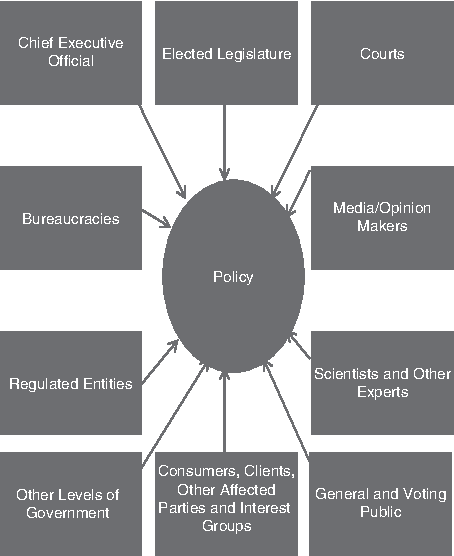
General Authorizing Environment for Policy Making. Source: McLaughlin, C.P. & McLaughlin, C.D. (2008, p. 240). 7
The President
President Barack Obama has established childhood obesity as a domestic priority in the release of his February 9, 2010, executive memorandum entitled “Establishing a Task Force on Childhood Obesity”. 4 The president is the chief executive officer who yields the power to protect the U.S. Constitution and to lead the the United States in domestic and foreign policy issues. He is an important policy actor, and Obama has demonstrated a commitment to health care as one of 23 priority issues to be addressed by his administration. 8
Furthermore, President Obama acknowledged and reported what current research has demonstrated: that obesity has remained a persistent public health problem for decades that has now grown to crisis and epidemic proportions and threatens the economic security of the United States.2,4,7,7,10 While tremendous power is exerted through influencing policy, the president has limited authority to craft policy. 7 He must find a sponsor to introduce legislation. However, one policy tool aviailable to the president lies in the issuance of executive memoranda, as demonstrated above. Executive memoranda, when published in the Federal Register without challenge from Congress, become executive orders carrying the force of law.7,9,10
The First-Lady platform
First Lady Michelle Obama has assumed an important policy actor role in identifying childhood obesity as her policy platform. 11 She has already engaged many key policy actors through highly publicized events such as making healthy food choices modeled in the First Lady's Garden at the White House, 12 speaking at the National Governor's Associations Winter Conference (National Governors Association, 2010), and speaking with school systems, children, and parents regarding healthy lifestyles and prevention of childhood obesity. 11
Congress
Congress is arguably the most powerful of all federal policy actors, having the power to make laws and dictate budgets. 7 While congress may be sharply divided over partisan politics, the childhood obesity issue is a bipartisian issue.
Congress works within the political process to address presidential and partisian agendas. It is through the delegated committee work where the majority of policy work is accomplished. 7 The committee process is hightly influenced by special interest groups, political capital, and negotiations which often involve governmental buraucracies at all levels for administrtion and/or regulation. 7 For example, the Childhood Obesity Taskforce actors include the assistant to the president for domestic policy as chair and other policy actors, including bureaucrats from the Departments of the Interior, Agriculture, Health and Human Services, and Education, and from the Office of Management and Budget; the chief of staff to the first lady; the assistant to the president for economic policy; and heads of other exuctive departments, agencies, or offices designated by the chair. 4 Like all politicians, however, congressional members have divided loyalites between their policy actor responsibilities and the aggregate desires of their constituents.
State government
Healthcare expenditures comprise a large part of state budgets. State govenors serve as the chief executive officers at the state level, a corollary to the president. Govenors increasingly struggle to find solutions to the healthcare problems in this country, and provide quality preventative and wellness services. These issues become increasingly important in considering the preventive aspects of childhood obesity. West Virginia Governor Joe Minchin states, “Governors recognize that it is a critical priority in ensuring the economic viability of our states and the quality of life for our citizens that we work tirelessly to address the current healthcare delivery challenges states are facing”. 13 Unlike federal budgets, state budgets are not allowed to operate at a deficit. This creates further challenges in aligning resources to address the issue of childhood obesity. 2 Furthermore, state governments received less media coverage regarding budges and the overall policy process, which may serve as a comparative limiting factor when compared to the media attention received by federal initiatives. 7
Local government
It has often been stated that politics and policy processes begin at home. This underscores the importance of local governments in addressing and impacting childhood obesity. Local municipalities are important policy actors in setting policy agendas at the grassroots level. For example, city and county councils can be instrumental in establishing pedestrian-friendly communities as a preventive measure for addressing childhood obesity. Furthermore, members of local boards of education can significantly impact the amount of physical activity and healthy food choices in public school curricula.2,14–16
Special interest groups
Special interest groups are important policy actors who impact the entire policy process. Often, special interest groups have varying agendas that may or may not support the goal of solving childhood obesity within one generation.
In reality, very few groups would suggest that solving childhood obesity is not a worthy and imortant goal. However when considering economic defensiveness, some special interest groups may be conflicted regarding alliances. For example, economic forces drive the vending industry, a frequent supplier of calorie-dense foods in school environments. 2 Furthermore, vending companies often establish partnerships with school superintendents to share the profits of vending machine products. Since healthier food choices often cost significantly more than processed, competitive foods, about 90% of the time calorie-dense foods and beverages emerge as winners in the economic decisions for cash-strapped public school systems. 2
The Obesity Action Coaltion 17 and the National Association of Bariatric Nurses 18 are leaders among many special interest groups who provide scientifice evidence and information to positively influence policies regarding childhood obesity and obesity in general. These special interest groups assist in connecting the policy dots through research, education, and mobilizing grassroots advocates.3,19
Second only to Congress, interest groups may be the most important acotors in the health policy process, 7 and they are instrumental in the battle against childhood obesity. These groups are pivotal in generating proposals for committee work, providing expert tesitmony, and helping to mobilize public opinion. 7
Input into the Policy Arena
Special interest groups are not enough to ensure success in solving the issue of childhood obesity. Political climate, the economy, and public opinion are all important factors in any policy process. 7
Political climate
President Obama has established a political agenda conducive to healthcare reform. 8 The political climate, however, can vary depending on the election cycle, constituent relations, and party agendas. 7 Both risks and benefits are inherent in the goal of solving childhood obesity within a generation. This length of time will often exceed the careers of many elected officials and policy makers, leaving a political legacy of either success or failure.
As part of President Obama's executive memorandum, he called for an interagency plan in solving the epidemic of childhood obesity within 90 days. This is an ambitious goal given the pace with which current healthcare reform policy has stalled in Congress. On May 11, 2010, an ambitious plan, however, was returned to the President with a goal of returning to a childhood obesity rate of just five percent by 2030, the pre-epidemic childhood obesity rate of the 1970's.20,21 Seventy recommendations specific to the elimination of childhood obesity; many of which can be implemented right away, can be used for political capitol in the November, 2011 election cycle. This political capitol can assist elected officials who may need assistance with re-election. This issue impacts constituents of every elected official, making childhood obesity an agenda issue of importance for all politicians seeking reelection.
Finally, party agenda can determine the success or failure of any policy issue. The current administration has clearly maintained healthcare reform as a party issue. Childhood obesity is a good fit in this important agenda. The First Lady's choice of childhood obesity as her platform provides the visibility and political clout to move this issue across partisan lines. As in most situations, an economic model is an important element of the policy process.
The economy
The state of the economy is a large determinant impacting policy makers' willingess to tackle complex policy issues. 7 While there are improvements in the federal budgets over the past year, many states are challenged in balancing their budges in light of increasing unemployment and rising healthcare costs. 13 Solving the childhood obesity epidemic is an economic decision as well as a healthcare decision. Nearly one-third of all American children are overweight or obese.1–4,15,22 Solving this epidemic will improve the health of children in America and save billions of healthcare dollars in the prevention of treatable diseases.3,4
Interplay
President Obama has issued a call to America, brininging together all of the major policy actors to address childhood obesity. 4 The rules of the game have been clearly identified. Under the leadership of First Lady, Michelle Obama, federal stakeholders including Health and Human Services, U.S. Drug Administration, Federal Trade Commission, Department of Transportation and the Environmental Protection Agency have developed an action plan to impact prenatal and infant nutrition, provide clear food labeling, enhance healthy food choices in schools, increasing access to healthy food and snack choices and creating community and school policies to promote activity. 20 The federal stakeholders will vertically dissiminate and apply information to state and local stakeholders to coordinate both vertical and horizontal interagency processes. It is through the synergistic work of these groups that coalitions can work together for what is right for the children of America.7,9,19 The World Health Organization declares in its constitution that the highest level of health is a basic human right, the healthy development of the child is of basic importance, and governments have responsibility for the health of their people. 23 As a member of the WHO, the United States is not meeting the basic constitutional vaules of basic healthcare. Childhood obesity impedes the normal, healthy development of children, lending credence to the importance of interagency collaboration in solving this epidemic.
Threshold for Adoption
The success or threshold for adoption of a plan to solve childhood obesity can be summarized in the problem stream, the policy stream, and the political stream. 7 It has been demonstrated from a healthcare, economic, and WHO constitutional standpoint that childhood obesity is a problem of epidemic proportions. Public health, population-focused interventions can positively impact childhood obesity.1,2,7,9,10,14–16 It is important to note that while preventive measures are crucial in the successful management of childhood obesity, policy options supporting treatment for obesity are equally important. 24 Last, solving childhood obesity has clearly been placed on the political agenda. The first lady brings political capital that may generate the political will to address childhood obesity.
Conclusion
Childhood obesity is a serious public health epidemic that threatens the health, well-being, and financial stability of the United States.1–4 President Obama established childhood obesity as a domestic priority in the release of his February 9, 2010, executive memorandum, discussed above. 4 As mentioned, if an executive memorandum is uncontested by Congress, it will carry the weight of law. The February 9 memo called for an interagency plan to solve the epidemic of childhood obesity within a generation. The political feasability of solving the childhood obesity epidemic in the United States is dependent the interplay of policy actors, inputs into the policy arena, the interplay of policy actors and inputs into the policy arena, and the threshold for adoption. 7 The qualitative nature of the political feasibility process leads to a great deal of uncertainty; however, there is cause for hope.
The first lady has amplified the importance of solving childhood obesity in establishing this important topic as her platform. Her popularity and media coverage can be instrumental in ensuring policy success. Also, the NABN has an established history of excellence in research, clinical care, and advocacy. 19 Expert clinicians and scholars involved in research and management of obesity care will be instrumental in informing the policy process. This is a logical area for nursing influence and participation in this important policy process. Your input is needed to ensure resolution of the childhood obesity epidemic and to ensure the healthy development of every child in the United States and abroad!
Disclosure Statement
No competing financial interests exist.