




Abstract
Childhood obesity has reached epidemic proportions, and the problem is disproportionately represented in low-income, minority settings. In an attempt to intervene, an elementary school-based prevention program designed to educate children and their caregivers in healthy and active lifestyles was developed by a community-based coalition. The coalition was anchored by faculty, staff, and students of a medical school. The design, launch, and operations of this program serves as a model that may be useful to other communities.
Introduction
The United States is experiencing an obesity epidemic, but what is most alarming is the number of children who are obese. The prevalence of childhood obesity has nearly tripled over the past two decades. 1 Currently, almost one third of children and adolescents are either overweight or obese. 2 Overweight adolescents have a 70% chance of becoming overweight or obese adults. This increases to 80% if one or more parent is overweight or obese.3,4 According to the Center for Disease Control (CDC), overweight is defined as a body mass index (BMI) at or above the 85th percentile and lower than the 95th percentile, and obesity is defined as a BMI at or above the 95th percentile for children of the same age and sex. Classification of overweight and obesity for children and adolescents are age and gender specific because children's body composition differ for both age and gender. BMI is one way to screen children and adolescents for both overweight and obesity; however, it is not a direct measure of body fatness. 5
Factors contributing to childhood obesity are generally caused by a lack of physical activity, unhealthy eating patterns, or a combination of the two. 4 Recent studies have shown that genetics can also play a role in determining a child's weight, but the increasing numbers are not related to genetics alone. 6 Unfortunately, children who are obese are at risk for developing conditions in childhood that used to be found mainly in adults. For example, the onset of hypertension, fatty liver, nonalcoholic steatohepatitis, obstructive sleep apnea, high cholesterol, and type 2 diabetes are now increasingly common in children.6,7 The most immediate consequence of being overweight, as perceived by children themselves, can be social discrimination, which may result in poor self-esteem and lead to depression. 4
What populations of children are at higher risk of becoming obese? Studies have shown that low-income, minority children are disproportionately affected by obesity—primarily African-Americans, Hispanics, and Native Americans. Contributing to this disparity is the fact that low-income, minority children often live in communities with poor access to safe areas, which limits their ability to play outside. Compounding this circumstance is the reality that families who live in low-income neighborhoods also have limited access to grocery stores that carry fresh produce. 8
This paper describes the organization and structure of a school-based obesity prevention program in a predominantly low-income, minority elementary school. Preliminary outcomes have been reported elsewhere, 9 and evaluation of the program is ongoing.
Program Description: Site Selection
UKCOM selected an elementary school site setting for several reasons. First, an after-school program would be easy for students to attend, since they were already at the site. In addition, the school setting had in-kind resources, such as gyms, playgrounds, and fitness equipment that were age appropriate. Furthermore, there was the potential to enhance the existing school health and nutrition education curriculum. Lastly, there was the potential to influence attitudes and behaviors of teachers by encouraging the use of nonfood rewards.
The elementary school that UKCOM chose exhibited all of the national risk factors for obesity: low-income families (57% of annual household income <$10,000 and 93% of the children at the school qualified for free and reduced lunch); minority population (80% of the children were African-American or Hispanic); and located in a neighborhood that is both unsafe for outdoor physical activity and without access to full service grocery stores with fresh fruits and vegetables. Fifty-three percent of the children had a BMI above the 85th percentile, and 30% were overweight (national average is 16%). 9
Building a Coalition: Community Partners
Building a broad coalition of community partners was key to the program's success. It allowed for sharing costs, increasing the resources available, and diversifying the available assets. In the school, there were several key partners who played important roles in developing and shaping the program to meet the children's circumstances and needs.
UKCOM initially organized a planning meeting with the school's administrators and teachers to ensure their genuine investment in the program. The principal allowed college personnel to speak with the teachers during a faculty meeting, which facilitated high teacher attendance. During this meeting, administrators and teachers were able to provide suggestions and insight into potential barriers to the program. For instance, teachers recommended that the name of the after-school program should not be related to obesity because of the social ramifications. As a result of their feedback, the program was named Jumpin' Jaguars, which leveraged the school mascot. The teachers also indicated that students were often rewarded with candy for good behavior and achievement. After discussion, the teachers recommended that popular nonfood rewards, such as stickers, bouncy balls, pencils, and erasers be purchased as reward replacements. Additionally, during the initial meeting with school personnel, it was decided that 40 students would be the maximum number this program could serve because of facility size and appropriate supervision ratios.
Two supervisors were provided by the school: the school's social worker and the gym teacher. Both professionals agreed to organize activities for the children. Ancillary partners were identified through University of Kentucky (UK) Colleges of Agriculture, Medicine, Nursing, Education, and Public Health. All five UK Colleges recruited student volunteers who provided motivation and supervision of the student participants. All volunteers underwent a background check as a precaution. Many of the college students were also utilized as mentors to the children in the program. Since research shows children who are obese tend to have low self-esteem, as well as depression, UKCOM psychiatry residents were included as partners who offered lessons to student participants on the topics of positive behaviors, good choices, as well as positive self-image.
To have an effective and successful program, not only was partnering with the school vital, but also involving the community. Several community partners thought to be supportive of the program were identified. Involving a community health center was important in the planning process for expertise in health and fitness. The YMCA of Central Kentucky was contacted, and they agreed to partner with UKCOM in this initiative. They agreed to have the children come after school to their facility twice a month for swimming lessons, aerobics, and dance lessons such as hip hop, jazzercise, and Zumba. In addition, the YMCA agreed to provide the children and their families with discounted memberships and also invited the families to special events, such as family nights. Program participants were also offered discounted memberships for the YMCA's summer program.
Another community organization that was contacted was a local bank. They agreed to provide scholarship savings bonds to the children who attended 80% or more of the program sessions. These savings bonds were to be used for future college education, and could not be cashed until the child was 18 years of age.
It was decided that the student participants would need a snack after the program. Local grocers and pantries were contacted to solicit their partnerships. A food bank, the farmer's local market, and a large retail store agreed to provide each student in the program with a backpack full of healthy snacks to take home each week.
A final partner, the county health department, agreed to assign the school nurse to obtain BMIs on all the children in the school to identify student eligibility for the program and collect baseline data. The health department also agreed to collect BMIs of the student participants mid-year and at the end of the school year in order to monitor each student's progress.
Family Unit Involvement
Involving the parents and caregivers of the children was essential for success if children were to sustain at home the healthy and active lifestyles learned in school. The health department also requested that their nutrition staff educate and teach families and caregivers how to cook healthy meals on a limited budget. There were six cooking sessions. Parents attending at least five of the six lessons would receive a gift such as a set of pots and pans or a set of baking dishes. Families were also educated to obtain Women, Infants and Children (WIC) Nutrition Program vouchers at the Farmers' Market to purchase fresh fruits and vegetables. In addition, the Parent-Teacher Association (PTA) was actively involved in promoting the program. As an added incentive, siblings of participants were also permitted to join in the after-school features of the program. By inviting sibling involvement, the program did not appear to target only obese children. The program was implemented when the community partnerships were established and families were on board to participate.
Physical and Nutrition Education: The Jumpin' Jaguar Program
Physical education
Once the students who qualified for the program (BMI >85th %) were identified, they were invited to a kickoff event to register for the program. The goal of the kickoff event was to get parents and students excited and registered for the program. This was done by promoting to the families that there would be door prizes, free university logo t-shirts, attendance of university athletes and cheerleaders, and free healthy food. The first 40 students to sign up for the program were selected. Additionally, during the kickoff event, the YMCA provided a free 1-year membership for the children and the families; however, they needed to attend the YMCA at least five times per month to qualify.
The children met twice a week for 90 min after school (Fig. 1). Tuesdays and Thursdays were selected in order to avoid school holidays. The children were divided into groups of five with a total of eight groups. The gym teacher and the school social worker provided direct oversight of the program (these were paid positions). One or two UK student volunteers were assigned to each group (Fig. 2). The students attended the YMCA twice a month and either participated in some type of physical activity in the gym or went swimming. The YMCA assessed each student's level for swimming, and divided them into ability groups.
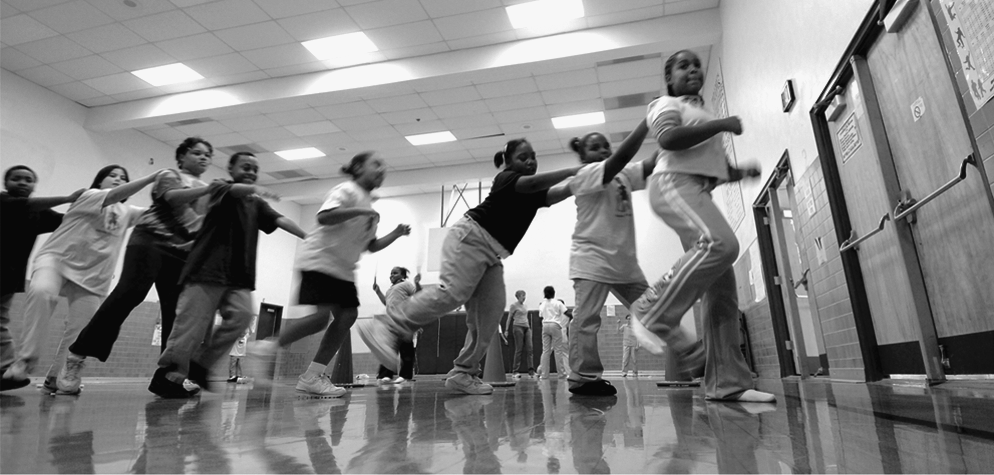
Typical after-school exercise activity.
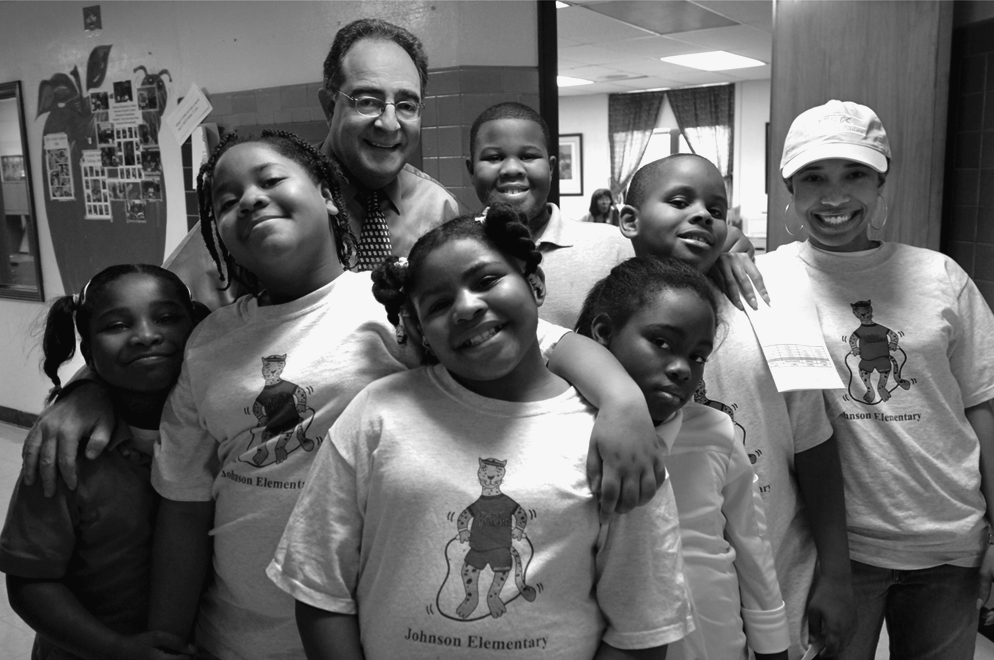
Jumpin' Jaguar participants with medical student volunteer and mentor far right. Behind group is Jay Perman, MD, Dean of University of Kentucky College of Medicine.
Nutrition education
Another important program component was nutrition education. Nutrition education was taught to the students by the UK Nursing student volunteers. The children took a field trip to the Farmers' Market to learn about different fruits and vegetables. Likewise, the manager from the Farmers' Market also came to the school and taught the children about how fruits and vegetables were grown and let the students sample different items. The We Can workshop series was a 6-week session in the fall, consisting of one 3-hour class per week. The series focused on cooking healthy meals on a limited budget and the importance of healthy lifestyles that needed to occur not only at school but in the home. Each class provided parents with a meal and the skills to prepare the meal at home. The parents who attended would make the meal during the 3 hours session and take it home. Education on using WIC vouchers at the Farmers' Market was also discussed. UK students volunteered to provide childcare during the class. Providing childcare, food, and gifts incentivized families to attend.
Monitoring the Program
Several indicators were used to measure the project's impact on obesity. BMI over the school year and overall school attendance was monitored. Student attendance was an important indicator because our banking partner agreed to provide college savings bonds to students who participated 80% of the time.
UKCOM sponsored a mid-year meeting with all the community partners to discuss status of the program—what was working and not working. Partners brainstormed together on improvement strategies. Bimonthly meetings with the afterschool staff were held to discuss their concerns and ideas; for example, volunteers not fully participating, students misbehaving, and deciding if discipline problems by participants warranted removal from the program. At the end of the year, an assessment meeting was held to discuss the overall experience for the students and for those who conducted the program. A meeting in the summer was planned again with community partners to discuss interest for the following year and potential changes.
Cost
The total annual cost of the program was approximately $16,000, which paid for nonfood rewards, the kick-off event, transportation to and from the YMCA, after-school staffing, t-shirts, swimsuits, savings bonds, physical education equipment, and aerobic instructors. All other work represented in-kind contributions.
This paper has described one low-cost model for emphasizing exercise and activity in a setting where children are at risk for obesity. It emphasizes the development of a broad-based coalition of education, governmental, nonprofit, and business organizations to champion healthy lifestyles in elementary school children. Coordination and oversight of the program was provided by an academic health center-based nurse practitioner. Models similar to this can be replicated in urban and rural communities.
Footnotes
Acknowledgements
Multiple people and organizations contributed to the development of the Jumpin' Jaguar Program. They include elementary school students and families, administrators, teachers, and staff. We would especially like to thank Julane Hamon, University of Kentucky College of Medicine, teacher Jackie Branham, and counselor Crystal Johnson, Executive Director of High Street YMCA, David Elsen, Dr. Malinda Rowe, Lexington Fayette County Health Department, and Dr. Rice Leach, Lexington Fayette County Health Department. Other instrumental partners in the after-school program include High Street YMCA, Fayette County Public School System, Community Trust Bank, Farmers' Market, and the UK Colleges of Medicine, Agriculture, Education, Nursing, and Public Health.
Author Disclosure Statement
No competing financial interests exist.