




Abstract
Background:
Diabetes and obesity are major causes of mortality and morbidity that are increasing all over the world. As obesity is a major risk factor for type 2 diabetic patients, weight loss is important in the treatment of type 2 diabetic patients. In our study, our aim was to evaluate the effects of exenatide and laparoscopic sleeve gastrectomy (LSG) in obese type 2 diabetic patients on the clinical and laboratory parameters.
Methods:
Twenty-five LSG and 25 exenatide patients followed up in our outpatient clinic were involved in the study.
Results:
At the end of the 6-month follow-up, weight loss was ∼35.4 kg in the surgery group and 11.5 kg in the exenatide group. Although postprandial glucose and hemoglobin A1c were significantly decreased in both groups, the decrease was significantly higher in LSG group compared to the exenatide group. Although there was no significant change in fasting blood glucose (FBG) in the exenatide group, there was a significant decrease in FBG in LSG group.
Conclusion:
LSG is a method that should be performed up on indication and much more radical compared to exenatide administration, but appears to be a more efficient application that corrects diabetes- and obesity-related metabolic parameters compared to exenatide therapy in type 2 diabetic obese patients.
Introduction
Increasing prevalence of type 2 diabetes mellitus is associated with increased lifespan, sedentary lifestyle, and obesity. 1 While the global prevalence of diabetes in the adult population in the world was 8.3% in the year 2010, it is expected to increase to 9.9% in 2030. 2 In TURDEP II study conducted in our country in 2010, the prevalence of diabetes was found to be 13.7% and obesity 32%. 3 According to literature, 23% of morbid obese patients had type 2 diabetes and the prevalence of diabetes by screening is 8%. 4 In obese diabetic patients, the management of type 2 diabetes is principally focused on blood glucose regulation rather than weight control. 5 However, the main guidelines recently pointed out the importance of obesity in the management of type 2 diabetic patients and the treatment algorithms have been renewed. 6 The treatment of type 2 diabetes varies slightly in obese patients. Apart from metformin, glucagon-like peptide-1 (GLP-1) receptor agonists and dipeptidyl peptidase 4 inhibitors, sodium glucose cotransporter 2 inhibitors and alpha glucosidase inhibitors, remaining oral antidiabetic agents, and insulin therapies cause weight gain, which may further impair metabolic control. 7
Incretin-based therapies are a new group of glucose-lowering drugs that imitate GLP-1 effect, which is a hormone secreted from intestinal L cells in response to food intake. It is known that pharmacological activation of the GLP-1 receptor increases insulin secretion, inhibits glucagon excretion and hepatic glucose output, and provides glycemic control by delaying gastric emptying. 8 In many clinical trials, GLP-1 receptor agonists added to metformin and/or other oral agents have been shown to provide glucose control without hypoglycemia or weight gain. 9 In our country, exenatide therapy, which is a GLP-1 receptor agonist, is becoming increasingly widespread with indications for use in obese type 2 diabetic patients in whom blood glucose cannot be controlled despite metformin and/or sulfonylurea treatment. 10
Bariatric surgery has come out as an effective therapy for morbid obesity due to its effects as stabilized weight loss and remission of type 2 diabetes-related comorbidities. Surgery is indicated if body mass index (BMI) is >40 kg/m2 or if there is an accompanying comorbid disease such as type 2 diabetes, hypertension, hyperlipidemia, or sleep apnea with a BMI >35 kg/m2.11,12 Laparoscopic sleeve gastrectomy (LSG), which was initially portion of the bilopancreatic diversion/duodenal switch procedure, has become the first choice in case of critical disease or morbid obesity. 13 At recent times, LSG has become an alternative to Roux-en-Y gastric bypass and laparoscopic gastric band procedures as it leads to significant and permanent weight loss, its relative facility, lack of anastomosis, endoscopic feasibility, no need for postoperative vitamins and micronutrient support, and having an option to revise or replace the operation. 14
This study was performed to evaluate and compare the effectiveness of LSG and exenatide treatments on anthropometric measurements such as weight and BMI, blood pressure, glycemic, lipid, and biochemical parameters in obese type 2 diabetic patients.
Subjects and Methods
This was a retrospective study performed in Endocrinology and Metabolism outpatient clinic of a university hospital. The study was carried out with the approval of the local Ethics Committee and in accordance with the Declaration of Helsinki. Medical records of type 2 diabetic subjects between 18 and 75 years of age with a BMI of ≥40 kg/m2 who either underwent bariatric surgery and were followed up for at least 6 months postoperatively or started on short acting exenatide treatment without surgery and were followed up for at least 6 months were enrolled in the study.The dose for exenatide treatment was 2 × 10 μg/day subcutaneously. Data of eligible consequitive 25 patients with LSG and 25 patients with exenatide treatment were included in the study. Gender, age, previous antidiabetic drug use, comorbid diseases, height, weight, BMI, diastolic blood pressure (DBP), systolic blood pressure (SBP), fasting blood glucose (FBG), postprandial blood glucose, hemoglobin A1c (HbA1c), creatinine, urea, alanine aminotransferase (ALT), aspartate aminotransferase (AST), high-density lipoprotein (HDL) cholesterol, low-density lipoprotein (LDL) cholesterol, triglyceride (TG), total cholesterol (TCh), thyroid stimulating hormone (TSH), and glucose and protein in spot urine were retrospectively recorded from the files.
Statistical analysis
The IBM SPSS Statistics 21 program was used for all statistical analyses in our study. The Shapiro–Wilk is used to assess whether the dataset is normally distributed or not. Independent sample t-test is performed to compare two independent groups that have normal distribution. If two independent groups are not normally distributed, Mann–Whitney U test is performed for comparison. Besides, Wilcoxon test is used to compare two dependent groups. Pearson chi-square, Fisher's exact chi-square, and Fisher-Freeman-Halton tests are used to compare categorical variables. Summary statistics are presented as mean ± standard deviation if data are normally distributed. The median (minimum − maximum) is given otherwise as summary statistics.Categorical variables are given by frequency and percentage values. Significance level is taken as α = 0.05.
Results
A total of 50 type 2 diabetic obese subjects, 25 of whom were in the exenatide group and 25 of whom were in the LSG group, were included in the study. There was not any significant difference between the two groups in respect of gender and age distribution (Table 1).
Baseline Demographic and Laboratory Characteristics of the Patients Participating in the Study
ALT, alanine aminotransferase; AST, aspartate aminotransferase; BMI, body mass index; DBP, diastolic blood pressure; FBG, fasting blood glucose; HDL, high-density lipoprotein; LDL, low-density lipoprotein; LSG, laparoscopic sleeve gastrectomy; PPG, postprandial glucose; SBP, systolic blood pressure; TCh, total cholesterol; TG, triglyceride; TSH, thyroid-stimulating hormone.
Baseline median weight and BMI values were 118 kg (88–191) and 41.8 kg/m2 (40.1–78.6) in the exenatide group, 133 kg (103–190) and 47.6 kg/m2 (40.4–78.1) in the LSG group, respectively, and were significantly higher in the LSG group than in the exenatide group. The insulin used was significantly higher in the exenatide group. When baseline FBG, PPG, and HbA1c were evaluated, although there was no significant difference concerning FBG among groups, PPG and HbA1c were found to be significantly higher in the exenatide group compared to LSG group. There was not any significant difference between the two groups in respect of protein in spot urine. There were no significant differences between the two groups in terms of systolic and DBPs, renal functions (urea, creatinine), liver functions (AST, ALT), lipid profile (LDL, HDL, TG, TCh), and TSH.
After 6 months of treatment, median BMI values were 39.9 kg/m2 (30.9–71.2) in the exenatide group and 36 kg/m2 (28.7–63.2) in the LSG group, which was significantly higher in the exenatide group (Table 2). Median FBG, PPG, and HbA1c were significantly higher in the exenatide group. After 6 months, ALT, DBP, and TG values in the LSG group were found to be significantly lower than the exenatide group. Concerning glucose in spot urine, there was a significant difference between the two groups. We did not find any significant difference between the two groups in respect of median value of body weight, number of patients using insulin, total insulin dose, SBP, AST, LDL, HDL, TCh, renal functions, spot urinary protein, and TSH values.
Demographic and Laboratory Characteristics of the Patients in Exenatide and Laparoscopic Sleeve Gastrectomy Groups After 6 Months of Treatment and Their Comparisons
When the baseline and sixth month of treatment values of the patients in the exenatide group were compared, it was seen that there was a significant decrease in weight, BMI, SBP, DBP, PPG, HbA1c, ALT, and total insulin dosage (Table 3). No significant differences were detected in FBG, number of patients using insulin, urea, creatinine, AST, LDL, HDL, TG, TCh, TSH, protein, and glucose in spot urine values at the sixth month of treatment compared to baseline. When the baseline and sixth month of treatment values of the patients in the LSG group were compared, there was a significant decrease in weight, BMI, SBP, DBP, FBG, PPG, HbA1c, AST, ALT, and number of patients using insulin. Lipid profile revealed a significant increase in HDL and a significant decrease in TG compared to baseline at 6 months of LSG. At 6 months after surgery, it was found that there was a significant decrease in the number of patients who had protein in spot urine compared to baseline. No significant differences were detected in insulin dosage, urea, creatinine, LDL, TCh, TSH, and glucose in spot urine values at the sixth month of treatment compared to baseline.
Comparison of Baseline and Sixth Month Values and Percentage Changes (Δ) of Clinical and Laboratory Parameters in Exenatide and Laparoscopic Sleeve Gastrectomy Groups
px: Comparison of initial and sixth month parameters of exenatide group.
py: Comparison of initial and sixth month parameters of LSG group.
pz: Comparison of Δexenatide ve ΔLSG.
When the percentage of changes in laboratory and clinical parameters were compared in the exenatide and LSG groups after 6 months of treatment according to baseline, the decrease in weight and BMI in the surgical group was found to be significantly higher than the exenatide group (Fig. 1). The decrease in FBG, PPG, and HbA1c was significantly higher in the LSG group compared to the exenatide (Fig. 1). The decrease in ALT was significantly higher in the LSG group than in the exenatide group. Increase in HDL and decrease in TG values in the LSG group were significantly higher compared to the exenatide group.
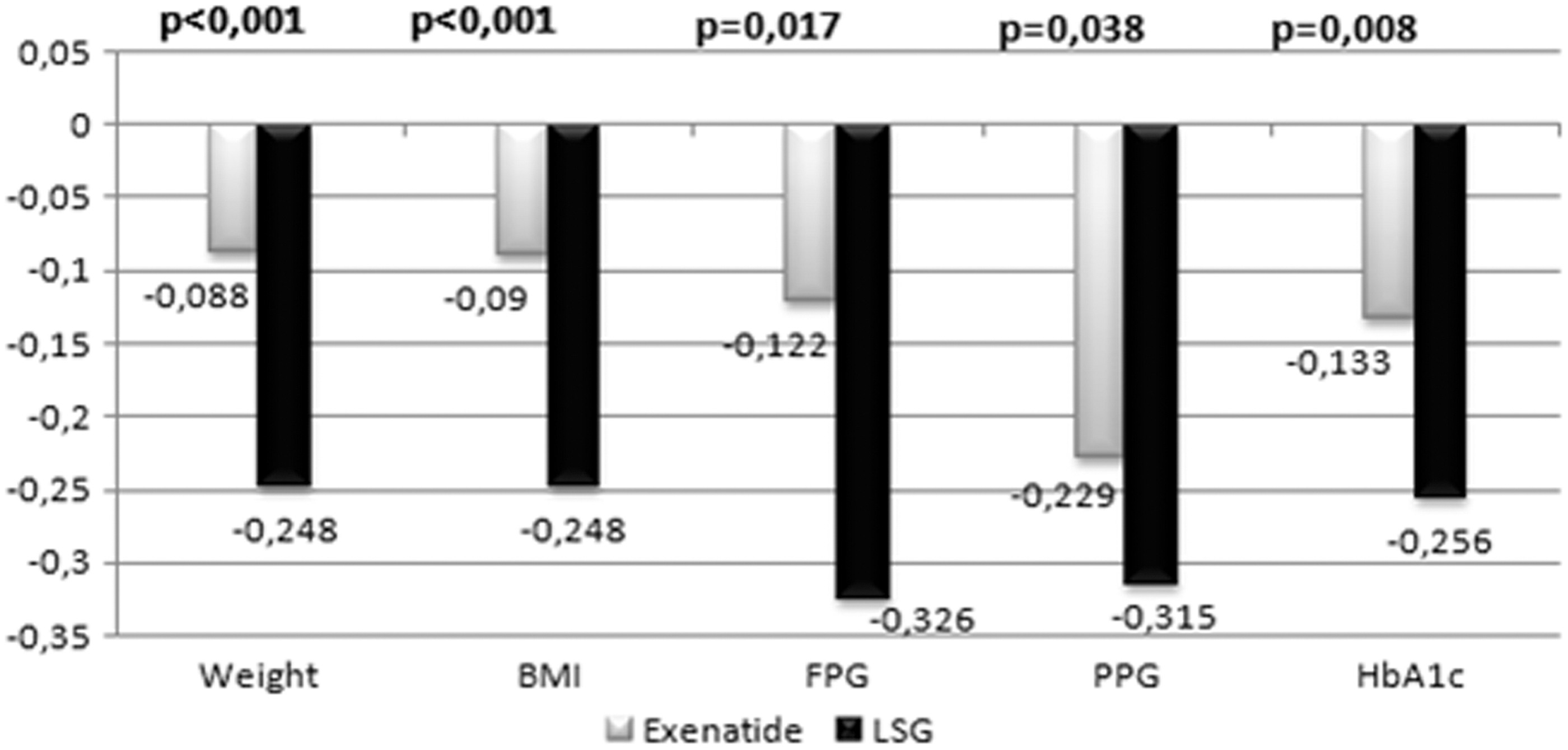
Percentage changes in exenatide and LSG groups compared to baseline at 6 months in terms of antropometric measurements and glycemic parameters. LSG, laparoscopic sleeve gastrectomy.
Discussion
Our present study indicated that, LSG led to a better control in weight, BMI, blood pressure, glycemic, and biochemical parameters compared to exenatide treatment in obese type 2 diabetic patients after 6 months of treatment. Trials have shown that GLP-1 agonists generally result in a weight loss of 3–6%.15,16 Exenatide is the first synthetic GLP-1 agonist and its short-acting form was used by our subjects. Different studies conducted in type 2 diabetic populations with exenatide indicated weight losses of 4–7 kg in ∼52–82 weeks of treatment. 17 In our study, weight and BMI values at baseline were found to be significantly reduced after 6 months of treatment in the exenatide group patients. Mean weight loss in our patients was 11.5 kg at the end of 6 months. More weight loss in a shorter period by exenatide in our study compared to literature may be associated with higher baseline BMI values, age, gender distribution, other antidiabetic agents used, treatment compliance, and dietary habits of the study patients.
Studies in the literature have shown that exenatide results in a significant decrease in both FBG and PPG. When short acting exenatide is considered, it is expected to exert more effect on PPG than FBG. 18 As an antidiabetic agent, exenatide reduced PPG and HbA1c after 6 months of treatment as expected, but FBG did not change effectively in our subjects.
There are studies conducted in obese type 2 diabetic patients in the literature indicating blood pressure, lipid profile and transaminase especially ALT level control via exenatide usage. In different studies both SBP and DBP were shown to be reduced by exenatide usage.17–19 In our study, exenatide also reduced insulin dosage used per day, SBP, DBP, and ALT of the patients, possibly due to weight reduction. Lipid profile changes were not detected at the end of sixth months of exenatide treatment.
LSG is an important surgical procedure for losing weight in morbidly obese subjects. 20 It gives the advantage of blood glucose control in type 2 diabetic obese subjects as in our patient population. Since it is a surgical procedure, patients should be chosen carefully in terms of surgical indications. In different studies in the literature, LSG was shown to lead to significant weight loss in patients applied, upto 65% loss at the end of 1 year of surgery. 21 In accordance with the results in the literature, mean weight loss in our patients was 35.4 kg at the end of 6 months.
Besides weight loss, there are studies indicating better glycemic, lipid, and blood pressure control after LSG procedures.22–25 Similar to the results of different studies in the literature, in our patient population LSG effectively controlled FBG, PPG, HbA1c, SBP, and DBP. A significant increase in HDL and decrease in TG levels were obtained at sixth month after LSG. Studies involving long-term follow-up of patients reveal significant decreases in AST and ALT levels after bariatric surgeries were performed.26,27 Similarly in our study, both metabolic profile control and weight reduction might lead to the decrease in transaminase levels of our patients. Both AST and ALT decreased significantly at the end of 6 months of LSG.
In a study investigating the effect of large amounts of weight loss after bariatric surgery on renal parameters, 24-h urine protein and albuminuria were significantly reduced in the first year after surgery with an improvement in glomerular filtration rate. 28 In accordance with the literature, in our study, there was a significant decrease in the number of patients who had protein in spot urine at 6 months after LSG. The importance of this result should be investigated in larger patient groups.
There are studies in the literature conducted in obese type 2 diabetic subjects comparing the effects of different bariatric surgical procedures with different GLP-1 analogs in respect of weight reduction, glycemic, lipid, and blood pressure control.29–31 The decrease in hepatic enzyme levels, especially in ALT due to a significant decrease in hepatosteatosis with treatment of obesity is a valid condition for both medical and surgical treatment. Although there are many studies in the literature that examine both treatment modalities separately, we cannot find any comparative studies on liver function especially including sleeve gastrectomy and GLP-1 analogs.
Our results indicated that at the end of 6 months; LSG controlled weight, BMI, FBG, PPG, HbA1c, and ALT levels better than exenatide treatment. Both LSG and exenatide decreased SBP and DBP effectively with no significant difference among groups. AST levels decreased significantly in LSG group but not in the exenatide group at the end of 6 months. Exenatide therapy had no prominent effect on lipid profile while LSG increased HDL and decreased TG levels significantly in our patient groups at the end of 6 months.
In conclusion, this study demostrated that exenatide has positive effects on obesity-related diabetic and metabolic parameters. LSG is a more radical method than that of exenatide in type 2 diabetic obesity, which should be applied within indications, and it is a more effective remedy for obesity-related diabetic and metabolic parameters. Both types of treatment should be evaluated for each patient in terms of advantages and disadvantages, and treatment should be decided according to patient characteristics.
Footnotes
Author Disclosure Statement
No competing financial interests exist.
Funding Information
This research did not receive any specific grant from funding agencies in the public, commercial, or not-for-profit sectors.