




Abstract
Abstract
Social marketing involves the application of commercial marketing principles to advance the public good. Social marketing calls for much more than health communications campaigns. It involves four interrelated tasks: audience benefit, target behavior, essence (brand, relevance, positioning), and developing the “4Ps” (product, price, place, promotion) marketing mix. The ongoing U.S. Department of Agriculture “Loving Support Makes Breastfeeding Work” campaign was launched in 1997 based on social marketing principles to increase breastfeeding initiation rates and breastfeeding duration among Special Supplemental Nutrition Program for Women, Infants and Children (WIC) participants. Since then there have been improvements in breastfeeding duration in the country, and the majority of WIC women now initiate breastfeeding. Breastfeeding in public places is still not well accepted by society at large, and any and exclusive breastfeeding durations remain exceedingly low. Lessons learned from “Loving Support” and other campaigns indicate that it is important to design social marketing campaigns to target the influential societal forces (e.g., family and friends, healthcare providers, employers, formula industry, legislators) that affect women's decision and ability to breastfeed for the recommended amount of time. This will require formative research that applies the social–ecological model to different population segments, taking and identifying the right incentives to nudge more women to breastfeed for longer. Any new breastfeeding campaign needs to understand and take into account the information acquisition preferences of the target audiences. The vast majority of WIC women have mobile devices and are accessing social media. The Brazilian experience indicates that making breastfeeding the social norm can be done with a solid social marketing strategy. This is consistent with the recently released “Six Steps to Achieve Breastfeeding Goals for WIC Clinics,” which identifies the need for exclusive breastfeeding to become the social norm at WIC clinics and strongly recommends for these clinics to adhere to the World Health Organization Code of Marketing of Breast-Milk Substitutes.
Introduction
Following the spirit of the IOM workshop, this article is divided into four sections. First, it introduces the social marketing framework. Second, it presents a social marketing analysis of the “Loving Support” campaign, taking into account how both the characteristics of WIC participants and the context in which breastfeeding happens in the United States have changed (including the WIC program) since the launching of the campaign. Third, it identifies social marketing lessons learned from three other campaigns. The article concludes with key recommendations for improving the “Loving Support” campaign specifically and breastfeeding promotion in general in the United States following social marketing principles.
What Is Social Marketing?
In the public health sector, the term “social marketing” is often times used interchangeably with the term “behavioral health communication campaigns.” 2 However, social marketing calls for much more than health communications campaigns. Social marketing involves the application of commercial marketing principles to advance the public good. 2 A social marketing campaign starts with the identification of a benefit (e.g., breastfeeding) and how the target audience perceives this benefit (Table 1).
WIC, Special Supplemental Nutrition Program for Women, Infants and Children.
Developing effective social marketing campaigns requires an in-depth understanding of the determinants of the behavior in the different contexts where it will take place and the consequences of performing the behavior or not. This understanding allows for the initial development of the campaign's brand, relevance, and positioning through an evidence-based marketing mix following the “4Ps” (product, price, place, promotion). The marketing mix is designed to maximize use of the product (e.g., breast pump) (or service [e.g., peer counselors] or activity [e.g., breastfeeding support group]), taking into account consumers' perceptions about the price or sacrifices they will need to make to follow the target behavior. For example, employed women may be very resistant to consider exclusive breastfeeding if sacrificing their jobs is what it would take for them to be able to do so. The third component of the marketing mix involves providing access to product via strategic placement through opportunity points (e.g., Baby-Friendly Hospitals, WIC peer counseling). Lastly, the product or service needs to be promoted through innovative communications campaigns and experienced by the target population. 3 Effective social marketing campaigns need to be developed based on mixed methods formative research and need to embed within them effective process and outcome evaluation systems. 2
“Loving Support Makes Breastfeeding Work”: A Social Marketing Analysis
The campaign was developed by Best Start Social Marketing based on formative research that identified embarrassment, time, and social constraints at school or work and lack of social support (especially the first 2 weeks after delivery) as key barriers for breastfeeding among WIC participants. These findings were the basis for the “Loving Support” brand and the “Make Breastfeeding Works” brand promise of the campaign. 1 These findings have also help guide the content of campaign products, services, and promotion through ads, pamphlets, staff support kits, and training and technical assistance for WIC staff. The campaign has had excellent penetration across WIC “markets” nationwide, although it has not been franchised, meaning that different WIC agencies have utilized the campaign in different ways and/or have developed breastfeeding promotion and support approaches “independent” but influenced by the “Loving Support” campaign. Although studies have not been conducted to assess the specific impact of the campaign on improvements in breastfeeding outcomes among WIC women, its strong penetration and central role in the WIC program make it likely that it has been an important actor facilitating improvements in breastfeeding behaviors.
During the past decades the characteristics of both the end users themselves (i.e., WIC mothers) and the national and WIC environment where breastfeeding promotion and support are taking place have changed substantially. Thus, it is important to understand if and how these changes may affect the (re)design of breastfeeding campaigns, including “Loving Support.”
What has changed?
WIC program
Understanding the current WIC target audience requires addressing the characteristics and preferences of the millenial generation formed by individuals born between 1977 and 1994. There are over 14 million millennial generation mothers in the United States, accounting for 63% of all births and 76% of first births that took place in the country in 2009. This generation is highly diverse, with 40% of the millennials belonging to an ethnic/racial minority group. 2 About 90% of WIC mothers, the great majority of whom belong to the millennial generation, have a mobile device. Millenial mothers frequently access information through the Internet, prefer customized and interactive means of communications, and want for their diversity to be recognized in messages and images and for these to appeal to the multifaceted nature of their identity (i.e., beyond simply and only being addressed as mothers). 1
Breastfeeding promotion in the WIC program has strengthened considerably since the launching of the campaign. This includes the increasing availability of quality support, including peer counseling, breastfeeding support groups, access to breast pumps, and International Board Certified Lactation Consultants on staff. Also, the WIC Food Package benefits have recently been restructured in part to make the “price” of choosing exclusive breastfeeding more attractive, although the distribution of free infant formula by WIC is likely to continue to be a powerful disincentive for WIC women to practice exclusive breastfeeding for the recommended 6 months.1,3
National context
In recent years unprecedented numbers of changes in Federal and State programs, laws, and policies relevant to breastfeeding promotion have occurred. Key among these are (1) First Lady Michelle Obama's full embrace of breastfeeding as a measure to address the childhood obesity epidemic, (2) the U.S. Surgeon General's recent release of the Call to Action to Support Breastfeeding, (3) Healthy People 2020 goals for breastfeeding initiation, exclusive and any breastfeeding duration, in-hospital formula supplementation, and support by employers, (4) the Centers for Disease Control and Prevention's call to strengthen the Baby-Friendly Hospital Initiative in the United States, (5) the Joint Commission's inclusion of in-hospital exclusive breastfeeding rates as part of the perinatal core measures, (7) WIC's decision to fully implement the redesigned food benefit packages, (8) the 2010 Patient Protection and Affordable Care Act, and (9) the 2010 Healthy, Hunger-Free Kids Act-WIC reauthorization recommending, among other things, breastfeeding performance bonuses for WIC clinics.1,3,4
These major contextual breastfeeding-favorable changes together with the continuing breastfeeding initiation increasing trends indicate that WIC and the country as a whole may have now an audience that may be much more receptive to access breastfeeding support services, provided the demographic and communication channel changes are taken into account.1,3 However, new or redesigned campaigns will need to take into consideration the major barriers that still remain in place, especially for promoting exclusive breastfeeding for 6 months and any breastfeeding for at least a year. 1 Disparities in breastfeeding behaviors emphasize the need to improve breastfeeding initiation rates among black women1,5 and reduce mix feeding rates among black and Hispanic women. 5
What has not changed?
The key barriers identified through the formative research for the “Loving Support” campaign are still valid today. Embarrassment with breastfeeding in public continues to be a major barrier, indicating that breastfeeding is still not the social norm. This is not surprising as public opinion polls continue to show that the U.S. population does not have a favorable view toward breastfeeding in public. 6 There are inadequate maternity leave policies, and many employed women encounter difficulties when trying to pump their breastmilk or breastfeed their infants during the workday. Likewise, lack of breastfeeding support during the first days after delivery continues to be a major challenge. In addition, the widespread promotional activities from infant formula companies, which go against the spirit of the 1981 World Health Organization International Code of the Marketing of Breast-Milk Substitutes, still prevent women from making truly informed choices regarding their breastfeeding decisions. Changing the defaults in these major societal contextual factors (public opinion factors, work-related policy and legislation, protection against unethical marketing) is needed for new or redesigned social marketing campaigns to be able to nudge women to practice optimal infant feeding choices. 1 An exemplar of how this can be addressed is illustrated by the Brazilian National Breastfeeding Program.1,7,8
Social Marketing Lessons Learned from Three Other Campaigns
The Brazilian National Breastfeeding Program
Breastfeeding duration in Brazil increased from 2 months in 1975 to 10 months in 2000 7 and continues to increase. Equally impressive improvement in exclusive breastfeeding rates among infants under 6 months have also been documented. The Brazilian National Breastfeeding Program began in 1980, after many years with little improvement in median breastfeeding duration. At that time, the goal of the launching phase was to mobilize stakeholders such as politicians, journalists, and other decision-makers and opinion leaders. Well-known pediatricians delivered the messages that “breastfeeding saves money” (as this was during a time of economic crisis) and “we know what works to promote breastfeeding.” At that point, the Ministers of Health and Social Development approved the launching of the National Breastfeeding Promotion Program. In the next phase, from 1981 to 1986, in a phase that Rea refers to as “social communication,” 7 improvements began. The goals were to generate a social movement through key stakeholders and to develop and launch well-designed mass media campaigns. The first such campaign took place in 1981 with a key message to breastfeed for at least 6 months. Stakeholders included civic, social, community, faith-based, and mother support groups. They were reached by TV, radio, and printed collateral on lottery tickets, utility bills, and bank statements. Newspaper articles targeted opinion leaders, and articles in professional journals and meetings were developed for health practitioners and academics, particularly members of the Brazilian Association of Obstetrics & Gynecology and the Brazilian Association of Pediatrics.
A second social communication phase in 1982–1983 built on lessons learned during the first phase. It used formative research to determine messaging now that people were generally sensitized. This campaign had pretested messages for mothers, such as “continue breastfeeding; every woman can,” “you can produce enough milk,” and “your breasts will not drop if you breastfeed.” The campaign also urged mothers to “make up your own mind,” in recognition of the bias by many pediatricians for formula. As an example of how they reached their audience, a popular soap opera included pro-breastfeeding messages and celebrities appeared in TV public service announcements. 7
Brazil continued implementing its marketing mix after 1983 by applying the “4Ps” in an integrated manner.1,8 Efforts ranged from helping to develop and then enforcing the World Health Organization International Code of Marketing of Breast-Milk Substitutes to promoting the Baby-Friendly Hospital Initiative (although Brazil's high rates of cesarean sections has meant a lower number of hospitals that qualify) to supporting community-based approaches. Changes in legislation were needed, such as those related to maternity leave and the work environment. The country also developed what has now become one of the most extensive human milk bank networks in the world, which they have used to market the social and economic value of breastfeeding. 7 Investments in lactation management training and education that began after 1983 continue to be strongly active to this date. 1
An analysis of the Brazilian program indicates that the factors that facilitated scale-up and sustainability included evidence-based advocacy, political will and legislation, workforce training and program implementation at the facility and community levels, innovative culturally appropriate communications campaigns that include celebrities, research, monitoring, and evaluation, visible community events (e.g., breastfeeding week), and multisectoral engagement and coordination1,8 (Fig. 1).
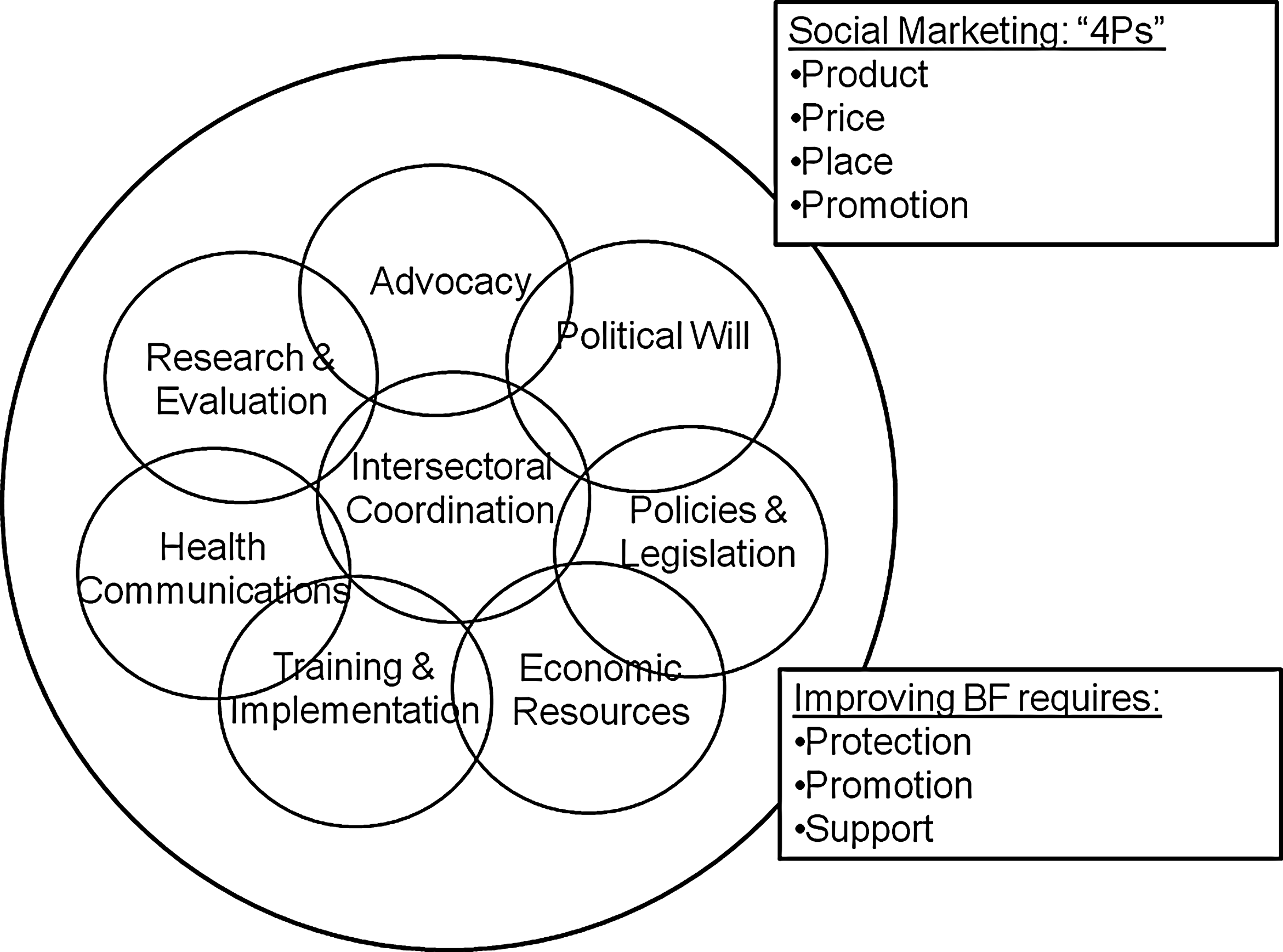
The Brazilian National Breastfeeding (BF) Program architecture: social marketing at its best. Modified from Pérez-Escamilla. 8
The Brazilian program demonstrates that scale-up sustainability depends on a strong and well-coordinated promotion program, with intersectoral coordination providing the glue. Messages must resonate across different stakeholders, may need to change over time, and must reach diverse audiences, including different racial and socioeconomic groups and ages.1,8
The VERB™ “It's What You Do” campaign
The breastfeeding promotion sector can learn from social marketing campaigns addressing other themes. Of note is the VERB campaign delivered by the Centers for Disease Control and Prevention from 2002 to 2006 with the goal of increasing and maintaining physical activity among 9–13 year olds (i.e., tweens). The campaign was successful at increasing significantly free time physical activity in the target audience. 2 The application of the social marketing framework in this campaign provides a best practices example for others to follow. The campaign had a realistic and clear benefit goal (i.e., increase physical activity), branding was based on formative evaluation, and attention was placed on understanding how to “sell” physical activity to tweens, understanding the places of opportunity for physical activity, and using highly innovative approaches for promoting the goal of the campaign. 9 The VERB brand is based on the concept that there are thousands of action words or verbs in the dictionary that tweens can choose from to have fun while becoming more physically active (e.g., run, jump, dance, etc.). The campaign became highly visible in places to which tweens are highly exposed, including youth media, shopping malls, schools, and community-based organizations and events (e.g., National Day of Play). Thus, well-coordinated partnerships were key for the success of this campaign. Campaign promotion approaches were highly innovative; for example, during the last phase half a million bright yellow VERB-branded balls were distributed. Tweens were asked to play with the ball, pass it on to a peer, and to go online to report his or her experience playing with the ball in the campaign's Website. This clever approach allowed tweens to literally touch, play, and experience VERB and not just to passively see or listen to the campaign's messages.
As in the case of the Brazilian National Breastfeeding Program, the VERB campaign illustrates how a multisectoral campaign that is well planned, branded, and multicoordinated can be successful at achieving its intended goal(s)1,9,10 when it integrates well the “4Ps.”
The National Breastfeeding Awareness campaign
This campaign was designed to promote breastfeeding among first-time low-income mothers who were at risk of not breastfeeding, with the support of their partners. The campaign was planned in 2003 and delivered in 2004–2006 by the U.S. Department of Health and Human Services. The campaign included health communications, 18 community demonstration projects, and a phone line and Website service with trained information specialists answering calls and e-mails in both English and Spanish. The campaign was informed by 24 focus groups conducted in 2002 in Chicago, San Francisco, and New Orleans with white and African-American women. The campaign was unable to reach its goal of increasing the prevalence of breastfeeding at 6 months. 1 This is not surprising as for most part this campaign was strongly based on a health communications effort only. In addition, even though the campaign received $30 million in free advertising during 2 years, the formula industry spent $80 million during the same period of time promoting its products. And, some key media outlets such as baby magazines that ran paid advertisements from the formula industry refused to run the campaign's public service announcements at no cost. The free public service announcements were delivered through other types of magazines, radio, newspapers, and billboards. 1 Coverage data showed that the campaign reached about one-third of WIC participants, with billboards being the most popular exposure channel and “babies were born to be breastfed” being the most popular message. 1
The key lesson learned from this campaign is that health communication campaigns by themselves are not enough to improve breastfeeding duration. Also, health communications campaigns without adequate budgets for paid public service announcements are likely to be less effective given the priority placed by key media channels toward paid advertisement by the formula industry. Implementation of the full social marketing framework (i.e., the “4P's”) is indeed likely to be needed to increase breastfeeding duration in the United States.1–3
Conclusions and Recommendations
Social marketing is a framework that has been successfully applied to improve breastfeeding and other behavioral and health outcomes. Social marketing has been oftentimes been misunderstood and simply interpreted as promoting desirable behaviors through social communications efforts. 2 Lessons learned from the “Loving Support” campaign indicate that even though major improvements have occurred in the context where breastfeeding promotion and support are taking place and some improvements in breastfeeding outcomes have occurred, exclusive breastfeeding for 6 months and any breastfeeding for at least a year are still not the social norm in the United States. Changing public opinion toward breastfeeding in public is a major step that needs to be taken for making breastfeeding “in all places and at all times” 11 a social norm in the country. For this to happen it is important to design social marketing campaigns that target the key forces (e.g., family and friends, healthcare providers, employers, formula industry, legislators) that influence the decision and ability of women to breastfeed for the recommended amount of time. This will require formative research that applies the social–ecological model to different population segments in order to identifying the right systems and individual incentives needed to nudge more women to breastfeed for longer.1,3 New breastfeeding campaigns need to understand and take into account the information acquisition preferences of the target audiences. Lack of access to breastfeeding support during the first 72 hours after delivery (a time when women often encounter major breastfeeding difficulties) continues to be a challenge that can also be addressed through the social marketing lens. 1 The Brazilian experience indicates that making breastfeeding the social norm is challenging and takes time but that it can certainly be done with a solid social marketing strategy.1,8 This is indeed consistent with the recently released “Six Steps to Achieve Breastfeeding Goals for WIC Clinics,” which emphasizes the need for exclusive breastfeeding to become the social norm at WIC clinics and strongly recommends for these clinics to adhere to the World Health Organization Code. 12
Footnotes
Acknowledgments
The IOM Updating the USDA National Breastfeeding Campaign Workshop Planning Committee members were Rafael Pérez-Escamilla (Chair), Karan DiMartino, Gail G. Harrison, M. Jane Heinig, James H. Lindenberger, and Carole Peterson. The IOM study staff for this workshop were Sheila Moats (Study Director), Julia Hoglund, Heather Breiner, Anton L. Bandy, Geraldine Kennedo, and Linda M. Meyers.
Disclosure Statement
No competing financial interests exist.