




Abstract
Abstract
Background:
There has been a significant increase in the number of published peer-reviewed articles on breastfeeding over the last two decades. However, in part because of the lack of clear or consistent definitions used in these publications, generalization and comparison of findings have been difficult, and interpretation of findings is often limited. This study was undertaken to examine this issue by assessing if and what definitions of breastfeeding have been used in a variety of relevant journals and the source of those definitions.
Materials and Methods:
An iterative systematic approach was used to select articles for review from major breastfeeding and health-related journals. Articles were reviewed for use of breastfeeding terminology, descriptors (e.g., exclusive, partial), and full definitions. Descriptive analysis was carried out using Excel (Microsoft®, Redmond, WA). A flow chart was developed to examine sources of definitions in use.
Findings:
Descriptors are seen 68% of the time, and full definitions are only offered in slightly more than a quarter (28%) of the articles. Among those journals that are primarily dedicated to breastfeeding research, 43–64% included descriptors, and 20–29% included definition of the descriptor. The pediatric journal included a high percentage with descriptors (77%), but only 18% were defined further. Among the other journals, there was a wide range (0–60%) with descriptors but fewer providing definitions. Only 26 articles offered a definition, and of these, 21 articles included a citation. Most derived from the Interagency Group for Action on Breastfeeding and World Health Organization definitional schemas.
Discussion:
There remains a need by journals for increased requirement of inclusion of breastfeeding definitions and by researchers of attention to their use. For this to occur, there must first be the reconfirmation and/or development of a set of consistently utilized definitions that are applicable for the study of behaviors, support interventions, and health outcomes for both the mother and of the child. Therefore, an inclusionary international Working Group Process Approach is recommended, similar to that used in 1988, with confirmation and dissemination by all major organizations and agencies.
Background and Introduction
Efforts to create global consensus on the definitions of breastfeeding preceded the Innocenti Declaration of 1990. A preconference was held. World Health Organization (WHO)-published definitions more than two decades ago 3 are generally accepted and are used by the U.S. Centers for Disease Control and Prevention and other national health agencies around the world. They were developed by the Nutrition Division of WHO, with the related emphasis on nutrition research questions. The definitions address full-term infant and young child intake, rather than emphasis on the breastfeeding considerations for research on maternal physiology and other issues in reproductive health or on those that may be necessary in the study of prematurity or specific maternal/child issues. These definitions, as further outlined in a subsequent document on infant and young child feeding indicators, 4 serve as the basis for much of the ongoing international survey research. A previous review of the two sets of definitions that had been endorsed by international groups is presented and discussed. 5
UNICEF/WHO/U.S. Agency for International Development/Swedish International Development Cooperation Agency/Ad Hoc Interagency Group for Action on Breastfeeding Consortium Definitions
The Innocenti Meeting of July 31–August 1, 1990, held in Florence, Italy, was the culmination of a series of meetings, including conferences that addressed issues such as breastfeeding and health care, women's work, health worker education, and definitions. In addition, there was an expert meeting held at WHO in Geneva, Switzerland, to review the outcomes of those meeting, held earlier in 1990, that resulted in the publication of “Breastfeeding: The Technical Basis and Recommendations.” 6 One of these meetings, held on April 28, 1988, was to create consensus on the definition of breastfeeding, following a Working Group Process Approach (WGPA). The WGPA includes a series of steps: (1) initial solicitation of current status, in this case, collection of those definitions that are in use by the various stakeholders; (2) analysis of these definitions, including comparisons and themes, and presentation for discussion; (3) meeting of the stakeholders and experts to achieve initial consensus; (4) vetting with those who participated and refinement; (5) vetting with a group of outside experts and potential users and refinement; and (6) dissemination for use by the broader audience, in this case, journals and professional organizations.
This and the other pre-Innocenti meetings were sponsored by the ad hoc Interagency Group for Action on Breastfeeding (IGAB), a working group of representatives from UNICEF, U.S. Agency for International Development (USAID), Swedish International Development Cooperation Agency (SIDA), and WHO. In addition to these organizations, the meeting was attended by or received input and review from the International Lactation Consultant Association (ILCA), La Leche League International (LLLI), the Population Council, the International Baby Food Action Network, the Johns Hopkins School of Hygiene and Public Health, Wellstart International, Family Health International, and the technical secretariat, Georgetown Institute for Reproductive Health/Breastfeeding Division. The completed definitions were then reviewed and modified according to input solicited from more than 50 other breastfeeding research and program experts from developed and developing countries, including Drs. Derrick Jelliffe, a noted researcher and evidence-based advocate on breastfeeding, Margaret Kyenkya-Isabirye, UNICEF Infant and Young Child Feeding Advisor, Dr. Ted Greiner, advisor to SIDA, and many other individuals and organizations. This was completed and submitted for publication in October 1989. 7
The purpose of bringing together this breadth and depth of expertise and following this process was to ensure that any definition of breastfeeding agreed upon would serve the needs of both researchers and programs, as well as being physiologically useful in research on the mother or on the child, and would be applicable for any related policy development.
The parameters that were agreed upon for creating a definition included:
1. Any definition would only apply to a single point in time, perhaps a 24-hour recall. 2. It only defines aspects of breastfeeding and does not define other forms of feeding. 3. It differentiates breastfeeding (child at the mother's breast) from other forms of breastmilk feeding. 4. It encourages further description when the basic definitions are used.
The definitions that resulted from this WGPA are presented in Table 1.
The schema also suggests that researchers and program planners should differentiate breastfeeding from when there is use of expressed milk, as well as defining how the expressed milk or other milks are fed (i.e., by bottle with nipple, by spoon, etc.), if there is pacifier use allowed, and, where applicable, the type, timing, and amount of other feeds (Table 2).
This set of definitions was suggested to authors by several journals over the subsequent years8–10 and served as the basis for the development of an Index of Breastfeeding Status for use in research. 11 Also, at that time, it was also suggested that WHO/UNICEF establish a “6 month full breastfeeding” norm.
This effort and meeting were held in preparation for the Innocenti Meeting of 1990, so the suggestion was made that WHO/UNICEF adopt these definitions. The response to this suggestion was to call for a later WHO expert meeting, which was held in 1991.
WHO Breastfeeding Definitions 1991
WHO/UNICEF 4 convened an expert committee to develop a set of definitions that, in principle, built upon the IGAB definitions. The process used was a standard approach (i.e., a meeting of experts was convened in Geneva to address a specific agenda, in this case development of definitions for the WHO Nutrition Office), and, given the purpose of the convening office, the central focus was breastfeeding as it contributes to infant and young child nutrition intake. Hence, the resulting WHO/UNICEF definitions were designed primarily for the study of infant nutrition and primarily addressed the need to quantify human milk intake. The variety of behaviors associated with breastfeeding and human milk feeding as they might impact the mother or child health were not the focus. The definitions that emerged are presented in Table 3.
This set of definitions provides a clear and, comparatively, simplified set of definitions for describing human milk intake. They differ from those developed for Innocenti in that they:
• Are simplified: fewer in number and clearly defined and, hence, easier to use. • Avoid consideration of various levels of mixed or partial breastfeeding.
However, they also:
• Do not differentiate between modes of feeding. • Do not include consideration of the effect of storage. • Do not have sufficient detail to allow consideration of the impact on maternal physiology and potential milk production maintenance. • Include one definition that is broad, “predominant” breastfeeding, which may indicate (1) nearly full breastfeeding with little difference from exclusive, (2) early introduction of replacement feeding, or (3) significant feeding of juices or teas, up to 49%. • Do not allow for study of the differences between direct breastfeeding and indirect breastmilk feeding in terms of immunological and other factors that may impact the health of the mother or child.
This article explores the current state of the use of definitions of breastfeeding in major research journals and raises some of the same questions that were asked 25 years ago: how can we define breastfeeding for research purposes so that study findings might be more comparable and hence interpretable? Therefore, this article includes a summary of major definitional schemas in use (already discussed) and a systematic review of current use of breastfeeding terminology in recent peer-reviewed literature and presents recommendations for increased consistency and comparability. Ethical approval was not required for the present study.
Materials and Methods
We used an iterative systematic approach in sampling recent literature to identify if a definition of breastfeeding had been provided and, if so, to review the definition used and related citation. Initially, we reviewed all articles from August 2010 to August 2011 in three breastfeeding journals—Breastfeeding Medicine, Journal of Human Lactation, and the International Breastfeeding Journal—and Pediatrics. Working back from the most recent issue, journals were reviewed until they covered either about 25 articles or the full year. In order to better understand if the use of definitions varied by journal type, we then added journals that were either general health or public health in nature to offer a wider perspective on how breastfeeding might be defined in clinical and public health. We used the search terms “breastfeeding,” “exclusive breastfeeding,” “lactation,” and “infant feeding” to identify a similar number of non-lactation journals. To achieve about 25 articles, we included the five most recent articles using those search terms in Pediatrics, American Journal of Public Health, American Journal of Preventive Medicine, The Lancet, Journal of the American Medical Association, and the British Medical Journal.
In total, 114 articles were reviewed. Each article was examined to see (1) if it offered any description beyond the use of the word “breastfeeding,” (2) if it offered a descriptor (i.e., any additional wording to describe the pattern under study, such as the word exclusive or duration), and (3) if further definition was offered for that term, it was considered to have a definition.
Finally, if there were a definition, the citation indicated was then reviewed to assess whether or not there was a definition in the citation and whether that reference referred to an earlier definition. This was used to develop a flowchart, or tree, to identify any major sources for the definitions in current use.
Descriptive analyses were carried out using Excel (Microsoft®, Redmond, WA) spreadsheets.
Findings
The review of the breastfeeding-related articles from predominantly breastfeeding journals, as well as from other public health and clinical journals, revealed a relatively low level of provision of definitions. Table 4 summarizes the findings from Supplementary Table S1 and the Supplementary Bibliography (Supplementary Data are available online at www.liebertpub.com/bfm), which is an annotated bibliography of all articles reviewed. Of the 114 articles identified, 94 were research articles, and 20 were commentaries or similar features. Among these articles, 58% provided any descriptor of the feeding pattern beyond simply stating “breastfeeding.” About a quarter of all of the articles reviewed (23%) included any definition, and 21 of the 114 (14%) provided a citation for the definition used (Fig. 1). If we examine only the research articles, a similar pattern emerges; although descriptors are seen 68% of the time, definitions are only offered in slightly more than a quarter of the articles (28%).
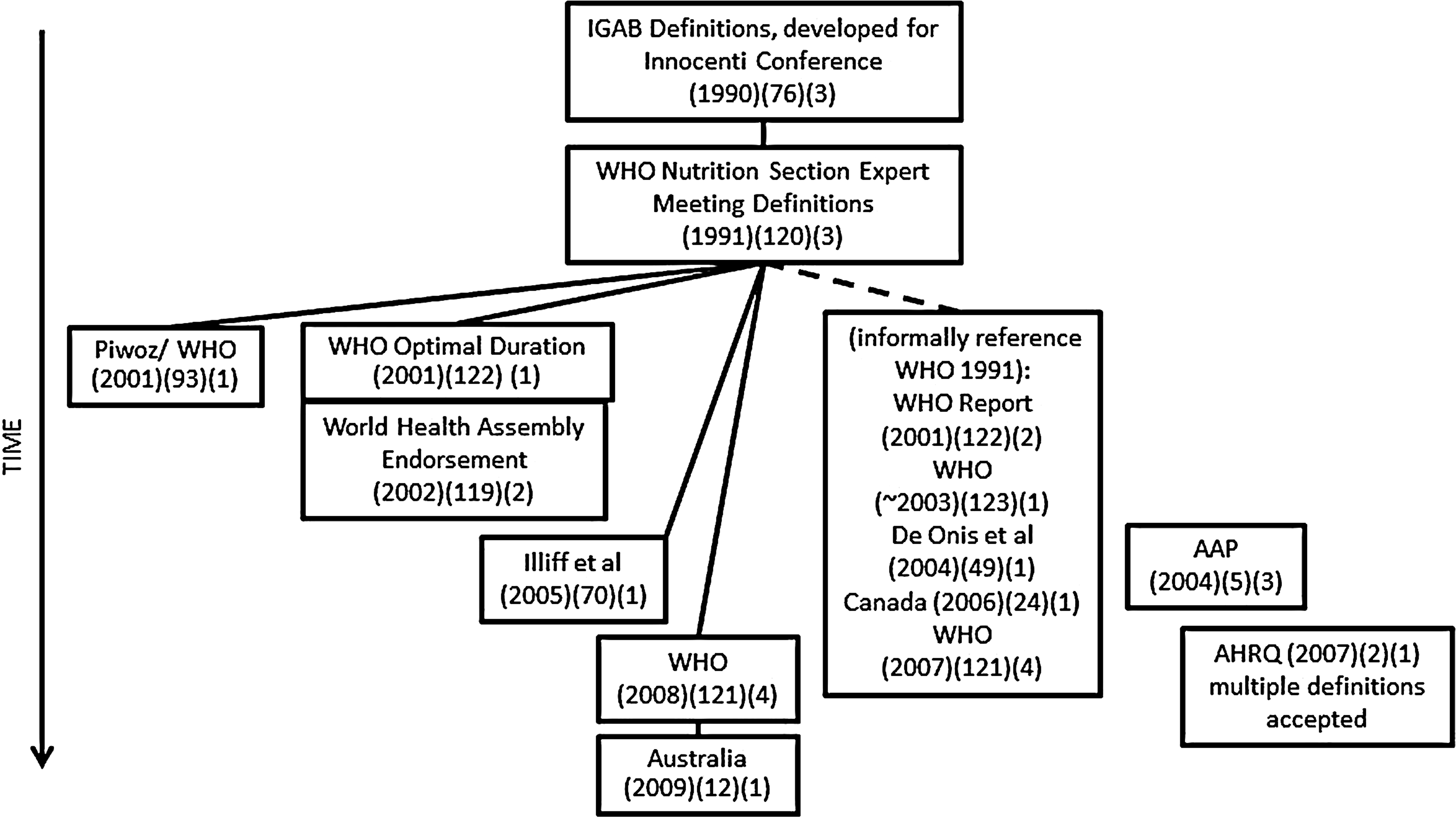
Reference tree: Citations (year) (Supplemental bibliography reference number) (number of times cited) that were provided as formal or informal reference articles for definitions used in the recent articles that were included in this review. These reference articles are then shown linked to their reference, if provided, and arranged by time of publication. AAP, American Academy of Pediatrics; AHRQ, Agency for Healthcare Research and Quality; IGAB, Interagency Group for Action on Breastfeeding; WHO, World Health Organization.
Primarily a breastfeeding journal.
Among those journals that are primarily dedicated to breastfeeding research, the percentage of articles that included a descriptor was 43–64%, and only 20–29% of all articles included definition of the descriptor. The pediatric journal included a high percentage with descriptors (77%), but only 18% defined further. Among the other journals, there was a wide range (0–60%) with descriptors, but fewer providing definitions.
Twenty-six articles offered a definition of their breastfeeding pattern. Of these, 21 articles included a citation for the definition that they used. These 21 cited a total of 15 references. As is shown in Figure 1, many of the references formally or informally cited WHO publication publications, which in turn cited UNICEF/WHO/USAID/SIDA/IGAB Consortium definitions that were developed in preparation for the Innocenti Declaration. 2 Two other references that were cited as providing a definition, those from 2004 and 2007, did not refer to any specific previous publication as a source of the definition used.
Discussion
The number of published articles that include research on breastfeeding is increasing, and this should help us better understand the impact of various patterns of breastfeeding and/or human milk feeding on a wide variety of health outcomes for both mother and child. However, the review, compilation, and comparison of findings from these studies are severely limited by the lack of definition and, hence, lack of comparability, based on the breastfeeding patterns. Among those articles found to offer more than simply the term “breastfeeding,” complete definitions still were limited to about a quarter of the articles reviewed. At times, the definitions were provided with no citation or referred to an article that did include guidance as to best practices but no definitions of the terminology. This lack of provision of definitions was recognized more than 20 years ago, prior to the Innocenti Declaration, and the definitions developed in preparation for the Innocenti meeting remain a major source of those in current usage, primarily due to their contribution to the subsequent 1991 WHO Expert Committee definitions.
Neither set of definitions presented in this article is sufficient for the current breadth and depth of study on the many aspects of breastfeeding: from bench to bedside to barrio. Gene Anderson's group at Case Western developed an Index of Breastfeeding Status based on the IGAB/Innocenti definitions, and several groups have developed intensity scales based on the schema attached to those definitions. However, the vast majority of studies in the world today use the WHO definitions, especially in survey work at the population level.
Today, social media has increasingly been the vehicle for addressing controversies in the interpretation of breastfeeding research. This is catalyzed in part by apparently contradictory research findings due at least in part to the lack of definitions of the breastfeeding under study. This further underscores the urgent need for those involved in breastfeeding research to create consistent and comparable definitions to aid in research standards and to allow more ready systematic review and meta-analyses. Furthermore, the interest in breastfeeding as a maternal and child health issue demands that definitions are developed that allow consideration of physiological impact in addition to nutritional intake.
Electronic medical records, if they are to be useful in research or in basic monitoring, must also have a standard set of quantitative measures.
The limitations of this review include the restriction of the review to selected journals and a limited period of time. However, those journals selected were chosen because they are often used by the breastfeeding research community. Other recent articles that have also called for new definitions are not critiqued herein.
Conclusions and Recommendations
There remains a need for increased journal attention to requiring inclusion of breastfeeding definitions and for researcher attention to their use. Furthermore, as electronic medical records are promulgated, it is essential that we have comparable terms and indices for universal inclusion. For this to occur, there must first be the reconfirmation and/or development of a set of consistently utilized definitions that are applicable for the study of behaviors, support interventions, and health outcomes for both the mother and the child.
Based on this review, the following steps are recommended:
1. Request sponsorship for a new international WGPA for the 21st century, such as that used to develop the definitional schema in 1988. The attendee organizations at that meeting might include those attending the original definitions meeting—ILCA, LLLI, WHO, UNICEF, SIDA, and USAID—and others that might use the definitions in policy and programing and additional experts and leadership in understanding breastfeeding research, such as the International Society for Research on Human Milk and Lactation, the Centers for Disease Control and Prevention, and other U.S. federal agencies, as well as representative editors of major breastfeeding and public health journals and at least one expert in electronic medical records. 2. Distribute the outcomes of this process to journals and to research groups to assist in setting guidance for future research. 3. Disseminate the conclusions to the readership of breastfeeding research—clinicians, lay groups, and the public—through a variety of media and to other groups noted above, to support better understanding of research when reported.
Footnotes
Acknowledgments
This study would not have been carried out without the input and ideas of Drs. Sera Young, Audrey Naylor, and the ABM Protocol Committee (Drs. Maya Bunik and Kathie Marinelli). This review was supported by the Carolina Global Breastfeeding Institute, which funded the time of A.S. as a graduate research assistant. All data are cited as to source.
Disclosure Statement
The authors have no competing financial interests. M.H.L. led the development of the IGAB definitions and was indirectly involved in the development of the WHO/UNICEF definitions and in their use while employed at UNICEF. M.H.L. is the Director of the Carolina Global Breastfeeding Institute ( ), which funded this research. M.H.L. supervised A.S. in carrying out the annotated review of articles and creating drafts of the findings tables. M.H.L. edited and drafted the remainder of the article and drafted the final figure. A.S. declares no competing financial interests.
References
Supplementary Material
Please find the following supplemental material available below.
For Open Access articles published under a Creative Commons License, all supplemental material carries the same license as the article it is associated with.
For non-Open Access articles published, all supplemental material carries a non-exclusive license, and permission requests for re-use of supplemental material or any part of supplemental material shall be sent directly to the copyright owner as specified in the copyright notice associated with the article.
